SHOWA Introduces Recycled Microfibre Gloves for Industrial Hand Protection
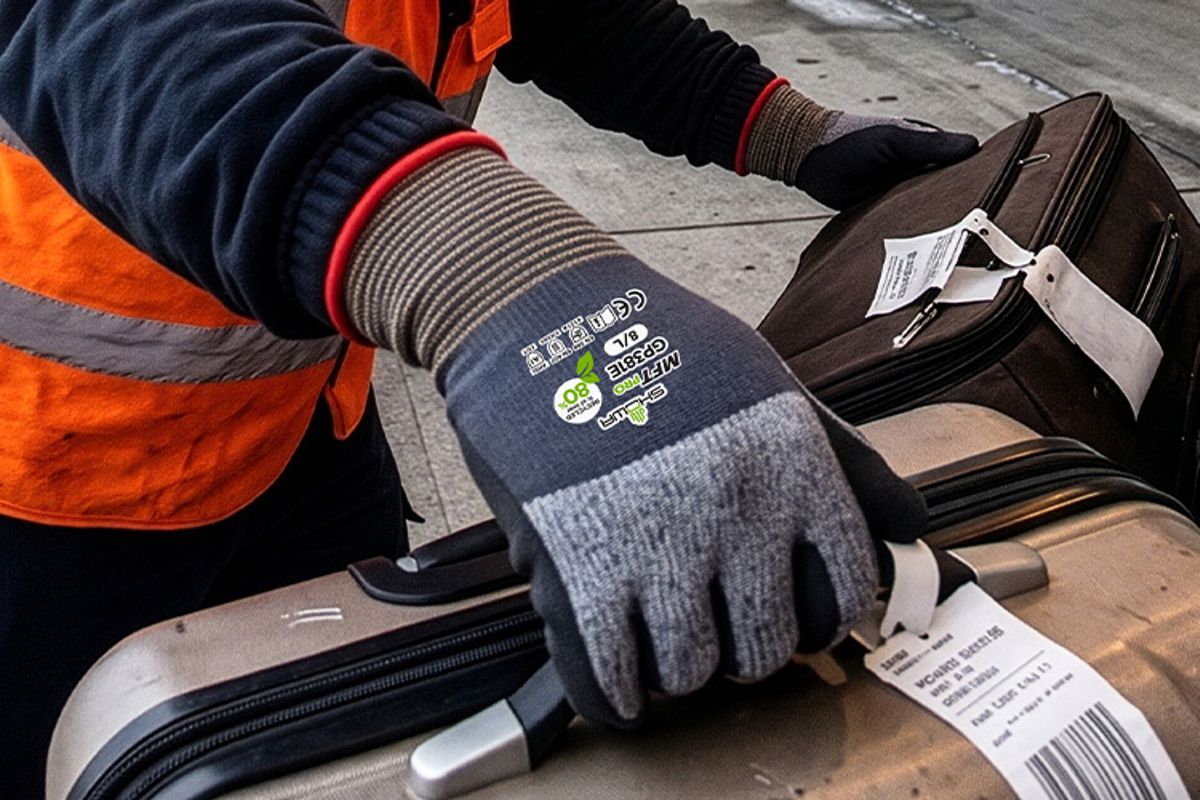
Protective glove manufacturer SHOWA has introduced the RECYCLED MFT PRO GP381E, incorporating more than 80% recycled fibres in its knitted liner while retaining the handling characteristics of its established MFT PRO range. Developed for mechanical engineering, maintenance and industrial assembly, the glove combines recycled microfibre and nylon yarn with a nitrile palm coating designed to maintain grip when handling oily or greasy components.
Industrial gloves are routinely replaced because of wear, contamination or deterioration, making material consumption a recurring consideration for employers operating large maintenance teams, manufacturing facilities and construction fleets. SHOWA has concentrated its recycled material development on the glove liner, retaining the microfibre construction used in its existing products. The GP381E is the first model in a planned four-glove RECYCLED MFT PRO range.
Briefing
- SHOWA’s GP381E incorporates more than 80% recycled fibres in its knitted liner.
- Recycled microfibre and nylon yarn are combined with an embossed microporous nitrile palm coating.
- The glove is designed for handling components in wet, oily and greasy working conditions.
- The product carries EN 388:2016+A1:2018 mechanical protection rating 4121A and EN 407:2020 thermal protection rating X1XXXX.
- Three additional models are planned, while paper banding replaces single-use plastic packaging.

Recycled Fibres in Industrial Glove Construction
The GP381E uses SHOWA’s proprietary MicroFiber Technology, which employs extra-fine fibres to produce a close-fitting liner. The construction is designed to maintain close contact between the hand and glove, reducing internal movement and helping wearers retain control during precise handling tasks.
This approach is suited to work involving small fasteners, electrical housings, mechanical assemblies and hand tools, where excess material around the fingers can interfere with dexterity. SHOWA has retained the underlying liner construction while introducing recycled microfibre and recycled nylon yarn, with the company stating that the material preserves the flexibility, comfort and handling characteristics of its existing MFT PRO products.
The liner is also described as water-absorbent and quick-drying, helping to manage perspiration during extended wear. Moisture management can influence comfort in workshops and maintenance environments, particularly where gloves are worn continuously for repetitive tasks.
“Businesses are increasingly looking for practical ways to reduce the environmental impact of their PPE, but performance and worker acceptance cannot be compromised,” said Kyohei Watanabe, Global Product Coordinator at SHOWA.
“The development challenge was therefore to introduce a high level of recycled content while preserving the comfort, fit and control users expect from the MFT PRO range. GP381E shows how recycled materials can be introduced into industrial hand protection without losing sight of the qualities that matter to the wearer.”
Nitrile Grip for Mechanical and Maintenance Work
The GP381E’s palm is finished with an embossed microporous nitrile coating designed to improve grip on components exposed to oil, grease or moisture. Nitrile coatings are widely used in industrial handling gloves because they offer abrasion resistance and can provide useful grip without the bulk associated with heavier protective constructions.
For construction equipment maintenance, these characteristics are relevant to routine work involving hydraulic fittings, engine components, lubricated fasteners and workshop tools. Similar requirements arise in automotive assembly and industrial plant maintenance, where operators regularly alternate between precision handling and more demanding manual tasks.
Actual grip performance will depend on the type and quantity of contamination, the component surface and the conditions of use. Although nitrile is also used in chemical-resistant gloves, a nitrile palm coating does not automatically establish protection against chemical exposure or prolonged contact with oils and solvents. Those applications require selection against the relevant chemical protection standards and manufacturer guidance.
GP381E is manufactured without natural rubber latex and is offered in sizes 6/S through 10/XXL. Its gold-coloured cuff distinguishes the recycled version from the existing MFT PRO range, allowing users and stores personnel to identify it more readily.

Mechanical Protection and European PPE Requirements
SHOWA states that GP381E meets applicable requirements of Regulation (EU) 2016/425, the European framework governing personal protective equipment, alongside EN ISO 21420 general requirements for protective gloves.
The glove carries an EN 388:2016+A1:2018 mechanical protection rating of 4121A, indicating abrasion resistance level 4, Coupe blade cut resistance level 1, tear resistance level 2, puncture resistance level 1 and ISO 13997 cut resistance level A. These classifications describe different mechanical hazards and should be considered individually when selecting gloves for particular tasks.
The abrasion rating is relevant to repetitive handling of tools, equipment components and manufactured materials, while the relatively modest cut and puncture ratings require consideration where sharp metal edges, exposed wire or pointed objects are present. EN 388 classifications are laboratory performance ratings and do not establish a universal level of protection across every working environment.
GP381E also carries an EN 407:2020 thermal protection marking of X1XXXX, indicating contact heat resistance level 1. Under the standard’s test conditions, this classification corresponds to contact with a surface at 100°C for a minimum threshold time of 15 seconds before the specified temperature rise is reached. It should not be interpreted as a general safe handling time for hot components, nor as protection against flames, molten metal or other thermal hazards.
For European procurement, the declared performance levels, product marking and manufacturer’s instructions provide the basis for matching the glove to a workplace risk assessment. Construction and engineering applications can involve very different combinations of abrasion, cutting, puncture and thermal exposure, even within the same maintenance operation.
Recycled Materials and PPE Procurement
SHOWA’s recycled-content figure applies specifically to the GP381E liner rather than the complete glove. The nitrile coating and other components must also be considered when assessing the finished product’s material composition.
The manufacturer also reports a carbon saving of 71.0 g CO₂ per pair for the recycled product. This is a manufacturer-stated figure, and the calculation boundary, baseline product and assessment methodology should be confirmed before it is used as a comparative lifecycle claim.
For organisations purchasing gloves in substantial quantities, material composition is only one consideration. Durability, replacement frequency and wearer acceptance affect both operating costs and the environmental performance of protective equipment. A glove incorporating recycled fibres may reduce demand for virgin materials, but its overall footprint also depends on manufacturing, transport, service life and disposal.
End-of-life management presents a particular challenge for industrial gloves. Products used around oils, adhesives, coatings and other contaminants can be difficult to recycle, even where their original materials contain recycled content. The presence of recycled fibres at manufacture does not necessarily make the finished glove recyclable after use.
SHOWA has also replaced single-use plastic packaging with paper banding for the GP381E, reducing the amount of plastic accompanying each product. For purchasing teams seeking to document recycled material use across their PPE inventories, the combination of recycled liner content and reduced plastic packaging provides additional product information alongside protection ratings, durability and cost.
Expanding the MFT PRO Range
The GP381E builds on SHOWA’s original MFT PRO 381 and the subsequent expansion of MicroFiber Technology across a broader selection of general-purpose protective gloves. By adapting an established construction, the company has retained familiar fit and handling characteristics while introducing recycled liner materials.
SHOWA intends to introduce three additional RECYCLED MFT PRO models, extending the technology across a wider range of working environments. Specifications, release dates and protection classifications for those variants have not yet been detailed.
The range is intended for applications across manufacturing, automotive, engineering, construction, warehousing, packaging and landscaping. GP381E is particularly suited to consideration for general mechanical handling where dexterity and grip are required alongside protection against routine abrasion.
The planned additions will show how far SHOWA can extend its recycled microfibre construction across gloves with different mechanical protection and handling requirements, while retaining the characteristics of the established MFT PRO platform.
Key Industry Questions
- What percentage of the SHOWA GP381E is recycled? More than 80% of the glove’s knitted liner material consists of recycled fibres. This does not represent the recycled content of the complete glove.
- What materials are used in the GP381E? The glove combines a seamless recycled microfibre and nylon liner with an embossed microporous nitrile palm coating.
- Is the GP381E suitable for construction equipment maintenance? It is designed for general-purpose mechanical handling, including oily and greasy environments. Suitability depends on the hazards involved and the workplace risk assessment.
- What cut protection does the GP381E provide? Its EN 388 rating of 4121A includes Coupe cut resistance level 1 and ISO 13997 cut resistance level A. Higher-risk cutting applications may require gloves with greater cut resistance.
- What abrasion resistance does the glove offer? GP381E achieves EN 388 abrasion resistance level 4, the highest level within that particular test classification.
- Does the GP381E provide heat protection? Its EN 407 rating of X1XXXX indicates contact heat resistance level 1, tested at 100°C under specified laboratory conditions. It does not establish protection against other thermal hazards.
- Can the glove be used for chemical handling? Chemical protection should not be assumed from its nitrile coating. Relevant EN ISO 374 certification and manufacturer compatibility information are required for chemical exposure applications.
- Is the GP381E latex-free? SHOWA states that the glove contains no natural rubber latex.
- Are recycled gloves necessarily more environmentally sustainable? Recycled fibres can reduce demand for virgin materials, but overall environmental performance also depends on manufacturing, durability, transport and end-of-life management.
- Will other recycled MFT PRO gloves become available? SHOWA plans three additional models, although their specifications and release dates have not yet been announced in the supplied material.
Strategic Takeaways
- Recycled fibres can be incorporated into established protective glove designs. SHOWA has retained its MFT PRO microfibre construction while changing the liner’s material composition.
- Mechanical protection remains application-specific. The GP381E’s high abrasion rating sits alongside more modest cut and puncture resistance, requiring careful matching to workplace hazards.
- Environmental claims require clear material boundaries. More than 80% recycled liner content does not establish the recycled percentage of the complete glove.
- Replacement frequency remains a practical consideration. Durability and service life influence both procurement costs and the environmental benefits of alternative glove materials.
- Additional models could broaden the range of applications. The planned expansion will test how recycled microfibre construction performs across different handling and protection requirements.