Rowan Engineers Develop Reverse-Time Imaging for 3D Printed Concrete
A 3D concrete printer can build a wall layer by layer, but every new deposit adds weight to material that has yet to develop its full strength. If the lower layers deform excessively, an otherwise successful printing operation can end in structural failure before the wall is finished. Understanding exactly when and how that deformation occurs has proved difficult, particularly because the structure being measured does not exist when printing begins.
Engineers at Rowan University in New Jersey have developed an imaging technique that approaches the problem from an unusual direction. Instead of tracking deformation forwards from the beginning of construction, the researchers start with images of the finished structure and work backwards through the printing process, reconstructing how individual layers changed shape as the concrete was deposited and cured.
The technique, described in the journal Experimental Mechanics, adapts an established optical measurement method to the particular demands of additive manufacturing. It offers researchers a way to investigate the behaviour of fresh concrete under progressively increasing loads, potentially improving the experimental evidence used to develop printable mixtures, validate engineering models and refine construction processes.
Briefing
- Rowan University researchers have developed a reverse-time digital image correlation technique for measuring deformation in 3D printed concrete.
- The method reconstructs earlier deformation using thousands of photographs captured during printing and curing.
- Natural surface roughness provides identifiable features for tracking movement without applying artificial markers.
- The researchers developed a theoretical framework, tested the approach against conventional measurements and demonstrated its application to concrete printing.
- The technique could support material development and quality control research, although real-time autonomous control remains a longer-term possibility.
Measuring a Structure That Does Not Yet Exist
Digital image correlation (DIC) has been used for decades in experimental mechanics to measure how materials deform under loading. Cameras record images of a specimen, and specialised software tracks the movement of identifiable surface features between successive frames. The resulting measurements can reveal displacement and strain across the observed surface, providing information that would be difficult to obtain using individual contact sensors.
The technique normally begins with a reference image of an existing object. As the material is loaded, heated or otherwise subjected to changing conditions, subsequent images are compared against that original state.
Concrete additive manufacturing complicates this approach because the object is continuously being created. At the beginning of a printing operation, most of the eventual wall or structural component has yet to be deposited. Each successive layer introduces new surfaces, making it impossible to establish a conventional initial reference image of the complete structure.
The problem becomes particularly challenging when researchers want to investigate the earliest stages of deformation. Freshly extruded concrete must be sufficiently workable to pass through the printer’s pumping and deposition system, while also developing enough stiffness and strength to support the layers placed above it.
Unlike conventional cast concrete, which is generally supported by formwork during its early development, extrusion-based printing relies heavily on the mechanical properties of the deposited material itself. The timing of successive layers, their geometry and the rate at which the mixture develops strength all influence whether a printed component can maintain its intended shape.
Islam Mantawy, an assistant professor in Rowan’s Department of Civil & Environmental Engineering and head of its Additive and Robotic Construction Laboratory, explained the consequences of getting that balance wrong.
“The idea is we need to avoid any premature failure,” said Mantawy. “If you’re building an 8-foot-tall wall and the bottom layer starts to crack and collapse, the entire structure can fail before you reach the final layer. What was supposed to be a faster, more efficient construction method becomes slower and less efficient because you have to start over from scratch.”
Reconstructing Deformation in Reverse
The Rowan team, led by Mantawy and Behrad Koohbor, addressed the reference-image problem by reversing the conventional DIC measurement sequence.
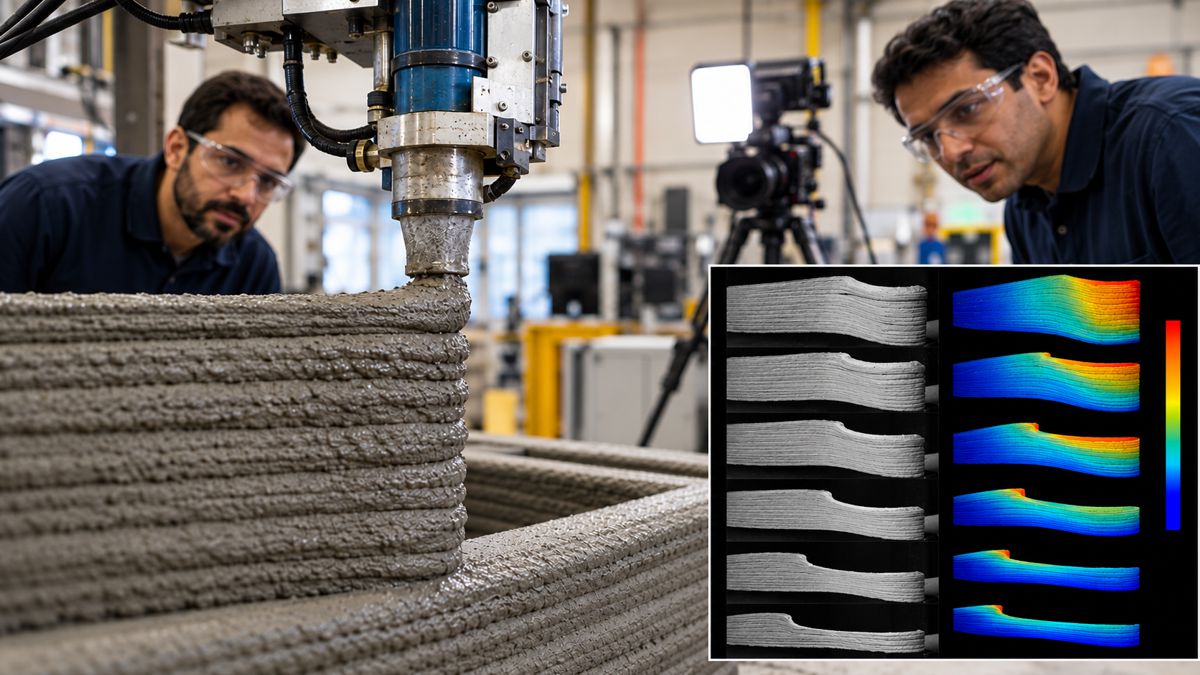
Their method uses images of a completed specimen as the reference condition, then works backwards through thousands of photographs captured during the printing process. By tracking surface features from one image to the preceding image, the researchers can reconstruct the deformation history of material that was progressively deposited.
The naturally irregular surface of extruded concrete is particularly useful for this approach. Its roughness provides identifiable visual features that can be followed between images, removing the need to apply the artificial speckle patterns commonly used in controlled DIC experiments.
The researchers first developed a theoretical framework for reverse-time digital image correlation and evaluated the approach against conventional forward-time measurements using quasi-static tensile tests on AA6061 aluminium specimens. They then demonstrated its application to concrete additive manufacturing, where the evolving geometry makes conventional reference-based measurements more difficult.
This validation sequence provides an important foundation for the work. The aluminium tests allowed the researchers to examine the measurement method against an established approach before applying it to the more complicated conditions encountered during concrete printing.
Koohbor, an associate professor in Rowan’s Department of Mechanical Engineering and affiliated faculty member of its Advanced Materials & Manufacturing Institute, described the principle succinctly.
“We are literally writing the history of the process, but we start from the end and go back,” said Koohbor.
Working backwards does not mean the technique can recover information that was never recorded. A sufficiently detailed photographic sequence is still required, along with surface features that remain identifiable between images. Camera resolution, lighting, viewing geometry and the visibility of the concrete surface can all influence measurement quality.
Nor does reverse-time analysis inherently provide a live assessment of the printing operation. In its demonstrated form, the technique reconstructs deformation from an existing image sequence, making it particularly suited to experimental investigation and retrospective process analysis.
Understanding Early-Age Concrete Behaviour
The mechanical behaviour of freshly printed concrete is governed by processes occurring over different timescales. Immediately after extrusion, the material must resist deformation under its own weight, while its internal structure develops and cement hydration gradually contributes to strength gain.
As additional layers are deposited, the concrete near the bottom of the structure experiences increasing vertical loading. Depending on the mixture properties and printing conditions, this can produce settlement, lateral deformation or local instability. The time between successive layers becomes important because material deposited earlier may have developed greater resistance to deformation by the time additional loads arrive.
Temperature, humidity and mixture composition introduce further variables. Changes in environmental conditions can affect the development of material properties, while moisture movement and shrinkage may contribute to dimensional changes during subsequent curing.
These interacting processes are difficult to characterise through conventional material tests alone. A laboratory specimen subjected to a prescribed load does not necessarily experience the same loading history as concrete deposited continuously by a robotic printer.
Reconstructing deformation throughout an actual printing operation offers another source of experimental evidence. Researchers could compare the movement of individual layers with deposition timing, specimen geometry and measured material properties, examining how closely the observed behaviour corresponds to predictions.
The approach could also support the validation of computational models used to assess concrete buildability. Such models attempt to predict whether a proposed mixture and printing sequence can produce a stable structure, taking account of the material’s developing mechanical properties and the loads imposed during construction.
A detailed deformation history would allow engineers to test those predictions against measurements taken from printed specimens, rather than relying exclusively on their final geometry or the results of separate material tests.
There are limits to what optical measurements can establish. DIC records visible surface displacement and strain; it does not directly reveal the complete internal stress distribution or identify every subsurface defect. Understanding the structural behaviour of printed concrete still requires complementary material testing, analytical models and, where appropriate, other inspection techniques.
Applications in Material Testing and Quality Control
Concrete printing involves a close relationship between material formulation and machine operation. A mixture may perform well under one set of deposition conditions but behave differently when the printing speed, layer dimensions or interval between passes changes.
The Rowan technique could provide a useful means of investigating those relationships under controlled experimental conditions.
Researchers might, for example, print identical wall specimens using different concrete formulations and compare their reconstructed deformation histories. Alternatively, they could vary the time between successive layers to examine how the developing stiffness of the material affects settlement and dimensional stability.
Such experiments could reveal when deformation occurred and where it was concentrated, allowing the results to be compared with conventional measurements of fresh concrete properties. The approach would be particularly useful where two specimens appear similar after curing but experienced different deformation histories during construction.
For material suppliers, this type of evidence could contribute to the development and assessment of mixtures intended for particular printing systems. Equipment manufacturers could also use deformation measurements when evaluating deposition strategies, nozzle configurations or operating parameters.
These remain potential applications rather than demonstrated commercial capabilities. The research establishes a measurement approach, but routine deployment would require further work on repeatability, accuracy under different conditions and integration with existing printing and testing procedures.
Moving from laboratory specimens to full-scale construction would introduce additional challenges. Large printed components may require multiple cameras to maintain adequate surface coverage, while complex geometries, changing illumination and obstructions around the printer could complicate image analysis.
The technique would also form only one part of a broader quality assurance process. Measuring deformation during construction can help identify how a component behaved as it was produced, but it cannot independently establish hardened material strength, internal integrity, long-term durability or compliance with structural design requirements.
Towards More Autonomous Concrete Printing
The longer-term ambition of researchers working on construction additive manufacturing is to develop systems that can respond to the behaviour of the material while printing is underway.
A printer capable of assessing deformation as it occurs could potentially adjust deposition rates, layer timing or other operating parameters to maintain stability. Achieving that level of control would require reliable measurements, sufficiently rapid processing and validated relationships between the observed behaviour and the corrective actions available to the machine.
Reverse-time DIC does not yet provide that closed-loop capability. Its contribution is more fundamental: it gives researchers a way to recover deformation information from a manufacturing process in which the object being measured is continuously changing.
The resulting data could help establish the models and experimental understanding needed to develop future monitoring systems. Similar measurement challenges may also arise in other additive manufacturing processes where material is deposited progressively and the final structure cannot serve as an initial reference.
Mantawy sees a detailed understanding of structural behaviour as essential to that progression.
“Without knowing what’s happening inside the structure, you won’t be able to achieve self-operating 3D printing,” Mantawy said. “It’s a way to have an eye on the structure as it evolves.”
The research was supported in part by a US Department of Education Graduate Assistance in Areas of National Need grant. Rowan engineering students Nicholas Pagliocca, Anthony Mackin, Aly Ahmed and Jenna Migliorino contributed to the work.
The study, published in Experimental Mechanics, demonstrates how an established measurement technique can be adapted to a manufacturing process that presents a fundamentally different reference problem. For researchers developing concrete printing technology, the ability to examine what happened to each layer after it was deposited offers a more detailed picture of the material’s behaviour during construction.
Key Industry Questions
- What is reverse-time digital image correlation? It is an optical measurement technique that reconstructs earlier surface deformation by analysing a sequence of images backwards from a later reference condition.
- Why is conventional digital image correlation difficult to use in concrete 3D printing? Conventional DIC requires an initial reference image of the object being measured. In concrete additive manufacturing, much of the structure has not yet been created when printing begins.
- How does the Rowan University method track concrete deformation? The technique uses naturally occurring surface features in extruded concrete to identify and measure movement between successive photographic images.
- How was the reverse-time technique validated? The researchers developed a theoretical framework and compared reverse-time measurements with conventional forward-time DIC during quasi-static tensile testing of AA6061 aluminium specimens before demonstrating the method in concrete printing.
- Can the method identify when a printed concrete wall begins to deform? It can reconstruct deformation from recorded images, potentially allowing researchers to examine when and where surface movement occurred during printing and curing.
- Does the technique measure internal concrete defects? No. DIC measures visible surface displacement and strain. Internal conditions require additional measurement methods or validated engineering models.
- Could reverse-time DIC improve printable concrete mixtures? Potentially. Researchers could use deformation histories to compare how different mixtures respond to progressive layer loading and different printing conditions.
- Can the method control a concrete printer in real time? Not in its demonstrated form. Reverse-time DIC is a retrospective measurement approach, although the resulting research could contribute to the development of future automated monitoring and control systems.
- Is the technique commercially available for construction-site quality control? The supplied research describes a laboratory-developed and tested method. Routine commercial deployment has not been established.
Strategic Takeaways
- Buildability depends on early-age material behaviour. Concrete must develop sufficient resistance to deformation while successive layers continue to increase the load.
- Reverse-time analysis addresses a distinctive measurement problem. The completed geometry can provide a reference condition when no equivalent reference exists at the beginning of manufacture.
- Deformation histories can strengthen material testing. Measurements taken throughout printing may reveal differences between mixtures and deposition strategies that are not apparent from the finished specimens.
- Experimental validation remains essential. Optical deformation data can support the development of predictive models, but the accuracy and practical limits of the technique must be established under relevant operating conditions.
- Autonomous printing requires reliable feedback. Retrospective measurement can improve the understanding needed for future control systems, while real-time intervention remains a separate engineering challenge.