Treviso Demonstrates That Trenchless Infrastructure is the New Urban Utility Standard
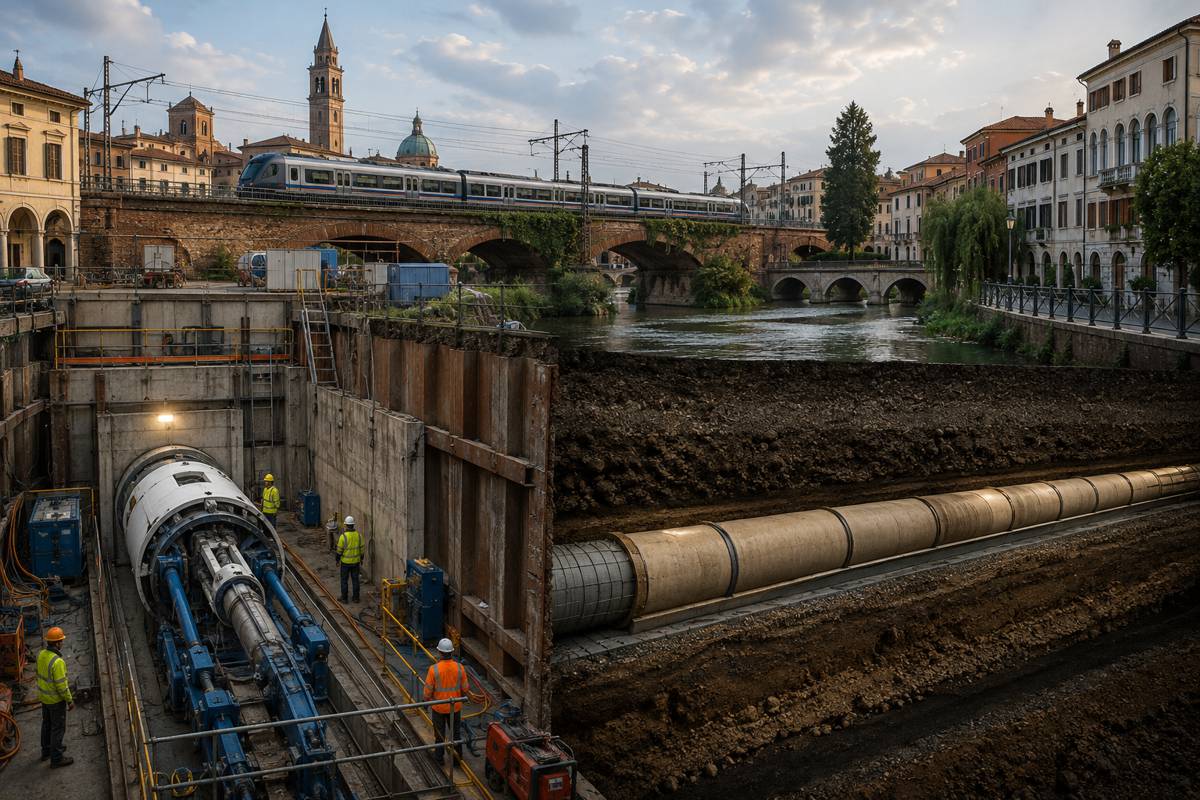
A 400 metre sewer is not, on the face of it, the sort of project that moves markets. In the historic centre of Treviso, the works were delivered by the successful tenderer, RTI Consorzio CON.CO.S.–P.A.T.O. S.r.l., with LF Costruzioni among the firms in the executing consortium. They installed a DN 800 line at roughly 11 metres depth, threading it beneath an active railway and under the river Sile using slurry microtunnelling and vitrified clay jacking pipes supplied by Steinzeug-Keramo.
The client was Alto Trevigiano Servizi Spa (ATS), the publicly owned utility that runs the integrated water service across 51 municipalities in the provinces of Treviso, Belluno and Vicenza. Judged purely on length and diameter, it is a routine municipal contract of the kind delivered across Europe every week.
Judged against the corporate and financial news of the same week, it reads very differently. On 21 July 2026, Wienerberger, which owns Steinzeug-Keramo, told investors that infrastructure and renovation now account for more than 60 per cent of group revenues while residential new build has fallen away sharply in the United States, Canada and the United Kingdom.
The Treviso drive, which was tendered and built years before the announcements, illustrates a structural point that construction professionals, investors and asset owners are still under-pricing: the growth in European building materials has moved underground, into buried water assets that regulation has made non-discretionary and that recession in housebuilding barely touches.
Briefing
- A 400 metre DN 800 sewer was installed by trenchless microtunnelling beneath a live railway and the river Sile in Treviso at approximately 11 metres depth, in high groundwater conditions typical of the Venetian plain, using KERA.Drive vitrified clay jacking pipes as a directly jacked solution with no secondary casing.
- Client ATS confirmed on 21 July 2026 a €26 million pool financing arranged by Banca Finint and subscribed by the BCC Iccrea group, supporting a 2026 to 2029 investment plan exceeding €160 million and serving around 500,000 people.
- Parent company Wienerberger reported Q2 2026 revenues of €1.41 billion, up 13 per cent year on year, with operating EBITDA down to €230 million from €253 million as residential new build weakened; piping is now the group’s largest segment by revenue at €1.4 billion in 2025.
- The recast Urban Wastewater Treatment Directive (EU) 2024/3019 must be transposed by 31 July 2027, adding stormwater management plans, micropollutant removal and progressive energy-neutrality duties that convert sewer renewal into compliance-driven capital expenditure.
- Italy already carries active financial penalties for historic wastewater non-compliance, with the Court of Justice imposing a €10 million lump sum plus €13.6875 million for each six months of continued delay in March 2025.
The Load Case That Decided The Method
The engineering interest in Treviso lies in the concentration of constraints rather than in any single one of them. The alignment passes below an operational railway, which removes settlement tolerance almost entirely, and below the Sile, a 95 kilometre resurgence river fed by more than a thousand springs and protected within its own regional park.
Groundwater across the Venetian plain sits high and is hydraulically connected to those springs, so the design had to assume continuous external water pressure at around 11 metres rather than a manageable drawdown. Open-cut was never a serious option in a city centre where the surface belongs to heritage fabric, rail operations and a protected watercourse.
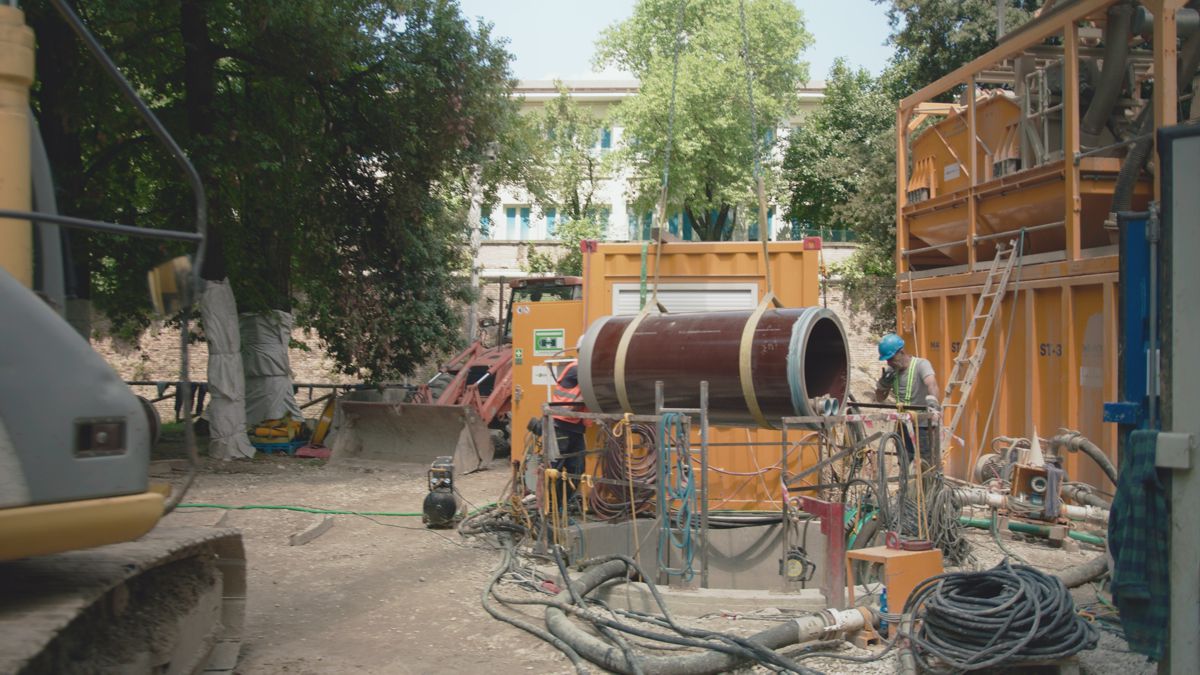
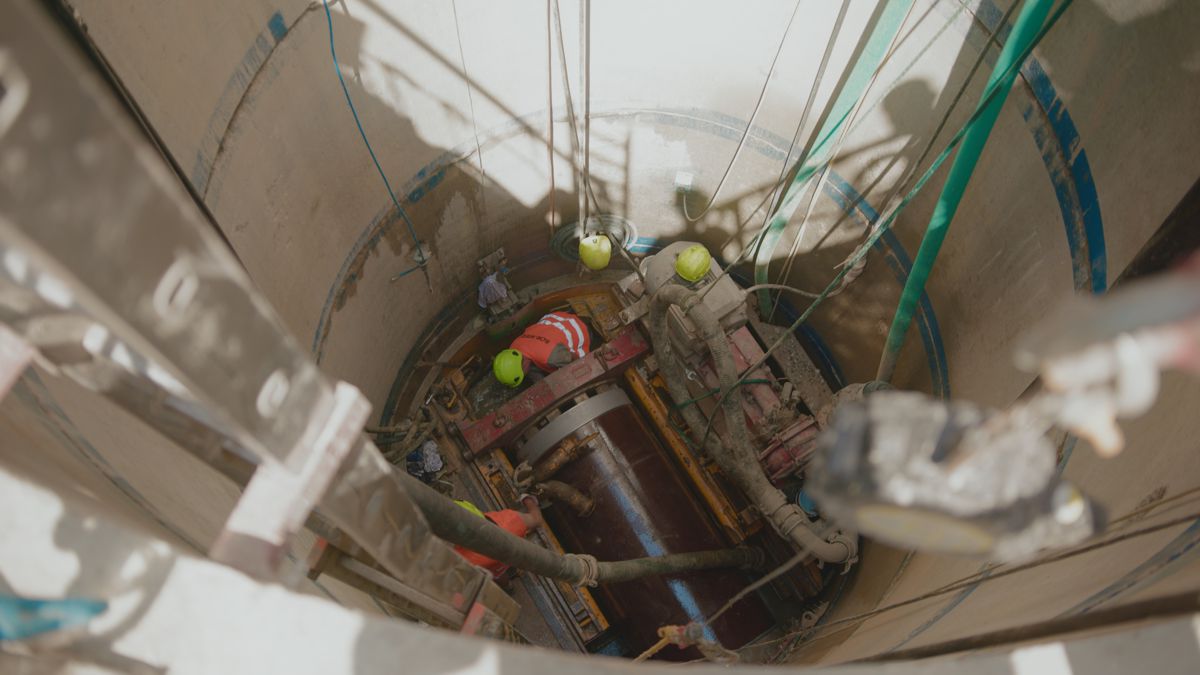
Slurry microtunnelling answered the ground conditions directly by maintaining continuous face support, which is what keeps settlement inside the envelope a live railway demands. The more consequential decision was to jack the product pipe itself rather than install a casing and then thread a carrier through it. Eliminating the casing removes an entire construction operation, along with annulus grouting, spacer systems and the associated quality risk, and it reduces the bore diameter, the jacking forces and the volume of spoil requiring characterisation and disposal in an urban setting.
For a contractor working from constrained shafts in a historic centre, that simplification shows up as programme certainty and reduced site footprint, which are the two variables that most often determine whether an urban trenchless job makes or loses money.
Consultant ENKI, an Italian practice specialising in geophysical and geomechanical characterisation for microtunnelling and horizontal drilling, sat at the front of that risk chain. In slurry-supported drives, the ground investigation is not a preliminary formality but the principal control on jacking force prediction, cutter head selection and face pressure management.
Projects of this type rarely fail because the pipe was inadequate; they fail because the ground was understood too late. The commercial lesson for infrastructure owners is that money spent on characterisation ahead of a river and rail crossing buys down a risk that no contract clause can transfer cheaply once a machine is under a live railway.
Why Material Selection Became The Commercial Decision
Jacking pipes in this diameter range are contested territory, with reinforced concrete, polymer concrete, glass-reinforced plastic and vitrified clay all viable on paper. What separates them in practice is the combination of longitudinal compressive strength under jacking load, watertightness under sustained external head and resistance to the chemistry a gravity sewer generates over its life.
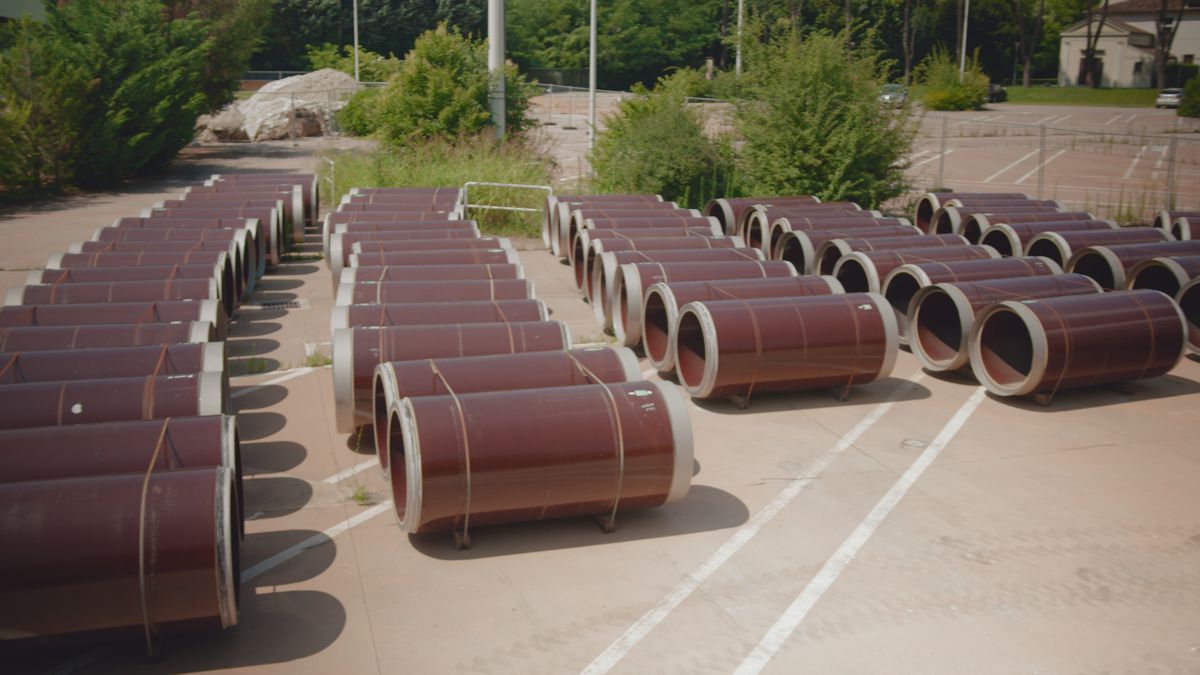
Vitrified clay carries a longitudinal compressive strength of around 100 N/mm² and a wall thickness in jacking grades that translates into large pressure transfer areas at the joint, which is what allows high permissible jacking forces without a casing. Manufacture and testing to EN 295-7, the European standard covering vitrified clay pipes and joints for pipe jacking, gives specifiers a documented conformity route rather than a proprietary performance claim.
The durability argument is where the whole-life economics turn. Concrete sewers degrade through biogenic sulphuric acid attack where hydrogen sulphide is generated and oxidised at the crown, and the resulting rehabilitation liability is one of the larger hidden costs in European wastewater networks.
Vitrified clay is chemically inert across the full practical pH range and resistant across the whole wall thickness rather than at a surface barrier, which removes that failure mode from the asset register. Steinzeug-Keramo, which has manufactured vitrified clay pipes for more than 170 years and is Europe’s largest producer of the systems, notes that its oldest pipe still in service passed 167 years. Design lives quoted at a century or more are difficult to verify prospectively, but the operational evidence base for ceramic sewer pipe is longer than for any competing material, and for a utility financing assets against a 30 year concession that asymmetry has a real discount-rate consequence.
Lorenzo Vidus Rosin, Sales Engineer Italy at Steinzeug-Keramo, framed the selection in terms that extend beyond the material itself, “KERA.Drive is the sustainable solution. Not only from the material perspective, but also from an installation point of view.” The installation half of that claim is the more commercially interesting one. A single-pass directly jacked ceramic pipe removes the need for a separate casing, the subsequent installation of a carrier pipe inside it, the spacers that centre one within the other, and the grouting or treatment of the annulus between the two, which compresses both the programme and the volume of imported and exported material moving through a constrained city-centre site.
Where Veneto’s Water Money Is Going
Set alongside the Treviso drive, the region’s investment pipeline shows why buried water assets are becoming a distinct value pool. On 21 July 2026, ATS confirmed a €26 million financing arranged by Banca Finint to support a 2026 to 2029 capital programme worth more than €160 million across water supply, sewerage and treatment. That financing does not fund the Treviso crossing, which was tendered and built earlier, but it signals the scale of committed regional spend that projects of this kind now sit within.
The 2026 to 2029 investment plan exceeds €160 million and covers water supply, sewerage and treatment, with headline items including expansion of the Salvatronda works at Castelfranco Veneto and the Carbonera plant, alongside extension of the sewer network into areas that still lack it. The historic centre remains a live focus for the utility’s ongoing sewer works, though the microtunnelled DN 800 crossing described here was delivered under an earlier contract and sits outside that 2026 to 2029 programme.
The financing structure matters as much as the sum. The €26 million facility was arranged by Banca Finint and subscribed by the BCC Iccrea group through BCC Banca Iccrea, Banca della Marca, Banca delle Terre Venete and BCC Pordenonese e Monsile, drawable in tranches over a 24 month availability period.
ATS is also one of 12 Veneto utilities within the Viveracqua consortium, which has used the pooled Hydrobond structure to bring institutional capital into small and medium-sized municipal water operators that individually lack the balance sheet to access bond markets. That aggregation model is the quiet enabler of European sewer renewal: it converts fragmented municipal demand into financeable scale, and it explains why suppliers with pan-European distribution are seeing infrastructure order books hold up while housebuilding contracts.
Regulation Is Turning Sewer Renewal Into Non-Discretionary Capex
The recast Urban Wastewater Treatment Directive, adopted as Directive (EU) 2024/3019 in November 2024, must be transposed into national law by 31 July 2027 and replaces the 1991 regime from 1 August 2027. It obliges larger cities to prepare integrated stormwater management plans that reduce overflow and urban flood risk, extends collection and secondary treatment duties to smaller agglomerations on a phased basis, introduces quaternary treatment for micropollutants and sets progressive energy-neutrality targets running to 2045.
Under the polluter pays principle, producers whose products contribute micropollutant load must fund at least 80 per cent of the additional treatment cost through extended producer responsibility. Taken together, these obligations reclassify a large tranche of sewer and treatment work from discretionary asset management into statutory compliance with dated deadlines.
Italy has a sharper incentive than most member states. In March 2025 the Court of Justice of the European Union imposed a €10 million lump sum on Italy plus €13.6875 million for every six months of continued delay in bringing four agglomerations into compliance with the original directive, in a case running back to a 2014 judgment covering 41 agglomerations.
National water distribution losses remain close to 42 per cent, and the PNRR has directed several billion euros towards aqueduct rehabilitation, sewer renewal and treatment capacity, including roughly €2 billion across 124 primary water infrastructure projects and a loss-reduction programme scaled up by a further €1 billion during the plan’s renegotiation. Layered above that, the European Water Resilience Strategy adopted in June 2025 carries a European Investment Bank commitment of more than €15 billion for 2025 to 2027 against an estimated annual investment shortfall of around €23 billion. Contractors and materials suppliers are therefore selling into demand created by legal deadlines and penalty exposure rather than by construction sentiment.
What Wienerberger’s Numbers Say About Where Value Is Concentrating
Away from Treviso, and with no direct connection to that scheme, the largest listed building materials group operating across the region tells the same structural story through its own results. Wienerberger’s Q2 2026 trading update, published on 21 July 2026, made the divergence within the sector explicit. Group revenues rose 13 per cent year on year to €1.41 billion, supported by 7 per cent organic growth, yet operating EBITDA fell to €230 million from €253 million as weak residential new build in the United States, Canada and the United Kingdom took hold. The company estimates that this shortfall will reduce group EBITDA by approximately €100 million across full-year 2026, of which about €40 million was incurred in the first half.
On the back of that, management cut full-year operating EBITDA guidance to approximately €700 million, against €754 million in 2025 on revenues of €4.6 billion. Chief executive Heimo Scheuch described the period as delivering one of the most significant portfolio transformations in our company’s history, and the underlying mix supports that characterisation more convincingly than the headline earnings do. The decline is concentrated in cyclical exposure, while the segments the group is steering towards are the ones holding up.
Piping is the business carrying that argument. It contributed €1.4 billion in 2025 and is now the group’s largest segment by revenue, with demand attributed to the European water resilience agenda and to power grid upgrades rather than to construction cycles. The acquisition of NEWS Group, a Nordic wastewater specialist, alongside the Terreal roofing and Italcer tile platforms, has pushed new residential exposure below 40 per cent of end markets. For investors reading the sector, the signal is that ceramic and plastic pipe assets are increasingly valued as regulated-infrastructure exposure with utility-like demand characteristics, while brick and roof tile volumes retain full housing cyclicality.
For procurement teams, the same shift means supplier capacity in jacking pipe and wastewater systems is being expanded and consolidated at precisely the moment compliance deadlines tighten. Framework agreements struck now lock in access to that capacity before demand from regulated water programmes fully arrives. That combination makes the current period a favourable window for negotiation, and it will not stay open indefinitely.
Trenchless Economics And The Capability Constraint
Microtunnelling carries a higher direct cost per metre than open-cut in unconstrained ground, and the case for it rests on avoided disruption rather than on unit rate. Academic assessments of urban pipeline work place the social costs of open-cut construction anywhere between roughly 6 and 78 per cent of direct project cost depending on traffic density and duration, against a far smaller figure for trenchless methods, and comparative life-cycle studies consistently show materially lower carbon footprints where excavation and reinstatement are eliminated.
In Treviso the relevant comparison is not open-cut trenching, which was never realistic beneath a live railway and a protected spring-fed river, but the other feasible crossing methods. Directly jacking the carrier pipe still earns its place there through the casing, carrier install, spacers and annulus works it removes, though the case rests on method-versus-method economics rather than on trenching costs that were never really on the table.
The constraint is capability rather than demand. Independent forecasts for the trenchless microtunnelling services market cluster around high single-digit compound growth into the 2030s, though estimates diverge widely between research houses and should be read as directional. Italy has encouraged no-dig methods in subsurface utility works since a prime ministerial directive in 1999, and has built a competent specialist contracting base, yet the pool of crews able to execute a slurry drive beneath a live railway and a protected river remains thin across Europe.
Utilities that intend to spend compliance capital before 2027 and 2035 deadlines are competing for the same MTBM fleets, guidance systems and experienced operators. The practical implication for asset owners is that securing trenchless delivery capacity through longer framework agreements is now as strategically important as securing the funding itself.
Specifying For The Next Hundred Years
What makes Treviso instructive is the alignment between asset life, financing horizon and regulatory timetable. A directly jacked ceramic sewer installed 11 metres beneath a railway and a river is, in practical terms, unmaintainable and unreplaceable within any reasonable planning horizon, which means the specification decision is effectively permanent.
ATS is financing that asset over a concession measured in decades, against directive deadlines that extend to 2045, in a network where an eventual failure would require the same railway and river to be crossed again. Under those conditions, the material premium on a jacking pipe with documented chemical inertness and a two-century operational record is not a sustainability gesture but a straightforward risk-adjusted purchase.
The wider read-across for the construction and infrastructure sector is that the most defensible earnings in European building materials now come from products buried in places nobody will revisit. Housebuilding will recover on its own timetable, and Wienerberger’s guidance is candid about how long that may take. Meanwhile the water and wastewater renewal cycle proceeds on a legislated schedule, funded through utility tariffs, pooled municipal bond structures, EIB facilities and recovery-plan grants that are largely insulated from mortgage rates.
Contractors, consultants and suppliers who have built genuine trenchless and wastewater competence are positioned in the part of the market where demand is set by statute, and a 400 metre drive under a Venetian river is a fair enough emblem of where that market has gone.
Key Industry Questions
- Why was a casing pipe unnecessary on the Treviso crossing? Casing pipes are used when the carrier pipe cannot withstand jacking loads or when the installation method requires a separate protective bore. Vitrified clay jacking pipes manufactured to EN 295-7 are dimensioned for direct jacking, with wall thicknesses that generate large joint pressure transfer areas and longitudinal compressive strength around 100 N/mm². That allows the product pipe to be pushed directly behind the machine. The commercial effect is significant: it removes annulus grouting, spacers and carrier installation from the programme, reduces bore diameter and jacking forces, cuts spoil volumes and delivers a finished asset at the moment the drive completes. In constrained urban sites, that simplification usually matters more to project economics than the pipe unit price.
- How does the EU’s recast wastewater directive change procurement priorities? Directive (EU) 2024/3019 requires transposition by 31 July 2027 and applies from 1 August 2027. It obliges larger cities to produce integrated stormwater management plans, extends collection and treatment duties to smaller agglomerations, introduces quaternary treatment for micropollutants and sets progressive energy-neutrality obligations running to 2045. For procurement, the practical shift is from condition-driven asset management to deadline-driven compliance. Utilities need bankable programmes with fixed completion dates, which favours methods and materials with predictable delivery risk and documented conformity to European standards. It also raises the value of framework agreements that lock in specialist contracting capacity before national transposition triggers a synchronised surge in demand across member states.
- What financial exposure does Italy face on wastewater compliance? In March 2025 the Court of Justice of the European Union imposed a €10 million lump sum on Italy, together with a periodic penalty of €13.6875 million for each six month period of continued delay, over four agglomerations still failing collection and treatment obligations. That case originates in a 2014 judgment covering 41 agglomerations. The penalties are national rather than utility-level, but they shape political priority and funding allocation, reinforcing the flow of PNRR and regional money into sewerage and treatment. For suppliers and contractors, the relevance is that Italian wastewater investment is being driven by legal exposure as well as service improvement, which makes the demand less sensitive to macroeconomic conditions.
- Is vitrified clay competitive on cost against concrete and GRP jacking pipe? On initial material cost, vitrified clay generally sits above reinforced concrete and is broadly comparable with polymer concrete and glass-reinforced plastic depending on diameter and market. The case for it rests on whole-life performance. Concrete sewers are vulnerable to biogenic sulphuric acid attack where hydrogen sulphide is generated, and rehabilitation of degraded crowns is a substantial cost line in mature European networks. Ceramic pipe is chemically inert throughout the wall section rather than protected by a surface barrier, and it offers high abrasion resistance and jacking capacity. For assets installed under rivers, railways or heritage centres where replacement is effectively impossible, the durability premium is usually the rational purchase.
- What does the Wienerberger Q2 2026 update tell investors about the pipe sector? The update shows revenue growth of 13 per cent to €1.41 billion alongside an EBITDA decline to €230 million, with residential new build in the United States, Canada and the United Kingdom expected to cost around €100 million of group earnings across 2026. Against that, piping delivered €1.4 billion in 2025 and is now the largest segment by revenue, supported by water resilience investment and grid upgrades. Infrastructure and renovation together exceed 60 per cent of group revenues. The read-across is that European pipe systems businesses are increasingly valued on regulated-infrastructure demand characteristics rather than construction cyclicality, which changes the appropriate multiple and the appropriate risk framing.
- How should asset owners manage ground risk on river and rail crossings? Ground investigation is the primary control, and the Treviso project used a specialist consultant in geophysical and geomechanical characterisation for exactly that reason. In slurry-supported microtunnelling, the site investigation determines face pressure management, cutter head configuration and jacking force prediction, and those parameters govern settlement performance beneath sensitive assets. Attempting to transfer residual ground risk contractually is expensive and rarely effective once a machine is under a live railway. Owners get better value by funding a thorough characterisation programme, sharing the resulting data openly at tender, and adopting a risk allocation that rewards contractors for accurate prediction rather than penalising them for conditions nobody investigated.
- Why does the Sile crossing carry additional environmental weight?The Sile is a 95 kilometre resurgence river fed by more than a thousand springs, widely described as the longest river of its type in Europe, and it is protected within the Parco Naturale Regionale del Fiume Sile before flowing into the Venetian lagoon. Its flow depends on groundwater rising where permeable gravels meet impermeable clays, so the aquifer and the river are hydraulically continuous, and disturbing one disturbs the other. That sensitivity is what ruled surface-disturbing approaches out of contention and confined the realistic choice to deep, continuously supported crossing methods. Installing the pipe at around 11 metres depth with continuous face support keeps the works clear of the river bed and the shallow groundwater regime that sustains the springs, which is why the method choice was as much an environmental decision as an engineering one.
- What capacity constraints could slow European sewer renewal? The binding constraint is specialist delivery capability rather than funding or demand. Microtunnelling requires machine fleets, guidance systems, slurry separation plant and, above all, crews experienced in drives beneath live infrastructure. Compliance deadlines under the recast directive fall on similar timetables across member states, which concentrates demand for that capacity into the same window. Ancillary constraints include shaft construction in congested urban ground, spoil characterisation and disposal, and the availability of jacking pipe in larger diameters from manufacturers with European production. Utilities that begin securing multi-year framework capacity now will face materially better pricing and programme certainty than those tendering project by project closer to statutory deadlines.
Strategic Takeaways
- Buried water and wastewater assets have become the counter-cyclical core of European building materials, and suppliers with genuine infrastructure exposure are now better read as regulated-demand businesses than as construction cyclicals.
- Compliance deadlines under the recast Urban Wastewater Treatment Directive and existing infringement penalties are converting sewer renewal from discretionary asset management into dated statutory capital expenditure, which changes both funding priority and procurement urgency.
- On crossings where replacement is effectively impossible, material selection is a permanent risk decision rather than a unit-cost comparison, and documented chemical inertness and jacking capacity justify a premium over the asset’s full life.
- Specialist trenchless delivery capacity, not capital, is emerging as the practical brake on European sewer programmes, making multi-year framework agreements with microtunnelling contractors a strategic procurement priority before deadline-driven demand peaks.
- Pooled municipal financing structures such as the Veneto Hydrobond model are what allow small and medium-sized utilities to access institutional capital at scale, and their spread across Europe will determine how quickly compliance investment actually converts into constructed assets.