Smarter Street Furniture Supporting Active Travel in Newbury
Urban streets across the United Kingdom are being quietly reshaped. Not through sweeping megaprojects or high-profile infrastructure programmes, but via small, carefully considered interventions that change how space is used and shared. In Newbury, a modest trial led by West Berkshire Council illustrates how these incremental changes can influence the safety, flexibility and long-term management of active travel infrastructure.
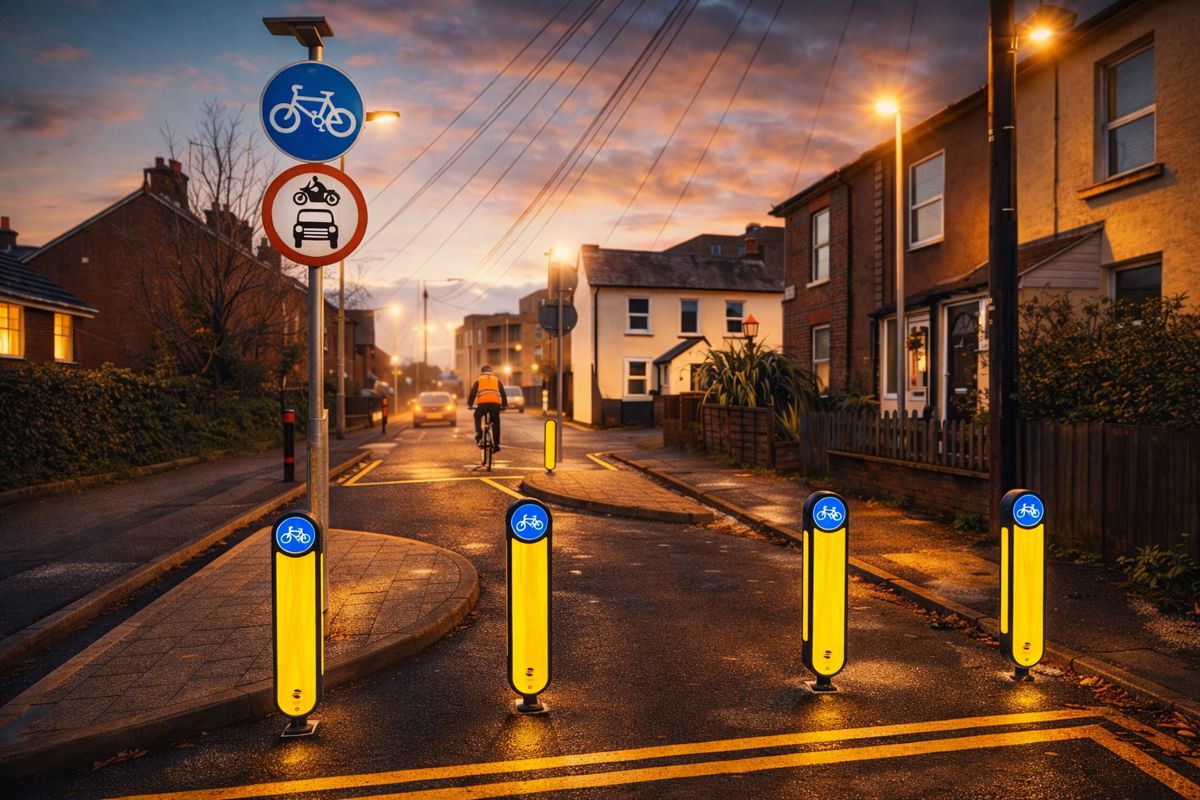
Working alongside Volker Highways, the council introduced a series of compact bollards along Kings Road as part of an active travel scheme. Supplied by Traffic Management Products Ltd, the installation focused on a refined approach to cycle lane delineation, combining visibility, safety and maintainability in a constrained urban environment.
This wasn’t simply a product trial. It served as a live test of how modern street furniture design and installation methods can support evolving transport policies, particularly as local authorities continue to prioritise cycling, walking and shared-use spaces.
Briefing
- Compact bollard design trialled to improve cycle lane clarity in limited space
- Integration of signage and delineation reduces streetscape clutter
- Retention socket system enables easier maintenance and future reconfiguration
- Rebound base design supports safer interactions with vulnerable road users
- Positive feedback highlights practical benefits for long-term highway management
Redefining Cycle Lane Infrastructure in Tight Urban Spaces
The challenge facing many local authorities is straightforward on paper yet difficult in practice. Cycle infrastructure must be visible, compliant and safe, while also fitting into streets that were never designed with active travel in mind. In towns such as Newbury, where carriageways are often narrow and space is contested, traditional approaches can lead to visual clutter or compromised layouts.
The installation on Kings Road addressed this by replacing conventional bollards and separate signage with a more integrated solution. Eight compact units were deployed, each incorporating a cycleway sign directly into the bollard structure. By consolidating functions, the scheme reduced the number of individual assets required on the street.
This approach aligns with broader guidance emerging from UK transport bodies, including Department for Transport, which emphasises the importance of legible, uncluttered streetscapes in encouraging active travel uptake. A clearer visual environment not only benefits cyclists but also improves driver awareness and reduces cognitive load in busy urban settings.
Safety Considerations in Shared Use Environments
Safety remains central to any intervention involving vulnerable road users. The bollards used in the Newbury trial were designed with a rebound base, allowing them to flex when struck rather than acting as rigid obstacles. This detail, while easily overlooked, reflects a growing emphasis on passive safety within urban design.
Shared spaces, where pedestrians, cyclists and vehicles coexist, require infrastructure that minimises harm without compromising function. The rebound mechanism reduces the likelihood of injury in the event of contact, particularly for cyclists who may inadvertently clip a bollard in confined conditions.
At the same time, high-visibility reflective panels enhance delineation between the carriageway and cycle lane. Research into road safety consistently shows that clear visual boundaries improve compliance among drivers, especially in low-light conditions. By combining passive safety with strong visual cues, the installation addresses both behavioural and physical risk factors.
Maintenance and Flexibility Driving Long-Term Value
While visibility and safety often dominate discussions around cycle infrastructure, maintenance considerations are equally critical from an asset management perspective. Traditional fixed installations can create ongoing challenges, particularly when schemes need to be adapted or repaired.
The Newbury trial incorporated a retention socket system, allowing each bollard to be removed and replaced without extensive groundworks. This offers practical advantages for highway authorities managing constrained budgets and evolving transport strategies.
As active travel schemes are frequently introduced on a trial basis, flexibility becomes essential. Authorities need the ability to adjust layouts, respond to public feedback and refine designs without incurring significant additional costs. Socket-based installations support this iterative approach, enabling infrastructure to evolve alongside policy and user behaviour.
For contractors such as Volker Highways, this also streamlines operational processes. Reduced excavation and reinstatement work can lower disruption, shorten installation times and improve overall efficiency across maintenance programmes.
Product Design Meeting Policy Ambitions
The bollard used in the scheme, the Mini-Metro Bollard, reflects a broader shift in how street furniture is being developed. Rather than treating bollards as standalone elements, manufacturers are increasingly designing integrated solutions tailored to specific use cases such as cycle lanes and shared paths.
Its compact profile is particularly relevant in environments where space is limited but clarity remains essential. By maintaining compliance with visibility standards while reducing physical footprint, the design supports more balanced street layouts.
This aligns with the UK’s wider active travel agenda, which has gained momentum in recent years through initiatives such as Active Travel England and increased funding for local cycling and walking infrastructure. Authorities are under pressure to deliver schemes that are not only effective but also adaptable and cost-efficient.
In this context, product design becomes a critical enabler. Solutions that combine multiple functions, reduce installation complexity and improve lifecycle performance can help bridge the gap between policy ambition and on-the-ground delivery.
Feedback from a Live Highway Environment
Trials conducted in live traffic environments provide valuable insights that cannot be replicated in controlled conditions. After eight weeks in service, feedback from both the council and contractor involved in the Newbury scheme has been positive.
The installation was noted for its visibility and finish, as well as its suitability within a cycle lane setting. Importantly, it also demonstrated the practical benefits of combining rebound bollard technology with socket-based installation methods.
Such feedback carries weight because it reflects real-world performance rather than theoretical expectations. For other authorities considering similar interventions, evidence from live trials can inform procurement decisions and reduce perceived risk.
Supporting the Evolution of Active Travel Infrastructure
The Newbury scheme sits within a much larger transition taking place across the transport sector. As cities and towns work to reduce car dependency and encourage more sustainable modes of travel, the role of small-scale infrastructure becomes increasingly significant.
Cycle lanes, shared paths and pedestrian-friendly streets rely on clear, consistent and adaptable design. Street furniture, often seen as a minor detail, plays a central role in shaping user experience and ensuring safety.
By focusing on practical improvements such as integrated design, passive safety and maintainability, schemes like this contribute to a more coherent and resilient transport network. They also highlight the importance of collaboration between manufacturers, contractors and local authorities in delivering effective solutions.
A Practical Step Towards Better Streets
There’s no single solution to the challenges of urban mobility. Instead, progress tends to come through a series of incremental improvements, each addressing specific constraints and opportunities. The Newbury trial demonstrates how thoughtful design and installation methods can deliver tangible benefits without requiring large-scale intervention.
For decision-makers in the construction and infrastructure sectors, the message is clear. Investing in smarter, more adaptable street furniture can support policy objectives, improve safety and reduce long-term costs. It’s a pragmatic approach that aligns with the realities of modern highway management.
As active travel continues to gain traction, the lessons from schemes like this will shape how future infrastructure is planned and delivered. Small changes, executed well, can have a lasting impact on how streets function and how people move through them.