When A Copper Mine Starts Trading Like A Currency
A trading agreement that slipped out quietly this week may end up mattering far more to the people who build, fund and police major infrastructure than its modest billing suggests. Perpetuals.com Ltd, a fintech group whose shares trade on Nasdaq under the ticker PDC, has agreed to bring tokenised versions of copper, gold, geothermal energy and a basket of so-called critical minerals onto a regulated European exchange. These aren’t abstract financial widgets. They’re claims on the very materials that go into roads, rail, power grids, data centres and the clean-energy build-out that governments keep promising.
The counterparty is Datavault AI Inc, a Nasdaq-listed (DVLT) real-world asset tokenisation specialist, and the venue is PM MTF Ltd, a Multilateral Trading Facility regulated by the Cyprus Securities and Exchange Commission and run on Perpetuals’s technology. Strip away the jargon and the pitch is fairly simple: take a stake in a working mine or an energy project, turn it into a digital token, and let people buy and sell that token around the clock the way they’d trade a share. For an industry where capital tends to get locked up for years at a stretch, that’s no small idea.
There’s a second strand to the announcement, and it’s the one that’s been turning heads. The same company has just reported startling early numbers for UpsideOnly, a consumer trading platform it launched in mid-May. Put the two together and you get the outline of a strategy: build a crowd, then give that crowd something tangible to trade. Whether it holds up is another matter, and the firm’s history gives plenty of reason to read the small print.
Briefing
- Perpetuals.com (Nasdaq: PDC) has signed a Mutual Services Agreement with Datavault AI (Nasdaq: DVLT) to list tokenised commodity programmes, starting with the MTB Copper project, on the CySEC-regulated PM MTF venue.
- Five token programmes are in scope, spanning gold, copper, geothermal energy, US critical minerals and European iron-nickel, with a combined targeted issuance topping $328 million across the confirmed projects.
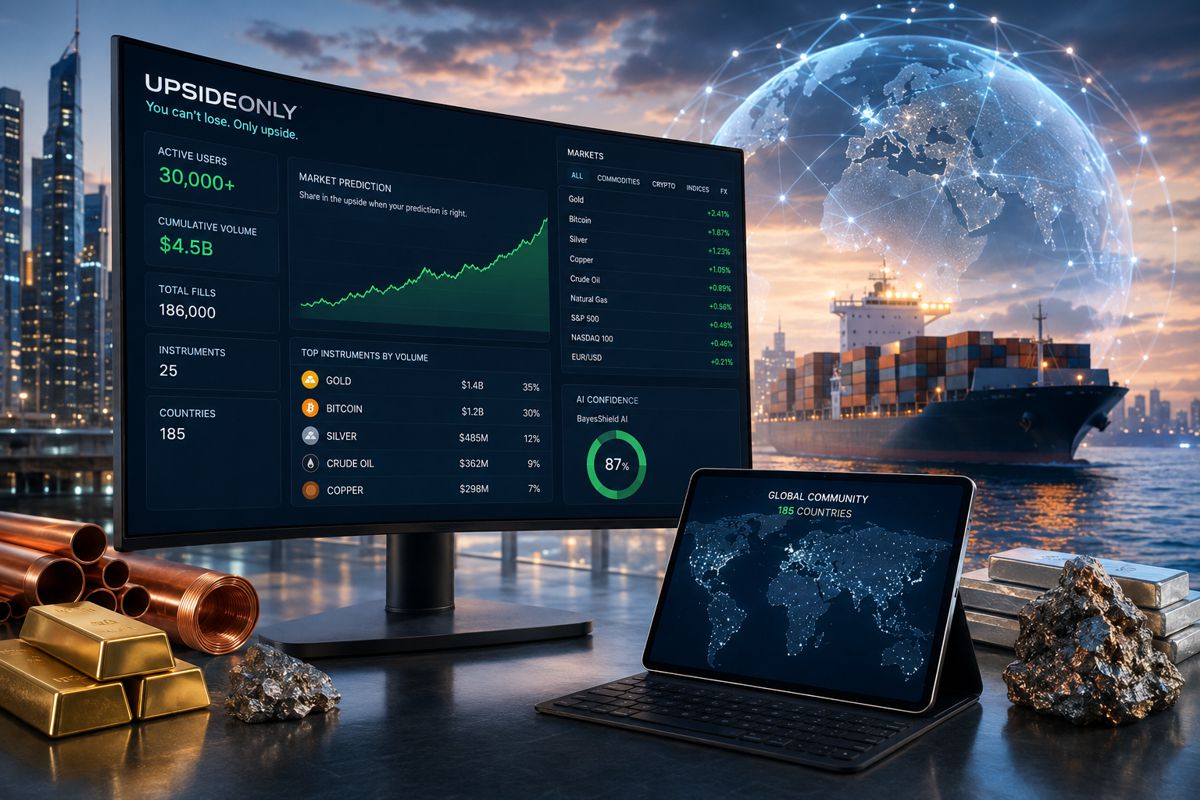
- UpsideOnly drew more than 30,000 active users from 185 countries in its first fortnight, logging $4.5 billion in cumulative volume across 186,000 fills and 25 instruments.
- Gold led trading at $1.4 billion, ahead of bitcoin’s $1.2 billion, with precious metals making up roughly 35% of all activity.
- Perpetuals is led by co-chief executive Patrick Gruhn, formerly head of FTX Europe, and the “risk-free” framing of its retail product has already drawn scrutiny from analysts.
What Tokenised Copper Means For The Build Pipeline
Start with the part that speaks directly to infrastructure. The agreement initially covers MTB Copper, a programme tied to a copper mining venture, with room to widen into gold, geothermal energy, US strategic minerals and European iron-nickel deposits. Each token, on Datavault AI’s account, is meant to be backed by real physical resources, with structured rights that can include equity in the underlying operation, royalty streams from production and, in the gold programme, discounted bullion acquisition rights. In plain terms, the buyer isn’t just betting on a price chart. They’re meant to be holding a sliver of a working asset.
For contractors, project developers and the funds that back them, the draw is liquidity. Mining and energy projects are famously capital-hungry and slow to pay back, and the secondary market for a stake in a single mine has traditionally been thin to non-existent. A regulated venue where those stakes can change hands at any hour, in fractional sizes, could in principle widen the pool of money willing to commit early. Datavault AI lists the broader line-up as GoldVault, targeting $150 million or more and slated for the third quarter of its 2026 financial year, Coppercoin at $100 million or more, the Triton Geothermal programme at $120 million, and American Strategic Minerals at $78.2 million, with a European iron-nickel project to follow under a separate work order.
Nathaniel T. Bradley, chief executive of Datavault AI, framed the venue as the missing piece. “Perpetuals has built the regulated infrastructure that physical commodity tokenization needs and has been missing,” he said, adding that “Partnering with a platform that has already demonstrated this kind of user growth puts our token programs in front of what we believe may be the largest possible audience at exactly the right moment for Datavault AI.” The geothermal angle is worth a beat of its own, given how much of the current power-demand story runs through data centres and the scramble for clean, round-the-clock electricity to feed them.
The Crowd That Came First
None of this works without an audience, which is where UpsideOnly comes in. Perpetuals says the platform pulled in more than 30,000 active users from 185 countries in a fortnight, generating $4.5 billion in cumulative volume across 186,000 fills and 25 instruments. Those are the kind of figures that make rivals sit up, though it’s worth remembering they measure activity on a product where, by design, users aren’t staking their own cash on each trade.
The instrument mix is the genuinely interesting bit for a commodities story. Gold topped the table at $1.4 billion, edging out bitcoin at $1.2 billion, and precious metals accounted for roughly 35% of everything traded. That tilt towards hard assets, rather than crypto, fits neatly with the company’s next move into tokenised metals and minerals. Matthew Nicoletti, chief strategy officer and a director of Perpetuals, didn’t hide his satisfaction. “The past two weeks have made clear that Perpetuals is building something that fills a major need in the market. UpsideOnly adoption has exceeded everything we projected, and now closing this Datavault AI agreement demonstrates our velocity,” he said, before adding: “We are moving fast and the momentum is real.”
How The “Risk-Free” Model Actually Works
The line that’s followed UpsideOnly around is that users “can’t lose.” It pays to understand what that does and doesn’t mean. On the company’s telling, traders submit predictions across stocks, crypto, commodities and currencies, and a proprietary model called BayesShield decides which of those calls to back with the firm’s own capital. If a trade wins, the user shares the profit. If it loses, or never gets placed, the user walks away no worse off. No personal stake rides on the outcome.
Users can put down a refundable deposit of a dollar or more to earn higher payouts and to weed out bots, and the company says that money sits in US Treasury Bills with a separate US-based fiduciary and can be withdrawn at any time.
So the slogan is accurate as far as it goes, and that’s rather the catch. The phrase describes only the user’s side of the ledger. Every losing position lands on Perpetuals itself, and the firm trades near a $22 million market capitalisation with a recent run of losses. Sceptics have flagged that as a thin cushion for a model that, taken to scale, asks one balance sheet to absorb the downside for tens of thousands of punters. The company itself acknowledges that risks remain at the operational level even when individual users face none on a given trade. For policymakers watching how “no-loss” marketing lands with retail audiences, the gap between the slogan and the structure is the bit worth keeping an eye on.
The People And The Provenance
Provenance counts here, because the people behind Perpetuals carry a story the industry knows well. Co-chief executive Patrick Gruhn ran FTX Europe before its parent collapsed in late 2022, taking billions in customer claims down with it. Gruhn has said publicly that he had no knowledge of fraud at the parent firm, and he and co-founder Robin Matzke clawed back the European assets through a long legal process, then built Perpetuals on top of them. That backstory isn’t incidental.
The trove of historic retail trading data recovered from the European business is what BayesShield was trained on, reportedly more than 22 billion executed trades.
The corporate plumbing is a touch unusual too. Perpetuals.com Ltd is a Japan-based, Nasdaq-listed entity that emerged after Earlyworks Co acquired Perpetual Markets Ltd, and it now runs a co-chief-executive structure alongside Satoshi Kobayashi. Its BayesShield engine, the firm says, monitors markets in real time across multiple asset classes and underpins the PM MTF venue, which it describes as operating under MiFID II, MiCA, DORA and EMIR. Plenty of regulated boxes, then, sitting right next to a consumer brand whose central promise leans hard on a word, “risk-free”, that compliance teams across Europe tend to treat with real caution.
What To Watch From Here
The bigger frame is a tokenisation market that’s grown up fast. Industry trackers put the value of tokenised real-world assets at north of $30 billion in 2026, with some forecasts stretching towards $1.6 trillion by the end of the decade as bonds, credit, property and commodities migrate onto blockchain rails. Tokenised commodities are a slice of that, around $7 billion at last count, and gold has done most of the heavy lifting so far. A regulated route for copper, geothermal and critical minerals would push the category somewhere it hasn’t really gone at scale.
For the construction and infrastructure world, the promise and the caveat sit side by side. If stakes in mines and energy projects really can trade like liquid securities, the cost and speed of financing the materials behind the global build-out could shift in ways that matter to everyone from a roads authority to a turbine manufacturer. The flip side is execution. Targeted issuance isn’t the same as money raised, a signed agreement isn’t the same as active trading, and a fast-growing user base isn’t the same as a durable one.
The plan reads well on paper. The next few quarters will show whether copper and gold tokens trade as briskly as the gold bets that got this whole story rolling.