Philippines Moves to Embed Green Skills Across its Construction Workforce
The Philippines has trained its first cohort of master trainers in foundational green construction skills, and the significance of the step lies less in the size of that initial group than in where it places green competencies within the labour force.
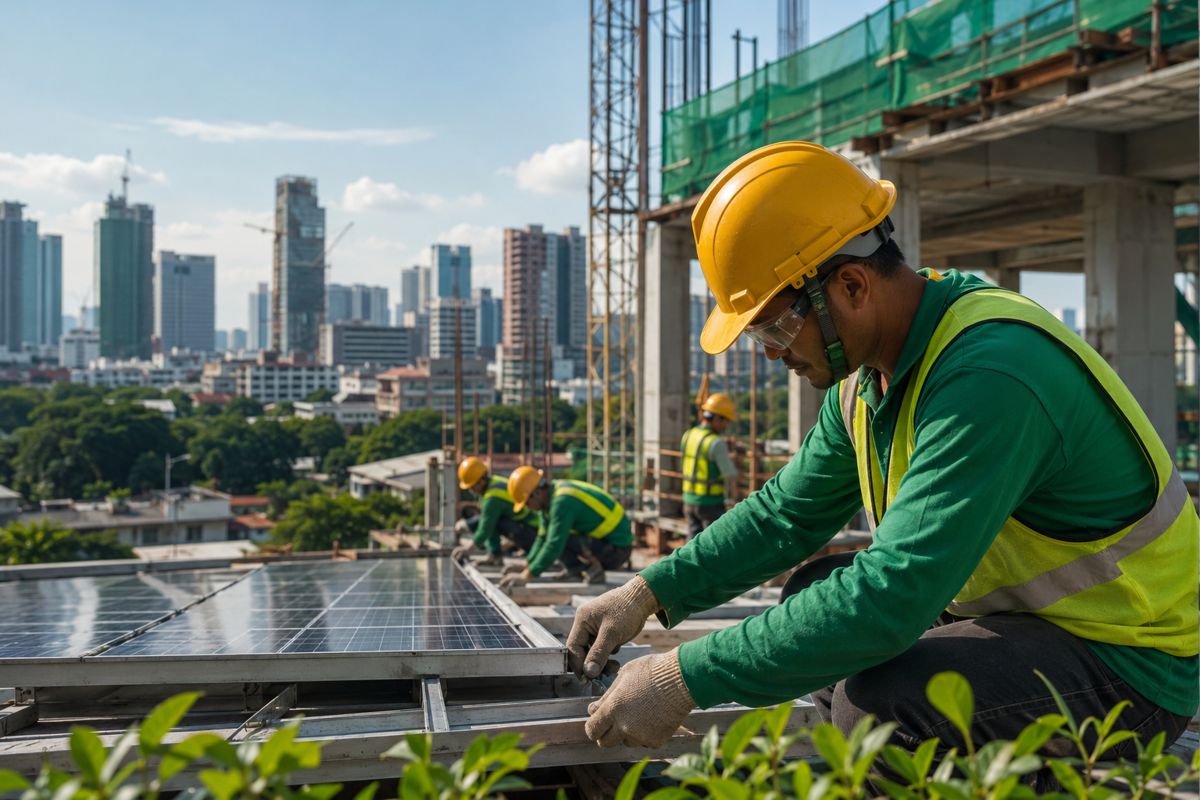
Until now, green skills training in Philippine construction has clustered at the top of the pyramid, around building standards, certification systems and project management. The new programme deliberately pushes practical, entry-level competencies down to the broad base of labourers, equipment operators and site supervisors who make up most of a sector employing close to a tenth of the national workforce. That reordering matters because a green building code is only as effective as the people on site able to deliver it, and for years the workers doing the physical building have been the group least served by sustainability training.
The timing is shaped by two pressures that rarely sit so closely together. The Philippines is one of the world’s most climate-exposed economies, absorbing around twenty tropical cyclones a year alongside earthquakes and flooding that repeatedly damage the built environment, which makes climate-resilient construction a matter of national resilience rather than reputational positioning.
At the same time, construction remains one of the country’s largest employers and a strategic sector under the National Green Jobs Human Resource Development Plan, yet adoption of green building practice has been slow despite policy already on the books. The master training in Introduction to Green Construction Skills, held from 2 to 5 June 2026 under the International Labour Organisation/Korea Partnership Programme’s Advancing Digital and Green Skills for Youth in ASEAN project, is the point at which that policy ambition begins to reach the worksite. Pilot test runs are scheduled for July, with a wider regional rollout from August.
Briefing
- A first cohort of master trainers completed the Introduction to Green Construction Skills (IGCS) programme on 2 to 5 June 2026, with pilot runs in July and a regional rollout from August.
- The course was developed with Korea Polytechnic University under the ILO/Korea Partnership Programme and targets entry- and mid-level workers rather than the management tier where green training has so far concentrated.
- Construction accounts for close to 10 per cent of Philippine employment, roughly 4.8 million people, in one of the world’s most climate-exposed economies.
- The IGCS is designed as a common competency that can be folded into existing construction training across the country’s technical and vocational system.
- The project, implemented in the Philippines and Thailand within a wider ASEAN aim, frames green and digital skills as a route to higher-paying, more secure work for younger and lower-skilled workers.
Why The Skills Gap Sits At The Base Of The Pyramid
The commercial logic of the programme rests on a diagnosis set out in the ILO’s 2025 baseline study of skills in the Philippine construction sector. Local demand for green construction has remained limited, held back by the slow uptake of green building practice even though instruments such as the Philippine Green Building Code already exist.
The study found that green skills interventions have mostly addressed advanced topics, building standards and project management among them, while practical entry-level skills are largely absent from technical and vocational education and from on-the-job training. The result is a workforce in which sustainability knowledge thins out sharply below the supervisory and professional tiers, leaving the people who actually place materials and run plant without a common grounding in resource and energy efficiency.
That gap creates a familiar deadlock. Slow adoption of green building suppresses employer demand for green skills, and the shortage of trained workers in turn slows adoption, so neither side of the market moves first. A series of ILO consultations earlier this year concluded that green skills first need to be defined clearly enough to be relevant to both workers and employers, with stakeholders agreeing that energy and resource efficiency should be treated as a competency every construction worker is expected to develop rather than a specialism reserved for designers.
Framing the transition around the whole workforce is also a deliberate equity choice. As Santiago Nolla, Secretary-General of the National Union of Builders and Construction Workers, put it: “The transition must be worker-centred. All workers, from labourers and skilled workers to equipment operators and supervisors, must have access to training opportunities that improve their access to green jobs.” For a sector contending with persistent labour shortages and the steady loss of skilled workers to higher-paying jobs overseas, broadening access to better-paid green work is as much a retention argument as a climate one.
What The IGCS Curriculum Sets Out To Standardise
The technical core of the initiative is an attempt to turn a broad concept into a teachable, repeatable competency. Developed with experts from Korea Polytechnic University, the IGCS course distils sustainability into a small set of capacities intended to apply to every worker in a green economy.
Joshua Miguel Lopez, National Project Coordinator of the ILO/Korea Partnership Programme, framed those capacities in plain terms drawn from the work itself, explaining that: “It is crucial to be mahusay or adept at using green building techniques, masinop or thorough in the use of energy and material resources, and ligtas, ensuring safe and secure construction for workers and building occupants.” The choice to anchor the competencies in everyday Filipino vocabulary is not incidental, since the course is meant to be understood and applied by workers across skill levels rather than absorbed only by those with formal technical training.
The substance behind that framing spans carbon reduction, resource efficiency, sustainable materials, passive and active building design, renewable energy and green building certification, with an emphasis on working with the local environment rather than against it. In practice that means designing and building to make the most of prevailing wind and sunlight, cutting energy and resource consumption, and selecting eco-friendly materials suited to the Philippine climate, all approached across a building’s full life cycle rather than at a single design stage.
Engineer Michael Gayona, Centre Coordinator of the Technical Education and Skills Development Authority Green Technology Centre, described the underlying shift in thinking when he said: “Green construction is a way of rethinking building performance across its full life cycle,” adding that: “The challenge now is not only how to teach these concepts, but how to contextualize them within the Philippine construction sector.”
The decision to package all of this as a common competency, capable of being embedded across existing construction-related training programmes, is what gives the curriculum its potential reach, because it is built to slot into the wider technical and vocational system rather than to stand apart as a niche course.
Turning A Pilot Into A National Standard
The master trainer model is the mechanism intended to carry the curriculum from a single cohort to nationwide coverage. The experts who completed the June programme were drawn from construction firms, labour unions, environmental groups and the academe, and they are expected to promote a shared set of green competencies that can be integrated into construction training across the country.
That train-the-trainer structure is what makes the August rollout plausible at scale, since each qualified trainer becomes a multiplier capable of reaching cohorts of workers and instructors well beyond the original group. The phased sequence, with pilot runs in July before regional expansion, also builds in a window to test how the material lands with different audiences before it is committed to broad delivery.
Institutional backing gives the rollout a route into the formal skills system rather than leaving it as a standalone exercise. In the Philippines the project is implemented with the support of the Technical Education and Skills Development Authority, the Philippine Constructors Association, the Department of Labor and Employment and the Construction Manpower Development Foundation, a combination that links the curriculum to the bodies responsible for vocational certification, contractor practice and labour policy.
The harder task, as Gayona’s reference to contextualisation signals, will be adapting internationally informed content to local materials, building types, climate conditions and worksite realities so that it is recognised as practical rather than aspirational. How thoroughly the competencies are absorbed into existing qualifications, and how consistently they are taught region to region, will determine whether the programme becomes a genuine national standard or remains a well-designed pilot.
A Regional Bet On Future-Proofing Construction Labour
The Philippine effort is one half of a two-country implementation that also runs in Thailand, sitting within a broader ambition to prepare construction labour across ASEAN for a sector being reshaped by sustainability and digitalisation. The economic backdrop gives that ambition weight.
The Philippine construction market was valued at more than forty billion US dollars in 2025 and is forecast to keep expanding at a mid-single-digit annual rate, driven by a large public infrastructure pipeline, sustained housing demand and a renewable energy build-out that will itself require skilled construction labour. Against that growth sits a structural shortage of skilled workers, worsened by emigration, which means the supply of capable labour is already a constraint on delivery and a competitive concern for contractors bidding on increasingly specialised work.
Positioning green and digital skills as a path to higher-paying, more secure employment is therefore aimed at younger and lower-skilled workers who have the most to gain from moving up the value chain, and at employers who need a deeper pool of capable labour to win and deliver complex projects.
The competencies are also portable beyond construction itself. Engineer Ronaldo Elepano, Jr., Immediate Past President of the Philippine Constructors Association, noted: “These foundational skills are relevant across a wide range of industries, from construction and engineering to energy, transport, and even business operations,” a point that strengthens the case for treating resource and energy efficiency as general workforce literacy rather than a single-sector add-on. For policymakers weighing where to direct limited training budgets, skills that transfer across the wider built-environment and industrial economy offer a broader return than those locked to one trade.
The Test Now Is Contextualisation And Demand
Whether this initiative changes practice on Philippine worksites will turn on two questions that the master training has set up but not yet answered. The first is contextualisation, the work of translating a curriculum shaped by international and Korean expertise into something that reflects local materials, climate and construction methods closely enough to be taught with credibility and applied without friction.
The second is demand, because foundational green skills will only hold their value if employers actively seek them when hiring and pricing work, and if the slow adoption of green building that the baseline study identified begins to shift. The programme’s design, with its common competency model, institutional partners and phased rollout, is built to address the supply side of that equation in a structured way.
What distinguishes the Philippine approach is its insistence on starting with the workforce rather than the standard, treating the labourers, operators and supervisors who build the country’s infrastructure as the people who most need foundational green skills rather than the last to receive them.
In a country this exposed to climate risk, embedding resource efficiency and climate-resilient practice as baseline competencies is a hedge against the cost of rebuilding as much as a contribution to lower emissions.
The coming months of pilots and regional delivery will show how far the model travels, and the same template is being watched across ASEAN as governments weigh how to ready a young, labour-intensive construction sector for a market that increasingly rewards building well and building green.