TNO’s Möbius Recovers The Plastic Streams Mechanical Recycling Leaves Behind
Europe’s circular-plastics debate has spent years stuck between two imperfect options. Mechanical recycling is cheap and established, but it struggles with contaminated, coloured, additive-laden or mixed material and tends to push recyclate down the value chain towards low-grade applications. Chemical recycling can rebuild polymers from their building blocks, but it is energy-hungry and capital-intensive.
Dutch research organisation TNO is pushing a third route into the gap between them, and its Möbius dissolution platform has now reached the point where it is being trialled on a client’s premises rather than confined to a laboratory bench.
For construction, infrastructure and automotive supply chains, the timing is what matters. The technology recovers high-purity polymer, and in some configurations valuable additives, from exactly the waste streams that regulators are now forcing manufacturers to draw recycled content from. With mandatory recycled-content rules arriving for vehicles and packaging, and with construction already absorbing a large share of Europe’s recyclate, a process that can lift difficult feedstock back to near-virgin quality has a clear commercial logic. The open question is whether TNO can convert a credible pilot and a strong patent position into disclosed plant-scale performance that investors and offtakers can underwrite.
Briefing
- TNO’s Möbius dissolution recycling platform has reached TRL 5 with its Leto pilot, which produced around 5 kg of recycled SAN from end-of-life vehicle waste, and is now being moved towards TRL 6 operation on an industrial client’s site.
- Möbius sits deliberately between mechanical recycling and chemical depolymerisation, using low-boiling organic solvents to dissolve a target polymer selectively, strip out contaminants and additives, then recover the polymer with its chains intact.
- Named industrial collaborations include Braskem on polyolefins, ELIX Polymers on ABS, Royal Dahlman, a specialist in industrial filtration technology who supplied the advanced filtration system integrated into the pilot’s filter module, and the Horizon Europe ABSolEU project alongside brand owners LEGO, Volvo and BIC.
- The commercial pull is regulatory: the EU’s End-of-Life Vehicles Regulation will phase in minimum recycled-plastic content for new vehicle types, and construction already accounts for a large share of European recyclate demand.
- The principal caveat is disclosure: TNO has not published a full mass and energy balance, life-cycle assessment, techno-economic analysis or solvent inventory, the very data points on which more advanced peers already publish at least partial evidence.
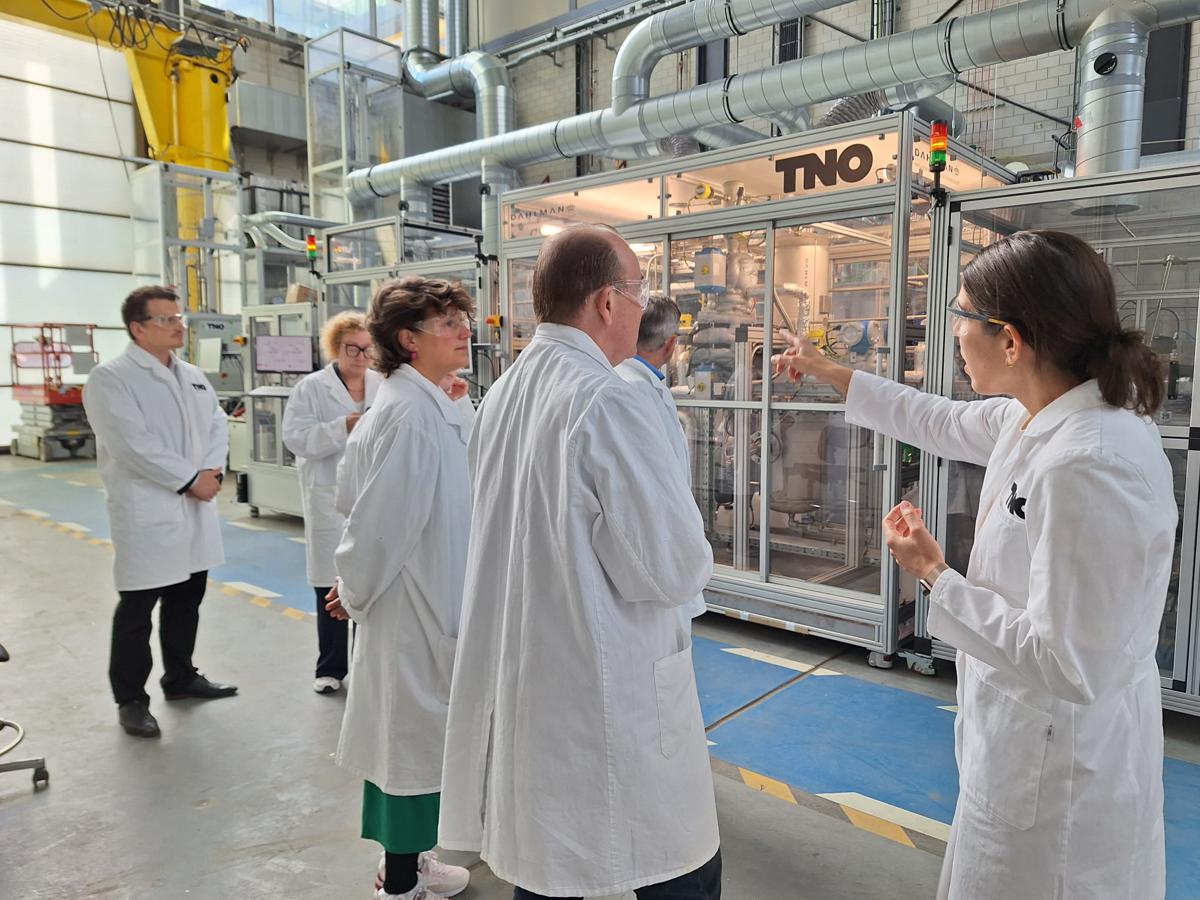
Inside The Rijswijk Lab
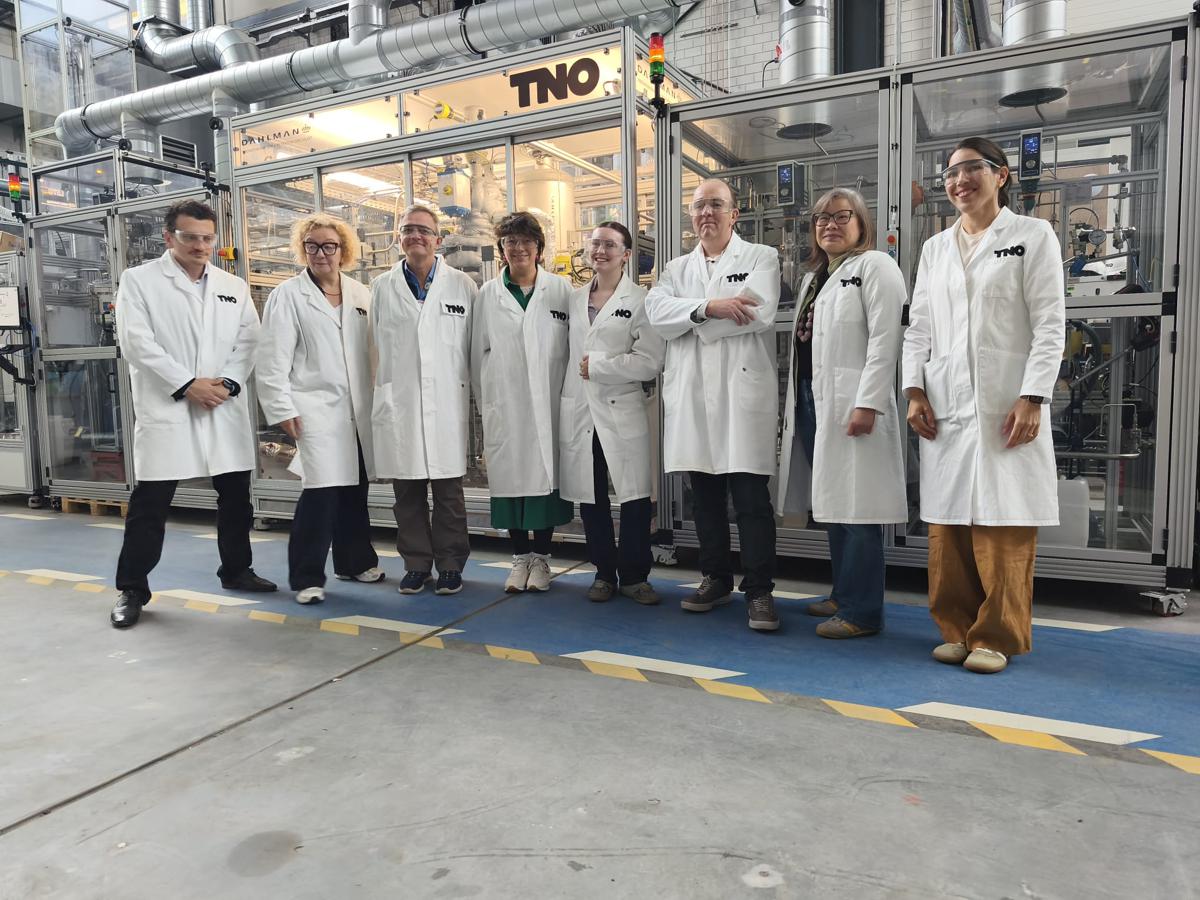
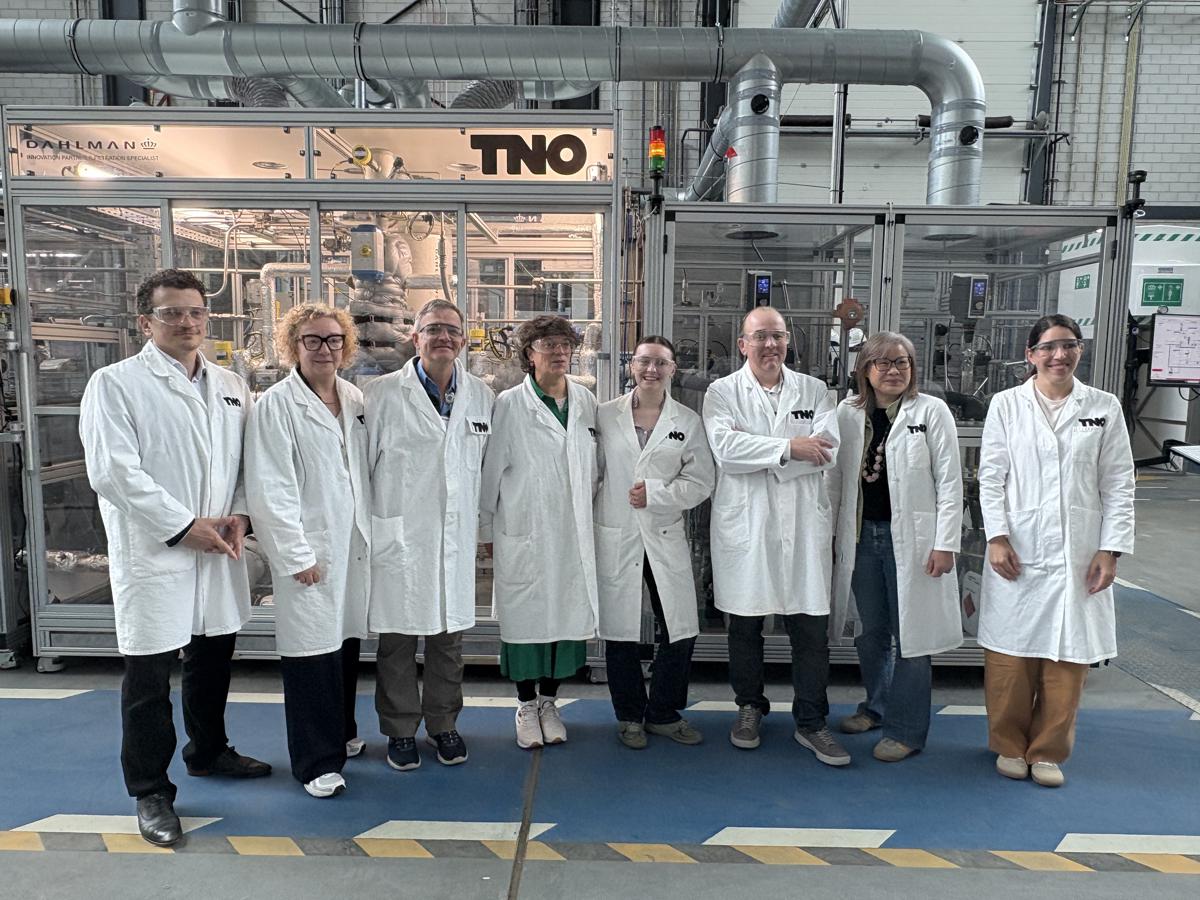
To understand whether Möbius is another promising recycling concept or something closer to industrial reality, we travelled to TNO’s campus in Rijswijk, on the southern edge of The Hague, as part of an international press visit.
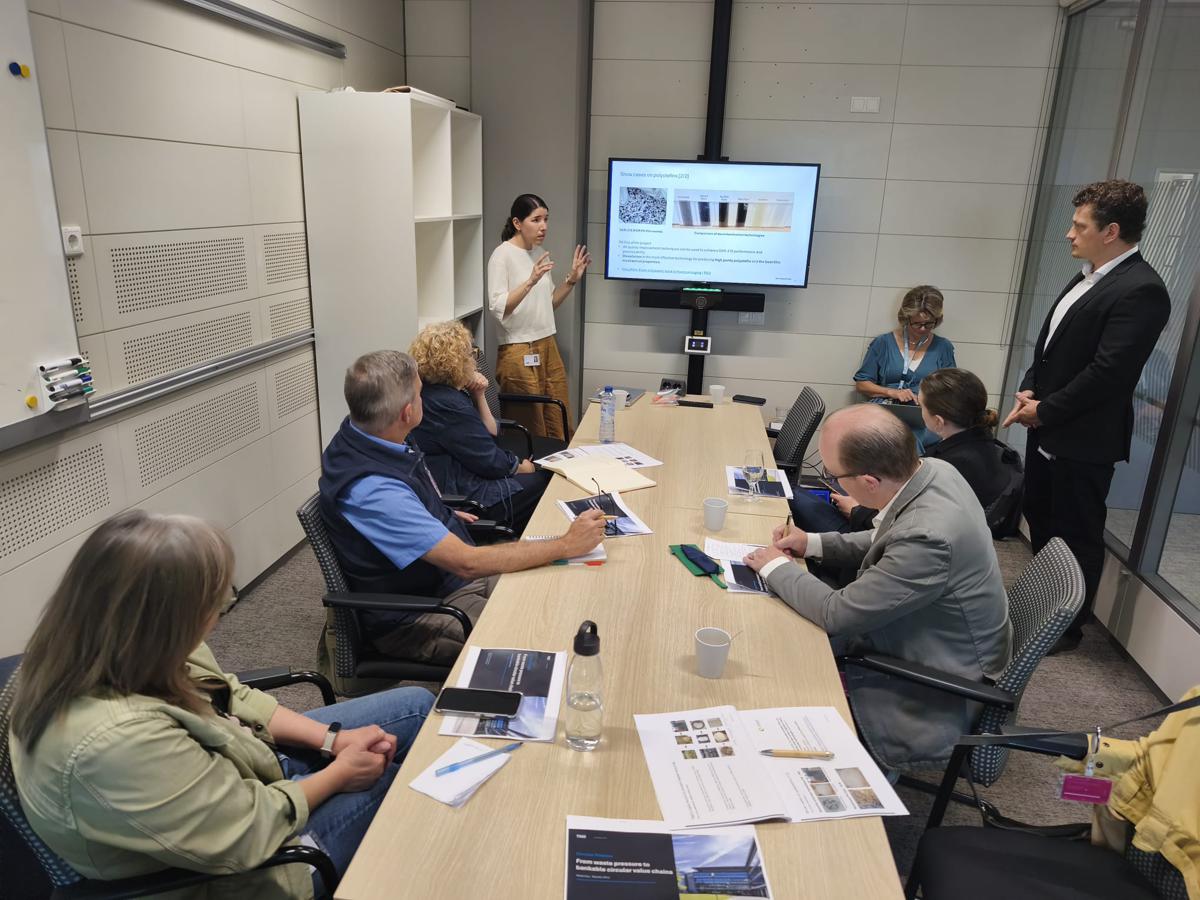
The session was led by Wojtek Kwos, business developer for circular plastics, and Lucie Prins, senior scientist within TNO’s Energy and Materials Transition division. Rather than presenting Möbius as a breakthrough moment or silver bullet, the discussion was framed around a more practical question: what happens to the plastic streams that mechanical recycling cannot economically recover?
TNO’s position is not that mechanical recycling has failed, quite the opposite. Mechanical recycling remains the preferred route wherever feedstock quality allows. Möbius is being developed for the material that sits beyond that boundary: mixed plastics, engineering polymers, coloured material, additive-heavy waste and streams where preserving polymer value matters more than maximising throughput.
Walking through the laboratory reinforced that distinction. The impression was less of a single machine and more of a growing toolkit of solvent systems, filtration stages, separation concepts and recovery routes being assembled around different classes of plastic waste. Much of the work remains stream-specific, identifying where selective dissolution creates more value than either mechanical recovery or full chemical conversion.
What emerged most clearly from the discussion was that the next bottleneck may no longer be chemistry. Kwos was candid that the challenge ahead increasingly sits in industrial pull rather than laboratory capability. Pilot infrastructure can demonstrate feasibility, but commercial deployment depends on feedstock access, manufacturing partnerships, specification requirements, investment and regulation aligning at the same moment. That observation became a useful lens through which to view the rest of the technology and the commercial environment now forming around it.
Why Infrastructure Should Care
Construction and infrastructure rarely dominate headlines around plastics, yet they remain one of the largest and most strategically important destinations for recycled polymer in Europe. Roads, tunnels, utilities and buildings already depend on plastics in ways that are often invisible once projects are complete. High-density polyethylene appears in drainage and water systems, polypropylene and geotextiles stabilise roads and embankments, expanded and extruded foams provide insulation, engineering polymers protect cabling and communications networks, and composite systems increasingly appear in barriers, temporary works and modular construction. The challenge is that much of this material enters service for decades, often exposed to UV radiation, chemicals, temperature cycles and mechanical stress that place tighter performance demands on recycled feedstock than many consumer applications.
That performance requirement is becoming more difficult to reconcile with the circular-economy targets now moving through regulation and procurement frameworks. Infrastructure clients increasingly want lower embodied carbon, greater recycled content and demonstrable material traceability without sacrificing asset life or maintenance intervals. Yet the available supply of high-quality recycled polymer remains constrained because conventional mechanical recycling performs best on relatively clean, well-sorted streams. Once polymers become mixed, coloured, laminated, additive-rich or contaminated, quality deteriorates rapidly and applications narrow accordingly.
This is where selective dissolution technologies such as Möbius become strategically interesting. Rather than treating contaminated plastics as unavoidable downcycling feedstock or sending them into energy-intensive molecular conversion routes, dissolution aims to preserve the value already embedded in the polymer chain while removing the contaminants that prevent higher-value reuse. If that approach proves scalable, infrastructure could become both a source and destination for circular polymers. Materials recovered from automotive, industrial and consumer waste streams may ultimately reappear in construction products with engineering performance closer to virgin resin than conventional recyclate.
The implications extend beyond material substitution. Infrastructure delivery itself increasingly depends on resilient supply chains as Europe attempts to reduce dependence on imported raw materials and improve resource security. Polymer shortages, energy volatility and industrial disruption during recent years exposed how vulnerable construction programmes can become when material availability tightens. Recovery technologies that unlock domestic waste streams could therefore evolve into strategic industrial infrastructure in their own right, sitting alongside aggregate plants, asphalt terminals, cement grinding facilities and materials-recovery centres.
There is also a more structural shift beginning to emerge. Historically, waste management and infrastructure development occupied separate industrial worlds. That boundary is becoming increasingly blurred. Future industrial parks may combine sorting facilities, mechanical recycling, selective dissolution, chemical recycling and manufacturing in integrated material hubs designed to recover maximum value before anything reaches energy recovery or landfill. In that model, difficult plastics stop being an environmental liability and become an urban resource reserve.
For the highways and infrastructure sectors, that possibility matters because circularity is no longer confined to reporting metrics and sustainability statements. It is beginning to shape procurement decisions, influence material specifications and determine who controls the next generation of industrial supply chains.
Why The Regulatory Calendar Has Moved Möbius From Curiosity To Candidate
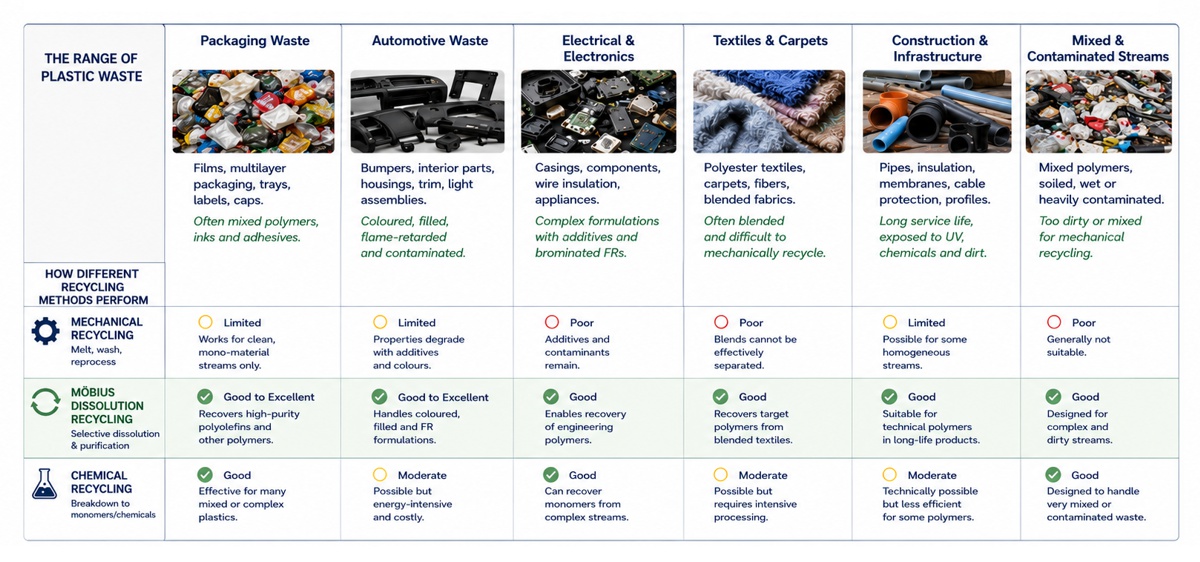
The strongest case for dissolution recycling no longer rests on chemistry alone. It rests on demand that policy is about to manufacture. After protracted negotiation, EU co-legislators reached a provisional agreement in December 2025 on the End-of-Life Vehicles Regulation, with the compromise text published in early 2026 and formal adoption expected around the middle of the year. The deal requires the plastic used in each new vehicle type to contain a minimum of 15 per cent recycled content within six years of entry into force, rising to 25 per cent within ten years, with at least 20 per cent of that recycled plastic sourced from end-of-life vehicles in a closed loop. That closed-loop clause is the detail that converts a research process into a market position, because it specifically rewards the recovery of automotive polymers from automotive waste.
This is precisely the territory Möbius has been targeting. The Leto pilot’s headline output, recycled SAN drawn from shredded vehicle plastics, maps directly onto a regulation that will compel carmakers to find recycled engineering polymers without sacrificing the colour, odour and mechanical consistency their parts demand. Mechanical recycling rarely clears that bar for filled, pigmented or flame-retarded automotive grades, which is why interest in dissolution and depolymerisation has sharpened as the rules have firmed up. Construction sits on the same trajectory through separate evaluations of recycled content in construction products, and the wider Packaging and Packaging Waste Regulation pushes food-contact and high-grade packaging in the same direction.
Construction deserves particular attention from a Highways.Today readership because it is the quiet anchor of recyclate demand rather than a marginal one. Building and construction is the second-largest plastics application in Europe after packaging, consuming on the order of ten million tonnes a year, and it functions as a net importer of recycled material, absorbing recyclate generated by other sectors into pipes, insulation, window profiles, membranes and flooring. Industry analyses have put construction at close to half of recycled-plastic consumption across the EU and neighbouring markets. A technology that can decontaminate difficult streams to a reliable specification therefore has two routes to value: supplying the regulated automotive and packaging markets directly, and feeding the durable, less visible demand that construction represents.
A Process That Sits Between Two Worlds
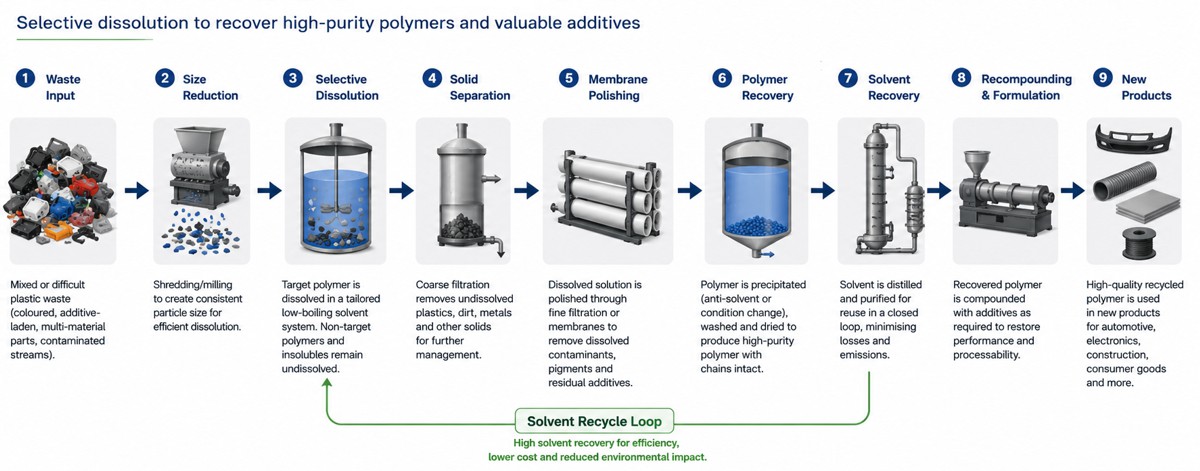
Möbius is a physical recycling process built on selective dissolution rather than chemical breakdown. A target polymer is dissolved out of a mixed plastic feed using an organic solvent, contaminants, pigments and non-target polymers are separated from the resulting solution, and the purified polymer is then recovered for reuse with its molecular chains preserved. TNO’s public description is deliberately generic, but consistent across its own material and independent reporting: feed preparation, selective dissolution, coarse solid-liquid separation, fine polishing of dissolved contaminants, polymer recovery and solvent recycle. For packaging and film work the company has described additional polishing to remove dissolved colourants, yielding a white recovered powder. For electronics and automotive plastics, the published route adds membrane filtration, spray drying and an evaporation step that isolates an additive-rich side fraction.
The choice of low-boiling solvents is central to the economics TNO is pitching. Because the polymer is never depolymerised, the energy needed to rebuild molecules is avoided, and because the solvents are chosen to be recoverable at relatively low temperature, solvent recycle is meant to be cheaper than the heat load implied by chemical recycling. TNO has consistently positioned the process as more energy efficient than depolymerisation while delivering higher purity than melt reprocessing, with solvent recovery feasible below roughly 120 degrees Celsius. That is a directionally plausible claim and it aligns with the company’s patent strategy, but it is a claim rather than a published figure, a distinction that becomes important when the technology is benchmarked against peers.
The additive-recovery angle is where the proposition becomes genuinely distinctive for regulated streams. TNO has emphasised the parallel recovery of valuable additives including pigments, plasticisers and flame retardants, and has flagged the recovery of an antimony-based flame-retardant compound, a designated critical raw material, from electronics and vehicle waste. For feedstock carrying legacy brominated flame retardants and other restricted substances, the ability to separate and concentrate those additives is not a side benefit but often the difference between a recyclate that can re-enter a demanding application and one that cannot, given obligations under REACH, RoHS and persistent-organic-pollutant controls.
The Patent Stack Tells The Real Story
TNO’s public webpages stop short of naming the solvents Möbius uses, citing the commercial sensitivity of polymer-solvent combinations that are continually being expanded for new waste streams. The clearest technical picture therefore comes from the company’s patent families, and they reveal a platform rather than a single flowsheet. A granted family on energy-efficient polyolefin separation discloses low-boiling apolar solvents, in particular MTBE and cyclopentane, chosen because they create an exploitable difference in precipitation temperature between polyolefins such as LLDPE and LDPE. The same family explains why elevated pressure is required, since low-boiling solvents cannot reach dissolution temperatures at ambient pressure, with one worked example dissolving a polyolefin mixture at 150 degrees Celsius and 6.5 bar before separating the polymers by controlled cooling.
A newer application extends that logic with a solvent-switching concept. Mixed polyolefins are first dissolved in a relatively expensive low-boiling solvent such as cyclopentane, a cheaper higher-boiling hydrocarbon is then blended in, and the first solvent is evaporated and recycled while the polymer remains dissolved in the second. The disclosed intent reaches beyond polymer recovery towards the preparation of liquid polyolefin streams suitable for downstream pyrolysis or cracking, with dissolution temperatures claimed below 130 and even below 100 degrees Celsius. A third family addresses engineering plastics directly, separating polycarbonate from mixed PC/ABS and PC/HIPS using ketone solvents with staged anti-solvent precipitation by acetone and methanol, in a closed-loop distillation scheme that targets recovered-polymer purities above 95 per cent.
Read together, the patents make a strategic point that a single process description would obscure. One branch handles polyolefin packaging and mixed polyolefin cleanup, one prepares liquefied polyolefin feed for thermochemical routes, and one handles staged precipitation of engineering plastics from automotive and electronics streams. Möbius is better understood as an evolving portfolio of selective-dissolution and selective-precipitation chemistries wrapped around common pilot infrastructure. For any prospective partner, that raises a concrete architectural question, namely whether Leto is configured as a flexible rig that swaps chemistry by campaign or as a fixed module optimised for particular business cases, because the answer drives both scale-up cost and the replicability of a first commercial line.
From Grams To Kilograms, And The Evidence That Comes With It
The development trail is unusually well documented for an R&D-stage recycling platform. The public record runs from gram-scale batch concepts in 2018, through roughly 100-gram semi-batch work with integrated solvent recovery in 2019, to the kilogram-scale semi-continuous Leto pilot commissioned in 2025 at TRL 5. TNO’s programme reporting records more than 1 kg of recycled polyolefin produced and recompounded with a partner in 2024, and around 5 kg of recycled SAN from end-of-life vehicle waste produced on Leto in 2025 and recompounded into partner products. The company’s October 2025 update framed the next move plainly: a TRL 6 deployment of Leto in an industrial setting on a client’s premises, with Royal Dahlman’s filtration technology integrated into the pilot’s filter module.
The most quantitatively useful evidence sits in the packaging and electronics work rather than the headline tonnage. In TNO-associated material from the PLAST2bCLEANED programme, an electronics route produced an antimony trioxide fraction above 90 per cent purity with very low bromine, while a separate brominated flame-retardant side stream concentrated bromine sharply, demonstrating the additive-separation logic in practice. The same material reported that spray drying removed more than 99.9 per cent of solvent in a single step, with residual solvent driven below 1,000 parts per million after extrusion drying. For flexible film, TNO’s CircuFilm work reported that dissolution produced a white polymer powder with zero per cent contamination on a difficult mixed-household DKR-310 stream, where alternative routes left between 1.7 and 3.1 per cent residual contamination, and that the dissolution route passed the challenge tests used for European food-contact certification by EFSA.
Those results are encouraging without being conclusive, and TNO has been candid about the gap. The company has said a demonstration installation of around 100 kilograms a day, sustained over roughly two years, would still be needed before the full food-contact regulatory and commercial pathway could be completed. The collaboration set around Leto gives that ambition substance: a joint development agreement with Braskem on polyolefin streams aimed at near-virgin resin and food-contact applications, work with ELIX Polymers on ABS, and the Horizon Europe ABSolEU project, in which TNO is testing recovered ABS against the quality requirements of brand owners including LEGO, Volvo and BIC. The presence of named offtakers with exacting specifications is a stronger validation signal than tonnage alone.
Where Möbius Sits Against A Crowded Field
For most of the last decade, plastics recycling has been presented as a contest between two camps. Mechanical recycling became the established industrial workhorse because it is comparatively simple, energy efficient and already integrated into collection and sorting infrastructure. Chemical recycling emerged as the next frontier, promising to break polymers back into molecular building blocks and rebuild materials to virgin quality. In reality, both approaches leave significant gaps in the middle of the market.
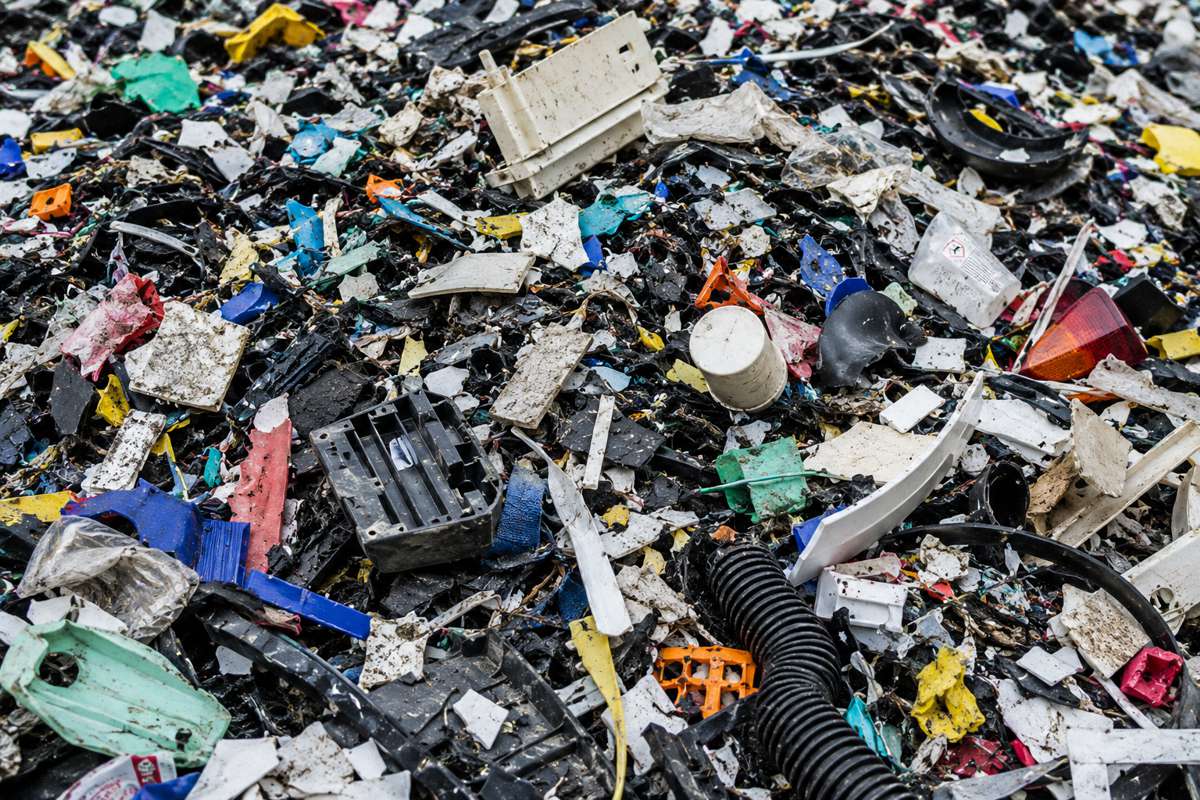
Mechanical recycling performs best when feedstock is clean, sorted and compositionally predictable. Once waste becomes coloured, multi-layered, additive-heavy or contaminated, quality can fall sharply and the recovered polymer often cascades into lower-value applications. Chemical routes can overcome some of those limitations but frequently introduce higher energy demand, larger capital requirements and more complex downstream processing. That leaves a growing category of plastics that still retain substantial value at polymer level but are difficult to recycle economically through either established route.
Selective dissolution technologies have emerged to occupy that space. Rather than melting plastics together or reducing them back to chemical feedstocks, dissolution aims to separate and purify intact polymers selectively. Several industrial players are already pursuing variants of this model, particularly for applications where contamination or mixed compositions make conventional recycling difficult. Some focus on multilayer packaging, others on styrenics, engineering plastics or polypropylene recovery. The common logic is straightforward: preserve the embedded value in the polymer chain while removing the contaminants that prevent high-quality reuse.
TNO’s Möbius platform enters this field with a noticeably broader ambition than many of its peers. Where commercial dissolution technologies are often designed around a relatively narrow polymer family or feedstock profile, Möbius appears to be developing as a flexible separation platform capable of addressing multiple waste categories through different solvent and precipitation strategies. Publicly disclosed work spans polyolefins from packaging, ABS and SAN from automotive and electronics applications, textile-derived polymers and streams carrying high concentrations of additives, pigments and flame retardants. That breadth matters because future waste systems are unlikely to deliver perfectly sorted mono-material streams at scale.
This positioning also aligns with where industrial demand appears to be moving. Automotive manufacturers, infrastructure operators, packaging producers and construction suppliers increasingly need recycled content that performs like virgin material while remaining compliant with evolving restrictions around hazardous substances and traceability. Recovering polymer alone may no longer be sufficient. The ability to identify, isolate and potentially recover additives and contaminants could become commercially important in its own right. That broader scope comes with a trade-off.
TNO has demonstrated progression through laboratory and pilot stages and has disclosed promising technical milestones through the Leto platform, but Möbius remains earlier in public commercial validation than some specialist competitors operating at larger disclosed throughput or publishing more mature environmental and economic datasets. Detailed public evidence covering full mass balance, solvent circulation efficiency, life-cycle performance and plant economics remains limited. Those are ultimately the figures investors, manufacturers and regulators will look for as the technology moves beyond pilot operation.
Viewed through that lens, Möbius should not yet be seen as a finished industrial answer. It is better understood as an attempt to redefine what counts as recyclable in the first place. If TNO can demonstrate that difficult, additive-rich plastics can be converted into reliable engineering-grade feedstock without the energy burden associated with full molecular conversion, the prize extends well beyond waste management. It becomes a question of who controls access to the next generation of circular raw materials.
What’s Next For Möbius
Every emerging industrial technology reaches the same inflection point, where laboratory results stop being the limiting factor and commercial participation becomes the constraint. Möbius is close to that threshold. The chemistry has moved beyond theoretical feasibility, pilot infrastructure exists, multiple polymer pathways have been demonstrated, intellectual property has accumulated and industrial collaborations have begun to form around targeted applications. The task now is narrower and harder than proving the principle: showing where selective dissolution works commercially, at what scale and under what operating conditions.
That transition cannot happen in isolation, because advanced recycling is rarely commercialised by researchers alone. It is built through a sequence of partnerships that each retire a different uncertainty. Feedstock owners supply difficult waste streams, equipment suppliers industrialise the separation and recovery systems, manufacturers set quality thresholds, offtakers create demand certainty, investors absorb early scale-up risk and regulators establish acceptance pathways. The named collaborations already attached to Leto, from Braskem and ELIX Polymers to Royal Dahlman and the ABSolEU brand owners, are the first links in that chain rather than the finished article.
For organisations in construction, automotive, packaging, electronics and infrastructure, the opportunity is therefore broader than becoming a future customer. Companies with awkward waste streams can help define commercially viable feedstock windows, manufacturers under recycled-content pressure can shape the performance specifications, and infrastructure owners can test whether recovered engineering polymers meet long-life asset requirements. Equipment suppliers and process integrators may find as much value in building the industrial architecture around dissolution as in the chemistry itself. Engagement of that kind should still be disciplined, with partners pressing for clarity on feedstock flexibility, product specifications, solvent-recovery performance, energy demand, contaminant removal, life-cycle outcomes and scale-up economics. Those questions are not obstacles to participation but the work programme that an industrial partnership exists to complete.
The surrounding conditions increasingly favour that collaboration, with regulation pulling recycled content upwards, manufacturers seeking alternatives to volatile virgin supply, and construction continuing to absorb growing volumes of recyclate under tighter performance and traceability expectations. The next phase for Möbius consequently looks less like a technology story and more like an ecosystem one. If TNO and its partners can show that complex, additive-rich waste can be converted into specification-grade feedstock at industrial scale, the result would be more than another recycling line; it would move difficult plastics from environmental liability towards strategic domestic resource, and recycling plants closer to the industrial infrastructure that construction and manufacturing depend on. The evidence required for that case now has to be generated in the field rather than the laboratory, and that is the step the next two years will test.