Istanbul’s North Rail Crossing Closes the Middle Corridor’s Last Great Bottleneck
The Asian Infrastructure Investment Bank has signed the first phase of a financing package worth up to USD1.5 billion for the Istanbul North Rail Crossing Project, and while the headline reads as another large multilateral loan, its real significance sits several thousand kilometres to the east.
For most of the past decade, governments across Central Asia and the South Caucasus have poured capital into the Trans-Caspian International Transport Route, the rail-and-sea artery better known as the Middle Corridor, upgrading ports, second tracks, ferries and border sections to move Chinese and Central Asian cargo to Europe without passing through Russia. Almost every upstream segment has been widened, deepened or reconstructed.
The one place where the whole system still narrows to a thread is Istanbul, where cross-Bosphorus freight currently squeezes through a single passenger tunnel in a restricted overnight window. INRAIL is the piece of engineering that turns a corridor of improved fragments into a genuinely continuous high-capacity route, and that is why this particular signature matters far beyond Türkiye’s borders.
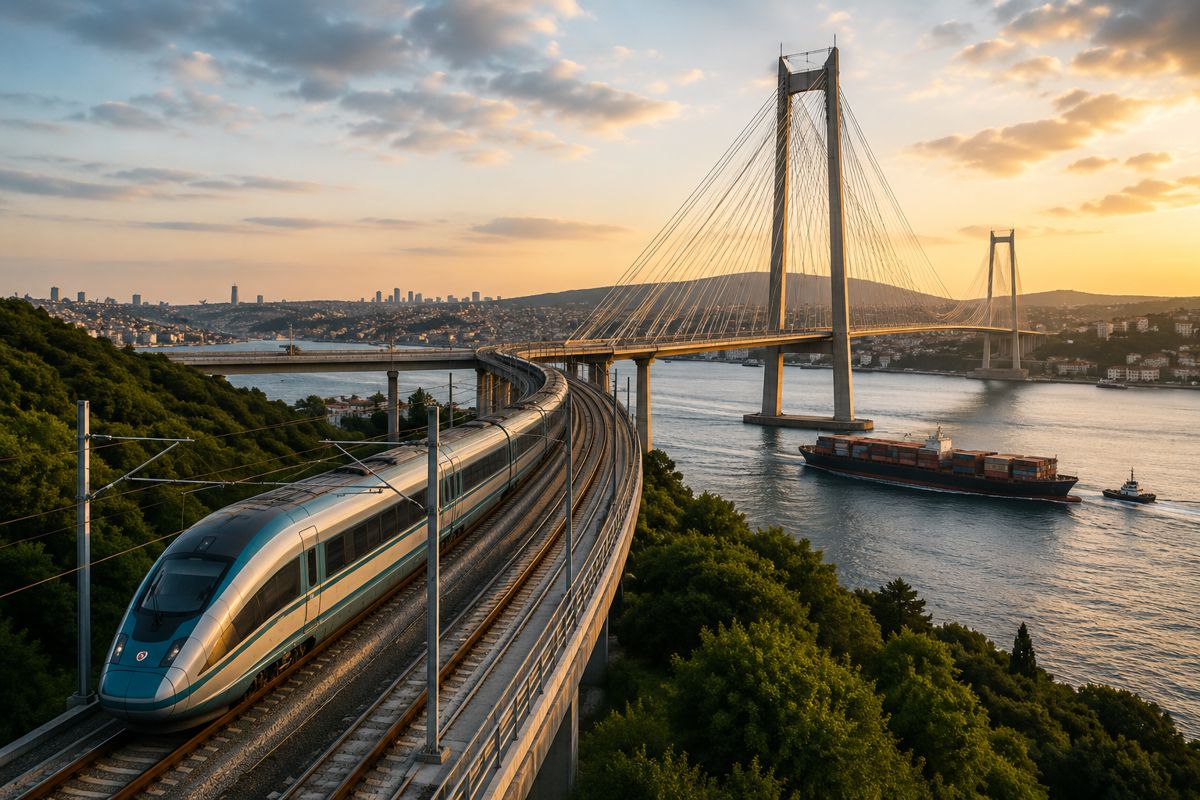
The project itself is substantial. It will deliver approximately 127 kilometres of double-track, electrified and fully signalised railway linking Çayırova on Istanbul’s Asian side with Çatalca on the European side, crossing the strait using rail-ready space reserved on the Yavuz Sultan Selim Bridge at the northern end of the Bosphorus.
Passenger services will run at up to 160 kilometres per hour and freight at 80 to 120 kilometres per hour, and the line will connect Istanbul Airport, Sabiha Gökçen Airport and the national high-speed network for the first time. With a total project cost of around USD8.27 billion, INRAIL ranks among the largest transport investments AIIB has supported in Türkiye, and it arrives at a moment when the commercial logic of east-west overland trade has rarely looked more compelling to shippers, contractors and infrastructure investors alike.
Briefing
- AIIB has signed the first phase of a financing package of up to USD1.5 billion for the Istanbul North Rail Crossing Project (INRAIL), structured as two loans of USD750 million, with the second tranche linked to implementation progress and financing needs.
- INRAIL will build roughly 127 kilometres of double-track, electrified and signalised railway between Çayırova and Çatalca, crossing the Bosphorus on rail-ready space on the Yavuz Sultan Selim Bridge and bypassing congested central Istanbul.
- The line is expected to cut rail freight time between the two sides from around 13 hours to 3.6 hours, and to nearly halve public-transport travel between Istanbul and Sabiha Gökçen airports from about 120 minutes to 65 minutes.
- The USD8.27 billion project is co-financed by six multilateral development banks, with the World Bank leading a coordinated effort providing roughly USD6.75 billion, alongside the Asian Development Bank, AIIB, the Islamic Development Bank, the EBRD and the OPEC Fund.
- INRAIL removes the Middle Corridor’s terminal chokepoint at Istanbul, complementing recent capacity upgrades on the Baku-Tbilisi-Kars and Divriği-Kars-Georgia lines, and is projected to cut around 16 million tonnes of carbon dioxide equivalent over its operating life.
Removing The Corridor’s Terminal Chokepoint
To understand why INRAIL commands the attention it does, it helps to trace the cargo that will eventually run across it. The Middle Corridor has grown from a diplomatic aspiration into an operational reality with remarkable speed. According to Kazakhstan’s transport ministry, volumes along the route have risen roughly fivefold over seven years, from around 800,000 tonnes to somewhere between four and five million tonnes annually, driven by rerouting away from Russia, simplified customs and steadily shorter transit times.
Turkish and Kazakh leaders have publicly floated a target of 10 million tonnes within a few years, and the World Bank’s benchmark study set out the case for tripling freight volumes and halving travel time by 2030. That trajectory only holds if every link in the chain can carry the load, and until now Istanbul has been the weakest.
The physical constraint is specific and well documented. Cross-Bosphorus rail traffic has depended on the Marmaray tunnel, an intensely used commuter link where freight trains are confined to a narrow overnight window that limits both throughput and the time available for maintenance. Every tonne of Central Asian cargo bound for European markets, along with Turkish exports moving in the opposite direction, has had to thread through that single overnight slot. Upstream, the picture is very different.
The Baku-Tbilisi-Kars railway, commissioned in 2017, saw its annual capacity lifted from one million to five million tonnes following reconstruction of its Georgian section, while the Divriği-Kars-Georgia line at Türkiye’s eastern edge, the single most capacity-constrained section of the corridor as recently as 2023, is being expanded from around 750,000 tonnes to a projected 20 million tonnes a year. INRAIL is the logical culmination of that sequence, and without it the eastern upgrades would eventually pour cargo into a bottleneck the corridor had already learned to fear.
A Six-Bank Financing Architecture And What It Signals
The financing structure surrounding INRAIL is as instructive as the engineering. The project is being delivered through a coordinated effort involving six multilateral development banks, with the World Bank leading preparation and mobilising roughly USD6.75 billion in combined financing alongside the Asian Development Bank, AIIB, the Islamic Development Bank, the EBRD and the OPEC Fund for International Development.
The World Bank approved a USD2 billion loan in March 2026, and AIIB’s contribution is deliberately phased, with the first USD750 million committed now and a matching second tranche tied to how implementation proceeds. That structure spreads risk across a broad institutional base, applies a single streamlined procurement approach across all lenders, and gives the Turkish government a diversified capital stack for a project too large and too strategically sensitive for any one balance sheet.
For infrastructure investors and contractors, the composition of that lending group carries a clear message about where connectivity capital is concentrating. When six of the world’s principal development banks align behind one greenfield railway, they are effectively underwriting the commercial case for the Middle Corridor as a durable trade artery rather than a temporary detour.
Konstantin Limitovskiy, Chief Investment Officer for Region 2 at AIIB, framed the significance of the operation in those terms, describing INRAIL as “a strategic investment in Türkiye’s transport future and one of AIIB’s most significant connectivity operations to date” and adding that, “by removing a longstanding structural bottleneck for freight and passenger transport, the project demonstrates how sustainable, technology-enabled and connected infrastructure can generate lasting economic opportunities while strengthening regional integration and resilience.” The phasing of AIIB’s own commitment, meanwhile, is a reminder that even the most strategically compelling projects are now financed against measurable delivery milestones rather than optimism alone, a discipline that contractors and suppliers will feel through the procurement pipeline.
Engineering Choices With Direct Commercial Consequences
The design decisions built into INRAIL translate almost directly into operating economics. By routing the crossing over rail-ready space already reserved on the Yavuz Sultan Selim Bridge, the project avoids the enormous cost and programme risk of boring a new tunnel beneath the Bosphorus, exploiting infrastructure that was planned with exactly this eventuality in mind. Running as a double-track, electrified and fully signalised line that bypasses central Istanbul, INRAIL allows freight and passenger operations to be separated from the congested Marmaray corridor, which is the change that unlocks the headline gains.
Rail freight time between Çayırova and Çatalca is expected to fall from roughly 13 hours to 3.6 hours, a reduction of more than nine hours on a single leg, and the line is engineered for a maximum freight capacity in the region of 50 million tonnes a year, an order of magnitude beyond anything the overnight tunnel slot could ever accommodate.
The passenger case reinforces rather than competes with the freight logic. Once the airports are wired into the national rail network, public-transport journey time between Istanbul Airport on the European side and Sabiha Gökçen on the Asian side is expected to fall from about 120 minutes to 65 minutes, and both hubs gain direct connections into Türkiye’s intercity and high-speed services.
That matters commercially because separating passenger flows onto a dedicated high-capacity alignment frees the Marmaray tunnel for its intended commuter role and removes the operational conflict that has capped freight growth. For logistics operators planning multi-year contracts along the corridor, the combination of predictable daytime freight paths, faster transit and a design capacity measured in tens of millions of tonnes changes the risk calculus of committing volume to the route.
Anchoring Türkiye’s 2053 Rail Ambition
INRAIL is not a standalone gamble but the flagship of a national strategy with unusually explicit targets. Under its long-range transport plan, Türkiye’s Ministry of Transport and Infrastructure intends to expand the national railway network well beyond its current length by 2053 and to more than quintuple rail’s share of freight, lifting it from around 5 per cent towards a target near 22 per cent. Transport officials have spoken of raising the volume of goods carried by rail from roughly 32 million tonnes today into the hundreds of millions, an ambition that only becomes credible if the network’s principal crossings can carry continuous, all-day freight.
The economic argument underpinning that shift is blunt: World Bank analysis prepared for the project notes that trucking in Türkiye costs around 2.8 times more per tonne-kilometre than rail freight and generates higher emissions, so every tonne moved from road to rail improves both cost competitiveness and the country’s decarbonisation position.
That national frame is why the project’s climate credentials read as commercial rather than merely reputational. INRAIL is projected to avoid roughly 16 million tonnes of carbon dioxide equivalent over its operating period, primarily through the modal shift it enables, and AIIB has positioned its financing as a contribution to climate mitigation with adaptation benefits from a more resilient network.
Kerem Dönmez, Director General of Foreign Economic Relations at the Ministry of Treasury and Finance, tied the investment explicitly to Türkiye’s wider positioning, calling INRAIL “one of Türkiye’s most strategic transport investments, reinforcing our vision of establishing an integrated, resilient and sustainable transport network that strengthens connectivity both within our country and across the wider region.” He added that the financing “reflects the confidence of our international development partners in Türkiye’s economic fundamentals and project implementation capacity,” and that the project would “strengthen the competitiveness of the Middle Corridor, enhance logistics efficiency, support greener transport, and create long-term economic value for Türkiye and the region.” Read alongside the modal-shift target, those are statements about market share in Eurasian trade as much as about transport policy.
Where Competition And Value Are Concentrating
The corridor that INRAIL completes is also reshaping the competitive map for logistics assets across three continents, and the investment signals are worth reading closely. Container traffic through Kazakhstan rose by more than a third in the first quarter of 2026 against the same period a year earlier, member states have approved a 2026 work plan centred on digitalised customs and electronic document exchange, and capital is flowing into Caspian ferry fleets, port terminals and dry hubs from Aktau and Kuryk to Batumi and Poti.
Türkiye is positioning the eastern city of Kars, terminus of the Baku-Tbilisi-Kars line, as a major logistics centre precisely to capture cargo moving between the Caucasus, Central Asia and Europe, and the country’s plan to roughly double its network of logistics centres over the coming decades points to sustained demand for terminals, marshalling yards and intermodal handling capacity. Each of those developments represents an addressable market for contractors, equipment suppliers and infrastructure funds that had previously treated the corridor as too fragmented to bank.
The competitive dynamic also carries genuine constraints that industry leaders should weigh rather than gloss over. Independent analysts have highlighted that Georgia currently remains the corridor’s sole gateway to Europe until alternative routings mature, that Caspian shipping capacity and port throughput are being tested by rising volumes, and that questions of governance and funding continuity persist at certain nodes.
None of that undermines the corridor’s momentum, but it does concentrate value in the segments that resolve those pinch points, whether that means new Ro-Ro tonnage on the Caspian, expanded terminal capacity at the Black Sea ports, or the signalling and electrification systems that let existing track carry more trains. INRAIL sits firmly in that value-creating category, because a high-capacity Bosphorus crossing lifts the ceiling on the entire western end of the route and makes upstream investment along the corridor materially more bankable.
What Industry Leaders Should Take From This
For contractors and technology suppliers, the practical opportunity is immediate and specific. A 127-kilometre greenfield line requires civil works, track, electrification, signalling and telecommunications delivered to the standards a six-bank lending group will scrutinise, and the single streamlined procurement approach adopted across the financiers should make the tendering process more legible for international bidders than a fragmented multi-lender project would allow.
Firms with credentials in high-capacity mixed-traffic railways, in interfacing new lines with airport and high-speed networks, and in the digital signalling that separates freight and passenger paths are well placed, and the phased financing structure means delivery performance will be watched closely enough to reward reliable execution. Rolling-stock, intermodal-handling and terminal-systems suppliers should be reading the same corridor-wide demand signals, from Kars to the Caspian ports.
For infrastructure investors and policymakers, the strategic reading is broader. The concentration of multilateral capital behind INRAIL, coupled with the Baku-Tbilisi-Kars upgrade, the Divriği-Kars-Georgia expansion and Türkiye’s explicit modal-shift targets, indicates that the Middle Corridor is being treated as durable trade infrastructure rather than a short-lived workaround, and that view is now backed by roughly USD6.75 billion of coordinated development finance on this project alone.
The window to build position in corridor-adjacent assets, whether ports, terminals, rolling stock or the digital layer that ties customs and operations together, is open while the route scales towards its 2030 volume ambitions. Removing Istanbul’s crossing constraint does not by itself guarantee those volumes, yet it does remove the argument that the corridor’s western terminus can never carry them, and for an industry that prices risk on continuity, that shift in perception is where the commercial story really begins.
Key Industry Questions
- Why is the Istanbul North Rail Crossing considered the Middle Corridor’s most important missing link? Every other major segment of the Trans-Caspian route has been upgraded in recent years, from the Baku-Tbilisi-Kars line to the Divriği-Kars-Georgia section, yet cross-Bosphorus freight still depended on the Marmaray commuter tunnel, where trains ran only in a restricted overnight window. That single constraint capped how much cargo the entire western end of the corridor could actually move, regardless of upstream capacity. By building a dedicated 127-kilometre high-capacity line that separates freight from passenger traffic and crosses on the Yavuz Sultan Selim Bridge, INRAIL removes the terminal chokepoint. It effectively raises the ceiling for the whole route, which is why its significance extends well beyond Istanbul and into the wider economics of Eurasian overland trade.
- How is INRAIL being financed, and why does the structure matter? The USD8.27 billion project is backed by six multilateral development banks providing roughly USD6.75 billion in coordinated financing, with the World Bank leading preparation and approving a USD2 billion loan in March 2026. AIIB has signed the first phase of a package worth up to USD1.5 billion, arranged as two loans of USD750 million, with the second tranche linked to implementation progress. Spreading the loan across the World Bank, ADB, AIIB, the Islamic Development Bank, the EBRD and the OPEC Fund distributes risk, applies one streamlined procurement approach and gives Türkiye a diversified capital stack. For the market, that alignment signals strong institutional confidence in the corridor as durable trade infrastructure.
- What operational improvements will the new line deliver? The most striking gain is in freight timing. Rail freight between Çayırova on the Asian side and Çatalca on the European side is expected to fall from around 13 hours to 3.6 hours, because the new line bypasses congested central Istanbul and removes the overnight-only restriction imposed by the Marmaray tunnel. The alignment is designed for a maximum freight capacity in the region of 50 million tonnes a year. On the passenger side, public-transport journey time between Istanbul and Sabiha Gökçen airports should nearly halve, from about 120 minutes to 65 minutes, while both airports gain direct links into Türkiye’s intercity and high-speed rail network for the first time.
- How does INRAIL support Türkiye’s national transport strategy? Türkiye’s long-range plan aims to expand its railway network substantially by 2053 and to more than quintuple rail’s share of freight, lifting it from around 5 per cent towards roughly 22 per cent. That shift depends on high-capacity crossings capable of carrying continuous all-day freight, which the current tunnel arrangement cannot provide. World Bank analysis notes that trucking in Türkiye costs about 2.8 times more per tonne-kilometre than rail and produces higher emissions, so moving cargo onto rail improves both competitiveness and decarbonisation. INRAIL functions as the flagship crossing that makes those national targets credible, anchoring the country’s ambition to become a logistics hub linking Europe, Asia and the Middle East.
- What commercial opportunities does the project create for contractors and suppliers? A 127-kilometre greenfield, double-track, electrified and fully signalised railway generates substantial demand across civil works, track, electrification, signalling and telecommunications, all delivered to standards that a six-bank lending group will monitor closely. The single procurement approach adopted across the financiers should make tendering more transparent for international bidders. Firms experienced in high-capacity mixed-traffic railways, in integrating new lines with airport and high-speed networks, and in digital signalling that separates freight from passenger paths are particularly well positioned. Beyond the line itself, corridor-wide demand extends to rolling stock, intermodal handling, terminal systems and logistics centres from Kars to the Caspian ports.
- How large is the Middle Corridor market that INRAIL serves? Cargo along the Trans-Caspian route has risen roughly fivefold over seven years, according to Kazakhstan’s transport ministry, reaching somewhere between four and five million tonnes annually as shippers reroute away from Russia. Container train traffic through Kazakhstan grew by more than a third in early 2026, and Turkish and Kazakh leaders have publicly targeted 10 million tonnes within a few years. The World Bank’s benchmark study set out the case for tripling freight volumes and halving travel time by 2030. Those figures explain the urgency behind removing bottlenecks such as Istanbul, since the corridor’s growth trajectory only holds if each segment, including its western terminus, can carry the rising load.
- What are the main risks or constraints facing the corridor? Independent analysts point to several pinch points that will shape where value concentrates. Georgia currently remains the corridor’s principal gateway to Europe until alternative routings mature, Caspian shipping capacity and Black Sea port throughput are being tested by rising volumes, and questions of funding continuity and governance persist at certain nodes. These constraints do not undermine the corridor’s momentum, but they mean investment returns will favour the assets that resolve bottlenecks, such as additional Caspian ferry tonnage, expanded terminal capacity and the digital systems that streamline customs. INRAIL belongs in that category, because a high-capacity Bosphorus crossing directly raises the ceiling on the corridor’s western end.
- What environmental benefits are expected from the project? INRAIL is projected to avoid approximately 16 million tonnes of carbon dioxide equivalent over its operating period, primarily by enabling a shift of freight from road to rail. AIIB has positioned its financing as a contribution to climate mitigation, with additional adaptation benefits arising from a more resilient rail network. Because trucking in Türkiye is markedly more carbon-intensive and expensive per tonne-kilometre than rail, the modal shift the line supports aligns environmental and commercial objectives rather than trading one against the other. For a country pursuing an explicit decarbonisation agenda alongside a logistics-hub strategy, the emissions savings reinforce the economic case rather than sitting apart from it.
Strategic Takeaways
- INRAIL removes the last high-capacity constraint on the Middle Corridor’s western terminus, converting a chain of separately upgraded segments into a continuous route and making upstream investment along the corridor materially more bankable.
- The concentration of six multilateral development banks and roughly USD6.75 billion behind a single greenfield railway signals that connectivity capital now treats the Trans-Caspian route as durable trade infrastructure rather than a temporary detour around Russia.
- Phased, milestone-linked financing of the kind AIIB has adopted is becoming the norm for strategic megaprojects, sharpening the premium on reliable delivery and giving disciplined contractors a competitive edge in procurement.
- Türkiye’s target of lifting rail’s freight share towards 22 per cent depends on crossings that carry continuous all-day traffic, positioning INRAIL as the flagship that makes the national modal-shift and logistics-hub ambition credible.
- Value along the corridor is concentrating in the assets that resolve bottlenecks, from Caspian ferry capacity and Black Sea terminals to signalling, electrification and digital customs, and firms that can build or supply those systems have an open window while volumes scale towards 2030.