Procore’s $845 Million DroneDeploy Deal Buys Construction AI its Eyes
When Procore Technologies agreed to pay approximately $845 million in cash for DroneDeploy, it was not really buying drones. The transaction reads on the surface as a reality-capture company changing hands, yet the strategic logic sits somewhere more consequential.
Procore has spent more than two decades assembling the definitive record of what construction teams decide, document and dispute, from requests for information to inspections and drawings. What it has never owned is a continuous, trustworthy account of what is actually being built on the ground, hour by hour, floor by floor. DroneDeploy supplies precisely that, and in an industry now racing to make artificial intelligence do useful work rather than impressive demonstrations, perception is proving to be the scarce commodity.
The timing sharpens the intent. Procore confirmed the definitive agreement publicly on 29 July 2026, the same day it reported second-quarter revenue of $375.2 million, up almost sixteen per cent year on year, and posted GAAP operating profitability for the quarter. For more than a year the company has told investors it intends to evolve from construction’s system of record into its system of intelligence, and acquiring the category leader in visual site data is the most concrete evidence yet that the shift is being funded rather than merely narrated.
For contractors, asset owners and the wider construction-technology market, the deal marks the moment when jobsite imagery stops being passive documentation and starts becoming the sensory input for software that can observe a site, reason about it, and act on the gap between plan and reality.
Briefing
- Procore has agreed to acquire DroneDeploy for approximately $845 million in cash, structured as a merger that makes DroneDeploy a wholly owned subsidiary, with closing targeted for the end of 2026 subject to regulatory clearance and DroneDeploy stockholder approval.
- The purchase price is roughly six times DroneDeploy’s entire lifetime venture funding of around $142 million, a premium that reflects the strategic value of proprietary visual data rather than the company’s balance sheet.
- Procore has secured a debt commitment of up to $700 million from Goldman Sachs Bank USA via a 364-day senior secured bridge facility, although completion of the acquisition is not conditional on that financing.
- The combined business would pair Procore’s record of nearly 400 million photos, more than 126 million drawings and over 10 million RFIs, submittals and inspections logged in a single year with DroneDeploy’s visual archive spanning roughly 20 trillion square feet of the built world.
- The deal is the first major acquisition under chief executive Ajei Gopal, who joined from Ansys in November 2025, and it positions reality capture as native perception for Procore’s emerging agentic AI, marketed as digital coworkers.
Paying For Perception, Not Drones
The price tells the real story. DroneDeploy raised roughly $142 million across its life as a private company, backed by Emergence Capital, Scale Venture Partners, Bessemer Venture Partners, Redpoint Ventures and others, and it reached operational break-even in late 2025 before topping up with a modest strategic round from existing investors. Against that history, an $845 million all-cash offer values the business at close to six times the capital ever invested in it.
Procore is not paying for a drone-mapping tool with a healthy subscription line. It is paying for a decade of accumulated, labelled, domain-specific visual data and the capture infrastructure that keeps producing it, assets that cannot be replicated quickly at any price.
That distinction matters because DroneDeploy itself had already outgrown the label in its name. Over the past two years the company reoriented from aerial photogrammetry towards a broader field-robotics and computer-vision platform, extending capture across ground robots, fixed and wearable cameras, mobile devices and LiDAR, and layering on Progress AI, a vision-language system built to automate progress tracking. Its founders spoke openly about a roadmap running through quadruped robots and, eventually, humanoid systems.
Procore is therefore acquiring a business that had already repositioned itself at the intersection of AI and robotics, which is exactly the perimeter Procore wants to defend. Chief executive Ajei Gopal was explicit about the near-term commercial mechanics, noting that the plan is to “immediately cross-sell DroneDeploy’s solutions into our broader customer base and vice versa” once the acquisition closes.
The financing structure reinforces how deliberately this was sequenced. Procore lined up a debt commitment of up to $700 million from Goldman Sachs Bank USA through a 364-day senior secured bridge facility, yet it went out of its way to state that completing the merger is not contingent on that money arriving.
For a company that only recently reached sustained GAAP operating profitability, funding the bulk of the price with committed debt rather than diluting shareholders signals confidence in the cash-generating trajectory of the combined platform. It also keeps the door open to permanent financing on better terms before the bridge matures, a conventional but telling move from a chief executive with a heavy mergers-and-acquisitions background.
From System Of Record To System Of Intelligence
Procore’s public thesis for the past year has been that its value is migrating up the stack, from a system of collaboration and record towards a system of intelligence. The acquisition of Datagrid gave it embedded reasoning capability, and in the days before the DroneDeploy announcement the company had already introduced packaged digital coworkers, expanded its library of AI agents and previewed Procore Skills, a feature that lets customers teach the platform their own standards and processes so agents apply company-specific ways of working across projects.
Each of those pieces addresses the reasoning and action layers of an AI system. What was missing was perception, the ability to know what is physically happening on site without a person walking it and typing up the result.
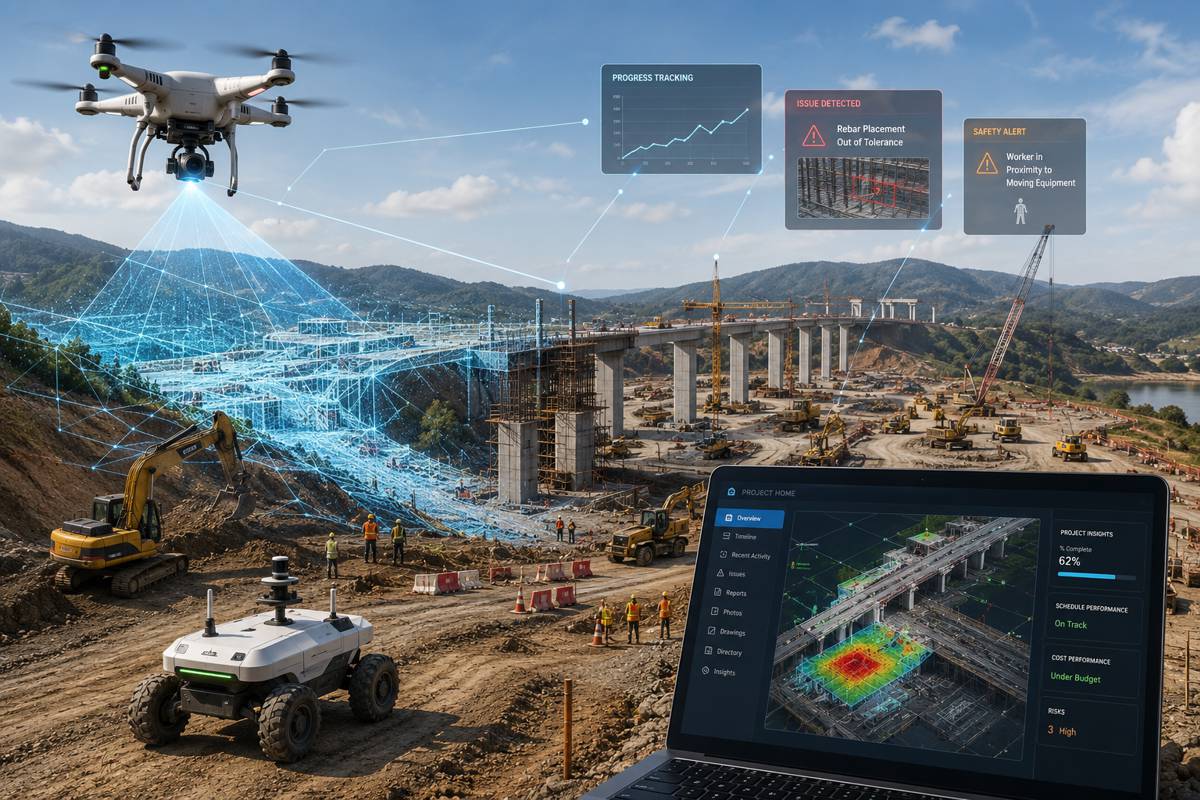
DroneDeploy closes that loop. Gopal framed the destination in terms of autonomous capability rather than better dashboards, describing the goal as delivering “digital coworkers that track what’s happening on a project, make sense of it, and then take action to change the outcome.” In practice that means multi-modal capture feeding observations directly into Procore, where the platform can compare as-built conditions against the model and the schedule, flag a discrepancy, and initiate a workflow such as an RFI or an inspection without waiting for a human to notice.
The commercial consequence is a shift in what construction software is sold to do. Instead of helping teams record decisions faster, the pitch becomes software that reduces the number of decisions a stretched field team has to make manually in the first place.
That ambition also explains the premium more convincingly than any revenue multiple. Perception is the hardest of the three layers to buy off the shelf, because it depends on years of real jobsite imagery captured under messy, variable conditions and annotated by people who understand construction. Reasoning models are increasingly commoditised, and workflow tooling is Procore’s home turf. Ground-truth data at scale is neither, which is why owning the capture layer rather than integrating with it was worth the better part of a billion dollars.
The Data Moat Nobody Else Can Assemble Quickly
The most defensible outcome of the deal is the dataset it creates. Procore brings a structured commercial record of construction decision-making, including nearly 400 million photos, more than 126 million drawings and upward of 10 million RFIs, submittals and inspections generated in a single year across its user base.
DroneDeploy contributes the physical counterpart, a visual archive covering approximately 20 trillion square feet of the built world, tens of millions of user-generated annotations and more than 100,000 labelled safety issues. Individually these are large proprietary corpora. Combined, they link the commercial ledger of a project to a spatial record of the same project, which is the connection that generic AI models cannot infer from public data.
This is where the wider market context becomes instructive. Industry analysis through 2026 has repeatedly found that the majority of construction AI pilots never reach production, with the common failure point being fragmented data spread across scheduling tools, spreadsheets, email and field apps that share no common entity model. Construction is unusually hostile terrain for machine reasoning because it contains hundreds of distinct entity types, from cost codes and variations to daywork sheets and safety observations, all of which need normalised relationships before software can reason across them.
A model is only as useful as the connected data it can act on, and access to the right proprietary data is what separates a proof of concept from a system a contractor will trust on a live project. By owning both the decision record and the visual record inside one platform, Procore is attempting to solve the fragmentation problem structurally rather than through yet another integration.
The strategic implication for competitors is uncomfortable. A rival can license a frontier model and build agents, but it cannot easily license twenty trillion square feet of annotated construction imagery tied to a decade of project outcomes. That asymmetry is precisely why the deal was priced as a strategic acquisition rather than a financial one, and why boards at competing platforms will now be asking how much a comparable data position would cost them, and whether it is still available to buy.
Automation Meets The Labour Squeeze
The demand case rests on a structural shortage that shows no sign of easing. Construction across most developed markets is short of skilled field labour, and the people who remain are frequently overscheduled, which limits how often sites can be walked, documented and checked against the plan. Reality capture attacks that constraint directly.
Where manual inspection depends on someone being physically present with a clipboard or a camera, a combination of drones, ground robots and fixed cameras can survey a site on a regular cadence and route the resulting observations into the platform automatically, securely and in context. The value is not the imagery itself but the labour hours it releases and the errors it catches earlier, when they are still cheap to fix.
DroneDeploy chief executive Mike Winn positioned the deal as an acceleration of that mission rather than a change of direction, stressing continuity of the capture products his customers rely on. “DroneDeploy was built to give people who build, power, and feed our world a source of truth about the physical site. Over the last decade, our customers have consistently told us the same thing—they want reality capture to be a native part of how they work, not another tool bolted on,” he said. That sentiment captures the commercial rationale for selling to Procore rather than remaining independent. Reality capture delivers most value when it is embedded in the platform where work is already coordinated, because that is where an observation can trigger an action. Winn added that the company remains “committed to delivering the best ground and aerial reality capture solutions—deeply integrated into Procore to drive automated action—while building on our early investments in AI and robotics.”
The robotics roadmap is the part most likely to be underestimated. DroneDeploy had already signalled expansion from drones towards quadruped and, in time, humanoid platforms, and had been broadening its capture stack across LiDAR, fixed cameras and mobile devices. Inside Procore, that trajectory gains a distribution channel of nearly three million users and a commercial engine to fund it.
For contractors, the practical horizon is a site that is increasingly monitored by autonomous hardware and interpreted by software, with human supervisors moving from data collection towards exception handling. That is a meaningful change in how field productivity is measured and staffed, and it will influence procurement decisions long before humanoid robots appear on a real project.
Redrawing The Competitive Map
The acquisition resets the competitive perimeter across construction technology. Procore’s platform rivals, chiefly Autodesk with its Construction Cloud and Trimble with Construction One, alongside Bentley and Hexagon in the broader infrastructure-software field, now face a competitor that has vertically integrated perception into its stack rather than relying on partnerships.
The independent reality-capture and site-intelligence specialists, including OpenSpace, Buildots, Doxel and Disperse, occupy the layer Procore has just bought its way into, and the read-across is that best-of-breed capture may increasingly need a platform home to realise its full value. Consolidation pressure in that segment is the logical consequence, and boards at both incumbents and independents will be recalculating their options.
One immediate question sits inside the deal itself. DroneDeploy has historically integrated with both Procore and Autodesk Construction Cloud, which made it a neutral capture layer that customers on rival platforms could adopt without lock-in. Bringing it inside Procore introduces an obvious strategic tension over how much that Autodesk-facing integration is nurtured going forward.
The companies have stressed continuity of the product, and severing cross-platform support would risk alienating a substantial installed base, yet the long-term incentive to route perception primarily into Procore’s own AI is equally clear. How that balance is managed will be watched closely by customers who value optionality and by competitors looking for an opening.
The more strategic message is about where purchasing power in construction software is heading. Value is concentrating in whoever can connect the commercial record of a project to a live, machine-readable record of the physical build, then act on the difference.
Procore has made an expensive, deliberate move to own that connection outright. Rivals now have to decide whether to answer with acquisitions of their own, deeper partnerships with the remaining independent capture specialists, or a bet that open integration will prove more attractive to customers than a single vertically integrated stack.
What Industry Leaders Should Watch Before Close
The transaction is not done, and several conditions will shape whether the strategic promise converts into delivered value. Closing is targeted for the end of 2026 and remains subject to DroneDeploy stockholder approval and regulatory clearance, including expiry or termination of the Hart-Scott-Rodino waiting period in the United States.
Given the data concentration the deal creates, the antitrust review is worth monitoring, even though construction software remains a fragmented market by the standards of most technology sectors. Procore has also been careful to note that its published financial guidance reflects the organic business only and does not yet include any contribution from DroneDeploy, so investors should not expect the numbers to move on this until the acquisition completes and integration begins.
Integration is where deals of this kind usually succeed or disappoint. Procore has established a retention pool of equity and cash for certain DroneDeploy personnel, an acknowledgement that the acquired value is bound up in a team as much as in a codebase, and the cross-sell that Gopal described depends on keeping that talent engaged through the transition.
Customers on both sides will want early clarity on product roadmaps, pricing and, critically, the future of cross-platform integrations. For contractors and owners evaluating their technology stack over the next year, the sensible posture is to treat perception as a platform-level capability rather than a bolt-on, to press vendors on how captured reality connects to commercial workflows, and to weigh the trade-off between the depth of a single integrated system and the flexibility of an open one. The direction of travel is now unambiguous.
The commercial contest in construction software has moved from recording the project to understanding it, and the companies that control the data linking plan to physical reality will set the terms for everyone else.
Key Industry Questions
- Why Would Procore Pay $845 Million For A Company That Only Recently Reached Break-Even? The valuation reflects strategic scarcity rather than current earnings. DroneDeploy raised around $142 million across its lifetime, so the offer represents roughly six times the capital ever invested in the business. Procore is paying for assets that are difficult to replicate at any speed, principally a decade of proprietary, annotated jobsite imagery spanning approximately 20 trillion square feet and the capture infrastructure that continually refreshes it. In an AI market where reasoning models are increasingly commoditised, domain-specific data becomes the durable advantage. Owning the perception layer outright, rather than integrating with it, gives Procore control over the ground-truth data its digital coworkers need to function, which is why the deal was structured and priced as a strategic acquisition.
- What Does This Deal Actually Change For Contractors On Site? The intended change is a reduction in manual documentation and inspection burden. Reality capture using drones, ground robots and fixed cameras can survey a site on a regular cadence and feed observations directly into Procore, where software can compare as-built conditions against the model and schedule, flag discrepancies and trigger workflows automatically. For overscheduled field teams facing a persistent skilled-labour shortage, that releases hours and catches errors earlier, when they are cheaper to correct. The practical shift is from people collecting and typing up site data towards supervisors handling exceptions that the system surfaces. Adoption will vary by project size and complexity, and the near-term reality is augmentation of existing workflows rather than wholesale automation.
- How Does This Affect Autodesk, Trimble And Other Platform Rivals? It raises the competitive stakes by vertically integrating perception into a single platform. Autodesk Construction Cloud, Trimble Construction One, Bentley and Hexagon now compete with a rival that owns its visual data layer rather than partnering for it. The independent capture specialists such as OpenSpace, Buildots and Doxel occupy the segment Procore has just acquired into, which increases the likelihood of further consolidation as best-of-breed tools seek platform homes. Rivals face a choice between making comparable acquisitions, deepening partnerships with remaining independents, or betting that open, cross-platform integration appeals more to customers than a single vertically integrated stack. Boards at competing vendors will be recalculating the cost and availability of an equivalent data position.
- Will DroneDeploy Continue To Work With Autodesk Construction Cloud? This is one of the deal’s genuine open questions. DroneDeploy has historically integrated with both Procore and Autodesk Construction Cloud, which made it a neutral capture layer usable across rival platforms. Bringing it inside Procore creates a clear tension between preserving that neutrality to retain a broad installed base and steering perception primarily into Procore’s own AI. Both companies have emphasised product continuity, and abruptly cutting cross-platform support would risk alienating customers who adopted DroneDeploy precisely for its flexibility. However, the long-term commercial incentive favours Procore’s own ecosystem. Customers who value optionality should seek explicit roadmap commitments on cross-platform integration before relying on it.
- What Is The Significance Of Combining The Two Datasets? The combination links a project’s commercial record to a spatial record of the same project, a connection generic AI cannot infer from public data. Procore contributes structured decision-making data, including nearly 400 million photos, more than 126 million drawings and over 10 million RFIs, submittals and inspections in a single year. DroneDeploy adds visual data covering roughly 20 trillion square feet, tens of millions of annotations and more than 100,000 labelled safety issues. Industry analysis has consistently found that most construction AI pilots fail because data is fragmented across systems with no common entity model. By unifying the decision record and the visual record within one platform, Procore addresses that fragmentation structurally, which is what separates a proof of concept from a production-grade system.
- What Are The Main Risks To The Deal Completing And Delivering Value? Several conditions remain. Closing is targeted for the end of 2026 and requires DroneDeploy stockholder approval and regulatory clearance, including the Hart-Scott-Rodino waiting period in the United States. The data concentration the deal creates makes the antitrust review worth watching, although construction software remains relatively fragmented. Beyond completion, integration is the usual point of failure for acquisitions of this type. Procore has established a retention pool for certain DroneDeploy staff, recognising that the acquired value depends on people as much as technology. Execution risks include retaining that talent, aligning product roadmaps, managing pricing and resolving the cross-platform integration question without unsettling either customer base.
- How Is This Being Financed And What Does It Signal Financially? Procore is funding the acquisition largely with cash supported by a debt commitment of up to $700 million from Goldman Sachs Bank USA, arranged as a 364-day senior secured bridge facility. Importantly, completion of the merger is not conditional on that financing being available. Choosing committed debt over share issuance, so soon after reaching sustained GAAP operating profitability, signals confidence in the combined platform’s cash generation and avoids dilution. The bridge structure also leaves room to arrange permanent financing on better terms before it matures. Procore has stated that its current financial guidance reflects the organic business only, so DroneDeploy’s contribution will not appear in the numbers until the acquisition closes.
- Is This Really About AI, Or About Selling More Drones? It is primarily about AI perception, with hardware as the means rather than the end. Procore has spent the past year assembling the reasoning and action layers of an AI system, through its Datagrid acquisition, packaged digital coworkers, an expanded agent library and the forthcoming Procore Skills feature. Perception was the missing layer, meaning the ability to know what is physically happening on site without a person recording it. DroneDeploy supplies that through multi-modal capture and a robotics roadmap extending towards quadruped and eventually humanoid systems. The strategic goal is software that can see a site, reason about the gap between plan and reality, and act on it. Drones are one sensor among several feeding that objective.
Strategic Takeaways
- Proprietary, domain-specific data has become the decisive asset in construction AI, and Procore’s willingness to pay roughly six times DroneDeploy’s lifetime funding shows that owning the perception layer outright is now judged more valuable than integrating with it.
- The competitive contest in construction software has shifted from recording projects to understanding them, and the companies that control the data linking commercial decisions to the physical build will increasingly set the terms of competition for platforms and specialists alike.
- Expect accelerated consolidation among independent reality-capture and site-intelligence vendors, as best-of-breed capture tools find they deliver most value inside a platform that can turn an observation into an automated action.
- Contractors and owners should treat reality capture as a platform-level capability rather than a bolt-on, and should press vendors on how captured site data connects to commercial workflows and whether cross-platform integrations will be maintained.
- The deal validates a labour-driven demand case for autonomous site monitoring, and organisations planning technology investment over the next several years should factor in a trajectory towards drones, ground robots and eventually humanoid systems interpreted by increasingly agentic software.