Why Rewarding Good Drivers Could Transform Road Safety
Every day, millions of drivers obey the speed limit. They receive no recognition, no reward and rarely even a second thought, while almost every pound spent on road enforcement is directed at the relatively small minority who break the rules. The imbalance is striking, because decades of road safety policy have invested heavily in the stick and left the carrot largely untouched.
That approach is coherent and, on the evidence, effective; speed cameras, penalty points and the threat of losing a licence reduce fatalities where they are deployed intelligently, and enforcement remains a pillar of every credible safety strategy. Yet deterrence carries a structural limit, because it treats every driver as a potential offender and concentrates public spending on catching the few, rather than reinforcing the many who already comply.
A behavioural experiment run in Stockholm in 2010 hinted at a different model, and fifteen years later the commercial infrastructure to deliver it at scale finally exists. The insurance sector has quietly built a multi-billion-dollar business out of rewarding safe driving, connected-vehicle and intelligent transport systems have matured into a substantial growth market, and artificial intelligence has made it possible to recognise good behaviour in real time rather than merely punish bad behaviour after the fact.
The significance for the construction, infrastructure and mobility industries is not philosophical but commercial, because value in road safety is beginning to shift from enforcement, which functions as a cost centre, towards behaviour-based data and engagement platforms, which function as a market. That shift matters because progress towards the European Union’s Vision Zero target has stalled, with around 19,940 people killed on EU roads in 2024 and most member states not on course to halve fatalities by 2030. When an established approach plateaus, the appetite for complementary tools grows, and the reward model is the most commercially developed of those tools.
Briefing
- The Stockholm “Speed Camera Lottery” of 2010 cut average speeds by roughly a fifth and demonstrated that compliance could be made desirable, yet the technology to scale rewards to millions of drivers did not exist at the time.
- Insurers have since commercialised positive reinforcement, with the insurance telematics market worth several billion dollars in 2024 and forecast to grow at close to twenty per cent a year, and schemes such as State Farm’s Drive Safe & Save and Progressive’s Snapshot rewarding safer driving directly.
- Intelligent transport systems, valued at roughly 47 to 58 billion US dollars in 2025 and growing steadily, now provide the sensing, connectivity and analytics needed to recognise good driving across a whole network rather than at a single camera.
- European policy already contemplates the funding question, with the European Parliament having urged member states to create road safety funds that recycle traffic fines, echoing the design of the original Swedish experiment.
- The decisive constraint is no longer technical capability but public trust, with data ownership, fairness across income groups and privacy shaping whether reward-based schemes gain acceptance.
The Experiment That Reframed Road Safety
The idea that reframed the debate began as a competition entry. In 2010, Volkswagen Sweden ran an initiative called The Fun Theory, and the winning submission, from American entrant Kevin Richardson, proposed a speed camera that did more than catch offenders. Speeding drivers would still be fined, but motorists travelling within the limit would be entered into a lottery, with the prize pool conceptually drawn from those fines. Implemented in Stockholm with the Swedish National Society for Road Safety over three days, the trial recorded a fall in average speeds from around 32 to 25 kilometres per hour, a reduction of roughly a fifth.
The financial reward itself was modest, and the experiment ran only briefly before ending in 2011. Its importance lay in what it demonstrated about motivation rather than in the sums involved. By giving compliant drivers immediate recognition and something positive to aim for, the scheme converted a rule to be feared into a small reward to be earned. What it could not do in 2010 was scale, because the system relied on a bespoke camera installation, sat awkwardly against data-protection rules, and had no means of recognising and rewarding millions of drivers day after day. It was a proof of concept waiting for the infrastructure and the commercial model to catch up, and both have since arrived.
Smiley Signs and Everyday Positive Reinforcement
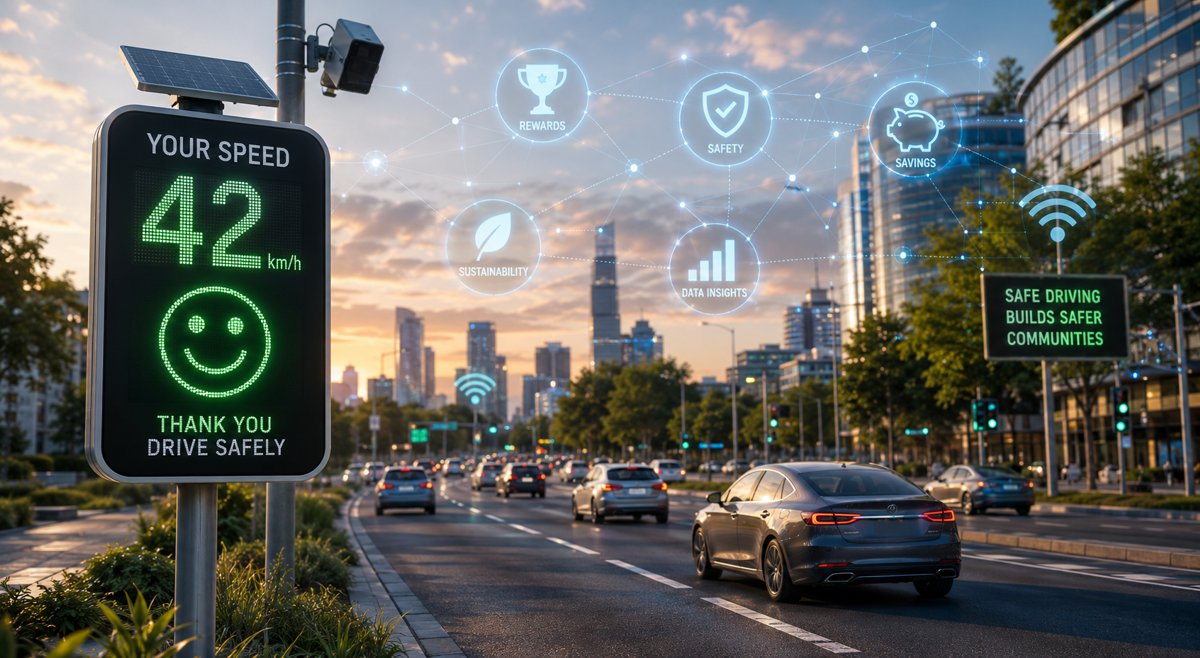
The underlying principle is already more widespread than many motorists realise. Across Europe, North America and Australasia, radar-triggered driver feedback signs increasingly display a smiling face to compliant drivers and a disapproving one to those exceeding the limit, offering immediate emotional feedback without issuing a fine or collecting evidence. Transport authorities and independent studies, including a meta-analysis referenced by the United States National Highway Traffic Safety Administration, have repeatedly found that these low-cost displays reduce average speeds, typically by a few kilometres per hour and by more in school zones and residential streets. The effect can soften over time and depends on placement, yet the signs remain among the cheapest interventions in the road safety toolkit, which is precisely why they have spread so widely. They are the everyday, analogue version of the same idea now being industrialised through connected vehicles and data, evidence that positive reinforcement is not a theory awaiting proof but a practice awaiting scale.
Positive reinforcement is already influencing how many people drive, often without them realising it. Modern navigation apps congratulate drivers for maintaining efficient speeds, electric vehicles reward smooth driving with greater range, and some fleet management systems rank drivers on safety and efficiency rather than simply recording violations. Collectively, these small interventions demonstrate that immediate feedback can shape behaviour long before enforcement becomes necessary.
Insurers Have Already Built the Reward Economy
While public authorities debated the merits of rewards, the insurance industry built a business around them. Usage-based insurance, which prices premiums according to how a vehicle is actually driven, has moved from novelty to mainstream. The insurance telematics market was valued at somewhere between four and seven billion US dollars in 2024, depending on the definition used, and analysts expect it to grow at close to twenty per cent a year through the end of the decade. Programmes such as State Farm’s Drive Safe & Save and Progressive’s Snapshot in the United States, along with gamified apps offered by insurers including Aviva in the United Kingdom, reward smoother acceleration, gentler braking and consistent speed with lower premiums, points and badges, rather than simply penalising drivers after an incident.
The commercial logic is straightforward and increasingly proven. Insurers using behaviour-based models report that they can reduce claims costs materially, in some analyses by twenty to thirty per cent, by identifying and rewarding lower-risk drivers while coaching the rest. The approach also changes the relationship between insurer and customer, repositioning the policyholder as an active participant in managing risk rather than a passive purchaser of cover. Independent schemes have extended the idea beyond individual insurers, and in the United Kingdom the Safe Roads Challenge app has geo-mapped the road network with digital trigger points that award experience points for compliant driving, redeemable against offers from consumer brands including Amazon, Asda, Nando’s and Spotify. The reward economy for safe driving, in other words, is no longer hypothetical; it is a functioning market with paying customers and measurable results.
Why Commercial Fleets Embrace Safe Driving Incentives
The principle extends naturally, and profitably, into commercial transport, which is where much of the construction and infrastructure sector meets the road every day. Contractors, logistics operators and utilities already gather vast quantities of telematics data from their vehicles and plant, historically to investigate incidents and defend claims. A growing number now use that same information to reward drivers for safe, efficient and fuel-conscious performance rather than only to apportion blame after the event. The commercial return is tangible, spanning lower insurance premiums, reduced fuel consumption, fewer collisions and the downtime they cause, along with measurable improvements in employee engagement and retention.
For fleet operators the economics are more immediate than for public authorities, because the costs and the benefits sit inside the same organisation. A contractor that cuts harsh braking and speeding across a mixed fleet of tippers, vans and service vehicles lowers its accident rate, its fuel bill and its insurance exposure at the same time, and can pass part of that saving back to drivers as a reward. That alignment explains why behaviour-based incentives have taken hold faster in commercial fleets than on the public network, and it offers a working template for the wider road system. Where the public sector is still designing funding mechanisms, private fleets have already demonstrated that rewarding good driving pays for itself, which makes them the most persuasive proof of concept the reward model has.
Intelligent Infrastructure Rewards Better Behaviour
What insurers do inside a private app, public infrastructure is now capable of doing across an entire network. The intelligent transport systems market, worth roughly 47 to 58 billion US dollars in 2025 and forecast to roughly double over the following decade, has assembled the sensing, connectivity and computing layer that the Stockholm experiment lacked. Roadside sensors, connected signals, automatic number plate recognition and vehicle-to-everything communication allow authorities to monitor flows in real time, optimise signal timings and, crucially, recognise good driving as readily as they detect an offence. Some of that capability is already visible to motorists, most obviously in the coordinated “green waves” that let those maintaining the correct speed pass through successive junctions without stopping, a small but tangible reward for driving to the limit rather than against it.
The safety returns from connected infrastructure are becoming measurable, which strengthens the investment case considerably. Real-world vehicle-to-everything deployments have been credited with cutting collisions involving roadside workers by around ninety per cent, reducing harsh braking events by up to eighty per cent and lowering journey times by as much as thirty per cent. Established suppliers including Siemens, Hitachi, Kapsch TrafficCom, Verra Mobility and Conduent are competing to provide the tolling, traffic management and analytics platforms that underpin these networks, and the centre of commercial gravity is moving from physical roadside hardware towards the data and V2X services layered on top. That migration matters for infrastructure owners, because it turns the road itself from a passive asset that records infringements into a platform capable of encouraging better decisions continuously.
Funding the Carrot
Every incentive scheme runs into the same practical question, which is who pays for the rewards. Here the policy groundwork is more advanced than many assume. The European Parliament, in its resolution on the road safety framework for 2021 to 2030, called on member states to establish national road safety funds that collect traffic fines and redistribute the proceeds towards safety measures. That is, in essence, the financial architecture of the original Swedish lottery written into policy recommendation, with revenue from those who break the rules recycled to benefit those who follow them. The mechanism does not need to be invented; it needs to be adapted and scaled.
Dynamic pricing on the network offers a second funding route that is already operational. New York’s Metropolitan Transportation Authority introduced congestion charging in Manhattan in 2025 using intelligent transport systems to manage traffic and generate revenue, demonstrating that authorities can meter road use at scale and direct the income towards policy goals. The same plumbing that charges for congestion could as easily credit compliant behaviour, whether through discounted tolls, credits towards public transport, electric vehicle charging or parking, or verified safety incentives for commercial fleet operators. None of these mechanisms displaces enforcement; they broaden the toolkit and, importantly, give infrastructure owners and tolling operators a commercial reason to participate rather than an additional cost to absorb.
AI Moves Road Safety from Reaction to Prevention
The most consequential change since 2010 is not the camera or the connected signal but the intelligence applied to the data they generate. Modern vehicles already produce large volumes of operational data covering speed, braking, acceleration, cornering and the interventions of driver-assistance systems. Combined with connected infrastructure, machine learning can identify behavioural patterns that no human operator could detect across a network, and it can do so before a pattern hardens into a collision. That capability moves the emphasis of road safety from reaction towards prevention, which is where the largest economic gains sit, since a crash avoided is far cheaper than a crash investigated and compensated.
For fleet operators, insurers and highway authorities, the prevention model changes the calculation of value. Rather than issuing a penalty after a dangerous event, systems can recognise developing risk, prompt coaching and reward sustained improvement, lowering claims, downtime and casualty costs in the process. The European Union has already begun mandating supporting technology, with intelligent speed assistance required on new vehicle types, which normalises the idea of infrastructure and vehicles working together to guide behaviour. As that capability spreads, the question authorities ask shifts from how to identify offenders towards how to help more drivers become consistently safer, and the two objectives cease to be in tension.
Building Trust in Behaviour-Based Road Safety
The technology is ready and the commercial appetite is evident, which places the burden of success squarely on governance. Reward-based systems depend on continuous data about where and how people drive, and that raises legitimate questions about who owns the data, how it is stored and whether participation is genuinely voluntary. The Stockholm experiment itself ran into Swedish data-protection constraints, and the regulatory environment has only grown more demanding since. Any public scheme will need to demonstrate that it collects the minimum data necessary, protects it rigorously and does not drift into routine surveillance of ordinary movement.
Fairness is the second condition, and arguably the harder one. Incentive schemes must work across different communities and income groups, or they risk rewarding those who can already afford newer, better-connected vehicles while excluding everyone else. Designing rewards that are meaningful without being regressive, and remaining transparent about how behaviour is measured and scored, will shape public confidence as much as any technical specification. Insurers have learned this within their own telematics programmes, where perceptions of fairness and clarity strongly influence take-up. For public authorities, the lesson is that trust is not a secondary consideration to be addressed after deployment; it is the precondition for deployment at all.
Designing Roads That Reward Better Decisions
Road safety has traditionally been framed as an engineering discipline supported by enforcement, and both remain indispensable. What has changed is that behavioural encouragement has moved from the margins to the mainstream, backed by a maturing commercial ecosystem rather than a single publicity campaign. The insurance sector has proved the model pays, intelligent transport systems have supplied the infrastructure, artificial intelligence has added the capacity to prevent rather than merely punish, and policy has begun to sketch the funding mechanisms. The pieces that were missing in Stockholm in 2010 are now, individually, in commercial service.
For the industries that build, finance and operate roads, the opportunity is to treat the network as an active participant in shaping behaviour rather than a passive estate of cameras and fines. Infrastructure owners can explore reward layers on tolled and managed roads, ITS suppliers can position behaviour recognition and analytics as products rather than by-products, and insurers and fleet operators can extend proven schemes into partnership with public authorities. Giving the carrot equal standing with the stick is no longer a behavioural curiosity; it is becoming a commercial and infrastructural strategy, and the organisations that grasp it early will help define how the next decade of road safety is delivered.
The next generation of highways may therefore do far more than carry traffic, because connected infrastructure and artificial intelligence make it possible to encourage better decisions before danger develops rather than simply to identify dangerous drivers once it has. Enforcement will always be necessary, since a minority will always ignore the rules whatever incentives are on offer, but an intelligent road network has the capacity to be encouraging as well as watchful. The Swedish lottery was never meant to become permanent, yet its central insight has aged remarkably well, namely that people respond when they are recognised for doing the right thing. On that reading, the smartest roads of the future may prove to be not those that catch the most offenders, but those that quietly persuade the greatest number of people to drive safely in the first place.
Key Industry Questions
- Does rewarding safe drivers actually reduce casualties, or is it mainly a marketing device? The evidence points to a real behavioural effect rather than a gimmick. The 2010 Stockholm trial cut average speeds by roughly a fifth over its short run, and insurers operating usage-based programmes report meaningful reductions in claims costs, in some analyses by twenty to thirty per cent, from rewarding and coaching safer driving. The mechanism works because immediate positive feedback reinforces behaviour more reliably than the distant threat of a fine. That said, rewards are best understood as a complement to enforcement rather than a replacement, and their long-term impact at national scale is still being established. Their commercial traction inside insurance is the clearest indication so far that positive reinforcement changes behaviour in ways insurers are willing to pay for.
- How large is the commercial market behind reward-based driving? Two adjacent markets carry it. Insurance telematics, the technology that measures driving behaviour for pricing, was valued at several billion US dollars in 2024 and is forecast to grow at close to twenty per cent a year through the end of the decade, while the wider usage-based insurance market runs into the tens of billions. Intelligent transport systems, which supply the roadside and network capability, were worth roughly 47 to 58 billion US dollars in 2025 and are expected to roughly double over the following decade. Together they represent a sizeable and fast-growing commercial base, which is why behaviour-based reward is no longer a public-sector experiment but a private-sector product line attracting sustained investment from insurers, technology suppliers and infrastructure operators alike.
- Who would pay for a public reward scheme, and is the funding model realistic? The funding architecture already exists in policy and in practice. The European Parliament has recommended that member states create road safety funds financed by traffic fines and redirected towards safety measures, which mirrors the design of the Swedish lottery. Dynamic road pricing offers a second route, as demonstrated by New York’s 2025 congestion charge in Manhattan, where intelligent transport systems meter road use and generate revenue that can be directed towards policy goals. Rewards could therefore be funded through recycled fines, toll or congestion income, insurer partnerships or employer and retailer contributions. The realistic path is likely to blend several of these sources rather than rely on any single one, which also spreads the cost and the political risk.
- What role does vehicle-to-everything technology play in enabling rewards at scale? Vehicle-to-everything, or V2X, communication is the connective layer that makes network-wide recognition of good driving feasible. It allows vehicles to exchange information with roadside infrastructure and with each other, so authorities can assess behaviour continuously rather than only at fixed camera points. Real-world deployments have been credited with cutting collisions involving roadside workers by around ninety per cent, reducing harsh braking by up to eighty per cent and lowering journey times by as much as thirty per cent. Those returns strengthen the investment case for the wider intelligent transport systems build-out. For reward schemes specifically, V2X provides the reliable, real-time behavioural data that a credible incentive model requires, moving the concept from a single junction to an entire corridor or region.
- How does artificial intelligence change road safety from enforcement to prevention? Artificial intelligence shifts the emphasis from responding to incidents towards anticipating them. Connected vehicles already generate detailed data on speed, braking, acceleration and cornering, and machine learning can detect risky patterns across a network before they result in a collision. Instead of issuing a penalty after a dangerous event, systems can flag developing risk, prompt targeted coaching and reward sustained improvement. The economic logic is compelling, because a crash prevented is far cheaper than one investigated and compensated, which benefits insurers, fleet operators and highway authorities simultaneously. This preventive orientation aligns with regulation such as mandatory intelligent speed assistance, and it reframes the central question authorities ask from who deserves a fine towards how more drivers can be helped to improve.
- What are the main data-protection and privacy risks of incentive-based road safety? The principal risk is that continuous behavioural monitoring drifts into unnecessary surveillance of everyday movement. Reward systems require data on where and how people drive, which raises questions about ownership, storage, retention and consent. The Stockholm experiment encountered Swedish data-protection constraints, and the regulatory bar has risen considerably since. Credible schemes will need to collect only the minimum data required, anonymise it where possible, secure it robustly and make participation genuinely voluntary where appropriate. Transparency about what is measured and how scores are calculated is essential, both for legal compliance and for public confidence. Insurers have learned that clarity and perceived fairness strongly influence take-up, and public authorities will face the same test with sharper scrutiny given their coercive power.
- Could reward schemes worsen inequality between drivers? That is a genuine risk and a central design challenge. Newer, better-connected vehicles generate richer data and may find it easier to earn rewards, which could disadvantage drivers of older cars or those on lower incomes. If incentives are tied to premium discounts alone, the benefits may flow disproportionately to those already able to afford newer vehicles and comprehensive cover. Avoiding this outcome requires rewards that are accessible through widely available smartphone apps rather than embedded telematics alone, and structures that recognise improvement as well as absolute performance. Fairness across communities and income groups will materially affect political acceptability, and schemes perceived as regressive are unlikely to survive public scrutiny regardless of their safety benefits.
- What should infrastructure owners and ITS suppliers do to capitalise on this shift? The practical move is to treat behaviour recognition as a product rather than a by-product. Infrastructure owners and tolling operators can pilot reward layers on managed and tolled roads, using existing pricing systems to credit compliant behaviour alongside charging for congestion. Intelligent transport systems suppliers can package analytics and V2X-enabled behavioural insight as commercial offerings, positioning themselves in the higher-value data and services layer rather than competing solely on hardware. Insurers and fleet operators can extend proven telematics schemes into partnership with public authorities, sharing both data standards and the funding burden. Early movers stand to shape the technical standards, procurement models and public expectations that will govern the market, which is generally where the strongest competitive positions in infrastructure are built.
Strategic Takeaways
- The reward-versus-punishment question has effectively been settled by the market, because insurers have already built a growing, multi-billion-dollar business out of rewarding safe driving, and that model is now migrating from private apps onto public infrastructure.
- Commercial value in road safety is shifting from enforcement hardware towards behaviour data, analytics and V2X services, which favours ITS suppliers and infrastructure owners able to position themselves in that higher-value layer.
- The funding obstacle is smaller than it appears, since recycled traffic fines, congestion and tolling income, and insurer or employer partnerships offer credible and blendable revenue routes that already exist in policy and practice.
- Artificial intelligence is turning road safety from a reactive, penalty-based discipline into a preventive one, concentrating the largest economic gains in crashes avoided rather than crashes compensated.
- Public trust, data ownership and fairness across income groups, rather than technical capability, will determine adoption, so transparent, voluntary and equitable design should be treated as a precondition rather than an afterthought.