BYD SHARK Pickup Truck DMO Secures Five-Star Euro NCAP Safety Rating
BYD’s SHARK DMO plug-in hybrid pick-up has secured a five-star Euro NCAP safety rating, adding independently assessed crash protection and driver-assistance performance to a vehicle designed to compete in the European pick-up market.
The double-cab model combines a 32.2 kWh battery, petrol-electric four-wheel drive and a claimed electric-only range of up to 90 km. With UK orders now open at £47,295 including VAT, the SHARK enters a market where buyers must balance carrying and towing capability, running costs and the practical demands of everyday commercial use.
The assessment draws on crash testing conducted by the Australasian New Car Assessment Program (ANCAP) in 2025, supplemented by additional Euro NCAP evaluations. Although published in October 2026, the European rating is based on Euro NCAP’s 2025 assessment protocol.
Briefing
- BYD SHARK DMO receives a five-star Euro NCAP safety rating based on the 2025 testing protocol.
- Adult Occupant protection scores 82%, with Child Occupant protection reaching 86%.
- Vulnerable Road Users protection scores 74%, while Safety Assist achieves 87%.
- The plug-in hybrid powertrain produces a claimed 436 PS and 650 Nm of torque.
- UK pricing starts at £47,295 including VAT, with a claimed combined driving range of 419 miles.
Crash Protection and Safety Systems
The SHARK achieved 82% for Adult Occupant protection and 86% for Child Occupant protection. Euro NCAP reported good protection in several principal crash scenarios, including frontal-offset, full-width rigid-barrier and side-barrier testing.
Protection for the six- and ten-year-old child dummies was particularly strong in the side-barrier assessment. The vehicle also incorporates child presence detection, designed to warn when a child may have been left inside.
The assessment nevertheless identified two areas requiring attention. Euro NCAP found that the side curtain airbag did not deploy correctly during testing. Although the recorded dummy injury measurements were unaffected, penalties were applied to the side-impact assessments. BYD is developing a revised airbag cover to address the issue.
The frontal collision compatibility assessment also found that the SHARK’s structure could make it an aggressive impact partner for another vehicle. This finding concerns the potential consequences for occupants of the other vehicle rather than the protection afforded to those inside the SHARK itself.
Active safety technology contributed to the remaining assessment categories. The pick-up scored 74% for Vulnerable Road Users protection, with its autonomous emergency braking system demonstrating good responses to cyclists and motorcyclists. An 87% Safety Assist score reflected the performance of its emergency braking, lane-support and speed-assistance systems, including a speed limiter that can respond to recognised local speed limits.
The five-star result adds the SHARK to BYD’s growing collection of independently rated European vehicles, following models including the DOLPHIN, SEAL, SEAL U DM-i and SEALION 7.
Plug-In Hybrid Powertrain and Vehicle Architecture
The SHARK uses BYD’s Super Hybrid DMO architecture, combining a turbocharged 1.5-litre petrol engine with electric motors driving the front and rear axles.
The front electric motor develops 231 PS and 310 Nm, while the rear motor produces 204 PS and 340 Nm. BYD quotes a combined maximum system output of 436 PS and 650 Nm, providing a claimed acceleration time from 0 to 62 mph of 5.7 seconds.
Unlike a conventional diesel pick-up with a mechanical four-wheel-drive transmission, the SHARK uses electrified propulsion at both axles. The arrangement allows traction and torque distribution to be managed electronically, with performance governed by the vehicle’s control systems and operating conditions.
Its 32.2 kWh Blade Battery is integrated into the ladder-frame structure using BYD’s Cell-to-Chassis technology. The manufacturer describes this arrangement as providing additional battery protection while accommodating the structural requirements of a pick-up.
BYD claims an electric-only driving range of up to 90 km and a combined petrol-electric range of 419 miles with a fully charged battery and full fuel tank. Real-world fuel consumption will depend heavily on charging frequency, journey length, load and driving conditions.
For fleets operating regular routes between depots and nearby sites, the battery could allow a substantial proportion of daily mileage to be completed electrically. Longer journeys can be undertaken using the petrol-electric powertrain without relying exclusively on charging infrastructure.
Practical Applications for Commercial Operators
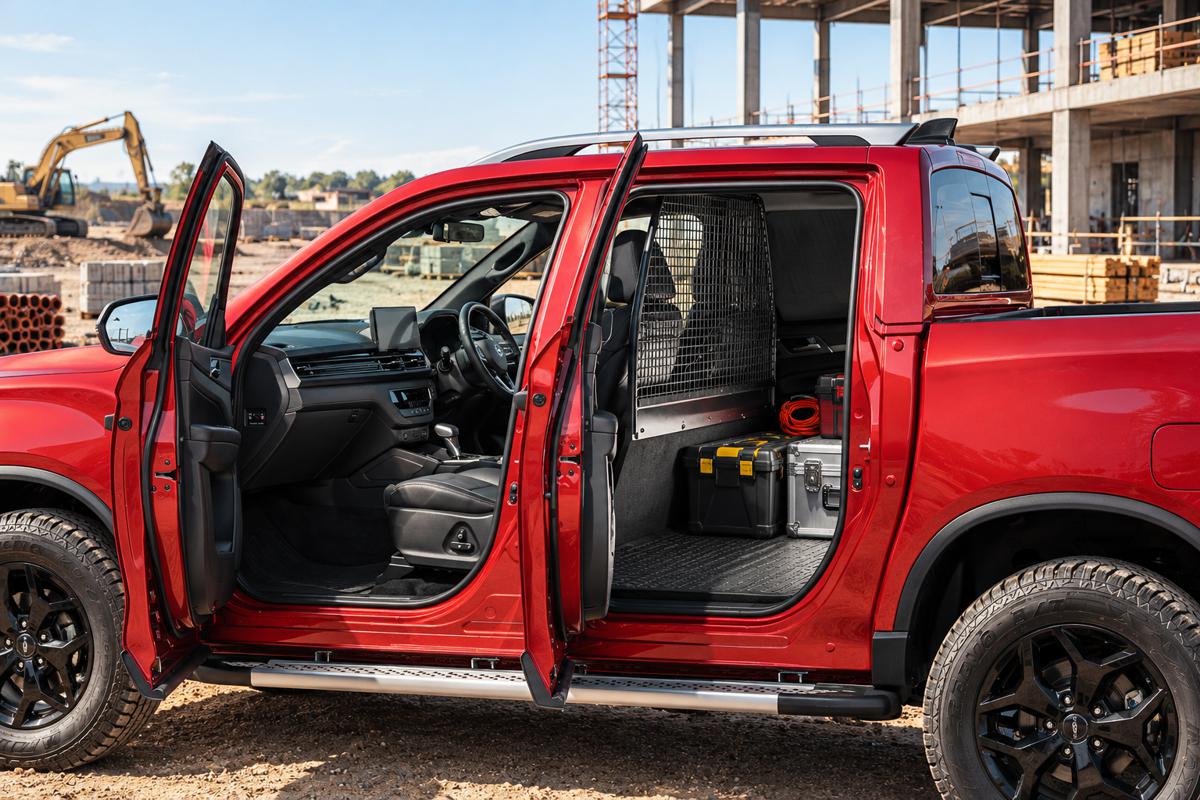
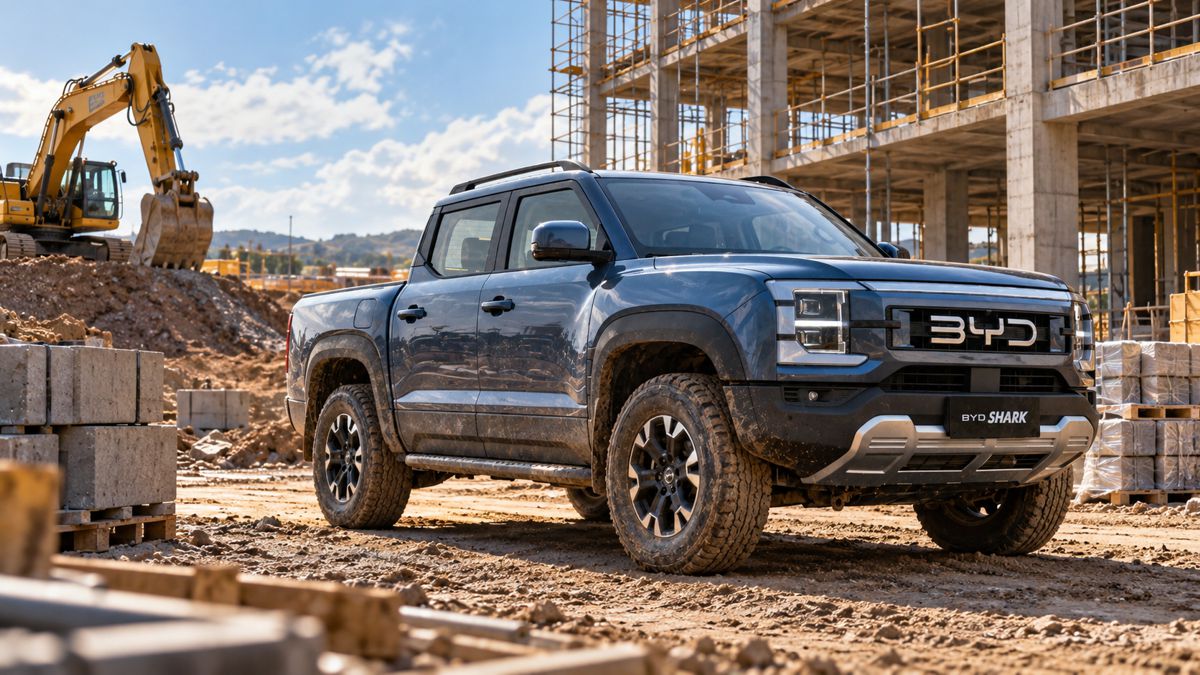
The SHARK’s double-cab configuration provides seating for five, placing it in a category used by construction supervisors, utility companies, maintenance teams and operators who require both passenger accommodation and a separate load bed.
One potentially useful feature is Vehicle-to-Load functionality, which allows electrical equipment to draw power from the vehicle’s battery through two onboard sockets. This could support site inspections, mobile maintenance and temporary operations where an external electrical supply is unavailable. Equipment compatibility will depend on the sockets’ rated output and the electrical demand of connected devices.
The vehicle also incorporates a 360-degree camera system, front and rear parking sensors and a head-up display. These can assist with manoeuvring in confined spaces, although electronic assistance remains a supplement to normal site safety procedures.
The manufacturer’s announcement does not establish the SHARK’s payload, towing capacity or detailed load-bed dimensions. These specifications will be central to comparisons with established commercial pick-ups, particularly for operators transporting materials, trailers or heavier equipment.
High power output and rapid acceleration do not necessarily translate into greater carrying or towing capability. Fleet buyers will also need to consider servicing arrangements, charging access, acquisition costs and residual values when evaluating the hybrid against conventional diesel alternatives.
Equipment and UK Market Position
BYD has equipped the SHARK with features more commonly associated with higher-specification passenger SUVs, including heated and ventilated front seats, a 10.25-inch digital instrument display and a 15.6-inch central infotainment screen.
Navigation, voice assistance, wireless Apple CarPlay and Android Auto connectivity are included, alongside remote cabin heating and cooling through the BYD smartphone application.
The specification positions the SHARK towards buyers who use their vehicles for both business and private journeys. Double-cab pick-ups have traditionally appealed to this audience, although their commercial attractiveness varies according to taxation, operating costs and the demands placed on the load bed.
Changes to UK tax rules have also altered the financial considerations for businesses purchasing double-cab pick-ups. Since April 2025, most newly acquired double-cab models have been treated as cars for certain business tax purposes, while VAT classification remains subject to separate rules. Buyers will need to establish the SHARK’s applicable classification and treatment rather than assuming the advantages historically associated with commercial pick-ups.
At £47,295 including VAT, the SHARK competes in a segment where established manufacturers offer diesel-powered alternatives supported by extensive service networks and long operating histories.
Safety and the Commercial Pick-Up Market
The Euro NCAP result gives prospective SHARK buyers a recognised benchmark for occupant protection, vulnerable road-user safety and driver-assistance performance. The identified limitations in side airbag deployment and collision compatibility also provide useful detail beyond the headline five-star rating.
For organisations operating vehicles across construction sites, public highways and urban environments, autonomous emergency braking, lane support and vulnerable road-user detection can complement existing fleet safety policies.
The rating does not establish how the vehicle will perform under every commercial operating condition. Off-road durability, sustained heavy loading, trailer handling and the long-term reliability of the hybrid powertrain require separate assessment.
The SHARK arrives with considerable electric propulsion capability and a competitive safety rating. Whether it can establish a lasting position in commercial fleets will depend on its working specifications and the extent to which electric operation delivers measurable savings under everyday operating conditions.
Key Industry Questions
- What safety rating has the BYD SHARK received? The SHARK has achieved five stars from Euro NCAP, with assessment results covering occupant protection, vulnerable road users and active safety assistance.
- Which Euro NCAP testing protocol was used? The October 2026 rating is based on Euro NCAP’s 2025 assessment protocol, incorporating ANCAP testing and additional European evaluations.
- Did Euro NCAP identify any safety concerns? Yes. The assessment identified incorrect side curtain airbag deployment and concerns about the vehicle’s frontal collision compatibility with other vehicles.
- What is the SHARK’s electric-only driving range? BYD claims up to 90 km using its 32.2 kWh battery. Actual range will vary according to operating conditions.
- Does the SHARK have conventional four-wheel drive? The vehicle uses separate electric motors at the front and rear axles, providing electronically controlled four-wheel-drive capability.
- Can the SHARK power equipment on a construction site? Yes. Its Vehicle-to-Load system provides two electrical outlets, although equipment compatibility depends on their rated power output.
- How much does the BYD SHARK cost in the UK? The announced UK starting price is £47,295 including VAT.
- Is the SHARK suitable for towing heavy construction equipment? Its towing capacity has not been established in the supplied announcement. Operators should verify the UK-approved towing specification before selecting the vehicle.
- How are double-cab pick-ups taxed in the UK? Since April 2025, most newly acquired double-cab pick-ups have been treated as cars for certain business tax purposes. VAT classification remains subject to separate rules, including the one-tonne payload test.
Strategic Takeaways
- A five-star Euro NCAP rating strengthens the SHARK’s safety credentials, although the assessment identifies limitations in airbag deployment and collision compatibility.
- The dual-motor hybrid architecture offers electronically controlled four-wheel drive without a conventional mechanical connection between the axles.
- A 32.2 kWh battery could reduce petrol consumption for fleets undertaking regular short-distance journeys with reliable charging access.
- Vehicle-to-Load functionality offers practical opportunities for mobile maintenance and site-support operations.
- Payload, towing limits, tax treatment and long-term operating costs remain central to the SHARK’s commercial competitiveness.