Delfland Tests Dredge Waste as a Low-Carbon Cement Substitute
Water authorities rarely feature in conversations about industrial decarbonisation, yet they sit on some of the largest concentrations of concrete infrastructure in any developed economy.
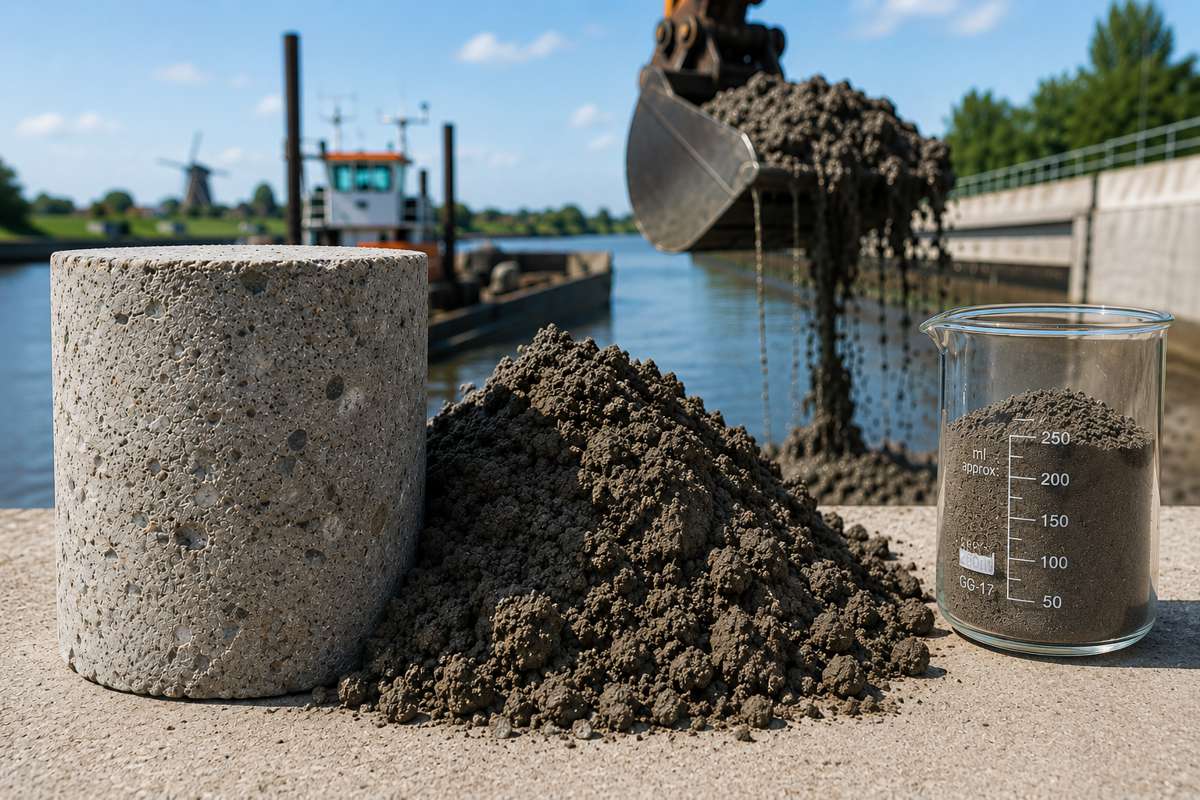
In the Netherlands, the Delfland regional water authority has begun testing whether the sediment it dredges from its waterways each year can be processed into a raw material for concrete, a move that would turn a recurring disposal cost into a potential feedstock for the construction supply chain.
The work is being carried out with ResourceFull, a Belgian materials specialist that develops cement alternatives from industrial by-products, and it remains a feasibility study. Even so, it touches questions that reach well beyond a single Dutch catchment.
The commercial logic is direct enough to interest asset owners across the sector. Research by STOWA, the foundation for applied research in Dutch water management, indicates that concrete accounts for around 80% of the assets Delfland owns and manages, and roughly 35% of the embedded carbon tied up in that estate. At the same time, the authority handles approximately 100,000 m³ of dredged sediment a year, a residual flow that currently carries cost rather than value.
Bringing those two numbers into the same frame, the embedded carbon locked into the concrete and the volume of the waste stream that could displace part of it, is what makes the project worth tracking for anyone responsible for maintaining ageing infrastructure on a constrained carbon and capital budget.
Briefing
- Delfland is testing whether dredged sediment can be processed into a raw material for concrete, with an ambition of fully circular concrete by 2050.
- Concrete represents around 80% of the authority’s managed assets and about 35% of their embedded carbon.
- Delfland dredges roughly 100,000 m³ of sediment a year, treated today as a disposal cost rather than a resource.
- Early testing by ResourceFull confirmed that clay from sediment can be thermally activated as a partial cement substitute, with a lower carbon footprint and possible strength benefits.
- The project is still a feasibility study; commercial use depends on building a market and supply chain that do not yet exist.
From Cost Centre To Raw Material
The financial case sits at the heart of why this study matters to infrastructure owners rather than only to chemists. Dredging is not optional. Waterways silt up, channels have to be kept open for drainage and flood safety, and the resulting sediment has to go somewhere. For most authorities that somewhere is a low-value destination, with the material treated as a residue to be disposed of at a cost that recurs year after year.
Reframing that residue as a feedstock changes the underlying economics, because the same maintenance activity that today generates a liability would instead generate an input with a price attached to it. For a body managing an estate that is four-fifths concrete, the prospect of feeding part of its own carbon problem with its own waste stream is commercially as well as environmentally attractive.
That shift is also where the harder questions begin. High-value reuse only delivers a return if there is a buyer, a specification the material can meet, and a logistics chain capable of moving it from dredging barge to batching plant in usable condition. None of that exists at scale yet for sediment-derived cement substitutes, which is precisely why Delfland has framed the exercise as a feasibility study rather than a procurement decision.
The authority has signalled that it will decide what role it wants to play in any next phase only once the research results are in, a measured stance that reflects the difference between proving a material in the laboratory and building a market around it. For investors watching the circular construction space, that gap between technical promise and commercial readiness is the defining feature of the sector at present.
Inside The Material Science
The technical work has so far followed two distinct routes, reflecting the fact that dredged sediment is not a single material but a mixture whose components behave very differently in concrete. In the first route, ResourceFull separated and processed the sediment to recover its sand fraction. A sample supplied by Delfland from Hoek van Holland proved unusually sand-rich, and once that sand had been sieved out it was used in an initial concrete test as a conventional aggregate.
The second and more significant route concerns the fine clay fraction. Preliminary research has confirmed that clay drawn from dredged sediment can be thermally activated and used as a partial substitute for cement, a finding that carries a lower carbon footprint and, according to the early work, may even improve the strength of the resulting concrete.
That clay pathway places Delfland’s experiment squarely within one of the most active areas of cement chemistry. Heating clay to drive off its bound water produces a reactive, pozzolanic powder that can replace a share of the clinker in cement, and the same principle underpins limestone calcined clay cement, the blended product that major producers are now commercialising.
Holcim has built a dedicated calcined clay line at Saint-Pierre-la-Cour in France and markets the output as a cement with around half the carbon footprint of the conventional benchmark, while Cementir distributes a limestone calcined clay cement under the FUTURECEM name across French and Benelux markets. Research on flash-calcined dredged sediment from the Port of Antwerp has shown that replacing 20 to 40 per cent of cement with the calcined material can match the strength development of a standard Portland mix by 28 days.
The science, in other words, is established; the open question for Delfland is whether its own sediment, with its particular blend of minerals and contaminants, can be processed reliably enough to join that family of products. Four further tests using sediment from other project partners are planned, with the most suitable mixture to be selected for the next phase on the basis of those results.
The Carbon Arithmetic
The environmental stakes explain why a regional water authority is willing to invest in materials research at all. Concrete itself emits no carbon dioxide once cured, but its production does, principally through the cement it contains. Globally, cement manufacture is responsible for around 8% of total carbon dioxide emissions, a share that comes from the energy used to heat raw materials and from the chemical release of carbon when limestone is converted to clinker.
Any process that displaces a portion of that clinker with a lower-carbon substitute therefore attacks emissions at their structural source rather than offsetting them after the fact. For an organisation whose embedded carbon is concentrated in concrete, the leverage available from substituting even part of the binder is considerable.
Set against that backdrop, Delfland’s 2050 ambition of fully circular concrete reads less as a slogan than as a sequencing target. Reaching it would require not only a proven material but a steady, specification-grade supply, durable demand from the authority’s own construction and renovation programmes, and a procurement framework that rewards circular content.
The more immediate prize is partial substitution, using activated sediment clay to cut the clinker content of the concrete poured into pumping stations, weirs, quay walls and the other hard assets that water management depends on. Because the authority both generates the raw material and commissions the structures that could use it, it occupies an unusual position in the value chain, able in principle to close the loop within its own boundaries in a way that few private buyers can.
Building The Missing Market
The constraint that recurs throughout the project is the absence of an established market and supply chain for sediment as a cement substitute. A material can be technically sound and still commercially stranded if there is no recognised standard for it, no contractor confident enough to specify it, and no processing capacity positioned near the point where the sediment arises.
Delfland and its partners are explicit that the application of dredged sediment as a cement substitute requires further development on all of those fronts, and until that work is done the project remains primarily a feasibility study. That candour is useful, because it distinguishes what the research has demonstrated, that the clay can be activated and used, from what the wider system has yet to deliver, which is a route to market.
External pressures may help close that gap faster than the economics alone would. Across Europe, between 100 and 200 million cubic metres of waterway sediment are dredged each year, and disposal options are narrowing as rules on sea discharge of contaminated material tighten, a trend already visible in French restrictions on dumping polluted sediment at sea.
As cheaper disposal routes disappear, the relative attractiveness of beneficial reuse rises, and the cost item that authorities currently carry becomes a stronger candidate for valorisation. The parallel commercial momentum behind calcined clay cement gives the supply side a reference point, since the processing equipment, quality controls and market acceptance being built for clay-based binders could in time accommodate a sediment-derived feedstock.
For now, though, the decision sits with Delfland, which has reserved judgement on its own role until the final research results clarify whether the material, the market and the carbon savings line up.
What The Test Signals For Asset Owners
The significance of Delfland’s work lies less in the single feasibility study than in the template it offers other large public owners of concrete infrastructure. Roads authorities, ports, rail operators and utilities all maintain extensive concrete estates and all generate residual material streams of their own, and the same arithmetic that makes sediment attractive to a water authority could apply to excavation spoil, demolition arisings and other by-products elsewhere in the sector.
A body that both produces a waste stream and procures the structures that might consume it has a rare opportunity to internalise the circular loop, capturing the carbon benefit and the cost avoidance within one balance sheet rather than splitting them across a fragmented supply chain.
The caution embedded in the project is just as instructive. Delfland has not claimed a finished product, committed to a procurement pathway, or asserted savings it cannot yet evidence, choosing instead to test, measure and decide in sequence. That discipline matters in a field where the distance between a promising laboratory result and a bankable supply chain is routinely underestimated.
The organisations most likely to benefit from circular concrete will be those that treat material innovation as an operational and commercial programme rather than a sustainability headline, building the standards, logistics and demand alongside the chemistry. On that measure, the value of the Delfland test is that it is being run the right way round, with the market question taken as seriously as the science.