Flocean Reaches First Water as Subsea Desalination Crosses Into Reality
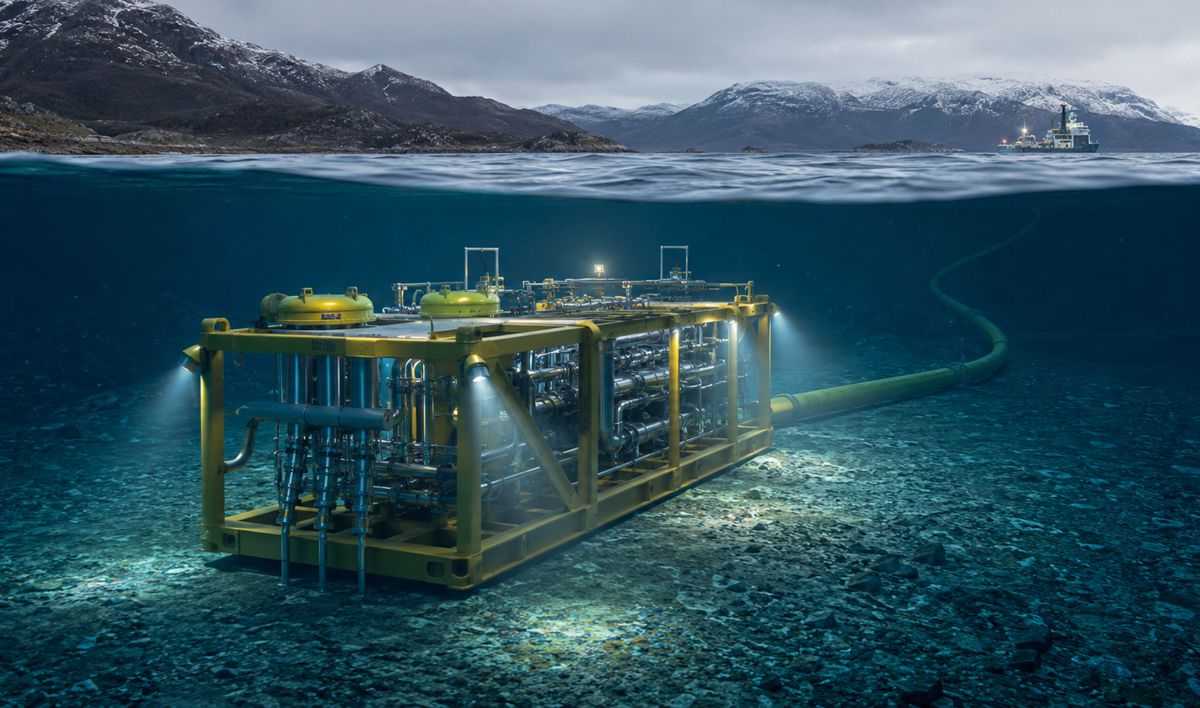
For most of the past decade subsea desalination has lived as an engineering proposition rather than a working asset, a promising answer to water scarcity that no one had yet built at scale. Flocean’s confirmation that its Flocean One system has reached “first water” and is now producing freshwater at full capacity from roughly 500 metres beneath the sea off Norway’s west coast moves the concept out of that holding pattern.
The milestone matters less as a technical curiosity than as the moment a new class of water infrastructure acquired a working reference. A plant that produces nothing is difficult to underwrite, while one that delivers freshwater every day presents utilities, industrial buyers and their financiers with something they can measure, contract against and price.
The significance is commercial as much as technical, and that is the part the wider infrastructure market will read most closely. Flocean has paired the milestone with a development pipeline of more than fifteen projects, including partnerships with Norway’s Alver municipality and with WaterConnect for the Maldives, a combination that signals genuine demand rather than speculative interest.
Reaching industrial-scale output in a developed economy with demanding regulatory and infrastructure standards is precisely the kind of proof point that allows a first-of-its-kind technology to travel. Set against a global water system under mounting strain, the arrival of a credible subsea option reshapes the menu of choices available to water-scarce coastal and island regions that have few conventional alternatives.
Briefing
- Flocean One has reached first water and is producing freshwater at full capacity from around 500 metres depth off Norway’s west coast, the first subsea desalination system to operate at industrial scale.
- The system harnesses natural ocean pressure to drive reverse osmosis, cutting energy consumption by 40 to 50 per cent against conventional coastal plants while producing up to one million litres of freshwater a day, enough for roughly 6,000 households.
- Flocean reports more than fifteen projects in active development, including agreements with Alver municipality in Norway and WaterConnect for the Maldives.
- Xylem, the Fortune 500 water solutions group and a strategic investor in Flocean, has framed first water as the operational proof point needed to advance projects from concept to construction.
- The approach removes coastal land conflicts, chemical pre-treatment and toxic brine discharge into shallow ecosystems, widening the range of sites where desalination is realistically possible.
First Water Turns A Project Pipeline Into Bankable Infrastructure
The commercial weight of the announcement rests on how subsea desalination is sold rather than simply how it works. Flocean operates a Build-Own-Operate model, selling treated water as a service to municipal and industrial customers under long-term offtake agreements, an arrangement that lives or dies on lenders’ confidence that the plant will perform across decades of operation.
Until now, those conversations rested on test-site data and engineering modelling, which constrains how far a contract can be firmed up and how cheaply it can be financed. An operating reference at full capacity changes the calculus, giving customers and capital providers the performance evidence that long-dated infrastructure deals require.
Sivan Zamir, Xylem’s Chief Innovation and Products Officer, placed the milestone in exactly those terms, noting:“First water is more than a technical milestone. It provides the operational proof point needed to advance projects from concept to development. As Flocean moves several commercial projects forward, they will see growing interest from regions that need new freshwater infrastructure but cannot accommodate conventional desalination. This achievement gives customers greater confidence in the potential of subsea desalination and represents an important step toward deployment at scale.”
That pipeline gives the milestone somewhere to go. Beyond the Alver agreement on Flocean’s home ground, the company has lined up work with WaterConnect for the Maldives and reported early project interest across the Mediterranean, Red Sea and Indian Ocean regions, markets where freshwater is scarce, land is contested and conventional plants face long permitting timelines. Xylem’s role matters here too, since the group’s strategic investment came with access to global distribution, a substantial balance sheet and the Xylem Innovation Labs accelerator, all of which shorten the distance between a single working plant and a fleet of them.
For an infrastructure class moving from demonstration to deployment, the constraint is rarely the technology alone; it is the commercial machinery needed to repeat it across dozens of sites, and that is the machinery Flocean is now assembling around a proven asset.
How Deep Water Rewrites The Economics Of Desalination
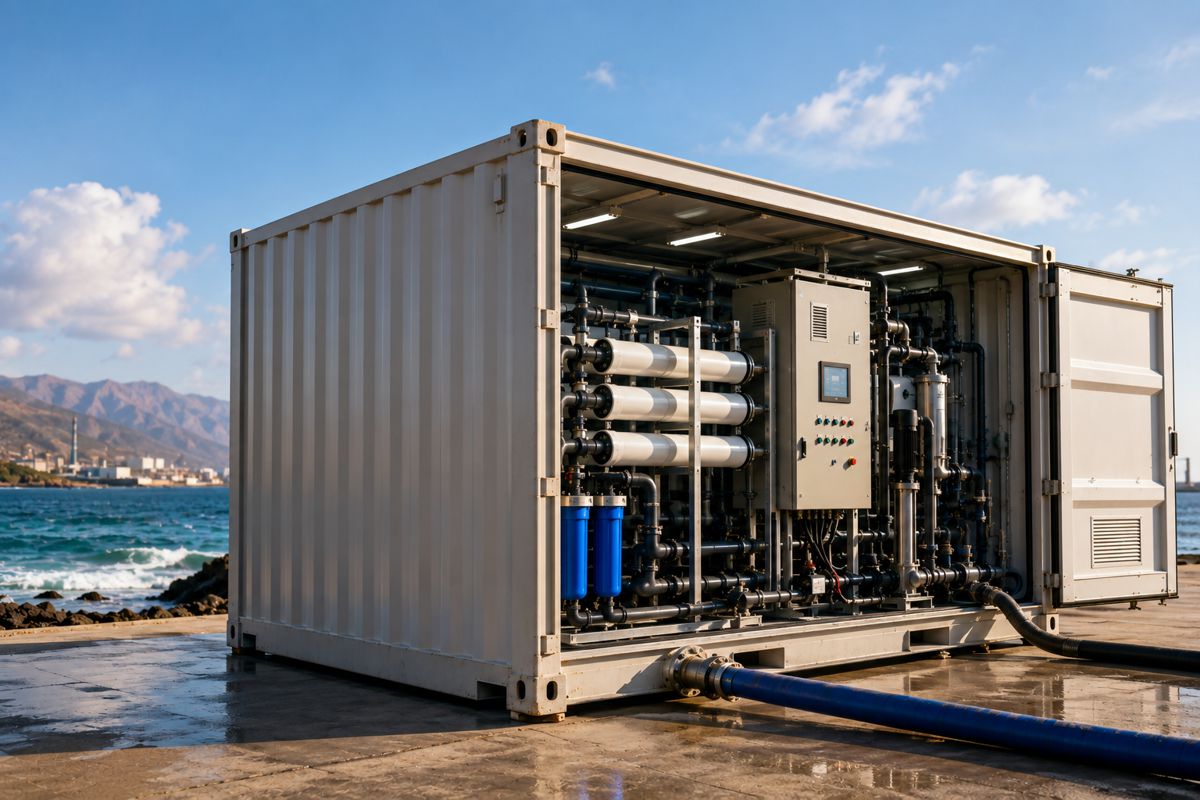
The engineering logic behind Flocean One is what makes the commercial story credible. By placing reverse osmosis modules at around 500 metres depth, the system uses the natural hydrostatic pressure of the deep ocean to help force seawater through its membranes, work that land-based plants must pay for with energy-intensive high-pressure pumps.
The result is a reduction in energy consumption of 40 to 50 per cent compared with conventional coastal desalination, a meaningful figure in a process whose running costs and carbon footprint are dominated by electricity. Deepwater conditions add a second advantage, because the stable temperatures, consistent salinity and low biological activity found well below the surface deliver cleaner intake water, which in turn reduces the chemical pre-treatment that burdens shallow-water plants.
The environmental profile follows from the same physics and is central to where the technology can be sited. Flocean One produces up to one million litres of freshwater a day, supply for roughly 6,000 households, without occupying contested coastal land, relying on chemical pre-treatment or discharging toxic brine into the sensitive shallow ecosystems that surround conventional intakes. Brine instead disperses at depth, away from the near-shore habitats that have made coastal desalination so contentious in many jurisdictions.
The modular design is the other half of the proposition, since capacity can be added pod by pod as demand grows rather than committed in a single large build, which lowers the upfront risk that has historically made desalination a fraught investment. Taken together, the combination of lower energy intensity, a lighter coastal footprint and incremental scaling is what allows Flocean to argue that subsea desalination is not a marginal improvement on existing methods but a different cost structure altogether.
Why Water-Stressed Regions Cannot Wait For Conventional Solutions
The demand backdrop gives the milestone its urgency. United Nations projections indicate that global freshwater demand will outstrip supply by around 40 per cent by 2030, with coastal and island regions facing the most acute shortages and, in many cases, no conventional alternative that can be built quickly enough. Conventional desalination has struggled to close that gap because it is constrained by multi-year permitting, heavy capital costs and limited availability of suitable coastal land, the very bottlenecks that subsea siting is designed to bypass.
A technology that operates independently of those coastal vulnerabilities offers genuine supply resilience, producing water without competing for the shoreline or waiting on permits that can stall a project for years.
The industrial dimension is where the strategic stakes are highest. Water-intensive sectors from semiconductor fabrication to data centres and mining are increasingly finding that water availability, not capital or power, is the binding constraint on where they can expand. A supply that adds freshwater capacity without consuming scarce land or drawing down existing freshwater reserves removes a hard limit on industrial growth in exactly the regions where that growth is being throttled.
Flocean’s founder and chief executive Alexander Fuglesang put the trade-off plainly, arguing: “For decades, subsea desalination was an idea that promised to change water infrastructure. Today, it’s producing drinkable water at industrial scale with secured partnerships in place. That’s a turning point for regions and industries facing chronic water scarcity. Reliable freshwater no longer requires choosing between coastal land use and environmental protection. We deliver both.” The claim is bold, but the operating plant behind it is what separates this announcement from the many water-scarcity solutions that never leave the drawing board.
The Race To The Seabed And What Xylem’s Stake Signals
Flocean is not pursuing the deep ocean alone, and that competition is a sign of category strength rather than weakness. United States developer OceanWell is building a subsea desalination farm in California, while fellow Norwegian firm Waterise has set its sights on the Gulf of Aqaba with a project tied to Jordan’s phosphate industry, each chasing the same physics of pressure-assisted reverse osmosis at depth. A field with several serious entrants tends to validate the underlying premise, attract supply-chain investment and accelerate the standard-setting that any new infrastructure class needs before it can scale.
Flocean’s distinction is that it has reached full-capacity production first, and has done so in a developed economy whose engineering and environmental standards are difficult to clear, which strengthens the case that the model will hold up elsewhere.
The investor signal reinforces that position. Flocean extended its Series A funding to 22.5 million dollars in late 2025, bringing in Xylem as a strategic investor alongside backers including Burnt Island Ventures, Katapult Ocean and Norway’s state-backed Nysnø Climate Investments, and the company was named one of TIME’s Best Inventions of 2025, the only desalination technology on the list.
Strategic capital from an incumbent of Xylem’s scale is meaningful because it reflects a judgement that subsea desalination can be commercialised rather than merely admired, and it brings the routes to market that start-ups typically lack. For a sector where investors have often been wary of long payback periods and technical risk, a working plant backed by industry money and independent recognition is the combination that tends to move capital from the sidelines into projects.
The Road From First Water To Scale
First water proves the hardest single question, that a subsea plant can produce freshwater reliably at industrial scale, but it does not yet prove the next one, which is whether the model can be repeated cost-effectively across dozens of very different sites. Membrane performance and long-run maintenance economics remain the live engineering questions for the entire subsea desalination field, and they will be answered project by project as operators accumulate years of running data rather than months.
Flocean’s home advantage is that its reference plant sits in one of the world’s most demanding operating environments, which gives prospective customers in warmer and harsher waters a credible baseline to assess. The task ahead is less about invention than about execution, financing, permitting and the patient work of turning a pipeline into delivered capacity.
What has shifted is the set of options available to the regions that need water most. Coastal cities, island states and water-intensive industries that previously had to choose between scarce shoreline, heavy energy bills and environmental harm now have a fourth path that sidesteps much of that bargain, provided it can be delivered at the prices Flocean projects.
The arrival of an operating subsea plant does not by itself solve a global water deficit measured in the tens of per cent, but it converts a long-standing promise into a working reference that others can underwrite, contract against and build upon. For an infrastructure category that has spent years as a compelling idea, that is the change that finally makes it real.