Volvo CE is Building its Next Excavator Factory Close to Home in Eskilstuna
The ground-breaking in Eskilstuna matters less for its ceremony than for what it reveals about where Europe’s heavy-equipment makers intend to build over the coming decade. Volvo Construction Equipment has committed SEK 700 million, around €64 million, to a new crawler excavator assembly plant on home soil, with completion targeted for 2028, at a moment when much of the continent’s industrial base is weighing whether to shift production offshore.
Excavators are the single largest segment of the construction equipment market, and the choice to expand capacity in high-cost Sweden rather than in cheaper geographies is a deliberate statement about proximity, resilience and control of supply. For contractors, rental houses and investors, the question worth asking is whether localised assembly can deliver the lead-time and supply-chain advantages Volvo is promising while staying cost-competitive against an increasingly assertive field of Asian entrants.
The plant will be capable of turning out up to 3,500 machines a year across the 14 to 50 tonne classes, on a mixed line able to assemble both battery-electric and combustion-engine models. That flexibility sits at the strategic core of the announcement. It allows Volvo CE to scale electric output as zero-emission site mandates tighten across the Nordics, without stranding capacity should diesel demand prove stickier than current forecasts suggest.
The investment also slots into a wider SEK 2.5 billion programme spanning Sweden, the United States and South Korea, pointing towards a regionalised manufacturing map in which each plant largely supplies its own market rather than feeding a handful of global export hubs.
Briefing
- Volvo CE has begun construction of a SEK 700 million crawler excavator assembly plant in Eskilstuna, Sweden, with completion targeted for 2028.
- The 30,000 square metre facility will assemble both electric and diesel excavators in the 14 to 50 tonne range, with annual capacity of up to 3,500 machines.
- The site is intended to serve European customers, shortening lead times, reducing logistics exposure and lowering transport emissions relative to longer-distance supply.
- The project forms part of a broader SEK 2.5 billion investment across Sweden, the United States and South Korea, announced in June 2025.
- Once running, the plant will leave Volvo CE producing all its key product lines in Sweden: articulated haulers in Braås, wheel loaders in Arvika, excavators in Eskilstuna and cabs in Hallsberg.
Capacity, lead times and the case for building close to customers
The operational logic behind the facility is straightforward enough to read off the specification sheet. A 30,000 square metre plant assembling up to 3,500 machines annually adds meaningful European capacity in a segment Volvo CE has openly identified as a priority, and the mixed-module layout means electric and diesel variants can share the same line rather than requiring separate investment. Local assembly is intended to compress delivery times, cut exposure to the long-distance logistics that snarled the industry during the pandemic years, and trim the transport emissions attached to shipping finished machines across continents.
Eskilstuna is already the company’s centre of gravity, hosting its global headquarters, its largest research and development centre, the sales organisation covering Europe, Africa, the Middle East and Oceania, and an existing component factory, so excavator assembly extends a cluster rather than starting one from scratch.
There is a harder-edged rationale layered beneath the efficiency arguments. Volvo CE has framed access to excavators as a matter of civil preparedness, a notable reframing of earthmoving capacity as part of national resilience rather than purely a commercial good. Actual construction remains conditional on environmental and building permits and is expected to advance through the first half of 2026, a reminder that even strategically motivated industrial projects in Europe move at the pace regulators allow.
Martin Lundstedt, President and CEO of AB Volvo, tied the decision to the broader competitiveness agenda, noting: “Long term investments in industrial capacity and skills are essential to the competitiveness of both the Volvo Group and Europe. I am very proud of the establishment in Eskilstuna, which strengthens our presence in Europe and contributes to the development of both Sweden and our company.”
A contested segment and the competitive logic behind the spend
Excavators are not a marginal product line to gamble on, which is precisely why the commitment carries weight. The category accounts for the largest share of the European construction equipment market, which industry analysts at Mordor Intelligence value at roughly USD 34 billion in 2025 and growing in the mid-single digits annually, and Volvo CE itself notes that demand for larger excavators in Europe has expanded by 50% since 2010.
That growth has not gone unnoticed by competitors. Chinese manufacturers including SANY, XCMG and Zoomlion have pushed into European markets with cost-competitive machines, direct financing and expanding local support networks, narrowing a gap that incumbents once treated as secure. With the top handful of players still holding more than 60% of regional share, the incumbents are defending established ground rather than carving out new territory, and proximity to customers is one of the few structural advantages a high-cost European producer can press.
Set against that backdrop, the Eskilstuna decision reads as a defensive and offensive move at once. By anchoring assembly inside its core market, Volvo CE shortens the feedback loop between European customers and the factory floor while insulating itself from the tariff turbulence and currency swings that have unsettled cross-border equipment trade.
Melker Jernberg, President of Volvo CE, positioned the plant within the company’s long industrial lineage, observing: “Sweden has been a natural part of Volvo CE’s industrial journey for nearly two centuries, and we are proud to continue making major investments that strengthen both Sweden and Europe on the global stage. By investing in new excavator production in Eskilstuna, we are strengthening our global competitiveness while creating jobs, developing technology, and reinforcing our strong industrial base in Sweden.” The subtext is that heritage and continuity are themselves competitive assets in a market where newer entrants are still building dealer trust and residual-value track records.
Hedging the electric transition on a single line
The technical design choice that deserves the closest attention is the mixed-module assembly line, which lets a single facility build electric and combustion-engine excavators side by side. That arrangement is a direct response to genuine uncertainty about the speed of electrification in the medium and large weight classes.
Compact electric machines have gained traction quickly in urban work, but the economics and charging logistics for heavier crawler excavators remain less settled, and a flexible line allows Volvo CE to follow demand rather than bet the plant on a fixed mix. The company has already signalled where it expects the curve to bend, having committed to an all-electric compact range by 2030, and the EC230 Electric is among the models earmarked for Eskilstuna assembly.
Regulation is doing much of the work to make that flexibility valuable. Stage V emissions rules are accelerating fleet replacement across Europe, while Scandinavian zero-emission site mandates, led by Norway and reinforced by Sweden’s own emission-free ambitions, are pulling electric excavators into urban and public projects faster than the wider continental average.
A factory that can swing its output between drivetrains protects Volvo CE against the risk of moving too early or too late on a transition whose timing varies sharply by country and project type. For fleet operators and rental groups weighing residual values, a producer hedged across both technologies on the same line offers a measure of reassurance that capacity will track real demand rather than a single regulatory scenario.
A reshoring statement with political weight
What distinguishes this announcement from a routine capacity expansion is the political theatre and the sovereignty framing wrapped around it.
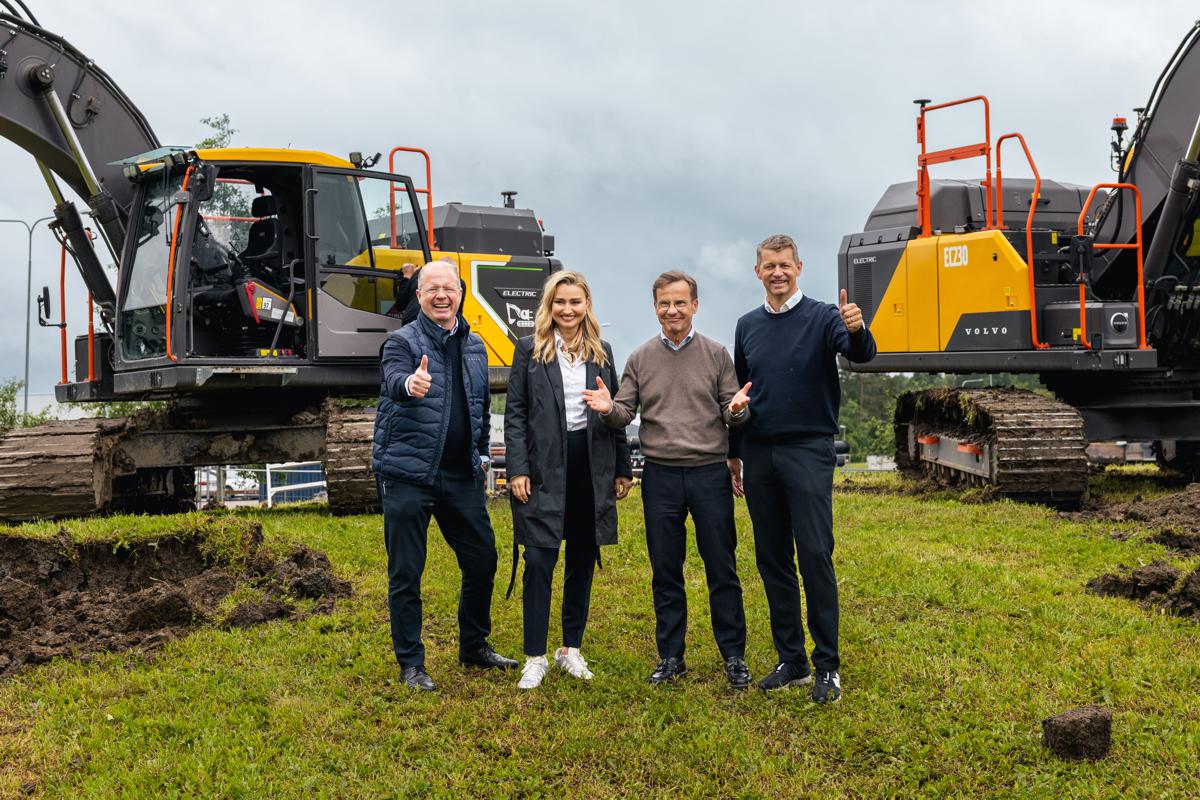
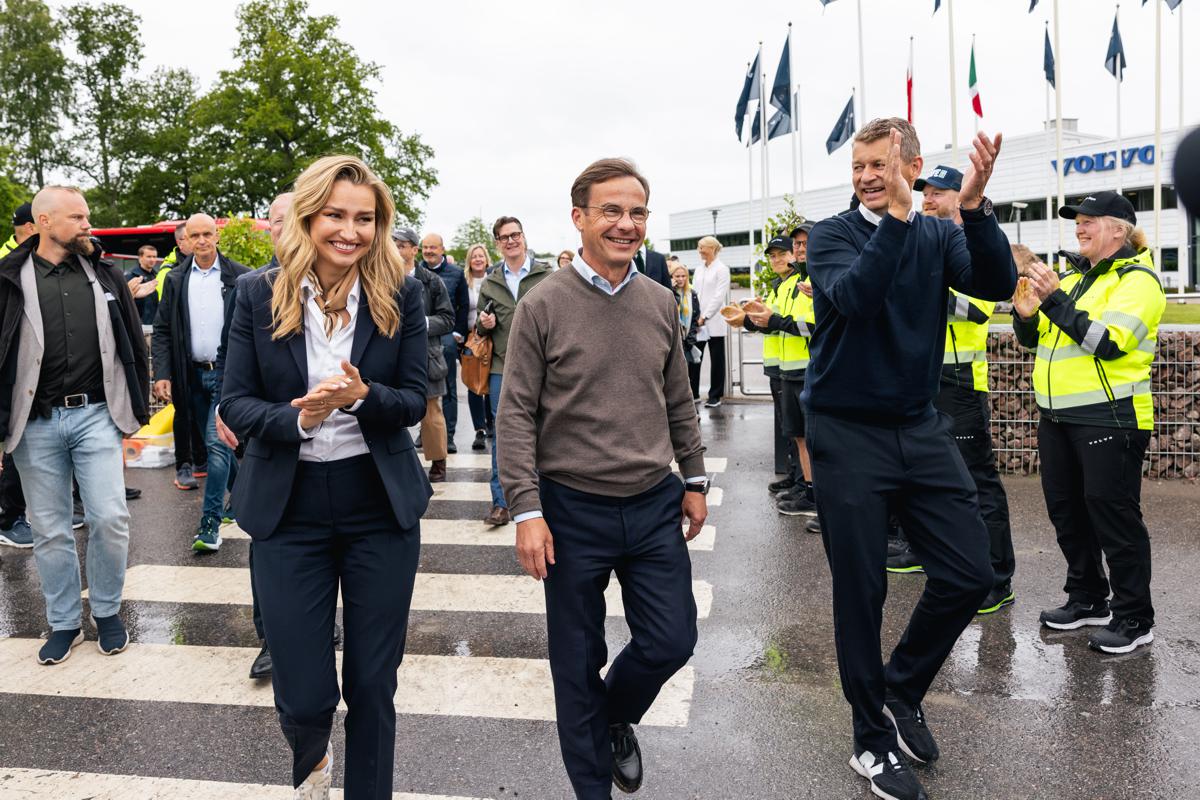
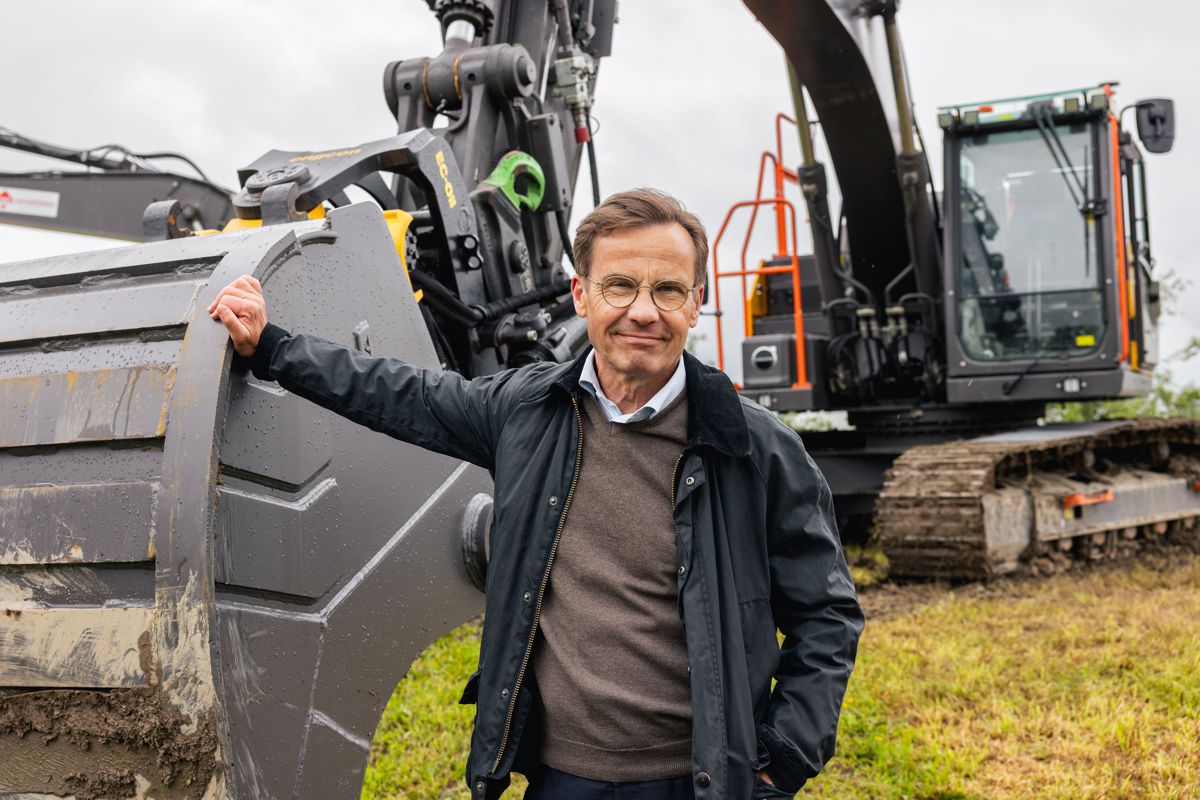
Swedish Prime Minister Ulf Kristersson and Deputy Prime Minister Ebba Busch took the controls of electric 23 tonne excavators for a symbolic first dig, and Kristersson, who grew up in Eskilstuna, described the moment in personal terms: “It really feels like coming home. I’m incredibly pleased to be here today and show how this proud heritage is being carried forward. I strongly believe in the close dialogue between business and politics that we have in Sweden – keep up the good work!” The presence of two of the country’s most senior politicians at a corporate ground-breaking signals how closely industrial capacity has become bound up with the broader European debate over economic security and strategic autonomy.
Busch made that link explicit, casting the machines as instruments of national capability rather than merely commercial products. “These yellow machines have quite literally built this country – from roads and mines to cities. At a time of increasing uncertainty, competitiveness is not just an economic issue. It is about independence, resilience and the ability to build our future with our own resources. Today, Volvo CE is writing the next chapter in Sweden’s industrial history – one that inspires and looks firmly to the future,” she said.
With around 40% of Volvo CE’s total production hours already based in Sweden, and the new plant set to leave every key product line manufactured domestically, the company is consolidating a national footprint at a time when peers are dispersing theirs, and it is doing so with visible state endorsement.
What Eskilstuna signals for the next decade of European manufacturing
The decision to break ground in Sweden rather than chase lower labour costs elsewhere is the clearest read yet on how at least one major European original equipment manufacturer intends to navigate a fragmenting trade environment. The wager is that resilience, speed to customer and political alignment will outweigh the cost penalty of high-wage production, and that a regionalised network of plants, each serving its home market, is a sturdier model than the global export hubs that defined the previous era of manufacturing strategy. If that bet pays off, Eskilstuna will stand as an early template for how legacy industrial firms defend share against lower-cost challengers without abandoning the markets and workforces that built them.
The risks are real and worth naming. High-cost European production must still justify itself on price as well as proximity, electrification could move faster or slower than the flexible line is calibrated for, and permitting timelines retain the power to slow even well-capitalised projects. Yet the strategic direction is unambiguous, and the SEK 2.5 billion programme behind Eskilstuna, spanning Sweden, the United States and South Korea, suggests this is a structural reorientation rather than a one-off gesture. For contractors and investors tracking where European earthmoving capacity will sit in 2028 and beyond, the answer increasingly runs through plants built deliberately close to the customers they serve.