ULMA’s 400-Tonne Formwork Package Keeping São Paulo Bridge on Schedule
Cable-stayed bridges tend to earn their attention once the cables are strung and the deck is soaring, but the economics of building one are settled far earlier, in the temporary structures that shape the concrete, carry its weight and give crews safe access to it.
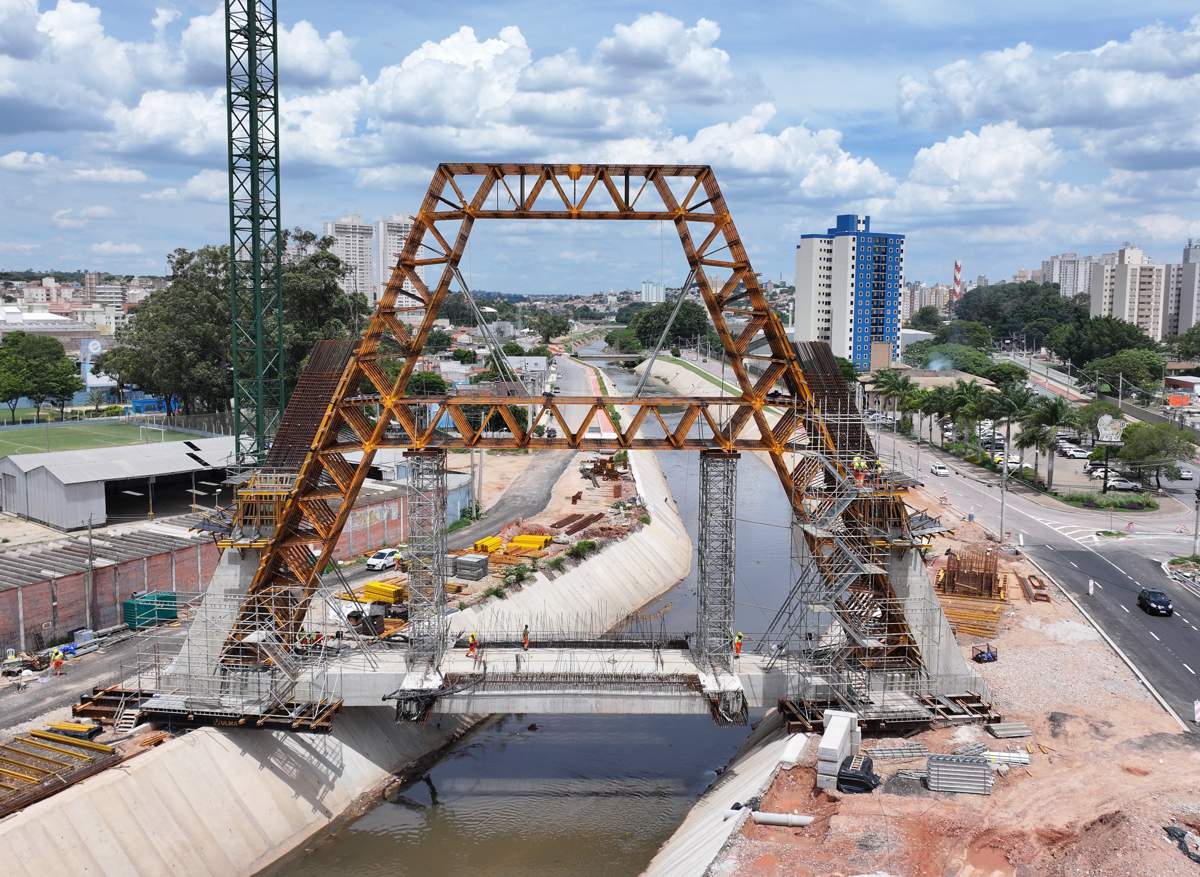
On the new cable-stayed crossing rising over the Jundiaí River in São Paulo state, that early phase has been handled by ULMA Construction, which supplied 400 tonnes of formwork, shoring and access equipment configured to the different demands of the job. The crossing is the centrepiece of the largest mobility programme in the municipality’s history, and the way its temporary works have been packaged says a good deal about where competition in the sector is heading.
For contractors and the public authorities that fund them, the interest here is less about the finished silhouette than about programme certainty. A single 43-metre pylon carrying the structure on both sides leaves little margin for improvisation, and the choice of temporary works determines how quickly the deck can be built, how much labour is exposed to work at height, and whether the schedule survives contact with the site.
ULMA’s involvement illustrates a wider shift in heavy civil works, where suppliers increasingly win business not on individual products but on integrated packages that pre-assemble complexity out of the critical path.
Briefing
- ULMA supplied 400 tonnes of formwork, shoring and access equipment for the Jundiaí cable-stayed bridge, the centrepiece of a roughly R$143 million (around £21 million) municipal mobility programme.
- The structure is carried by a single 43-metre central pylon, with both sides of the deck built simultaneously to compress the construction timetable.
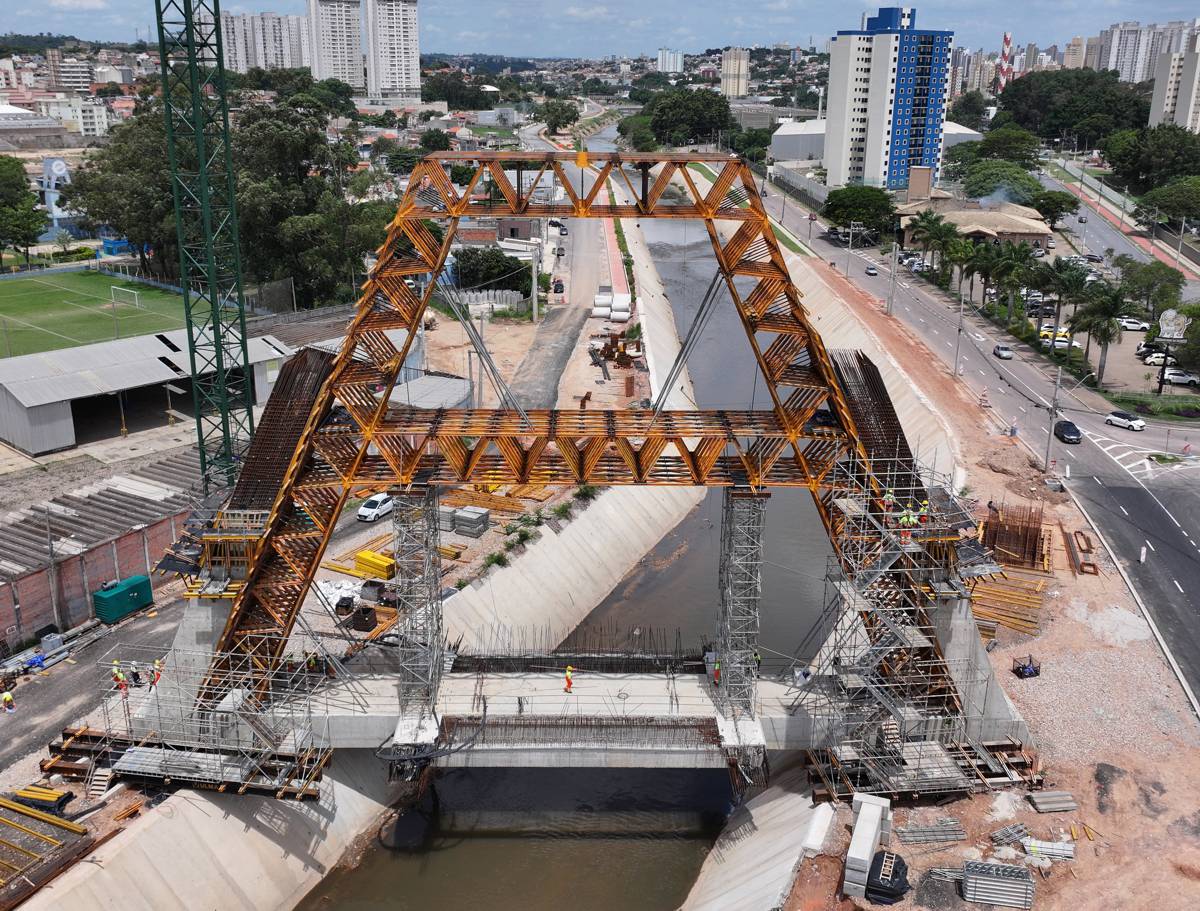
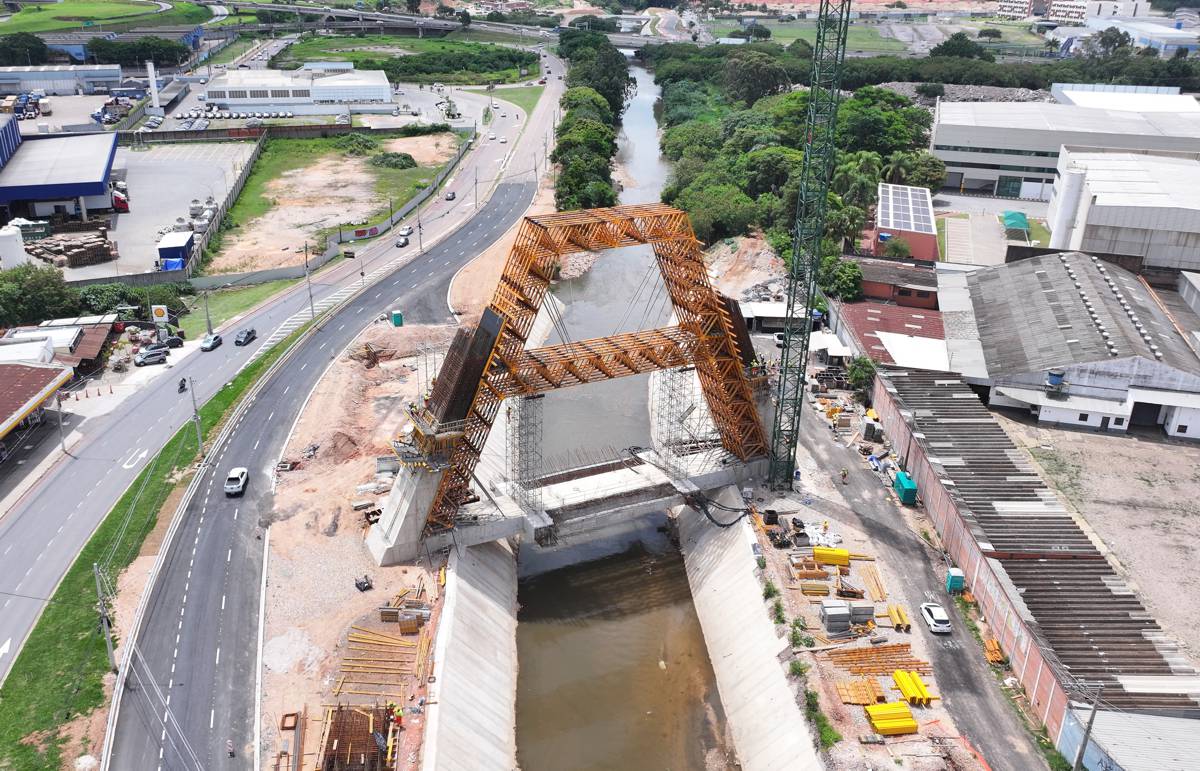
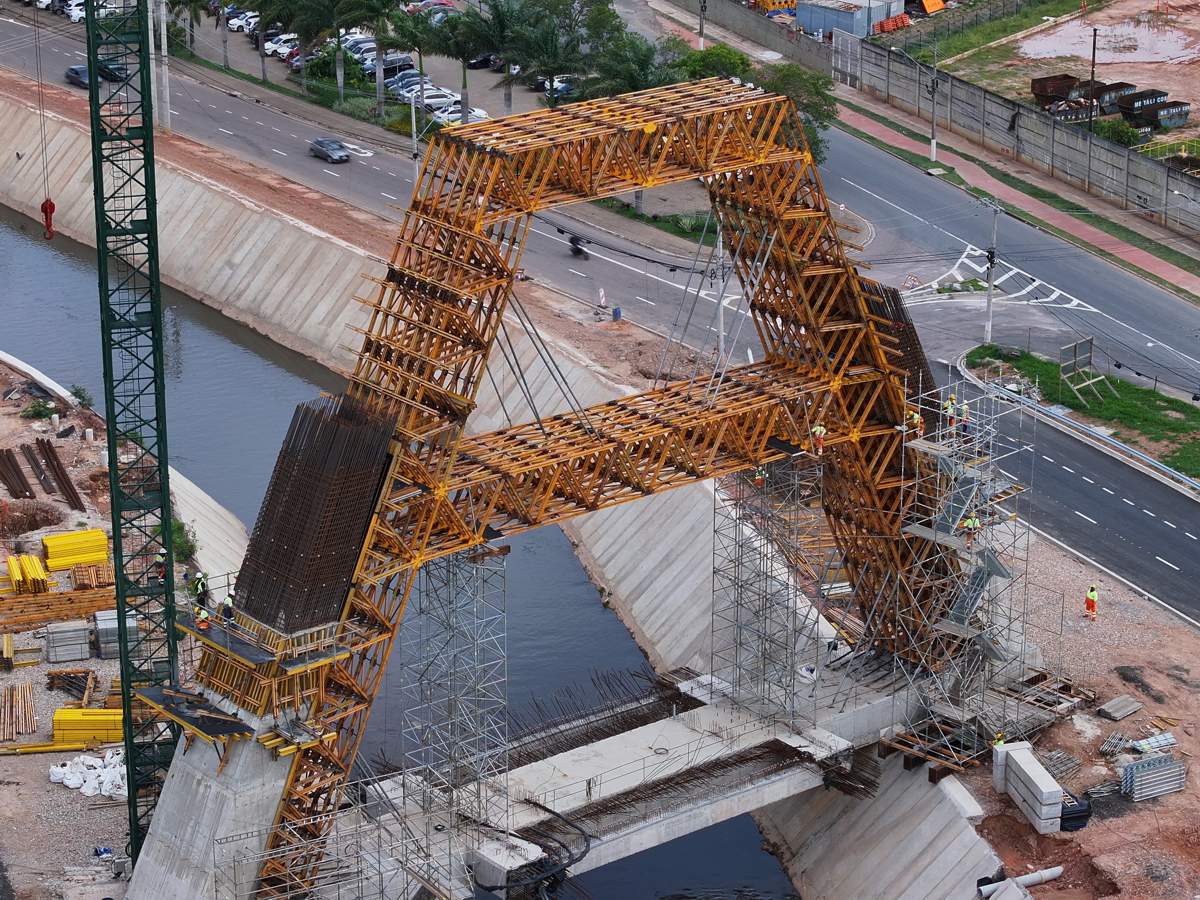
- The MK System allowed truss structures to be pre-assembled at ground level and lifted into position in a single operation, reducing time spent working at height.
- Supporting equipment included COMAIN modular formwork, T-60 shoring towers, and BRIO scaffolding and stair towers, providing continuous access through three-metre concreting lifts.
- The contract extends ULMA’s long record of cable-stayed bridge work in Brazil, a market where integrated temporary-works supply is becoming the main point of differentiation.
The Temporary Works Package Behind The Schedule
The headline figure of 400 tonnes matters less as a measure of tonnage than as an indication of scope. Rather than supplying a single formwork line, ULMA assembled a combined package spanning the MK System, COMAIN modular formwork, T-60 shoring towers, and BRIO scaffolding and stair towers, each tuned to a specific phase of construction.
That breadth is where value now sits in the temporary-works trade. A crossing of this type moves through several distinct stages, from early concrete placement to access and finishing works, and a supplier able to cover all of them from one engineering office removes interfaces, reduces the risk of incompatible kit and gives the contractor a single point of technical accountability.
Eduardo Lucena, a production engineer at ULMA, framed the crossing within the broader scheme, noting that the works are improving Jundiaí’s urban infrastructure through three conventional bridges, a tunnel beneath the João Cereser highway and, as the city’s landmark, the cable-stayed bridge itself. He placed particular weight on the role of the MK System in the shoring, pointing to its strength relative to the small number of components required and to the pressure of meeting programme dates, which he said the approach helped to ease.
José Carlos Alves Nogueira, the general foreman on the cable-stayed bridge, was blunter about the commercial logic, describing the MK System as the element that made the project viable on cost and time because the structure could be built in full and launched in one go without compromising quality, safety or ease of handling.
Engineering The Central Pylon
The defining technical constraint is the geometry. A single 43-metre mast supporting the deck on both sides, with the two flanks raised together, demands a temporary structure that is both stiff enough to hold the loads and adaptable enough to follow the shape as it rises. This is where the MK System earned its place. Built as trusses with high load-bearing capacity, it can be configured to almost any span geometry, and on the Jundiaí crossing it was used alongside VMK vertical formwork and BMK climbing brackets to form the working assemblies around the pylon and the approaching deck sections.
The more consequential detail is the sequencing. Because the MK components allow structures to be pre-assembled before they are placed, crews could build sizeable truss assemblies at ground level and lift them into position complete, rather than piecing them together in the air. That single-lift approach trims crane cycles, shortens the time workers spend at height and protects the stability of partially built sections, all of which feed directly into the programme.
On a bridge where both sides are advancing at once, the ability to standardise and repeat pre-built assemblies is what keeps the two halves in step and the schedule intact.
Access, Safety And The Concreting Sequence
Access and safety are frequently treated as secondary to the structural systems, yet on a symmetrical cable-stayed build they are inseparable from productivity. ULMA supplied BRIO scaffolding to provide continuous access across the working levels, with stair towers ensuring that personnel could move smoothly through the three-metre concreting lifts that characterised the pour sequence.
The general foreman described the rhythm plainly, explaining that at each three-metre stage the stairs and climbing equipment advanced together with the shoring, so that access and structure rose as a single coordinated system rather than as separate trades chasing one another up the pylon.
The formwork and shoring behind those pours came from the same integrated package. COMAIN modular formwork handled the concrete faces, while T-60 shoring towers carried the loads through the initial placement phases, and the BRIO stairs kept circulation open for both crews and, at the relevant stages, pedestrians.
Continuity of this kind is what allows a contractor to hold quality and safety standards while still working at pace, and it is precisely the sort of coordinated detail that a fragmented, multi-supplier procurement tends to lose. ULMA’s specialist team supported the planning, assembly and structural control of the systems throughout, a service element that increasingly forms part of the commercial proposition rather than an afterthought to it.
Inside Jundiaí’s Largest Mobility Programme
The bridge does not stand alone, and its significance is best read against the scheme that contains it. The crossing forms part of the extension of Avenida Antônio Frederico Ozanan, described locally as the largest mobility project in Jundiaí’s history, and once complete it will link the Ozanan corridor with Avenida Luiz Latorre.
The wider works run for around five kilometres in both directions and take in four bridges, a tunnel beneath the João Cereser highway, roughly 900 metres of canalisation along the Jundiaí River, a landscaped linear park planted with thousands of native trees, and a cycleway. Total investment stands at approximately R$143 million, split between around R$100 million from the São Paulo state government and R$43 million in municipal funds.
That funding structure is as telling as the engineering. Co-financing between state and municipality, with the state carrying the larger share, is a common route to delivery for mid-sized Brazilian mobility schemes, and it shapes both the procurement timetable and the political visibility of the works. The Jundiaí project has drawn attention at state level, with the crossing positioned as a strategic connection and a civic landmark rather than a simple river bridge.
For suppliers and contractors watching the Brazilian pipeline, schemes of this scale, bundling roads, bridges, drainage and green infrastructure under a single programme, represent a steady and repeatable source of work that does not depend on the occasional headline megaproject.
ULMA’s Brazilian Foothold
For ULMA, a formwork and scaffolding cooperative headquartered in Oñati in the Spanish Basque Country, the Jundiaí contract reinforces a position built over successive Brazilian bridge projects. The company has previously supplied temporary works for high-profile cable-stayed crossings in the country, including the Estaiada bridge on Rio de Janeiro’s Metro Line 4 and the arch-shaped landmark connecting major avenues in São Paulo, as well as the cable-stayed section of the Via Mangue motorway in Recife. That accumulated reference base matters in a market where contractors are cautious about entrusting critical, safety-defining temporary works to unproven suppliers.
The competitive picture is instructive. Formwork and shoring is a concentrated global trade in which a handful of international engineering-led suppliers compete less on catalogue products than on the quality of project-specific design and site support. ULMA’s pitch on Jundiaí, an integrated package that pre-assembles complexity, standardises repeat lifts and folds access and safety into the structural sequence, is characteristic of how the sector is trying to move up the value chain.
As labour availability tightens and clients grow less tolerant of programme slippage, the argument for buying an engineered temporary-works system rather than assembling one from parts becomes harder for contractors to ignore.
What The Jundiaí Job Signals
The finished crossing will be judged on its span and its cables, but the more durable lesson for the industry lies in how it was built. The combination of pre-assembled truss structures, single-lift placement, simultaneous construction of both sides and an access system that climbs in lockstep with the pour points to a model of bridge delivery in which the temporary works are treated as programme insurance rather than a commodity. On a mid-sized municipal scheme, that discipline is what keeps a landmark structure on time and on budget.
For the wider Brazilian market, the project is a reminder that the meaningful competition among temporary-works suppliers is now fought on engineering and coordination rather than tonnage. Schemes such as the Ozanan extension, which knit together bridges, tunnels, drainage and public realm under a single funding envelope, will continue to generate demand for exactly this kind of integrated capability.
The suppliers best placed to capture it will be those that can demonstrate, as ULMA has here, that a well-designed temporary structure is not a cost to be minimised but a route to schedule certainty on the projects that municipalities most want to be seen delivering.