Clearview and Prismo Secure DfT Approval for Cast Iron SolarLite S381 Active Road Stud
For most highway authorities, the obstacle to fitting active, illuminated road studs has rarely been the technology itself. Solar-powered studs that project their own LED light have been proven on UK roads for the better part of three decades, yet uptake on the busiest routes has been held back by the practicalities of specification, installation and maintenance.
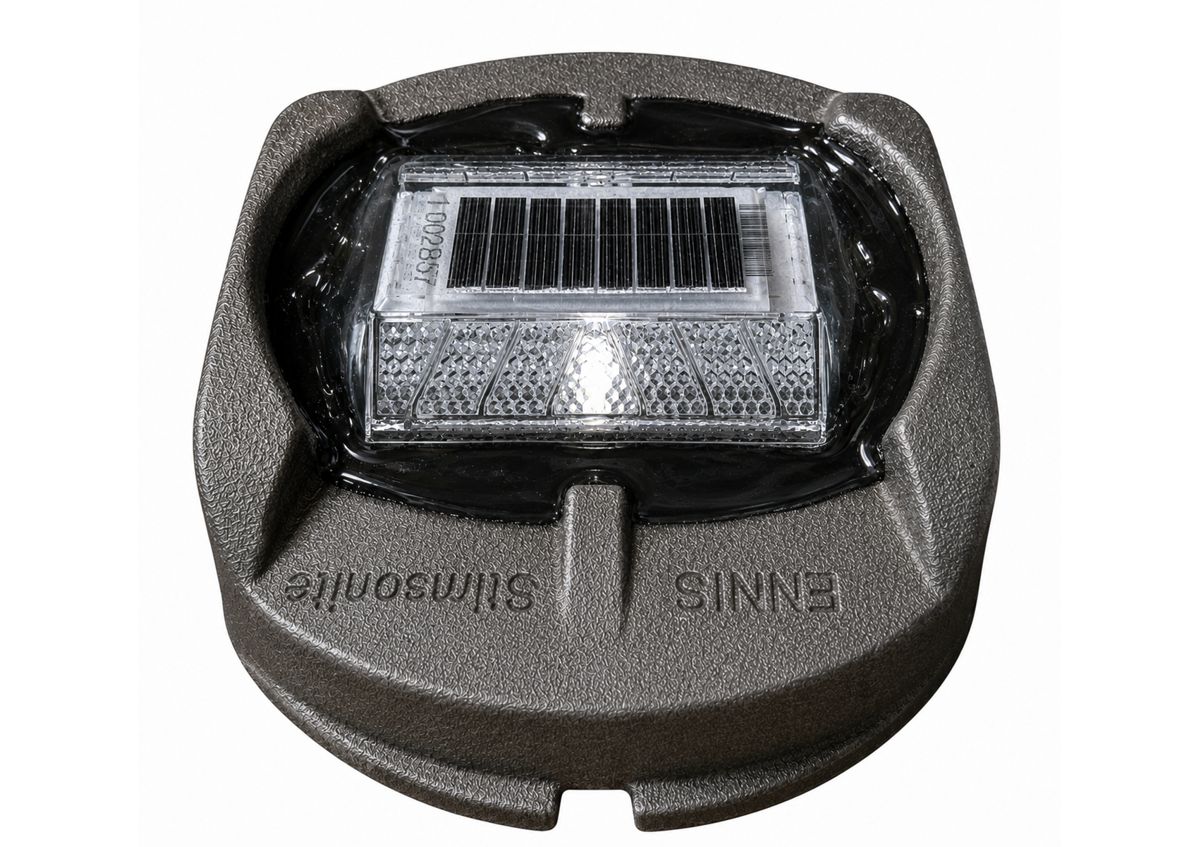
Department for Transport Type Approval for the SolarLite S381, developed jointly by highways technology firm Clearview Intelligence and road markings manufacturer Prismo, is significant precisely because it removes those practical frictions rather than reinventing the stud. The unit is designed to drop into a traditional cast iron road stud installation, which means an authority can replace a passive retroreflective stud with an active illuminated one using the same housing, the same contractors and the same working method it already knows.
That distinction matters commercially far more than it might first appear. Active road studs have generally required either bespoke installation or a shift in working practice, and anything that disrupts a planned resurfacing or lining programme carries a cost that specifiers notice. By fitting the standard cast iron shoe used across the network, the S381 lets white lining and road marking crews absorb the upgrade into routine works without additional civil engineering, electrical connections or programme changes.
In effect, the commercial question moves from whether an authority can accommodate active studs to whether it wants the additional visibility, which is a very different conversation to have with a maintenance budget holder.
Briefing
- Clearview Intelligence and Prismo have secured DfT Type Approval for the SolarLite S381, a solar-powered active road stud built into a standard heavy-duty cast iron housing.
- The design drops into traditional cast iron installations, allowing authorities to swap passive retroreflective studs for active LED guidance without extra civils, electrical works or changes to installation practice.
- The heavy-duty housing targets strategic and heavily trafficked routes, offering resistance to HGV loading and winter maintenance operations, including snow ploughs.
- Powered entirely by solar energy with no mains connection, the stud is quoted as visible up to 900 metres against roughly 90 metres for a conventional reflective stud, with an eight to ten year service life and quoted autonomy of up to seven days without sunlight.
- Lead times are around eight to ten weeks, positioning the product for inclusion in routine resurfacing and road-marking programmes rather than as a standalone scheme.
A Retrofit Route Rather Than A New Programme
The core proposition of the S381 is standardisation, and that is where its value to procurement teams sits. Because the stud uses the industry-standard installation methods associated with a conventional retroreflective stud housed in cast iron, contractors already understand the application process, and installation rates can broadly match those of the products crews fit every day.
For an authority weighing a network-wide safety improvement, the ability to fold active delineation into existing renewal cycles is a meaningful reduction in both risk and disruption, and it sidesteps the traffic management and lane closure overheads that a separate installation exercise would demand.
Alastair King, Head of SolarLite at Clearview Intelligence, framed the approval as a widening of the existing range rather than a departure from it. “Rather than replacing the existing SolarLite range, the new S381 expands it,” he said. “It complements Clearview’s established products by bringing the technology to schemes where cast iron housed road studs are preferred or specified, while also providing a direct upgrade path from conventional passive retroreflective studs to active illuminated guidance.”
The strategic logic is that specifiers who already default to a cast iron stud on a demanding route now have an approved active option that fits their established specification, which lowers the barrier to switching from reflection to active illumination without asking anyone to change how they work.
Built For The Strategic And Trunk Road Network
Where the standard housing addresses adoption, the choice of a heavy-duty cast iron shoe addresses durability, and it is this that opens the strategic road network to the product. Reflective and lighter-housed studs can struggle on high-load, high-speed corridors, and winter maintenance is often the more punishing test, since snow ploughs and gritting operations damage anything that sits proud of the carriageway.
Prismo brings long-established expertise in exactly this area through its Stimsonite road stud heritage, including hardened cast iron housings engineered for snow climates, and pairing that housing with Clearview’s illuminated insert is a deliberate move to make active guidance viable on routes that were previously off limits.
King was explicit that the housing is what extends the range into tougher territory. “The addition of the heavy-duty cast iron housing extends the range into more demanding operating environments,” he said. “As well as providing greater protection against heavy traffic loading, the housing is designed to withstand winter maintenance operations and is resistant to damage from snow ploughs, making it suitable for strategic routes and other heavily trafficked roads.”
James Moore, Managing Director at Prismo, positioned the collaboration in similar terms of fitness for a demanding network. “Together, we’ve combined our proven heavy-duty cast-iron housing with Clearview’s market-leading SolarLite technology to create a solution that meets the demanding requirements of today’s road network,” he said, adding that established installation methods mean authorities and contractors can introduce active studs quickly on their busiest roads.
The Visibility And Whole-Life Economics
The performance case for active studs rests on a simple physical difference. A conventional retroreflective stud only returns light when a vehicle’s headlights strike it at the right angle, and in good conditions that typically gives drivers around 90 metres of visibility, a figure rooted in a delineation concept that dates back to the cat’s eye of the 1930s. An active stud does not wait for headlights.
The SolarLite unit uses high-brightness LED optics powered by an integrated solar cell to project light directly into the driver’s line of sight, which Clearview quotes as visible up to 900 metres, roughly ten times the reach of a reflective stud. On bends, junctions and other hazards, that additional distance translates into earlier recognition and more reaction time, and the benefit is most pronounced in darkness and adverse weather, precisely when reflective performance degrades.
The operating model is designed to be low cost as well as low carbon. The stud runs entirely on solar power, so there is no mains connection to install and no ongoing electricity cost, and the two launch releases quote an expected service life of between eight and ten years alongside stored autonomy sufficient to keep a stud running for up to seven days without sunlight.
For an asset manager, the attraction is that a single approved product can deliver guidance on unlit or partially lit routes without introducing an energy bill or a new maintenance liability, and where the alternative would be installing or retaining lighting columns, the comparison becomes one of whole-life cost rather than headline unit price. Clearview also points to accident reductions at existing SolarLite installations, and while such site-level figures should be read as the company’s own case-study evidence rather than independent findings, the underlying mechanism of earlier hazard perception is well understood in road safety terms.
The Decarbonisation Context
The launch lands in the middle of a national rethink about how, and whether, to light rural and inter-urban roads at all. Clearview’s SolarLite technology has been trialled within ADEPT Live Labs 2, the three-year, £30 million programme funded by the Department for Transport to decarbonise the local highway network, where East Riding of Yorkshire Council has led work on replacing end-of-life street lighting with high-reflectivity lining and solar studs rather than like-for-like columns.
That project won an ADEPT pitching session in 2025 and has since drawn national recognition, and it speaks to a wider structural opportunity given that the UK carries in the order of 7.2 million street lighting assets, many of them ageing and carbon-intensive across their full life.
The company points to that programme in framing the S381’s environmental case, citing potential carbon reductions of up to 25 per cent and savings of approximately £1.24 million over ten years against conventional street lighting. ADEPT’s own published reporting from the East Riding test sites sets out related but not identical figures, calculating savings of around £1.1 million over the first ten years and £1.6 million over forty, alongside roughly 160 tonnes of CO2e avoided across the trial routes in the first decade.
The direction of travel is consistent even where the precise numbers differ, and the principle holds: removing lit columns and their embedded carbon while maintaining night-time guidance can cut both whole-life cost and emissions on the right roads. For authorities under pressure to hit net zero commitments without compromising safety, an approved, plough-resistant active stud gives that argument a specifiable product to hang on.
What The Approval Signals For The Market
Type Approval is often treated as a technical formality, but for a delineation product aimed at strategic routes it functions as a market unlock. It allows highway authorities to specify and deploy without the delay and cost of individual site assessments, which is frequently the point at which promising safety technology stalls in procurement.
With approval secured and lead times quoted at around eight to ten weeks, the practical path from specification to installation is now short enough to sit inside a normal maintenance planning horizon, and that timing is as important to adoption as any performance claim.
The wider signal is about how the road safety and decarbonisation agendas are converging on the same physical assets. Where authorities once treated lighting, lining and studs as separate line items, programmes such as Live Labs 2 are pushing a whole-of-carriageway view in which the right blend of high-reflectivity lines and active studs can, on suitable routes, do the job that a lit column used to do at a fraction of the carbon.
Products engineered to slot into existing practice, rather than demand new practice, are the ones most likely to move at scale, and the S381’s combination of a familiar housing, an approved active insert and an established installation method is squarely aimed at that reality. For Clearview and Prismo, the collaboration also consolidates a supply position that pairs proven illumination technology with British-manufactured heavy-duty housings, which matters to specifiers who value continuity of supply as much as headline capability.

Key Industry Questions
- What does DfT Type Approval actually mean for an authority specifying the S381? Type Approval confirms that a road stud meets the Department for Transport’s performance and testing requirements for use on the public highway, which allows authorities to specify it directly without commissioning individual site assessments or bespoke approvals. In procurement terms, that removes a common source of delay and cost, because the compliance question is settled at product level rather than scheme by scheme. For the S381 specifically, approval means the active stud can be written into standard resurfacing and lining specifications alongside conventional studs, giving specifiers confidence that the product is suitable for adoption within routine renewal programmes rather than treated as an experimental installation requiring separate justification.
- How does the S381 differ from Clearview’s existing surface and flush SolarLite studs? The core SolarLite technology is shared across the range, but the S381 is distinguished by its heavy-duty cast iron housing supplied through Prismo. Surface and flush variants are optimised for edge delineation and lower-profile applications, whereas the cast iron shoe is built to survive the loading and winter maintenance found on strategic and heavily trafficked routes. That difference is what extends the technology to corridors where a cast iron stud would traditionally be specified. Clearview has been clear that the S381 expands the range rather than replacing existing products, so authorities can select the housing appropriate to a given road type while retaining the same underlying illuminated performance.
- Can the S381 genuinely be retrofitted into existing cast iron housings? The product is designed to fit the standard cast iron installation used across the UK network, which means it can be incorporated where that housing type is already specified and, in principle, offers a direct upgrade path from passive to active studs. Crucially, it uses the same installation methods as a conventional retroreflective stud in cast iron, so contractors do not need additional civil engineering, electrical connections or new working practices. Authorities should still confirm compatibility with their specific existing installations and adhesives during specification, but the design intent is explicitly to let active guidance be introduced during routine works rather than through a separate civils exercise.
- How do the quoted carbon and cost savings compare with what ADEPT has published? The launch materials cite potential carbon reductions of up to 25 per cent and savings of approximately £1.24 million over ten years against conventional street lighting. ADEPT’s own reporting from the East Riding Live Labs 2 test sites sets out related figures of around £1.1 million over the first ten years and £1.6 million over forty, together with roughly 160 tonnes of CO2e avoided across the trial routes in the first decade. The figures are not identical, and specifiers should treat the vendor’s headline numbers as indicative rather than a like-for-like reproduction of the published trial data. The consistent conclusion across both is that replacing lit columns with solar studs and high-reflectivity lining can reduce whole-life cost and embedded carbon on appropriate routes.
- Is a solar active stud reliable through UK winters and extended low-light periods? Reliability in low light is the obvious concern for any solar-powered asset, and the S381 is quoted as storing enough energy to operate for up to seven days without sunlight, running automatically from dusk to dawn. In practice, studs charge across daylight hours even in overcast conditions and draw on stored energy during darkness, so continuous winter operation does not depend on bright sun. The cast iron housing is also engineered to withstand snow ploughs and gritting, which addresses the second winter risk of physical damage. Authorities specifying for northern or upland routes should nonetheless validate performance expectations for their specific light and weather conditions as part of normal due diligence.
- Where does the S381 sit on cost against conventional reflective studs over its life? On unit price, an active solar stud will cost more than a passive reflective one, so the case rests on whole-life value rather than upfront cost. The relevant comparison is often not stud against stud but active stud against the lighting or repeated interventions it can displace, since reflective studs lose retroreflectivity over time and can require refreshing within a few years. With no energy cost, low maintenance and a quoted eight to ten year service life, the S381 is positioned as a premium product whose economics improve where it reduces or removes a lighting liability. Authorities should model this at route level, factoring in traffic management savings from folding installation into existing programmes.
- What does the approval mean for white lining and Tier 1 contractors? For contractors, the significant point is that the S381 fits established installation practice, so it can be delivered by existing crews using existing methods without retraining or additional plant. That protects programme certainty, since the upgrade does not introduce new critical-path activities or specialist civils, and it allows contractors to offer authorities a higher-specification safety outcome within the same maintenance envelope. For Tier 1 firms managing large renewal contracts, an approved active stud that behaves like a conventional one operationally is easier to price, schedule and guarantee, which in turn makes it easier to recommend to clients pursuing both safety and carbon objectives.
- Could active road studs realistically replace street lighting on some routes? On certain route types, particularly rural and inter-urban roads with defined conflict points such as junctions and roundabouts, the evidence emerging from programmes like Live Labs 2 suggests that a designed combination of high-reflectivity lining and active studs can maintain or improve guidance without continuous overhead lighting. This is not a blanket replacement, and residential and complex urban environments are generally excluded from the approach. The realistic outcome is selective substitution, where authorities remove or avoid lighting on suitable stretches while retaining it where pedestrian and multi-user demands require it. Active studs such as the S381 give that strategy an approved, durable component to specify on the more demanding roads within it.
Strategic Takeaways
- Standardisation, not novelty, is the commercial lever: by fitting a standard cast iron housing and established installation method, the S381 converts active delineation from a special scheme into a line item inside routine renewal programmes.
- The heavy-duty housing materially expands the addressable market, bringing approved active studs to strategic and trunk routes where load and winter maintenance previously ruled lighter products out.
- Whole-life economics, not unit price, will decide adoption, with the strongest case arising where an active solar stud reduces or removes a lighting liability rather than simply replacing a reflective stud.
- The road safety and decarbonisation agendas are converging on the same carriageway assets, and products that slot into existing practice will scale faster than those demanding new practice, giving the S381 a structural advantage.
- Specifiers should treat vendor carbon and cost claims as indicative and validate them against ADEPT’s published trial data, while recognising that the underlying direction, lower embedded carbon with maintained night-time guidance, is well supported.