HTEC and Embotech Accelerate the Industrial Rollout of Level 4 Autonomous Logistics
The industrial autonomy market is entering a new phase where engineering execution, certification and scalable deployment are becoming just as important as advances in artificial intelligence. As autonomous vehicle technology matures, manufacturers, ports and logistics operators increasingly need solutions that can be replicated across multiple sites while maintaining rigorous safety standards and integration with existing operations.
Engineering specialist HTEC and autonomous driving developer Embotech have formed a strategic partnership designed to accelerate the deployment of certified Level 4 autonomous logistics systems. Rather than introducing a new autonomous platform, the collaboration addresses one of the industry’s biggest commercial challenges: scaling proven technology efficiently across diverse vehicle fleets, industrial facilities and global customer programmes.
For infrastructure owners, automotive manufacturers and logistics operators, this reflects a wider shift across industrial automation. Organisations are no longer asking whether autonomous logistics can work, but how quickly certified systems can be integrated into existing operational environments without increasing complexity or risk.
Briefing
- HTEC and Embotech have entered a strategic engineering partnership to accelerate deployment of certified Level 4 autonomous logistics systems.
- HTEC will provide software engineering, vehicle integration, connectivity and validation expertise while Embotech retains ownership of its autonomy platform and certified safety architecture.
- Embotech’s autonomous systems already move more than 2,500 vehicles every day across factories, logistics centres and ports.
- The collaboration aims to shorten deployment times across multiple vehicle platforms, industrial sites and OEM programmes.
- The partnership reflects growing industry demand for scalable, safety-certified industrial autonomy rather than experimental autonomous vehicle deployments.
Scaling Becomes the Next Competitive Advantage
Industrial autonomy has reached an important point in its commercial development. While much public attention continues to focus on autonomous passenger vehicles, industrial logistics has quietly become one of the most successful environments for highly automated transport. Operations take place within controlled environments, vehicle routes are predictable, and the commercial benefits from improved productivity and safety can be measured much more easily.
As adoption increases, however, engineering capacity has emerged as a limiting factor. Every deployment requires software integration, validation, vehicle adaptation and extensive testing before autonomous systems can enter production. Delivering these programmes repeatedly across multiple customers and locations demands substantial engineering resources beyond the core autonomy platform itself.
The partnership addresses precisely that challenge. Under the agreement, HTEC contributes expertise in embedded software, onboard systems, connectivity, vehicle integration and validation, allowing Embotech to increase deployment capacity while maintaining control of its certified autonomous driving platform and long-term product roadmap.
For vehicle manufacturers and logistics operators, this should reduce the time required to introduce autonomous operations across additional factories, ports and distribution facilities without compromising functional safety requirements.
Industrial Logistics Continues to Lead Autonomous Deployment
Unlike public road autonomy, industrial logistics has become one of the fastest-growing commercial markets for autonomous driving technologies. Automotive manufacturing plants, vehicle marshalling yards, ports and logistics hubs typically operate around the clock, creating ideal conditions for autonomous transport systems that can improve utilisation while reducing reliance on manual vehicle movements.
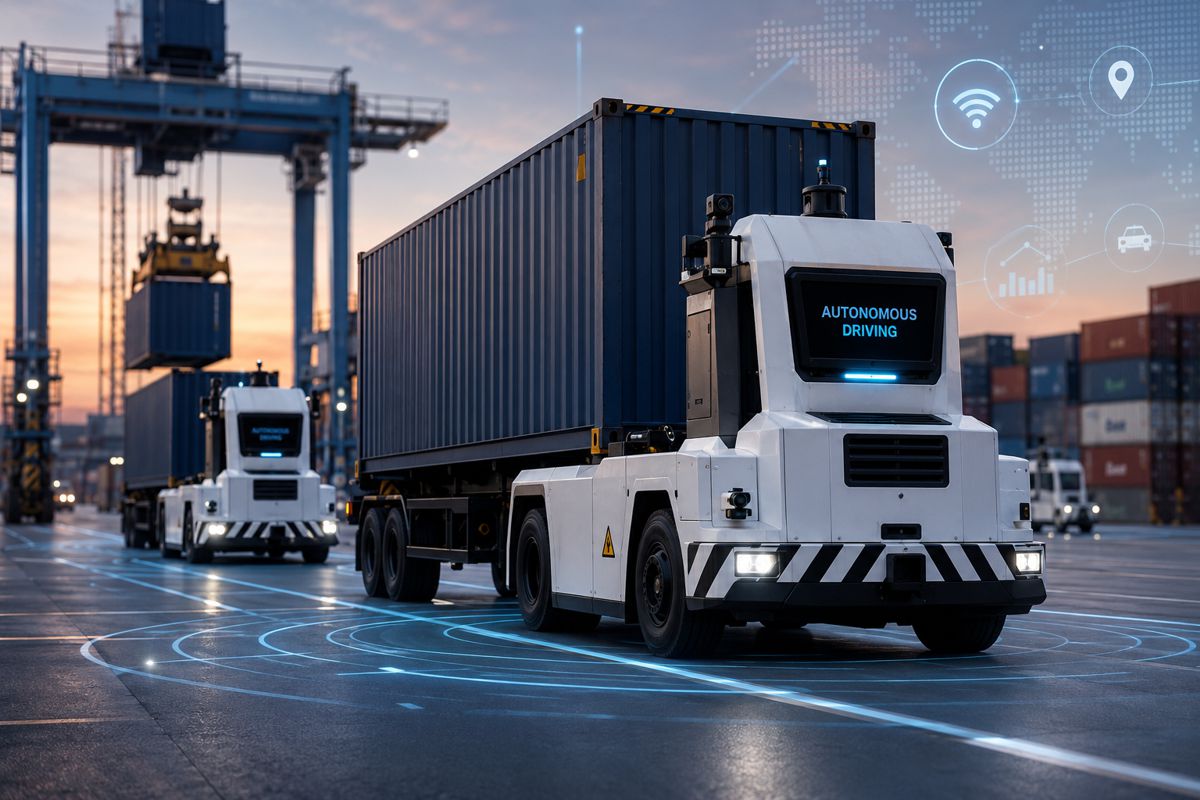
Embotech has already demonstrated that these systems can operate continuously in demanding industrial environments. Its Level 4 platform currently supports autonomous movement of more than 2,500 vehicles every day across customer sites operating 24 hours a day, seven days a week.
The company’s shared autonomy platform supports both vehicle-based and infrastructure-based operating models. Artificial intelligence manages perception, prediction and motion planning, while independently certified safety systems oversee operational integrity, providing the redundancy required for industrial deployment.
This distinction between operational intelligence and independently validated safety architecture has become increasingly important as regulators and industrial customers seek greater confidence before deploying autonomous systems at scale.
Certification Is Becoming a Commercial Asset
Safety certification is increasingly differentiating suppliers within the industrial autonomy market. While many autonomous vehicle developers continue to demonstrate prototype capabilities, relatively few have achieved internationally recognised certification for operational deployment.
Embotech notes that it is the first company worldwide to achieve multiple TÜV SÜD-certified Level 4 autonomous driving solutions. Independent certification carries significant weight among automotive manufacturers, infrastructure operators and industrial customers, particularly where autonomous systems interact with expensive assets, production schedules and human workers.
Certification can also simplify procurement. Infrastructure operators frequently require independently verified compliance before introducing new operational technologies into critical logistics environments. Demonstrating that safety systems have been externally assessed reduces uncertainty for project owners while supporting regulatory approval processes in many markets.
As industrial autonomy expands into additional logistics sectors, independently certified safety architectures are likely to become increasingly valuable commercial differentiators rather than simply regulatory milestones.
Supporting Multiple Vehicle Platforms
One of the industry’s continuing technical challenges is adapting autonomous systems across diverse vehicle types without redesigning software for every application.
Industrial fleets frequently include vehicles from multiple manufacturers operating simultaneously within the same logistics ecosystem. Automotive factories alone may use purpose-built transport vehicles, conventional trucks, specialised yard tractors and customer vehicles moving between production stages.
HTEC’s contribution focuses heavily on solving these integration challenges. Its engineering teams will support onboard software development, embedded systems integration, connectivity, validation and adaptation across multiple vehicle platforms.
This approach allows Embotech to concentrate development resources on advancing its autonomy platform while leveraging additional engineering expertise to expand deployment programmes more rapidly.
For original equipment manufacturers, this separation between platform development and deployment engineering offers a practical route towards wider implementation without fragmenting the underlying technology architecture.
From Physical AI to Operational Reliability
Artificial intelligence remains central to autonomous logistics, but successful deployment increasingly depends on combining AI with conventional engineering disciplines.
Embotech describes its platform as physical AI-enabled autonomy, integrating machine learning for perception, environmental understanding and decision-making alongside deterministic safety systems that ensure predictable operation under industrial conditions.
This balance reflects a broader trend throughout industrial automation. AI provides flexibility when interpreting complex environments, while certified software architectures continue to manage safety-critical functions that require deterministic behaviour.
The partnership reinforces that philosophy by combining Embotech’s autonomous driving expertise with HTEC’s experience across embedded systems, software engineering and full-stack AI implementation.
As autonomous industrial vehicles become larger, faster and more deeply integrated into production environments, dependable systems engineering may prove just as valuable as advances in AI algorithms themselves.
Autonomous Logistics Extends Beyond Automotive Manufacturing
Although automotive production remains one of the largest adopters of industrial autonomy, similar operational challenges exist across ports, freight terminals, distribution centres and intermodal logistics facilities.
Global ports continue investing heavily in automated container handling, autonomous transport vehicles and digitally connected logistics infrastructure as cargo volumes increase while skilled labour shortages persist. Meanwhile, distribution centres are expanding automation to improve throughput and maintain around-the-clock operations.
Embotech’s portfolio already reflects this broader opportunity. Its Automated Vehicle Marshalling (AVM) and Autonomous Tractor Solution (ATS) operate across automotive factories, vehicle logistics centres, ports and industrial yards where repetitive vehicle movement offers strong returns on automation investment.
The engineering partnership potentially enables these solutions to expand into a wider range of industrial environments by increasing deployment capacity without requiring significant changes to the underlying autonomy platform.
For infrastructure investors, this demonstrates how autonomous logistics is evolving from isolated pilot projects into scalable operational technology supporting industrial productivity.
Meeting Industry Demand Through Engineering Capacity
One of the less visible constraints facing advanced technology companies is the availability of experienced engineering talent. Developing sophisticated software is only one part of commercial deployment; integrating products into customer operations requires specialist knowledge spanning hardware, embedded software, networking, validation and operational testing.
By combining their capabilities, HTEC and Embotech are effectively separating innovation from implementation. Embotech continues developing its autonomy platform, certified safety systems and product strategy, while HTEC contributes engineering resources capable of supporting multiple deployment programmes simultaneously. This division enables both organisations to concentrate on their respective strengths while increasing overall delivery capacity.
The approach mirrors wider trends across industrial technology markets, where strategic engineering partnerships are increasingly helping software developers respond to growing customer demand without significantly expanding internal development teams.
Building the Foundations for Industrial Autonomy at Scale
Industrial logistics is steadily becoming one of the most commercially mature applications of autonomous vehicle technology. Success is no longer defined solely by sophisticated AI or successful demonstrations but by repeatable deployment, independent certification and reliable operation across multiple industrial environments.
“Our physical AI-enabled autonomy technology is already operating 24/7 in customer environments, and demand for Level 4 autonomous solutions continues to grow across industrial logistics,” says Andreas Kyrtatos, Embotech’s CEO. “HTEC adds the engineering expertise to make deployments faster and easier to scale across vehicle platforms and multiple sites.”
From HTEC’s perspective, engineering discipline remains fundamental to commercial success. “Scaling autonomy in real-world vehicle environments requires more than innovation, it demands industrial-grade execution,” says Darko Todorovic, HTEC’s CTO. “HTEC brings deep expertise in embedded systems and OEM integration to deploy Embotech’s autonomy platform to multiple vehicle platforms. Together with Embotech, we’re enabling autonomous systems to deliver reliably across complex fleets, platforms and sites.”
For the wider construction, infrastructure and industrial sectors, the collaboration highlights an increasingly important reality. The future of autonomous logistics will depend not only on smarter software but on delivering certified, repeatable engineering solutions capable of supporting global industrial operations at scale.
Key Industry Questions
- Why is Level 4 autonomy particularly suited to industrial logistics? Industrial environments offer more controlled operating conditions than public roads. Vehicle routes are generally predefined, operating speeds are lower, traffic participants are known and facilities can be equipped with supporting digital infrastructure. These characteristics simplify risk management while allowing autonomous systems to deliver measurable improvements in productivity, safety and equipment utilisation. As a result, factories, logistics yards and ports have become practical proving grounds for commercial autonomous vehicle deployment long before similar technology becomes commonplace on public highways.
- What distinguishes certified autonomous systems from demonstration projects? Certification provides independent verification that safety systems meet recognised standards rather than relying solely on internal testing. This gives customers greater confidence when introducing autonomous technology into operational environments where failures could affect production, personnel or valuable assets. Certification also supports procurement and regulatory approval by providing objective evidence that safety-critical functions have undergone rigorous external assessment.
- Why is deployment engineering becoming so important? Developing an autonomous driving platform is only one part of commercial implementation. Each customer deployment requires software integration, vehicle adaptation, communications configuration, validation and operational testing. As demand increases, engineering capacity becomes a significant constraint. Partnerships that expand deployment capability enable technology providers to deliver multiple programmes simultaneously while maintaining consistent technical standards and implementation quality.
- How could ports and logistics hubs benefit from autonomous vehicle operations? Ports and logistics terminals operate continuously and often involve repetitive vehicle movements between fixed locations. Autonomous transport can improve equipment utilisation, reduce delays caused by labour shortages, enhance operational consistency and support safer working environments. Combined with digital port management systems, autonomous vehicles also contribute to better scheduling, asset tracking and overall logistics efficiency.
- Does infrastructure need to change to support industrial autonomy? Many industrial facilities already possess digital infrastructure that supports autonomous operations, including high-accuracy positioning, wireless communications and traffic management systems. Additional investment may involve improved connectivity, mapping, charging infrastructure for electric vehicles and integration with warehouse or terminal management platforms. Compared with public-road autonomy, industrial deployments generally require fewer large-scale infrastructure modifications.
- What role does artificial intelligence play alongside certified safety systems? AI enables autonomous vehicles to perceive their surroundings, identify objects, predict movement and make driving decisions in dynamic environments. Safety-certified architectures operate alongside these AI functions, ensuring predictable responses under defined operating conditions and providing oversight of safety-critical behaviour. This layered approach combines AI flexibility with deterministic engineering principles required for industrial deployment.
- How does multi-platform compatibility influence commercial adoption? Large industrial organisations often operate mixed fleets from different manufacturers. Autonomous technology that can be integrated across multiple vehicle platforms reduces procurement complexity and allows operators to expand automation without replacing existing assets. Greater compatibility also improves scalability, enabling companies to standardise autonomous operations across multiple sites while protecting previous investment in fleet equipment.
- What does this partnership indicate about the future direction of industrial autonomy? The collaboration suggests that the industry is moving beyond technology validation towards large-scale commercial implementation. Future competitive advantage is likely to depend increasingly on engineering execution, certification, interoperability and deployment efficiency rather than simply developing more sophisticated AI. Organisations capable of combining proven autonomous platforms with scalable engineering resources are likely to be well positioned as industrial automation continues expanding globally.
Strategic Takeaways
- Independent safety certification is becoming a significant commercial differentiator as industrial customers prioritise proven, deployable autonomous systems over experimental technologies.
- Engineering capacity is emerging as a critical factor in scaling autonomous logistics, making strategic partnerships increasingly important across the industrial technology sector.
- Multi-platform software integration will become essential as manufacturers and logistics operators seek to automate diverse vehicle fleets without replacing existing assets.
- Industrial logistics continues to offer one of the strongest commercial pathways for autonomous driving because operational conditions support measurable productivity and safety improvements.
- Future investment opportunities will increasingly favour companies capable of combining advanced AI with robust systems engineering, validation expertise and repeatable deployment models.