Uzbekistan Backs New Tashkent International Airport with 35-Year Aviation PPP
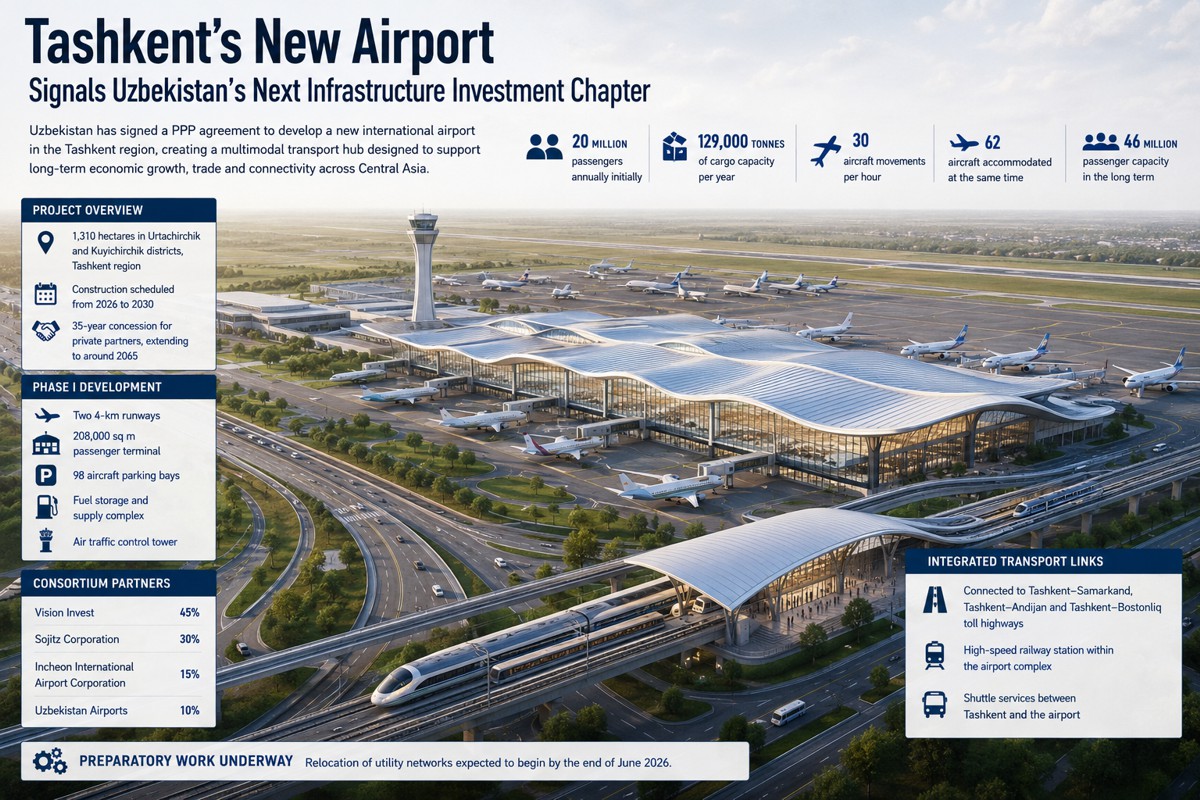
Uzbekistan has committed to one of Central Asia’s largest single pieces of transport infrastructure, signing a public-private partnership project finance agreement for the construction and long-term operation of the New Tashkent International Airport. The agreement, concluded between the state operator Uzbekistan Airports and an international consortium led by Saudi Arabia’s Vision Invest, sets in motion a greenfield facility that is designed to carry up to 20 million passengers a year at opening and, over the longer term, as many as 46 million.
For an infrastructure sector watching where the next wave of major aviation capital is being deployed, the deal matters because it combines scale, a clear risk-sharing model, and a demand story that has been building for the better part of a decade.
The significance is partly structural and partly geographic. Tashkent’s existing airport sits inside the city limits, was designed for around 11 million passengers, and cannot accommodate new runways, which places a hard ceiling on the capital’s ability to grow international connectivity. Rather than continue to patch a constrained asset, the government has chosen to relocate its primary gateway to open land in the Tashkent region and to bring in operators with experience of running some of the world’s busiest hubs.
The move reflects a wider pattern across emerging aviation markets, where states increasingly invite private capital and operational expertise to develop terminals while retaining sovereign control of the airfield itself. That template, tested in Saudi Arabia, Turkey, India and elsewhere, is now being applied to a market that has become one of the fastest-growing tourism destinations in the world.
Briefing
- Uzbekistan Airports signed a PPP with a consortium led by Vision Invest (45%) alongside Sojitz Corporation (30%), Incheon International Airport Corporation (15%) and Uzbekistan Airports itself (10%), concluded on the sidelines of the Tashkent International Investment Forum.
- The airport will occupy a 1,310-hectare greenfield site in the Urtachirchik and Kuyichirchik districts of the Tashkent region, with construction scheduled for 2026 to 2030 followed by a 35-year concession running to around 2065.
- Phase I comprises two four-kilometre runways, a 208,000-square-metre passenger terminal, 98 aircraft parking bays, a fuel storage and supply complex and an air traffic control tower, with reporting placing the first-phase cost at roughly $2.5 billion.
- Initial capacity is set at up to 20 million passengers and 129,000 tonnes of cargo a year, scaling over time to a terminal four times the size of the current facility, up to 46 million passengers, more than 40 boarding bridges and 160 aircraft stands.
- The complex will connect to the Tashkent–Samarkand, Tashkent–Andijan and Tashkent–Bostonliq toll highways and to a dedicated high-speed rail station, with relocation of utility networks scheduled to begin by the end of June 2026.
Inside the Concession Structure
The commercial architecture of the deal is as important as its headline capacity. The private consortium holds a 90% combined stake, split between Vision Invest at 45%, Japan’s Sojitz Corporation at 30% and South Korea’s Incheon International Airport Corporation at 15%, with Uzbekistan Airports retaining the remaining 10%. That distribution keeps the state at the table as a minority equity partner while placing majority ownership, and the associated capital burden, with experienced international developers and operators.
Under the terms agreed, the private partners will build, operate and maintain the passenger terminal and the forecourt area, and will carry out future expansion works across the 35-year concession. Responsibility for developing and managing the airfield infrastructure, including runways, taxiways and navigation systems, stays with the government.
This division of labour is a deliberate allocation of risk rather than an accounting formality. Terminal operations, retail, ground handling and passenger throughput are the areas where private operators can most readily add commercial value and recover their investment, and where global benchmarks for efficiency are clearest. Airfield assets, by contrast, sit closer to national security and air navigation sovereignty, which is why states routinely keep them in public hands.
Reporting around the signing has put the first-phase investment at approximately $2.5 billion, with the sponsors advised through to an anticipated financial close involving a group of senior lenders and international financial institutions. For lenders and equity investors alike, the appeal lies in a long concession horizon that can support project-finance structures, backed by a demand curve that has been rising sharply rather than recovering from a low base.
Engineering the Build
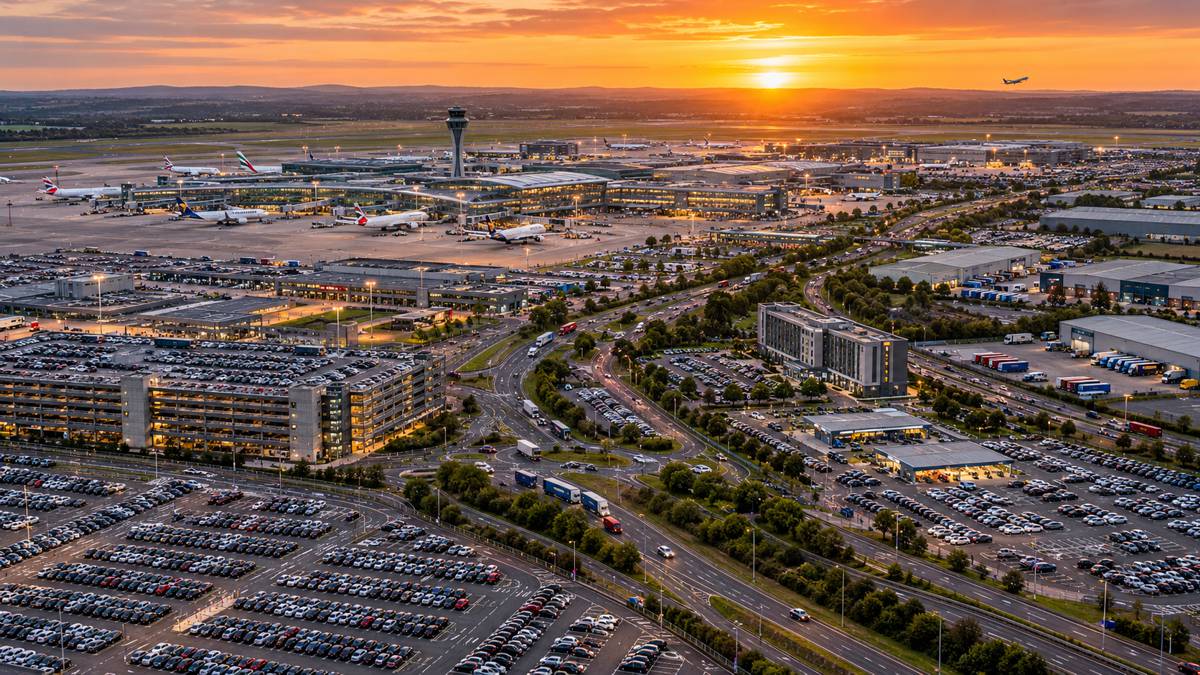
For the construction and engineering community, the first phase is the substantive prize. Two parallel four-kilometre runways will allow the airport to handle wide-body long-haul aircraft and to sequence up to 30 movements an hour, while the 208,000-square-metre terminal will anchor a site capable of parking 62 aircraft simultaneously and offering 98 stands at opening. A fuel storage and supply complex and a new control tower complete the initial airfield and landside package, giving the facility the core systems required to operate as a full international gateway from day one.
Preparatory activity is already under way on the ground, and the relocation of engineering and utility networks, one of the least glamorous but most schedule-critical elements of any greenfield build, is timed to begin by the end of June 2026.
The master plan looks well beyond the opening configuration. Long-term projections point to a terminal four times larger than Tashkent’s current facility, ultimately supporting up to 46 million passengers a year, more than 40 passenger boarding bridges and 160 aircraft stands. Phasing on that scale places a premium on modular design and on a delivery programme that can add capacity without disrupting live operations, a discipline that has defined the more successful hub expansions of the past two decades.
Delivering two runways, a large terminal and full supporting infrastructure inside a 2026 to 2030 window is an ambitious target, and it will test procurement, contractor mobilisation and supply-chain coordination across a site of more than 1,300 hectares. The compressed timeline is also a signal of intent, aligning the airport’s opening with national targets for tourism and connectivity rather than leaving it to drift.
A Multimodal Hub Rather Than a Standalone Airport
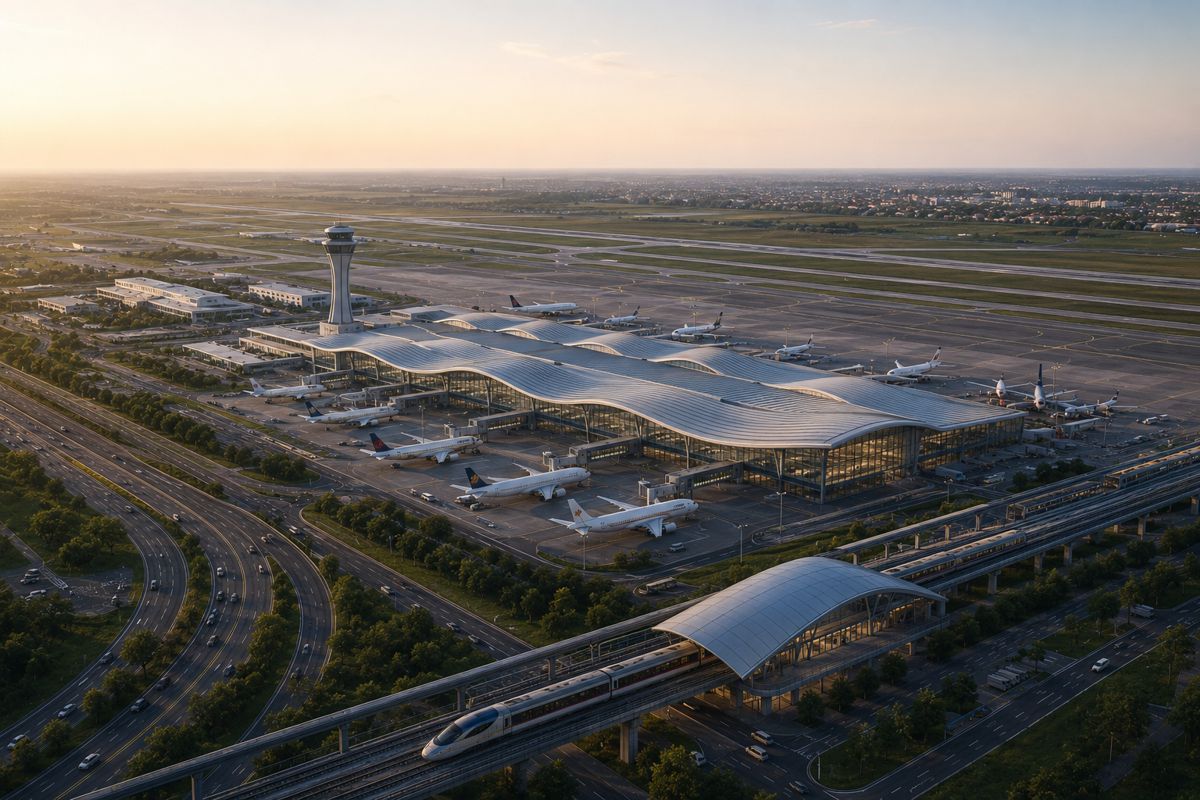
What distinguishes the scheme from a conventional terminal replacement is the ambition to embed the airport inside a wider transport network from the outset. The complex is planned to connect directly to three major toll corridors, the Tashkent–Samarkand, Tashkent–Andijan and Tashkent–Bostonliq highways, tying the new gateway into the road links that carry both freight and the country’s most visited heritage cities.
A dedicated station for high-speed trains will be built within the complex, and shuttle services will run between central Tashkent and the new site, addressing the practical question of how passengers reach a facility located outside the city. Taken together, these connections are intended to turn the airport into a genuine intermodal node rather than an isolated asset dependent on road access alone.
The logic here mirrors a broader shift in how modern airports generate value. Increasingly, the returns on large aviation assets come not only from aeronautical fees but from the surrounding logistics, commercial and land-development activity that a well-connected hub can attract. By wiring rail and highway capacity into the design early, Uzbekistan is positioning the airport to serve cargo consolidation, distribution and business travel alongside inbound tourism. For a landlocked country seeking to reposition itself as a Silk Road crossroads linking Europe, Asia and the Middle East, that connectivity is central to the commercial case rather than an afterthought.
The Demand Case Underpinning the Investment
The scale of the project only makes sense against Uzbekistan’s recent travel performance, which has been among the strongest in the world. The country welcomed roughly 11.7 million foreign visitors in 2025, an increase of close to 47% year on year, and UN Tourism ranked it among the seven fastest-growing destinations globally, with arrivals up around 73% on 2019 levels.
Total passenger traffic across the national airport network reached about 15.5 million in 2025, on the back of nearly 129,000 flights, a rise of roughly 14% in a single year. Tourism services exports, meanwhile, have climbed into the region of $4.8 billion, turning visitor numbers into hard-currency revenue and giving the government a fiscal rationale for backing large-scale aviation capacity.
That momentum has been engineered as much as it has been discovered. Since liberalising its aviation and tourism sectors from 2018, Uzbekistan has expanded visa-free access to citizens of close to a hundred countries, upgraded airports at Samarkand and elsewhere, and courted foreign carriers and operators. The Uzbekistan-2030 strategy targets 15 million foreign tourists a year, a figure the current trajectory could meet or exceed well ahead of schedule.
New Tashkent International Airport, legally established under a presidential decree dated 25 November 2025, is the capacity backbone intended to absorb that growth once the existing airport reaches the limit of its expansion. Without the new gateway, the constraint on runway capacity in the capital would become a brake on the entire tourism and connectivity strategy.
What the Operators Bring to the Table
The composition of the consortium is a large part of the story’s strategic weight. Incheon International Airport Corporation operates South Korea’s principal international gateway, one of the busiest and most technically advanced airports in the world, which handled more than 70 million passengers in 2024. It is also already active in Uzbekistan, having secured a separate PPP to modernise and manage Urgench International Airport, which gives it operational familiarity with the country’s regulatory environment.
Sojitz Corporation, a Japanese trading house with interests spanning energy, infrastructure, industry and healthcare, brings deep project-development capacity and has signalled substantial investment intent both in this scheme and in Uzbekistan more broadly. Vision Invest, as lead sponsor, is a Saudi developer that has built a portfolio across power, water, logistics and transport under the Kingdom’s Vision 2030 privatisation drive.
For Uzbekistan, the value of that mix runs beyond capital. As the chairman of Uzbekistan Airports framed it, the partnership is intended to deliver a modern, high-tech aviation hub while giving the country access to world-class expertise in designing, building and managing large airport complexes. Bringing in operators of this calibre offers a route to importing operational standards, digital systems and commercial know-how that would take far longer to build domestically.
It also plants a marker for the wider region. Saudi, Japanese and Korean capital flowing into a single Central Asian gateway underlines how contested the race to anchor the region’s aviation traffic has become, with neighbouring Kazakhstan and others pursuing their own capacity and connectivity ambitions.
The Long Road to 2065
With the PPP signed and site preparation beginning, the near-term milestones are financial close and the mobilisation of contractors for a build that must be delivered inside four years. The concession’s 35-year horizon means the partners are underwriting not just a construction programme but decades of operation, expansion and reinvestment, which places a premium on getting the initial design and phasing right.
If delivery holds to schedule, Uzbekistan will open a gateway sized for a market it expects to keep growing, and its private partners will hold a long-dated infrastructure asset in one of the more dynamic travel corridors of the coming decade. The scale of the commitment, extending to around 2065, reflects a bet that Central Asia’s aviation demand is structural rather than cyclical, and that the country that builds the capacity first is best placed to capture it.
Key Industry Questions
- Who is funding and building the New Tashkent International Airport, and how is ownership divided? The airport is being developed under a public-private partnership between the state operator Uzbekistan Airports and an international consortium. Ownership is split with Vision Invest of Saudi Arabia holding 45%, Japan’s Sojitz Corporation 30%, South Korea’s Incheon International Airport Corporation 15%, and Uzbekistan Airports retaining 10%. The private partners carry the majority of the equity and capital responsibility for the passenger terminal and landside facilities, while the government keeps ownership of the airfield. Reporting around the signing places the first-phase investment at approximately $2.5 billion, with financial close involving senior lenders and international financial institutions anticipated as the next major commercial step in the project’s development.
- Why does Uzbekistan need a new airport when Tashkent already has one? The existing Tashkent airport was designed for around 11 million passengers a year and sits within the city boundary, which prevents the construction of additional runways and effectively caps the capital’s international capacity. As passenger traffic and tourism have grown sharply, that ceiling has become a constraint on the country’s wider connectivity strategy. Building a greenfield facility on a 1,310-hectare site in the Tashkent region allows Uzbekistan to design in two long runways, a much larger terminal and full multimodal connections from the start. The relocation also frees the state to plan for capacity of up to 46 million passengers over the long term, a scale the current site could never physically accommodate.
- How are responsibilities divided between the government and the private consortium? The concession allocates risk according to where each party can add most value. The private consortium is responsible for building, operating and maintaining the passenger terminal and the forecourt area, and for delivering future expansion works over the 35-year term. The government retains responsibility for developing and managing the airfield infrastructure, which typically covers runways, taxiways and air navigation systems. This split follows a common international model in which states keep sovereign-sensitive airfield assets in public hands while inviting private operators to run commercially oriented terminal operations. The structure gives investors a clear revenue base in terminal, retail and passenger services, while limiting their exposure to the elements of airport operation most closely tied to national control.
- How large will the airport eventually become, and over what timeframe? Phase I is sized for up to 20 million passengers and 129,000 tonnes of cargo a year, with two four-kilometre runways, a 208,000-square-metre terminal, 98 aircraft stands, a fuel complex and a control tower. Construction is scheduled between 2026 and 2030, after which the private partners operate the facility under a concession running to around 2065. The master plan then allows for substantial growth, with the terminal ultimately expanding to four times the size of the current airport, capacity of up to 46 million passengers a year, more than 40 passenger boarding bridges and 160 aircraft stands. Delivery of that additional capacity would be phased across the life of the concession rather than built up front.
- What does the multimodal integration mean for the wider region? The airport is designed to connect directly to the Tashkent–Samarkand, Tashkent–Andijan and Tashkent–Bostonliq toll highways, and to include a dedicated high-speed rail station within the complex, with shuttle services linking it to central Tashkent. That connectivity is intended to make the airport a genuine intermodal node serving both passengers and freight, rather than a standalone terminal reliant on road access. For the region, it strengthens the case for Uzbekistan as a Silk Road logistics and travel crossroads linking Europe, Asia and the Middle East. It also supports the development of surrounding commercial and distribution activity, which is increasingly where large airports generate value beyond aeronautical charges.
- What experience do the consortium partners bring to the project? The consortium pairs financial capacity with operational depth. Incheon International Airport Corporation runs South Korea’s largest international gateway, which handled more than 70 million passengers in 2024, and already holds a separate PPP to modernise and manage Urgench International Airport in Uzbekistan. Sojitz Corporation is an established Japanese trading house active across energy, infrastructure and industry, bringing project-development experience and significant investment intent. Vision Invest is a Saudi developer with a track record across power, water, logistics and transport under the Kingdom’s Vision 2030 programme. Together they offer Uzbekistan access to global standards in airport design, digital systems and commercial management, alongside the capital required to fund a project of this scale.
- What are the main risks to delivery on the 2026 to 2030 timeline? Delivering two runways, a large terminal and full supporting infrastructure across a 1,300-hectare greenfield site within four years is an ambitious programme. Utility relocation, contractor mobilisation and supply-chain coordination all carry schedule risk, and early groundworks such as network relocation are timed to begin by mid-2026 precisely because they are critical to the wider sequence. Financial close is another gating milestone, since the funding structure must be settled before major construction can accelerate. Demand risk is comparatively lower given recent traffic growth, but macroeconomic conditions, currency movements and regional competition could all influence long-term returns. As with most large concessions, the quality of the initial phasing and design will shape how smoothly later expansion can be delivered.
- What does the project signal for infrastructure investment across Central Asia? The scheme demonstrates that Central Asia is now attracting serious, long-dated infrastructure capital from Gulf, Japanese and Korean investors competing to anchor regional traffic. The involvement of Vision Invest, Sojitz and Incheon in a single consortium shows that the PPP model, well established in Saudi Arabia, Turkey and India, is being applied to fast-growing frontier markets with credible demand fundamentals. For infrastructure owners and investors, it points to a pipeline of aviation, logistics and connectivity projects across the region as governments seek to convert tourism and trade growth into permanent capacity. It also raises the competitive stakes for neighbouring states, several of which are pursuing their own airport and connectivity programmes to secure a share of the same rising traffic.
Strategic Takeaways
- The concession’s clean split between privately operated terminal assets and state-controlled airfield infrastructure offers a replicable risk-allocation template that other Central Asian aviation projects are likely to follow.
- With initial capacity of 20 million passengers scaling toward 46 million, the airport is being sized for structural rather than cyclical demand, signalling long-term confidence in Uzbekistan’s tourism and connectivity trajectory.
- The presence of Saudi, Japanese and Korean investors in a single consortium marks Central Asia as a genuine arena for competitive, long-dated infrastructure capital, with implications for how neighbouring states position their own gateways.
- Multimodal integration with three toll highways and high-speed rail reframes the project as a logistics and commercial node, where value increasingly comes from surrounding development rather than aeronautical fees alone.
- The 2026 to 2030 delivery window and pending financial close make procurement discipline, contractor mobilisation and phased design the decisive factors in whether the programme meets its ambitious timeline.