Amman Opens its Kerbside to Private Investment for Citywide Smart Parking
Amman Vision for Investment and Development (AVID), the investment arm of the Greater Amman Municipality (GAM), has invited local and international firms to submit expressions of interest and prequalification documents for a citywide smart parking network, to be built and run under a public-private partnership. On its own, a parking procurement rarely commands attention beyond the specialist mobility sector.
The tender addresses one of the harder problems in any growing capital, which is what happens to the private car once a city starts moving serious volumes of people by bus. The scheme is designed to bring on-street and off-street parking together on a single digital platform, offering real-time availability and a range of associated services, with a target of managing roughly 5,600 smart spaces by 2031.
The commercial logic is worth drawing out because it sits at the centre of how mid-sized capitals are now financing urban technology. Rather than carrying the capital cost and operational risk of a sensor-and-software rollout on its own balance sheet, GAM is packaging the kerbside as an investable concession and asking the private sector to fund, deliver and operate it.
That approach turns a fragmented and largely uncommercialised public asset into a structured opportunity for smart-city vendors, mobility operators and infrastructure investors, while keeping the underlying asset in municipal hands. For the construction, technology and infrastructure supply chain, the invitation is a clear signal that Jordan intends to procure connected mobility through competitive partnership rather than one-off equipment purchases.
Briefing
- AVID has opened prequalification for a citywide smart parking network in Amman, delivered as a public-private partnership covering both on-street and off-street parking on a single digital platform.
- The network targets approximately 5,600 smart parking spaces managed through a unified platform by 2031, spanning key roads, commercial hubs and park-and-ride sites tied to the bus rapid transit system.
- GAM will retain ownership of all key public assets, full regulatory oversight and control of project-related data, with the private partner responsible for development and operation.
- Contract model, concession duration and the allocation of risk between the parties are to be settled during the request for proposals stage, giving prospective bidders an early read before commercial terms are fixed.
- The tender extends Amman’s transport reform beyond mass transit into kerbside management, positioning parking as a revenue-generating layer within an integrated mobility system.
The Deal on Offer and Why Bidders Are Being Courted Early
The structure AVID has chosen tells prospective partners a good deal about how the risk and reward will eventually be shared. By opening with a call for expressions of interest and prequalification rather than a fully specified tender, the municipality is testing appetite and building a shortlist of credible operators before the commercial terms are locked down. Details of the contract model, the concession duration and the split of risk between stakeholders are explicitly reserved for the request for proposals stage, which means the firms that engage now will help shape the parameters they later bid against.
For experienced concession players, that early visibility is valuable, since the economics of a parking network turn heavily on enforcement rights, tariff-setting powers and the length of the term over which capital can be recovered.
AVID is a natural counterparty for this kind of arrangement. As the master developer of GAM’s land, property and investment rights, the company has spent several years converting municipal assets into structured deals with private capital, and it has invited firms with demonstrated experience in smart parking technologies, urban mobility services and smart-city solutions to take part.
The prize on offer is not simply the management of 5,600 spaces in isolation but a foothold in a capital that is actively rebuilding its transport system and has shown a willingness to hand operations to the private sector. Vendors weighing the cost of mobilising bids will be reading the eventual RFP for clarity on payment mechanisms, whether the operator earns from user fees, availability payments or a revenue share, and how performance will be measured over the life of the concession.
Linking the Kerb to the Bus Network
The most strategically interesting feature of the scheme is where the parking sits. AVID has framed the network around key roads, commercial districts and park-and-ride facilities connected to the bus rapid transit system, which places kerbside management directly at the seam between private cars and mass transit. That matters because Amman’s bus network has moved from a standing start to meaningful scale in a short period.
Ridership on the BRT rose sharply as the routes matured, and figures compiled for the UITP MENA Centre for Transport Excellence show Amman’s BRT ridership increased threefold from 4.9 million in 2022 to 18.6 million in 2024. A parking layer built around park-and-ride sites is designed to convert some of that momentum into a repeatable journey, giving drivers a reliable place to leave the car and complete the trip by bus.
The context underlines why the timing makes sense. Amman is a car-dependent city of well over four million residents generating an estimated five million trips a day, and the BRT itself was conceived to lift the share of journeys made by public transport well above its historic level. The municipality has been extending the system, with services now reaching towards Zarqa and further phases under study, and AVID already operates the bus fleets on behalf of GAM.
Bringing parking into the same commercial and digital orbit as the buses gives the city a tool to influence where and how people park, to protect BRT corridors from kerbside congestion, and to make the combined system easier to use. Kerbside intelligence, in other words, is being treated as part of the transit product rather than as a separate municipal chore.
Inside the Unified Digital Platform
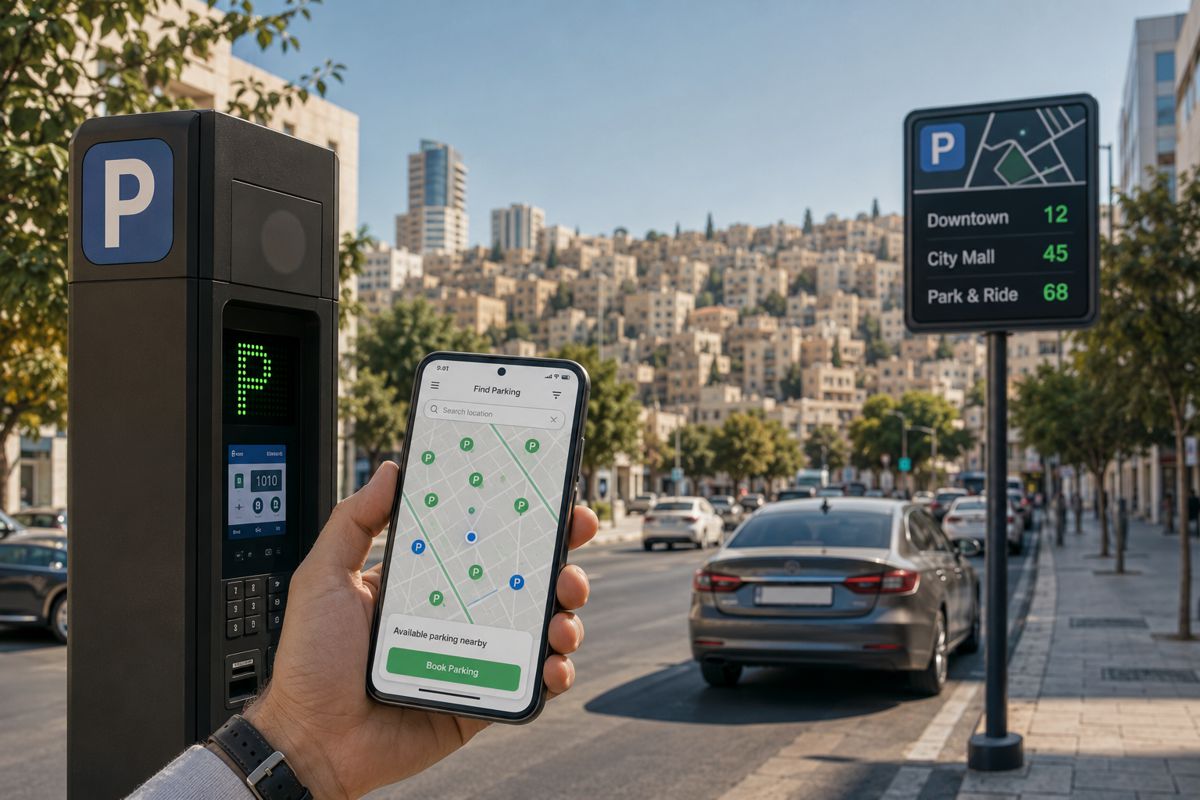
At the technical core of the project is the decision to manage on-street and off-street parking through one platform rather than a patchwork of standalone systems. Bringing both into a single environment allows real-time occupancy data to flow from sensors and cameras into a central management layer and out to drivers, which shortens the time spent circling for a space and reduces the low-speed cruising that adds to congestion and emissions in dense districts.
A unified platform also gives the operator a consistent view of demand across the whole network, which is the foundation for dynamic pricing, targeted enforcement and the kind of demand forecasting that lets a city plan capacity rather than simply react to it. Those capabilities are what separate a genuine smart parking system from a digitised version of pay-and-display.
The associated services flagged around the platform point to where the commercial value accumulates over time. Once occupancy, payment and enforcement run through one system, the operator can layer in digital payment, reservations, integration with navigation and, in due course, links to electric-vehicle charging and other kerbside uses. Each of those services deepens the relationship with the driver and creates additional revenue lines beyond the base parking fee.
For the construction and systems integration supply chain, delivery involves sensor networks, gantry and bay hardware, communications infrastructure, back-office software and the physical works needed to bring older off-street facilities up to a connected standard, which spreads the opportunity across civil, electrical and technology contractors rather than concentrating it in a single discipline.
A Market Moving Quickly Towards Connected Kerbs
The Amman tender lands in a global market that analysts expect to grow strongly through the end of the decade. Estimates vary by research house, but several place the smart parking sector in the region of eight to ten billion US dollars in 2024 and project a rise towards roughly twenty to twenty-four billion dollars by 2031, with compound annual growth rates commonly quoted in the low-to-high teens.
One assessment values the market at USD 10.39 Billion in 2024 and sees it reaching around USD 24 billion by 2031, while others chart a similar trajectory from a slightly lower base. The spread between forecasts reflects differing definitions of what counts as smart parking rather than any doubt about the direction of travel, and the consistent theme across them is that municipal and smart-city investment is a primary driver of demand.
For Jordan, engaging that market through a structured concession is a pragmatic way to import capability without importing the full delivery risk. AVID’s track record gives the proposition credibility, since the company reports having delivered dozens of projects worth several hundred million dinars across healthcare, commercial and mobility sectors, and it has been rolling out electric-vehicle charging as part of GAM’s smart-city agenda.
Placing a parking concession alongside that portfolio signals to international bidders that Amman is assembling a coherent programme rather than pursuing isolated pilots. The regional picture reinforces the point, with cities across the Middle East and North Africa increasingly treating parking, transit and payment as parts of one connected mobility layer that can be procured, operated and monetised together.
Public Ownership, Private Delivery and the Question of Data
One clause in the arrangement deserves particular attention from policymakers and bidders alike. GAM will keep ownership of all key public assets, retain complete regulatory oversight and control the data the system generates, while the private partner takes on development and operation. That division is becoming a defining feature of well-structured mobility partnerships, because the information a citywide parking network produces, covering occupancy patterns, movement flows and payment behaviour, is a strategic asset in its own right.
By holding onto it, the municipality preserves its ability to plan transport, set policy and avoid being locked into a single supplier over the long term, while still drawing on private expertise and capital to build and run the system.
For the winning operator, the framework sets clear expectations about where commercial freedom ends and public control begins. The partner can expect to earn from operating the network and its associated services, but it will do so within tariffs, standards and data rules set by the municipality, and it will need to demonstrate that its platform can hand insight back to GAM rather than wall it off.
That balance protects the public interest without deterring investment, provided the eventual RFP is precise about data ownership, interoperability and the handover of the system at the end of the term. Getting those provisions right early tends to be what separates concessions that attract strong international competition from those that stall, and Amman’s decision to state the principle up front is a constructive starting point.
The Road From Expression of Interest to Operation
The immediate task for interested firms is procedural, with prequalification and expression-of-interest documents to be assembled and submitted so that AVID can build a credible field before the RFP. The more substantive work will follow once the commercial terms take shape, when bidders can model the concession against real numbers for tariffs, term length and risk transfer.
Because so much of the eventual value depends on those parameters, the firms that treat this early stage as a chance to understand the municipality’s priorities, rather than a box-ticking exercise, are likely to be better placed when the competitive tender opens. The 2031 target for 5,600 managed spaces gives the programme a clear horizon and a delivery cadence that contractors and technology partners can plan against.
For the wider construction and infrastructure community, the significance of the announcement lies less in the headline space count than in what it represents. Amman is extending its mobility reform from the visible layer of buses and corridors into the harder-to-see business of managing the kerb, and it is doing so through a partnership model that keeps public control while inviting private delivery.
If the concession is structured and awarded well, it offers a template that other regional capitals facing the same congestion and car-dependence pressures are likely to study closely. The opportunity now sits with the operators, integrators and investors willing to engage early and help turn a stated ambition into a working network.
Key Industry Questions
- What exactly is AVID procuring, and at what stage is the process? AVID has opened the earliest formal stage of the procurement, inviting local and international firms to submit expressions of interest and prequalification documents for a citywide smart parking network in Amman. This is not yet a binding tender for a specific priced contract. Instead, it is a call to identify credible operators with experience in smart parking, urban mobility and smart-city solutions before commercial terms are set. The detailed contract model, concession duration and allocation of risk will be defined during the later request for proposals stage. Firms engaging now are effectively registering interest and demonstrating capability, positioning themselves to bid when the full commercial specification is released and the competitive phase begins in earnest.
- How is the public-private partnership structured, and who carries the risk? Under the arrangement, GAM retains ownership of all key public assets, full regulatory oversight and control of project-related data, while the private partner takes responsibility for developing and operating the network. The precise split of commercial risk, including how the operator is paid and over what period capital can be recovered, is reserved for the request for proposals stage. That structure keeps the strategic asset and policy levers in municipal hands while transferring delivery and operational risk to the private sector. For bidders, the key variables to watch are the concession term, the payment mechanism, whether revenue comes from user fees or availability payments, and the enforcement and tariff-setting powers granted to the operator.
- Why is the parking network being tied to the bus rapid transit system? The scheme is built around key roads, commercial hubs and park-and-ride sites connected to the BRT, which places parking at the junction between private cars and mass transit. Amman’s bus ridership has grown quickly, and linking parking to park-and-ride facilities is intended to convert car journeys into combined trips, giving drivers a reliable place to leave the vehicle and continue by bus. Managing the kerb around transit corridors also helps protect bus lanes from congestion and makes the overall system easier to use. In effect, parking becomes part of the transit product rather than a separate service, supporting the municipality’s broader goal of shifting more journeys onto public transport.
- What technology underpins a unified smart parking platform? A unified platform brings on-street and off-street parking into a single management environment, drawing real-time occupancy data from sensors and cameras and relaying availability to drivers. That reduces the time spent searching for spaces and the low-speed cruising that worsens congestion and emissions. Beyond detection, the platform supports digital payment, enforcement, dynamic pricing and demand forecasting, and it can later integrate with navigation apps and electric-vehicle charging. Delivery draws on sensor networks, communications infrastructure, back-office software and physical works to upgrade existing facilities. The single-platform approach is what distinguishes a genuine smart parking system, capable of planning capacity and shaping demand, from a simply digitised version of conventional pay-and-display parking.
- How large is the commercial opportunity for suppliers and investors? The direct scope is the delivery and operation of a network targeting roughly 5,600 managed spaces by 2031, but the value extends well beyond hardware. Analysts expect the global smart parking market to grow strongly through the decade, with several estimates placing it in the region of eight to ten billion US dollars in 2024 and rising towards twenty to twenty-four billion by 2031. Municipal and smart-city investment is a primary driver of that growth. For suppliers, the Amman concession spreads work across civil, electrical, communications and software disciplines, while for investors it offers exposure to a long-term operating asset in a capital that is actively expanding its transport system and has a demonstrated willingness to work through private partnerships.
- Who controls the data the system generates, and why does it matter? GAM will retain control of project-related data, alongside asset ownership and regulatory oversight. This matters because the information a citywide parking network produces, including occupancy patterns, movement flows and payment behaviour, is a strategic planning asset. By holding that data, the municipality preserves its ability to shape transport policy, plan capacity and avoid long-term dependence on a single vendor. For the operator, it sets a clear boundary between commercial freedom and public control, and it places a premium on platforms that can share insight back to the municipality rather than lock it away. Bidders should expect the eventual RFP to be specific about data ownership, interoperability standards and system handover at the end of the term.
- What does this mean for other cities in the region? Amman’s approach offers a working example of how a mid-sized capital can extend transport reform from mass transit into kerbside management while keeping public control. Many cities across the Middle East and North Africa face the same combination of rapid growth, car dependence and congestion, and several are already treating parking, transit and payment as parts of one connected mobility layer. A well-structured, competitively awarded concession in Amman would provide a template those cities can study, particularly on how to balance private delivery with public ownership of assets and data. The wider regional shift towards integrated, technology-enabled mobility suggests that similar procurements are likely to follow as other municipalities look to monetise and modernise their kerbs.
- What are the main risks to successful delivery? The chief risks are commercial and structural rather than technical. A concession of this kind lives or dies on the clarity of its terms, so ambiguity over tariffs, enforcement rights, concession length or data handling can deter strong bidders or store up disputes later. Integration with existing infrastructure and older off-street facilities adds cost and complexity, and interoperability across a single platform must be handled carefully. Getting user adoption right also matters, since the benefits of real-time availability and digital payment only materialise when drivers use the system. Amman’s decision to set out public ownership, oversight and data control up front reduces some of this uncertainty, but the quality of the eventual request for proposals will be decisive.
Strategic Takeaways
- Amman is treating kerbside parking as an investable concession rather than a municipal cost, giving smart-city vendors, mobility operators and infrastructure investors a structured route into a capital that is actively rebuilding its transport system.
- The early prequalification stage is a genuine opportunity to influence terms, since concession duration, payment mechanism and risk allocation remain open until the request for proposals, and those parameters will determine the economics of any bid.
- Tying parking to bus rapid transit park-and-ride sites reframes the kerb as part of the transit product, aligning private car management with a mass-transit system whose ridership has been climbing sharply.
- Municipal retention of asset ownership, regulatory oversight and data control is becoming the defining feature of well-structured mobility partnerships, and clarity on data and interoperability in the RFP will separate concessions that attract strong competition from those that stall.
- A successful, competitively awarded scheme would give other congested, car-dependent capitals in the region a replicable template for extending transport reform into connected kerbside management.