The Intelligent Machine Has Arrived
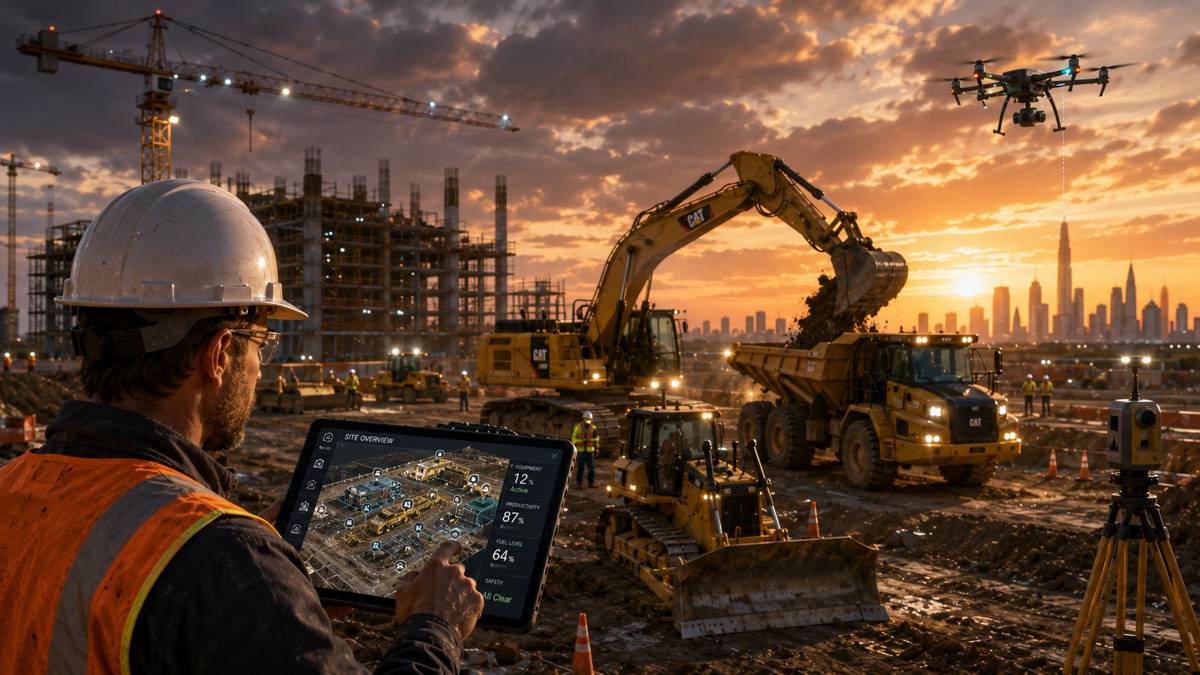
Picture a working earthworks site on a weekday morning. An excavator trims a batter to design grade on its own, its boom and bucket following a three-dimensional model while the operator watches from a remote operations centre and keeps an eye on two other machines at the same time. Nearby, a line of articulated dump trucks follows predefined haul routes with nobody in the cab, a drone lifts off to refresh a live digital twin of the site by lunchtime, and a maintenance platform flags a hydraulic pump that is trending toward failure before it can strand a machine mid-shift. None of this is a staged pilot arranged for the cameras, and none of it depends on technology that has yet to be invented. It is a reasonably ordinary description of an intelligent construction site as it already operates in 2026.
The industry has spent the better part of a decade being told that artificial intelligence is coming to construction and mining equipment. The more accurate reading now is that it already arrived, and it did so without a single defining product launch to mark the moment. Intelligence sits inside serial-production excavators, dealer-installed retrofit kits, quarry haulage fleets, remote operating stations and predictive-maintenance platforms that are billed, supported and updated like any other commercial product.
What has been fielded is rarely full autonomy in the popular sense. It is a layered stack of automated assistance, sensor fusion, computer vision, digital twins, telematics analytics and human-supervised autonomy that has changed, quietly and materially, how excavators, dozers, loaders, graders, compactors and haul trucks are operated on real sites.
The practical consequence is that the competitive divide is no longer manual versus fully autonomous. It is the divide between firms that can integrate sensing, connectivity, autonomy, safety assurance and workforce redesign into their everyday operations, and firms that cannot. The machines are already intelligent enough to reshape the economics and the safety profile of a jobsite, so the harder work now sits in interoperability, communications resilience, site readiness, cybersecurity, workforce trust and scaling across mixed fleets. That is a more demanding agenda than buying a single clever machine, and it is where the value in this cycle will be won or lost.
Briefing
- AI in heavy equipment is a deployed commercial reality rather than a forecast, spanning operator assistance, machine control, vision safety, remote operation, autonomous haulage, digital twins, predictive maintenance and the first coordinated multi-machine fleets.
- Every major manufacturer has now committed at corporate level, exemplified by Caterpillar’s CES 2026 partnership with NVIDIA to embed edge AI in its machines and Hitachi’s decision to rename itself LANDCROS from 2027.
- Komatsu commissioned its 1,000th autonomous ultra-class haul truck in April 2026, while Pronto and Heidelberg Materials ran North America’s first fully autonomous mixed-fleet quarry, moving more than two million tons in under eight months.
- China is scaling quickly, with XCMG delivering a hundred-unit autonomous electric mining haulage fleet and SANY, Zoomlion and LiuGong all productising autonomy and multi-machine collaboration.
- Europe’s regulatory frame is tightening, with the Machinery Regulation applying from January 2027 and the AI Act overlap reworked through the 2026 Digital Omnibus, bringing conformity assessment and cybersecurity firmly into scope.
Operator Assistance, Machine Control and Vision Systems
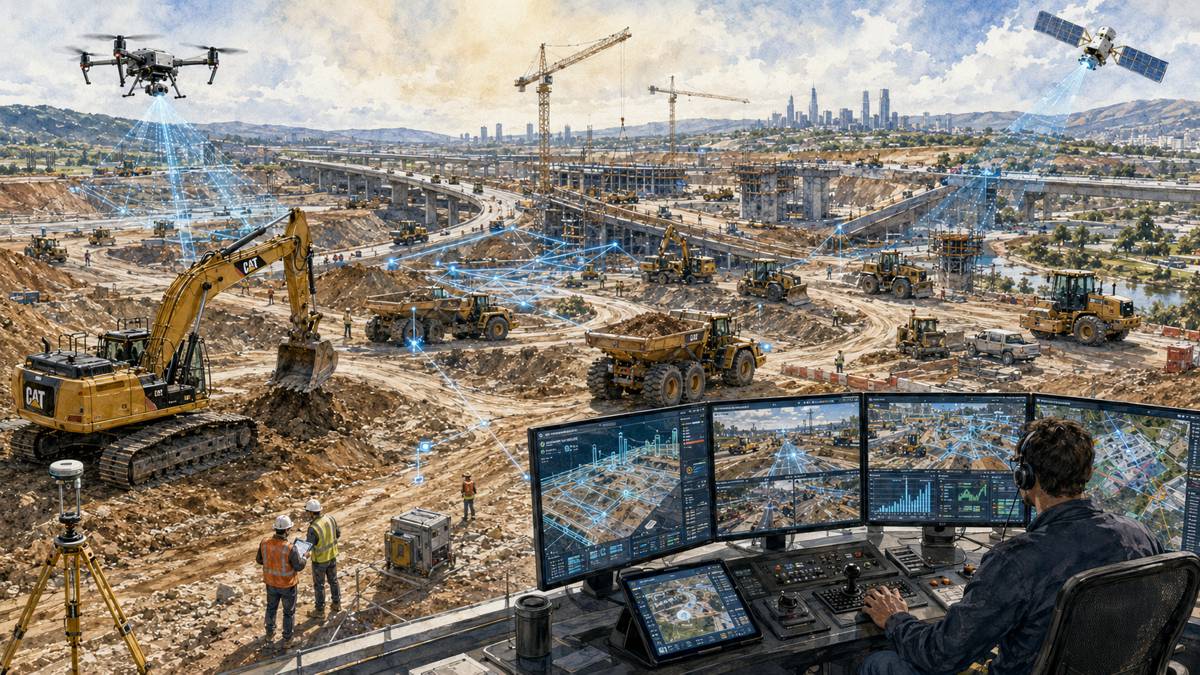
Operator assistance is where intelligence in heavy equipment has become normalised, and it is the layer that touches the widest slice of the working fleet. The commercial intent is not to remove the operator but to compress the skill gap between novice and expert, cut fatigue, avoid over-cut and overfill, prevent collisions and stabilise cycle times. Caterpillar’s Grade with Assist automates boom and stick movements and is marketed with efficiency gains of up to 45 per cent, while its mini-excavator packages combine indicate, E-Fence, Swing Assist and Bucket Assist functions to keep work inside a defined envelope and reduce the manual load on the operator. These are ordinary catalogue features tied to specific machine series, dealer support and software updates, not concept-hall theatre.
Volvo CE has built a similarly coherent family around the same idea. Dig Assist Start now ships as standard on many new crawler excavators, Volvo Active Control automates boom and bucket movements for GPS grading with claimed finish-grading improvements of around 45 per cent, and Load Assist blends on-board weighing, operator coaching, connected mapping and an integrated radar detection system.
John Deere’s construction stack is closer in intent still, but more explicit about where machine learning does the heavy lifting. Deere states that its Obstacle Intelligence uses cameras, radar and machine learning, and its SmartGrade offering now spans dozers, graders, compact loaders and excavators, often through integrated packages or direct compatibility with Leica and Topcon systems.
The consistent message across all three is that tighter integration lets a less experienced operator reach target grade faster and with less rework, which speaks directly to the labour shortages that dominate boardroom conversation across the sector.
That message points to an important structural feature of this market, which is that AI in heavy equipment often sits in an ecosystem that is partly original-equipment and partly geospatial-technology provider. Komatsu’s Intelligent Machine Control and 3D Machine Guidance bring on-machine three-dimensional guidance to excavators and dozers, while Trimble Earthworks, Topcon machine control and Leica iCON remain central to mixed-fleet digitisation.
Vision systems are the point where machine learning is most visibly embedded, and where the safety case is most tangible. Caterpillar’s Detect portfolio uses intelligent camera systems, radar and event reporting to detect people, inhibit machine motion and apply automatic braking when reversing; Komatsu’s KomVision stitches high-definition cameras and radar into a real-time bird’s-eye view; and Deere’s wheel-loader vision stack fuses multiple cameras, dynamic path lines and radar object detection.
It is worth stating plainly that not every system marketed as AI is a neural network in the modern sense. A GNSS-guided blade-control loop and a transformer-based excavator controller are very different engineering problems, and the distinction matters for validation, explainability and regulation even when both count as intelligent-machine capability.
AI Inside Every Major Manufacturer
The clearest sign that intelligence has become a baseline expectation rather than a differentiator is that every major manufacturer has now committed to it at a corporate level, not merely as a product line. Caterpillar used its keynote slot at CES 2026 to reposition itself as a technology company as much as an equipment maker, unveiling automated excavators, wheel loaders, haul trucks, dozers and compactors designed for operator-free trenching, loading, grading, hauling and rolling across connected jobsites.
The company also debuted the Cat AI Assistant, a voice-activated tool embedded in its digital and onboard products that draws on its Helios data platform to answer questions and recommend maintenance and parts. Caterpillar chief executive Joe Creed framed the shift in broad terms, saying: “As AI moves beyond data to reshape the physical world, it is unlocking new opportunities for innovation,” and the presence of a heavy-equipment maker at the centre of a consumer-technology show tells its own story about where the industry sees its future.
The commitment runs across the field rather than resting with a single leader. John Deere continues to build machine learning into its SmartGrade and obstacle-detection products across a connected base it puts at more than 650,000 machines, while Komatsu pairs its intelligent machine control, teleoperation and digital twin dashboard with the industry’s largest autonomous haulage fleet.
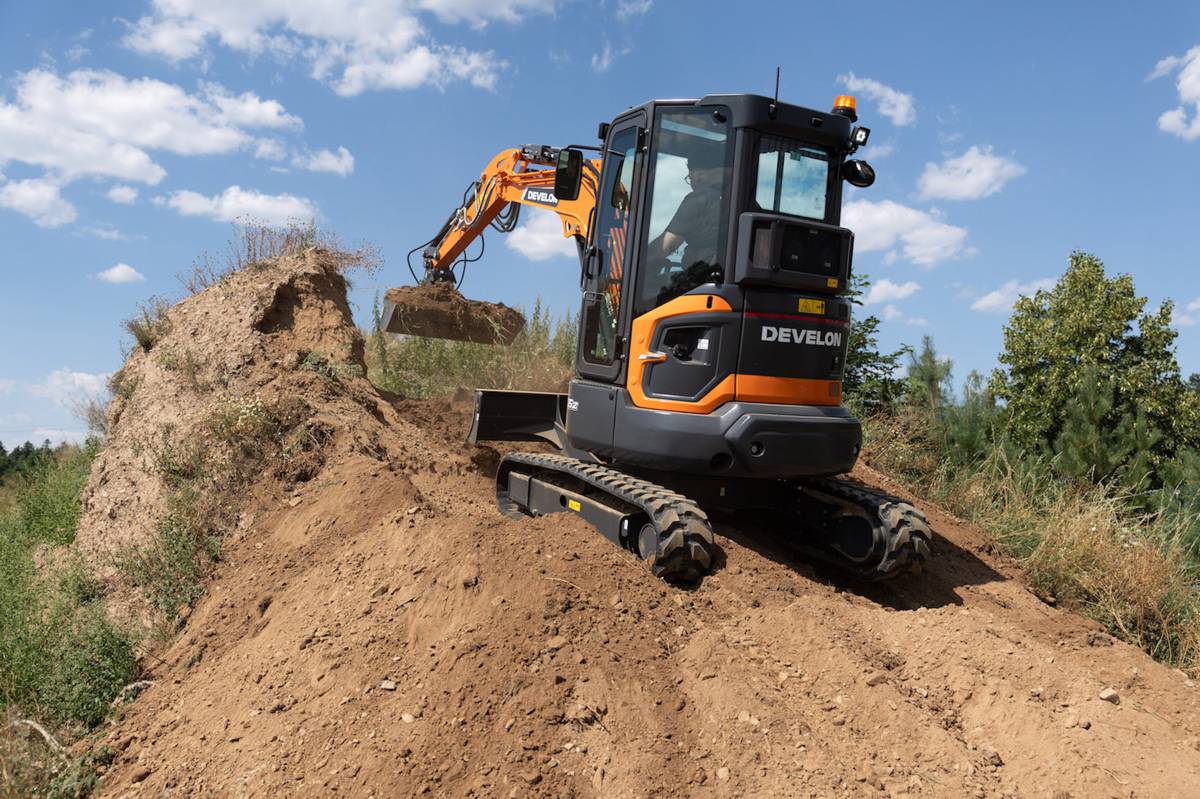
Hitachi Construction Machinery has signalled how deep the reorientation goes by announcing that it will rename itself LANDCROS Corporation from April 2027, on the reasoning that a hardware-centric business model alone is no longer viable against labour shortages, environmental regulation, rising costs and ageing infrastructure. HD Construction Equipment, the brand formed from the merger of Hyundai and Develon, launched nine AI-focused excavators at CONEXPO 2026 and built its North American growth target explicitly around AI as a competitive edge.
Volvo CE has continued to extend its Dig Assist, Active Control and ActiveCare portfolio while pushing electrification into larger machine classes. If 2025 was widely described as the proof-of-concept year for AI in construction machinery, 2026 has read much more like the year of large-scale deployment.
Mining as the Proving Ground for Construction AI
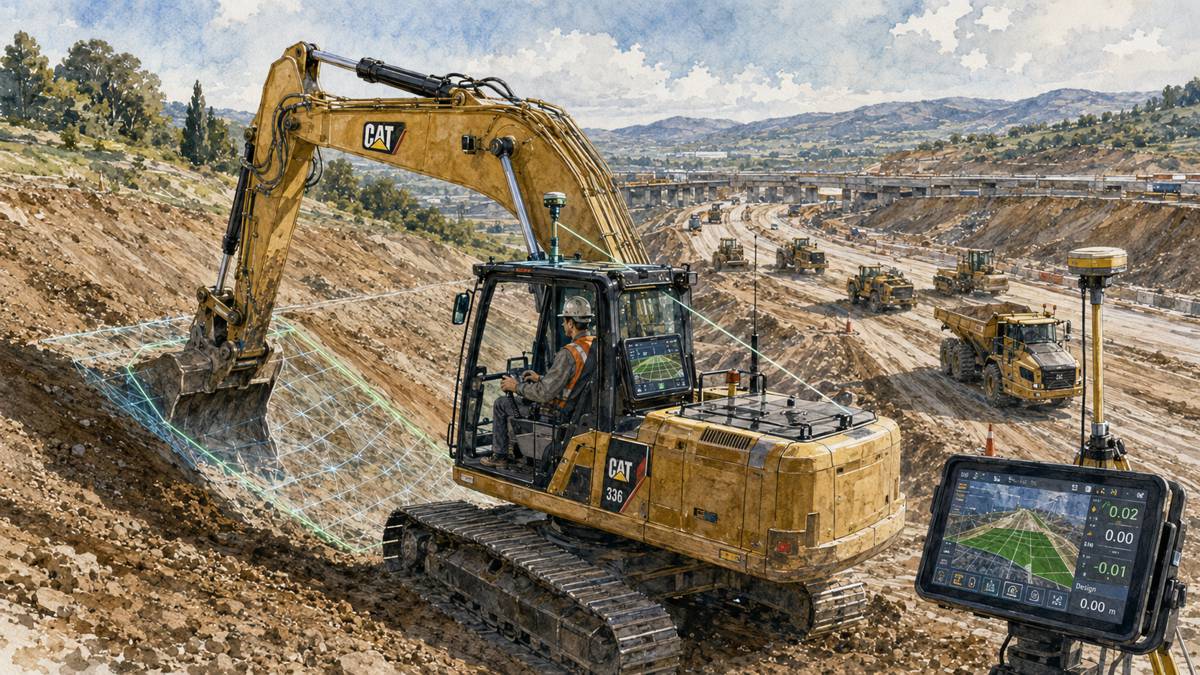
Mining has done for construction autonomy something close to what motorsport once did for the passenger car, serving as the demanding environment where the technology was hardened before it reached the mainstream. The reasons are structural rather than accidental. Mine haul routes are repetitive and relatively controlled, the sites are often remote enough that removing people from harm carries obvious value, the capital intensity justifies heavy investment in automation, and skilled labour is difficult and expensive to recruit and retain in such locations.
Those conditions made mining the natural first market, which is why Komatsu’s FrontRunner platform has been in commercial service since 2008 and why Australia’s Pilbara region became a global reference point for remote, harsh-environment operation through the Rio Tinto and Hitachi partnership. The lessons learned in that setting, in perception, positioning, fleet coordination and safety assurance, are precisely the lessons that construction and quarrying now inherit.
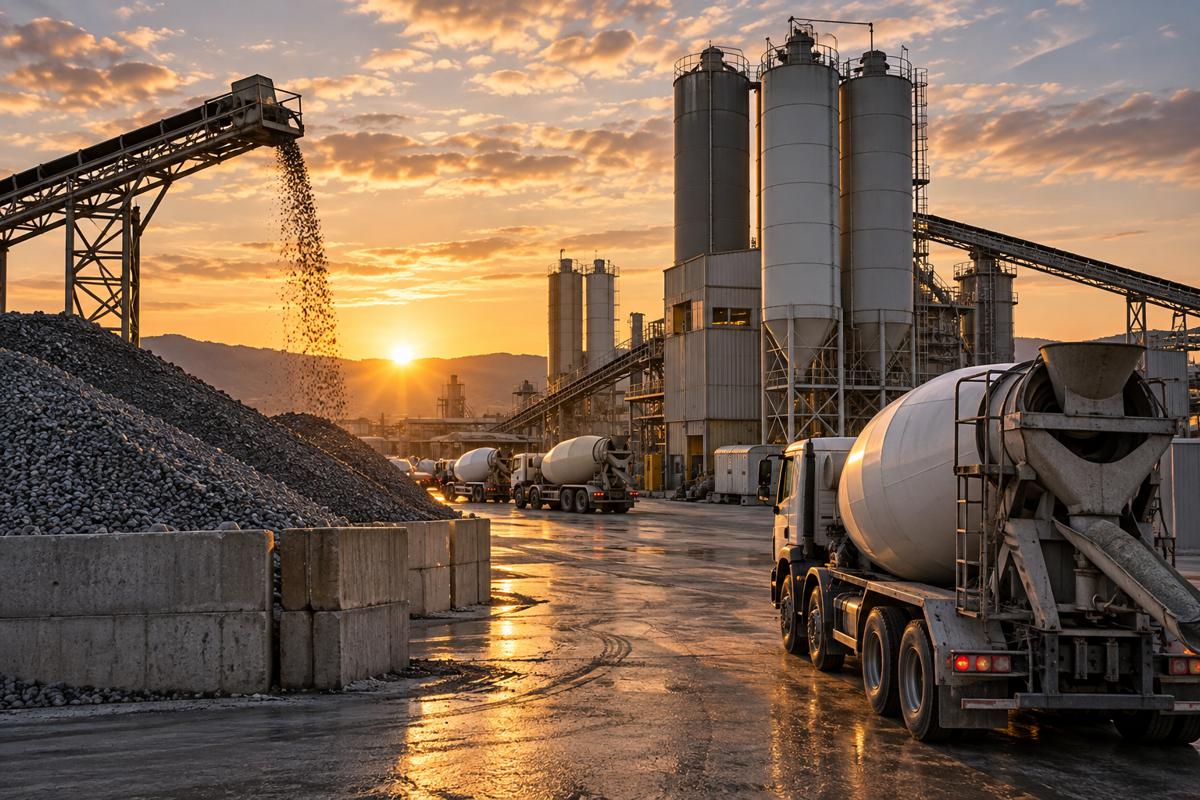
The transfer from mine to quarry to civil site is already visible and accelerating. Quarrying sits closer to mainstream construction supply chains, and because it uses smaller equipment classes with gentler duty cycles it is in some respects moving ahead of mining on electrification while adopting the same autonomy playbook. Heidelberg Materials’ work with Pronto and other partners is the clearest bridge, taking haulage autonomy proven in mining conditions and applying it to aggregates production that feeds directly into concrete and asphalt.
The broader significance for infrastructure is that the hardest technical problems of autonomous earthmoving have already been solved at scale somewhere, which materially shortens the path for the wider construction sector. Contractors watching mining should read its two-decade head start not as a curiosity but as a working preview of their own operating model.
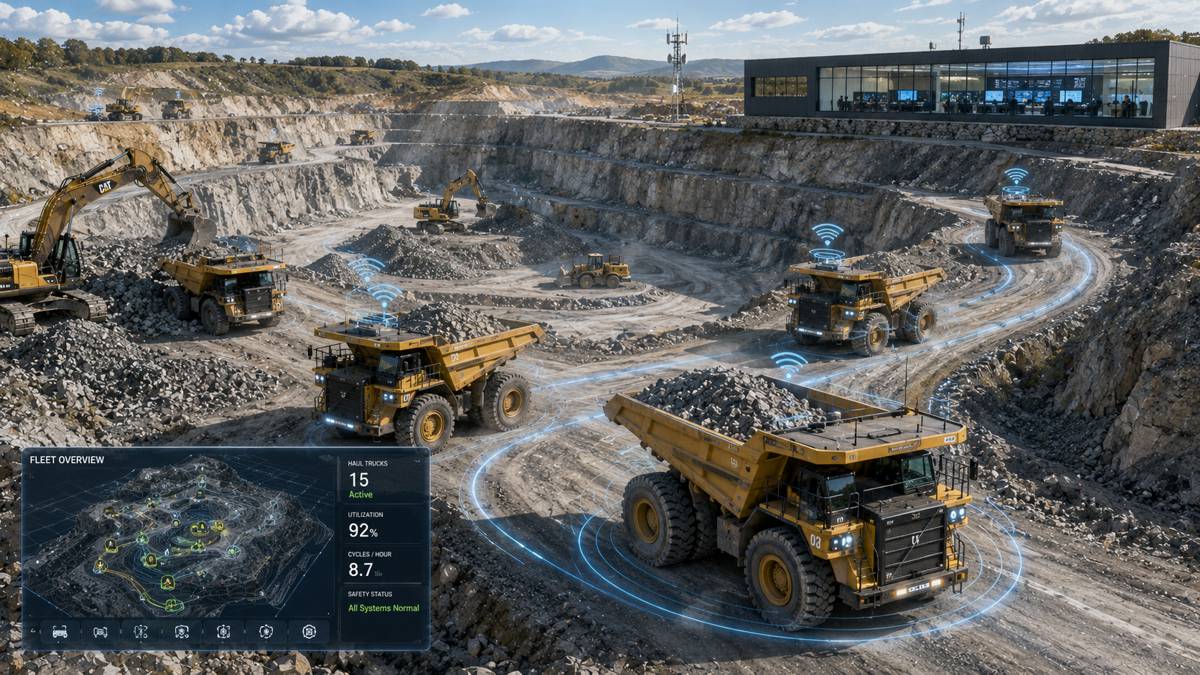
Autonomous Haulage Crosses Into Production at Scale
If operator assistance is the broad base of the market, autonomous haulage is the clearest proof that intelligent machines are already working at industrial scale rather than in demonstration videos.
In April 2026 Komatsu commissioned its 1,000th autonomous ultra-class haul truck fitted with its FrontRunner Autonomous Haulage System, becoming the first original-equipment manufacturer to reach that figure and extending its autonomous fleet into gold mining with a 930E electric-drive truck at Barrick’s Nevada Gold Mines. The scale behind the headline is the more telling detail. Komatsu says FrontRunner customers have collectively moved more than 11.5 billion tonnes of material since the platform’s commercial debut in 2008, across sites in North America, South America, Australia and Europe, which places autonomous haulage well beyond the pilot stage in the environments where it has matured longest.
The quarrying sector, closer to mainstream construction supply chains than deep mining, is now catching up quickly and in some respects leapfrogging on electrification because of its lighter duty cycles. The most instructive case is the partnership between Silicon Valley firm Pronto and Heidelberg Materials at the Lake Bridgeport quarry in Texas, described as North America’s first fully autonomous mixed-fleet quarry. Over an eight-month period the site autonomously hauled more than two million tons of limestone using a blended fleet of Caterpillar 775G and Komatsu HD605 trucks running on a single vision-only system that relies on cameras and AI rather than lidar or rigid pre-mapping.
The commercial insight was captured directly by Pronto chief executive Anthony Levandowski, who framed the achievement in terms that any fleet owner will recognise. “True scalability in the aggregates industry requires the ability to automate the iron you already own,” he said, adding that “By successfully running a mixed fleet of Cat and Komatsu trucks on Pronto AHS, we have proven that autonomy is no longer a ‘one-brand’ luxury.”
That mixed-fleet point is the strategic core of the story, because it removes the single biggest barrier to adoption, namely the assumption that autonomy requires wholesale replacement of an existing fleet. Heidelberg Materials has moved from a lighthouse project to a disciplined rollout, expanding Pronto deployments to its Mitchell, Indiana and Servtex, Texas sites through 2026 and targeting around 30 autonomous vehicles this year on the way to more than 100 across North America, Europe and Asia-Pacific by 2028. The rationale runs well beyond productivity.
Heidelberg’s Scott Tipping noted: “Our partnership with Pronto not only contributes to enhancing efficiency and safety at our sites, but it also helps us address recruiting challenges while further accelerating our sustainability efforts,” a candid acknowledgement that autonomy is now being deployed as much to solve a labour problem as a cost one. The same producer is simultaneously working with Applied Intuition, sensmore and Epiroc on other sites, which signals a market maturing into a competitive field of credible suppliers rather than a single vendor’s showcase.
Intelligent Machines on the Civil Site: Highways, Airports, Tunnels and Rail
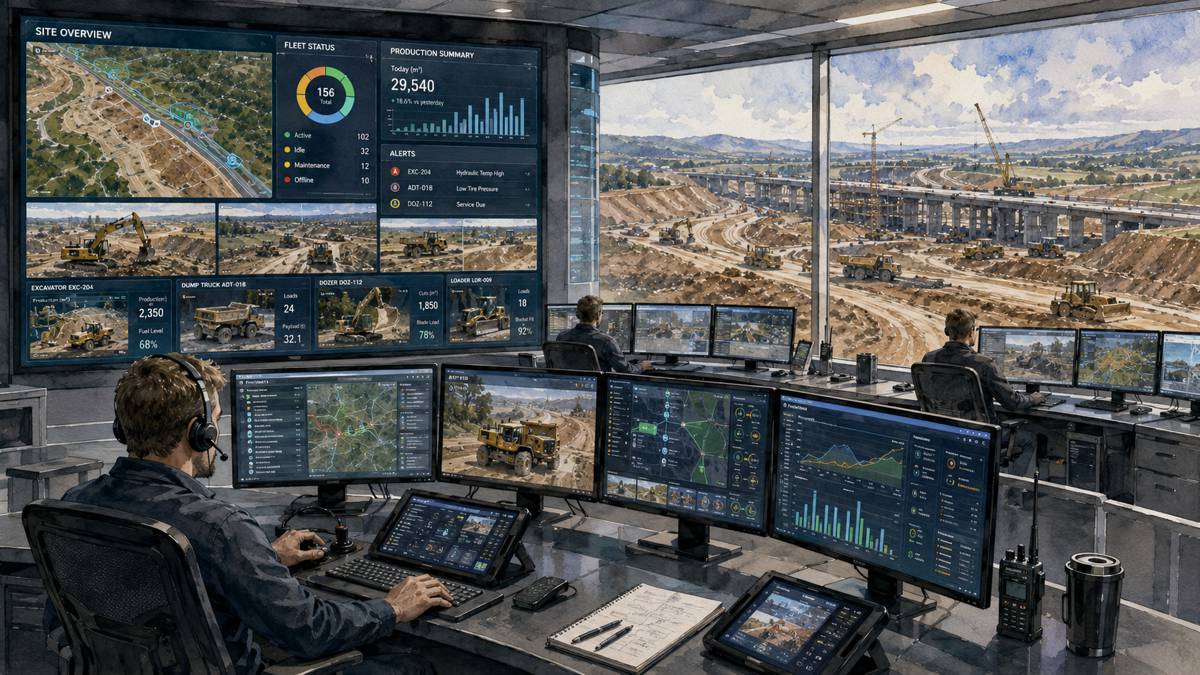
Mining and quarrying dominate the autonomy story because that is where the technology matured first, but the more relevant question for most infrastructure professionals is how intelligent machines are showing up on civil sites, and the answer is that they already are. On highway earthworks, three-dimensional machine control has become close to standard practice on major schemes, with GNSS-guided dozers and graders hitting design grade on the first or second pass where staked methods once took three or four, cutting the rework that quietly inflates earthmoving budgets.
At the autonomy end of the spectrum, the retrofit specialist Built Robotics put its first autonomous machine to work on demolition along Interstate 5 in the United States as far back as 2018, and its Exosystem now converts standard excavators into self-driving trenching robots that generate their own as-built records. Coordinated road paving has advanced furthest in China, where SANY’s autonomous paver-and-roller fleets have run on expressway projects at scale, but the underlying capability of machines holding line and level automatically is now widely available across Western fleets too.
Airport expansion, with its demanding tolerances and live operational constraints, has become an early proving ground in the United Kingdom. In 2025 the Vinci-owned contractor Taylor Woodrow trialled what was billed as the country’s first AI autonomous excavator, working with robotics firm Gravis Robotics and a Yanmar machine at the Advanced Manufacturing Research Centre in Sheffield, using excavation plans drawn from a real upcoming project. The trial fed directly into a planned deployment at Taylor Woodrow’s works at Manchester Airport, and the contractor framed it explicitly as part of a wider push to bring physical AI onto its sites.
Taylor Woodrow managing director Phil Skegg set out the rationale with unusual candour, noting: “Over the last 10 years our industry safety record has not improved, and our productivity has declined,” and that: “As an industry around 20% of the cost of what we build can be attributed to not getting it right first time.” That framing, in which autonomy is a response to stubborn safety and rework problems rather than a novelty, is exactly why civil contractors are paying attention.
Tunnelling has quietly become one of the most sophisticated arenas for machine intelligence, even if the machines never leave the ground. Modern tunnel boring machines increasingly rely on AI-driven navigation, adaptive control of excavation parameters and operational digital twins that fuse machine and ground data for predictive simulation, with Herrenknecht, which holds roughly a third of the global TBM market, developing autonomous-boring capability under names such as TBM Betty and rolling out automated functions for thrust control and tailskin sealing.
Chinese and Japanese manufacturers have pursued parallel systems, from CREG’s smart TBM programmes to Shimizu’s automated tunnelling work, reflecting a global race to reduce operator workload and error in confined, high-risk conditions. These are large-diameter, high-value machines on metro, road and water projects from Delhi and Mumbai to Chennai, where AI-enhanced analytics forecasting cutter wear and ground anomalies translates directly into fewer costly stoppages.
Rail construction and large-scale development sit on the same trajectory. Mega-projects such as California High-Speed Rail have driven demand for mechanised tunnelling and precise earthworks, while design-to-site platforms increasingly carry rail-specific intelligence, as with Bentley’s model-based OpenRail tools.
In heavy civil site preparation, the newest entrant is drawing serious capital, with Bedrock Robotics, founded by former Waymo engineers, raising a 270 million dollar funding round and partnering with Sundt Construction to automate excavators for site preparation on a 130-acre manufacturing facility in the American Southwest.
In Japan, Kajima’s long-running A4CSEL automated construction system has reached the point where a small number of operators can supervise a much larger group of machines, an approach demonstrated on dam and earthworks projects that points toward the large housing and mixed-use developments where repetitive groundworks are ideally suited to supervised autonomy.
Taken together, these examples show that the civil sector is not waiting for the technology to arrive; it is already selecting where to apply it first.
China’s Rapid Progress
No account of intelligent machines is complete without China, where the pace of productisation has been unusually high and where thirteen of the world’s fifty largest construction machinery manufacturers were based on the 2026 industry ranking. SANY has been the most visible internationally, with an autonomous paving and compaction fleet deployed on more than fifty projects and public demonstrations of coordinated paver-and-roller operation, but it is far from alone.
XCMG describes intelligence as the core direction of the industry and says several of its machines have reached Level 4 autonomous operation, particularly in mining and paving; in 2026 it delivered a first batch of one hundred pure-electric autonomous mining trucks to form what it called the world’s first commercialised hundred-unit unmanned electric haulage fleet. That is a scale of single-deployment autonomy that few Western programmes have matched, and it signals an intent to lead rather than follow.
The other national champions are moving in the same direction with distinct emphases. Zoomlion has set out to roboticise its equipment lineup through a dedicated robotics research platform and simulation environment, targeting both intelligent single-machine operation and coordinated multi-machine collaboration.
LiuGong has publicly demonstrated commercial unmanned autonomous electric loaders, extending its long-standing theme of machinery that augments human capability. The competitive implications for global infrastructure are considerable, because Chinese manufacturers pair aggressive automation with pricing commonly cited as materially below equivalent Western specifications and after-sales networks that now span well over a hundred countries.
Outside of China this widens the field of credible intelligent-equipment suppliers and raises the tempo of the whole market, even where English-language documentation of Chinese deployments remains uneven and figures are best treated as manufacturer-reported.
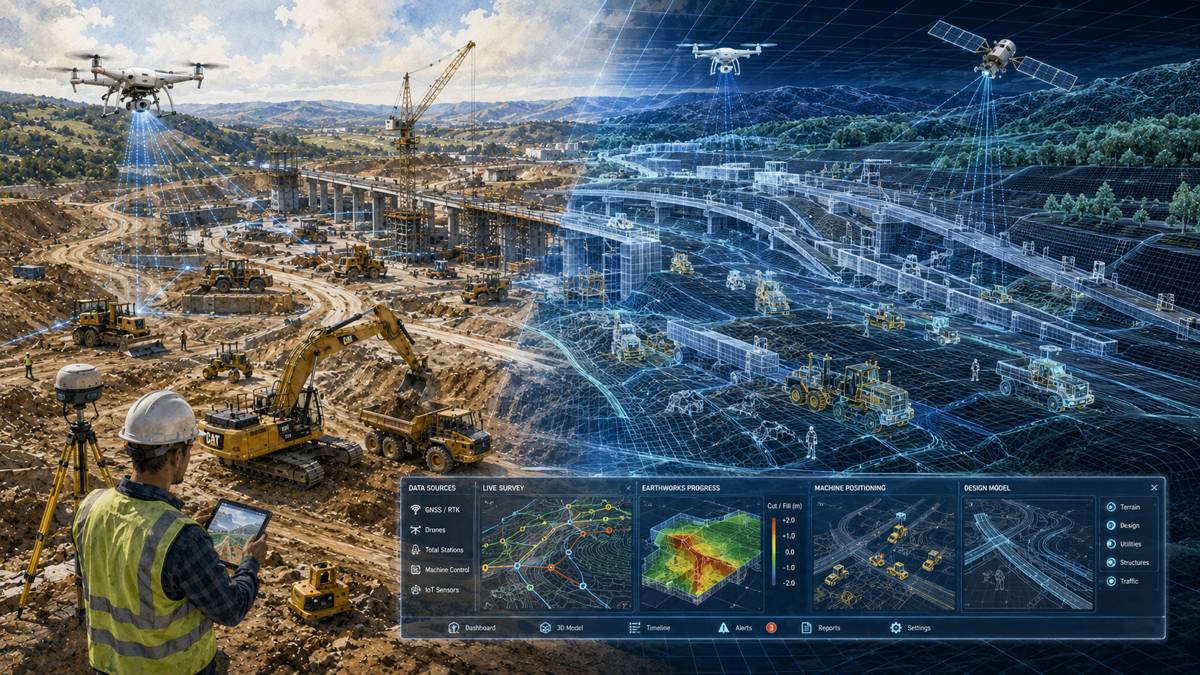
Remote Operation, Semi-Autonomous Excavation and Human–Machine Collaboration
Between full manual control and full autonomy sits a broad and commercially active middle ground, and it is arguably the most important part of the picture for civil construction. Remote operation has moved decisively from radio-controlled novelty to a supported business model. Caterpillar’s Command line spans line-of-sight consoles and remote operator stations, is sold for dozers, excavators and wheel loaders, and retains compatibility with Grade, Payload, Detect and Assist functions; the company reports that remote stations can control more than one machine and that some dozing projects move up to 30 per cent more material per shift.
Komatsu’s Smart Construction Teleoperation embeds the same idea inside its digital-site platform, allowing an operator to run a hydraulic excavator from an office environment and switch between machines from a single cockpit. The conceptual shift is significant because the human remains responsible for the work but is repositioned away from vibration, dust, noise, unstable ground, high walls and contaminated zones.
The retrofit route makes this accessible to contractors who cannot wait for a fleet refresh, and it is where some of the most socially interesting outcomes are emerging. Teleo’s universal kit can be installed on almost any make or model and paired with a purpose-built site mesh network and a command centre offering a 360-degree field of view.
At Tomahawk Construction in Florida a single operator supervised three articulated dump trucks from a centre 40 miles away, and in Montana a publicly backed pilot used Teleo-equipped John Deere loaders specifically to train military veterans with disabilities to operate heavy equipment remotely. That last example reframes human-machine collaboration as a question of who can participate in the work at all, not simply how fast the work gets done, and it hints at a widening of the available labour pool that the industry badly needs.
Semi-autonomous excavation is following the same measured path, automating the most repeatable parts of the cycle first rather than attempting a full dig-dump-return loop in one leap. Hitachi Construction Machinery’s Operator Assist System, trialled with Rio Tinto at the Pilbara mine, adds sensors and monitors to an existing excavator so that the machine automatically relieves front-end load when digging pressure runs high and helps avoid collisions during truck loading; the collaboration has since widened into a five-year programme covering operator assist, remote operation and partial autonomy.
Develon and HD Hyundai have been bolder in public, presenting Real-X in 2025 as the commercial successor to their cabless Concept-X2 and pairing it with a collaborative demonstration alongside Gravis Robotics and an articulated dump truck. Gravis itself occupies the pragmatic centre, layering learning-based control that uses hydraulic data, lidar, cameras and GNSS to read the soil over existing fleets, with field deployments reported at Manchester Airport and in Swiss and UK quarry work.
Morgan Sindall has reported that the robotic excavator could match a skilled operator for productivity, an assessment that captures the direction of travel even as independent verification of such figures remains limited.
Digital Twins, Fleet Management and Predictive Maintenance
Digital twins are the least visible layer of intelligence in heavy equipment and arguably the most scalable, because they turn a chaotic physical site into a data model that machine autonomy can plug into. Komatsu now markets Smart Construction Dashboard as a cloud platform that builds a three-dimensional virtual twin of the jobsite by combining design files, drone data and machine as-built information, creating an operational environment for progress control, quantity measurement and comparison of plan against reality.
Paired with Smart Construction Edge, which processes drone data and distributes GNSS corrections even where connectivity is poor, this gives a full site loop from survey to execution to reconciliation. In mining and large material-moving environments the same logic appears in MST Global’s HELIX platform and in Hitachi’s LANDCROS Connect Insight, both of which centralise equipment health, personnel location and near-real-time operational analysis. The common pattern is that machine intelligence scales best when the site itself becomes the model.
Predictive maintenance is the most commercially mature expression of this data layer, and it is where telematics quietly earns its keep. Volvo’s ActiveCare Direct uses telematics trends to flag developing issues before they become failures, Caterpillar delivers predictive diagnostics and recommendations through VisionLink, and John Deere’s Connected Support offers remote diagnostics, software updates and predictive alerts across a base the company puts at more than 650,000 connected machines.
Hitachi points to more than two decades of remote monitoring and AI analysis through its ConSite Mine service, while Trackunit’s IrisX pushes the mixed-fleet version of the same proposition as an operating-data layer for AI-powered predictive maintenance. None of this depends on spectacular robotics; it depends on interoperability, which is why standards matter here more than hardware. The ISO/TS 15143-3 schema, widely referenced as AEMP 2.0, defines how telematics data moves from manufacturer servers into customer applications, and without that layer digital twins collapse into brand silos rather than genuine site systems.
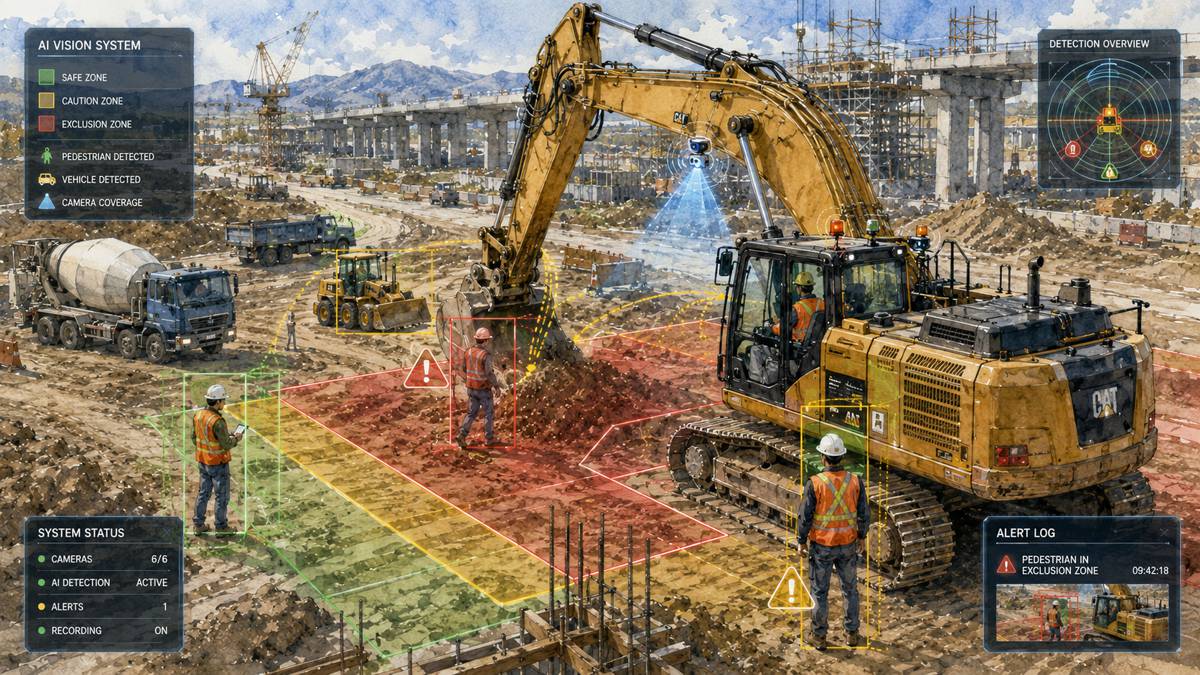
The Digital Construction Ecosystem Behind the Machines
Intelligent machines do not operate in isolation, and much of their value depends on a software and data ecosystem that connects design, construction and asset operation. This is the layer occupied by Bentley Systems, Autodesk, Trimble and Hexagon, whose platforms increasingly function as the connective tissue between a designed model and a machine executing it in the field.
Bentley has redoubled its AI investment around its iTwin digital twin platform, introducing an AI assistant, AI-powered search in its ProjectWise project management system, and new model-based design capabilities, underpinned by a connected data layer that lets project information be crawled for insight from design through to construction sequencing. Its acquisition of Cesium extended its reach into high-fidelity 3D geospatial visualisation, including reality-capture techniques that turn point clouds into photo-realistic scenes. These are not machine-control products, yet they are the environment in which machine-generated as-built data becomes usable intelligence.
Autodesk, Trimble and Hexagon complete the picture from complementary angles. Autodesk’s Construction Cloud and platform services provide the cloud-first model coordination that keeps every stakeholder working from the current version of a project, while Trimble spans design software, site positioning and the machine control that physically drives blades and buckets to grade.
Hexagon, through Leica Geosystems and its reality-capture and cloud platforms, links precise surveying and sensing to the same digital thread. The industry increasingly refers to this convergence as digital construction, in which building information modelling, digital twins, geospatial systems, robotics and AI operate as an integrated stack rather than separate tools, and the underlying modelling market is forecast to grow strongly through the decade as a result.
The practical lesson is that the return on an intelligent machine is amplified when it is plugged into this ecosystem and constrained when it is left to work alone.
AI Chips, Edge Computing and Onboard Processing
Beneath the visible features sits a quieter shift in where the computing actually happens. For much of the connected-machine era, telematics data was shipped to the cloud for analysis, which works well for maintenance trends but poorly for the split-second perception and control decisions demanded by a moving machine.
The industry is now moving decisively toward edge computing, in which sensor data is processed onboard in real time so that a machine can detect a person, adjust a bucket or coordinate with a neighbour without waiting on a network. The most prominent signal came at CES 2026, when Caterpillar deepened its partnership with NVIDIA and began integrating the NVIDIA Jetson Thor platform into its equipment, describing the result as a digital nervous system for the jobsite that processes billions of data points in milliseconds locally.
NVIDIA chief executive Jensen Huang set the collaboration in historical context, saying “For a century, Caterpillar has built the industrial machines that shaped the world,” and framing the partnership as spanning autonomous fleets through to the data centres that power them.
The strategic importance of onboard processing is greatest precisely where construction and mining tend to operate, which is often at the edge of reliable connectivity. Local compute lets an autonomous fleet keep working when the network is weak or absent, a point Komatsu has made through its Smart Construction Edge, which processes drone data and distributes positioning corrections at connectivity-poor sites.
The same architecture supports the in-cab assistance and voice tools now appearing, with Caterpillar’s AI Assistant using onboard processing so operators can query settings and troubleshooting without taking their hands off the controls. There is a candid limitation worth recording, which is that manufacturers rarely disclose the specific silicon, model architectures or validation datasets behind these systems, so buyers should treat compute capability as a genuine question in procurement rather than an assumed given. The direction of travel, however, is unmistakable, as intelligence migrates from distant servers onto the machine itself.
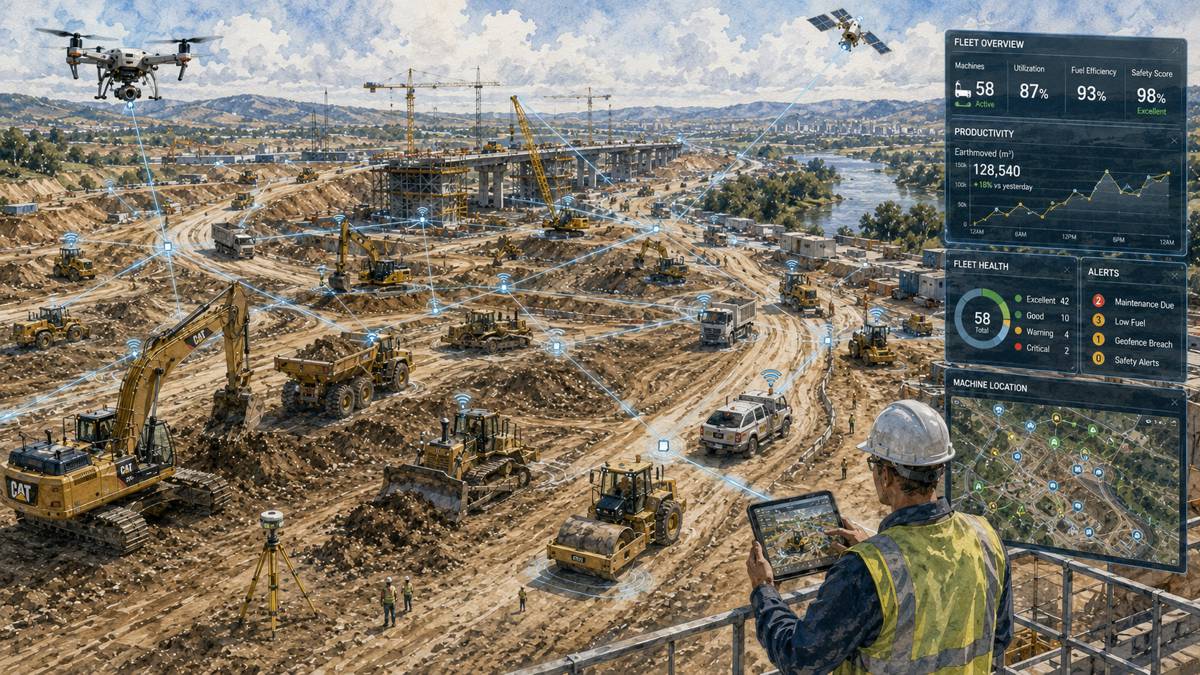
Coordinated Fleets and the Swarm Frontier
At the frontier, heavy equipment is beginning to behave less like a collection of individually clever machines and more like a coordinated robotic system. The strongest commercial evidence comes from roads, solar and quarry work rather than general urban excavation. SANY says its autonomous paving and compaction fleet has been deployed on more than 50 projects in China, and in a 2025 demonstration an autonomous paver was followed by two double-drum rollers and two pneumatic rollers working in real-time coordination, with the company reporting a workforce reduction of more than 60 per cent and tightly controlled surface flatness.
Built Robotics offers a different kind of coordination, running tightly choreographed fleets of specialised robots for solar piling that survey, distribute, drive and record piles as a single robotic workflow; the firm reports that its RPD 35 can run continuously and has proven several times faster than traditional pile driving across dozens of deployments and tens of thousands of operating hours. These are narrow task families, but their significance should not be understated, because they demonstrate that in constrained yet commercially important workflows, robot fleets already outperform conventional methods on both time and safety.
The research pipeline feeding this frontier is unusually rich and recent, which suggests the pace will hold. Academic reviews now frame earthmoving as moving from isolated single-machine tasks toward networked, collaborative multi-machine operations, and recent papers have applied reinforcement learning to bucket filling that adapts online to soil conditions, transformer-based end-to-end excavator control, and cycle-time estimation in simulation.
Patent activity points the same way, with disclosures around multi-machine teleoperation authorisation and cooperative truck-and-shovel loading. Coordinated earthmoving of the kind Develon, Gravis and HD Hyundai have demonstrated is not yet swarm robotics in the strict academic sense of decentralised collective behaviour, but it is clearly beyond single-machine autonomy. The trajectory from lead-follow workflows, where one operator triggers an autonomous compactor to finish a section, toward genuinely orchestrated site fleets is now visible rather than speculative.
Where Intelligent Machines Actually Pay
For all the technology on display, the question that decides adoption is a commercial one, namely where intelligent machines save money and how quickly they repay their cost. The clearest and fastest returns come from the least glamorous layer, which is machine control and grade assistance. By guiding a blade or bucket to a design model, these systems commonly lift productivity on rough grading by around a third to a half and let operators hit finish tolerance on the first or second pass rather than the third or fourth, which attacks rework directly.
Rework matters more than many balance sheets acknowledge, with industry sources attributing roughly half of all construction rework to bad data and miscommunication, and Taylor Woodrow’s own estimate that around a fifth of the cost of what the sector builds stems from not getting it right first time. Machine control also cuts fuel burn, reduces the number of survey visits and stakes, and lets less experienced operators perform to a higher standard, all of which show up quickly in project margins.
Predictive maintenance and connected telematics form the second fast-return layer, because avoided downtime and better-timed servicing translate almost immediately into utilisation gains on expensive assets. Platforms from Volvo, Caterpillar, John Deere and Trackunit turn machine data into early warnings that prevent a minor fault from becoming a major failure, and vision safety systems earn their keep by reducing the contact incidents that drive insurance costs and project delays.
These technologies share three attractive features for a cautious buyer, in that they can often be fitted to existing machines, they carry modest implementation risk, and they begin paying back within a single season rather than over many years. That profile makes them the natural first purchases for a contractor testing the water, and it explains why they have diffused so widely across the fleet.
Retrofit remote operation and autonomous haulage occupy the middle of the return spectrum, delivering strong value in the right settings while requiring more commitment. In repetitive, hazardous or hard-to-staff work such as quarry haulage, the economics are already compelling, with Pronto reporting fuel and tyre savings from optimised driving alongside the labour and safety benefits, and Caterpillar citing up to 30 per cent more material moved per shift in some remote dozing.
Built Robotics has similarly shown that autonomous piling can run several times faster than manual methods in solar work, and its rental-based model spreads cost rather than demanding a large upfront outlay. The frontier of end-to-end autonomous excavation and full multi-machine orchestration remains, for now, the early-stage investment, promising but not yet a routine purchase, where the value case depends on site conditions, connectivity and the maturity of assurance and standards.
The technology curve and the payback curve run in parallel, so the disciplined path is to bank the quick returns from machine control, telematics and safety first, then move up the autonomy ladder as confidence, infrastructure and regulation catch up.
The Changing Shape of the Operator’s Job
A recurring anxiety around intelligent machines is that they will simply eliminate operators, yet the pattern emerging on real sites is one of redefinition more than removal. Remote cockpits, teleoperation, one-click excavation and partial automation all shift the human toward supervision, exception handling, planning and quality assurance, and in many cases let one skilled person oversee several machines at once.
New roles are appearing alongside the traditional seat, from remote-operation specialists and fleet supervisors to autonomy technicians who commission and maintain the systems and site-model specialists who manage the digital twin. The Montana programme that trained military veterans with disabilities to operate loaders remotely is an early illustration of how the work can become accessible to people who could not previously perform it, which matters a great deal in a sector facing a persistent shortage of skilled operators.
Manufacturers appear to grasp that the workforce transition matters as much as the technology. Caterpillar accompanied its CES 2026 announcements with a commitment of 25 million dollars to workforce development, a recognition that intelligent machines still need people who can run, supervise and maintain them.
The practical implication for contractors and infrastructure owners is that adoption is as much a training and recruitment strategy as a capital-equipment decision, and the firms that invest early in reskilling are likely to capture the productivity gains soonest. Rather than hollowing out the trade, the more probable outcome is a gradual upgrading of it, in which operating heavy equipment becomes a more technical, safer and arguably more attractive career. That framing also speaks directly to the recruitment pressures that operators such as Heidelberg Materials have openly cited as a reason for automating in the first place.
Where It Is Landing, and the Rules Catching Up
The geography of adoption is uneven in instructive ways. North America is strongest in retrofit autonomy, remote operation, mixed-fleet telematics and quarry automation, with Caterpillar Command, Deere SmartGrade, Teleo, Built Robotics and Pronto all showing visible operating footprints. Europe leads on machine control, road and quarry digitisation and high-standard proving grounds, where automation is typically tied to digital construction and safety compliance rather than standalone robotics.
Asia is the most intense manufacturing and demonstration engine, with Japan central through Komatsu and Hitachi and China moving 5G remote control, intelligent excavation and autonomous road fleets into service at speed. Australia remains the most persuasive proof point for large-scale autonomy in harsh environments, while Africa and Latin America are firmly part of the commercial picture, with public evidence still richer in mining and quarrying than in mainstream civil earthworks. The pattern reflects where labour costs, safety pressures and remote geographies make the business case sharpest.
The standards and regulatory environment now matters as much as the hardware, and it is tightening in ways that favour disciplined operators. ISO 17757 addresses safety for autonomous and semi-autonomous earth-moving and mining machines, ISO 19014 covers functional safety of machine control systems, and ISO/TS 15143-3 underpins telematics interoperability.
In Europe the Machinery Regulation becomes the sole basis for placing machinery on the market from 20 January 2027, introducing explicit provisions on machine-learning behaviour and cybersecurity and routing certain AI safety components through third-party conformity assessment.
The picture shifted again in 2026, when the European Union’s Digital Omnibus reworked the overlap between the AI Act and the Machinery Regulation, moving machinery so that AI-specific health and safety requirements will be handled through delegated acts amending the Machinery Regulation rather than through the AI Act directly, and refining the definition of a safety component so that AI used purely for assistance, efficiency or optimisation is not automatically treated as high-risk.
The era in which AI could be marketed as a feature without an associated assurance burden is drawing to a close, and the firms that treat compliance as design discipline rather than paperwork will hold a real advantage.
What Intelligent Equipment Will Look Like by 2035
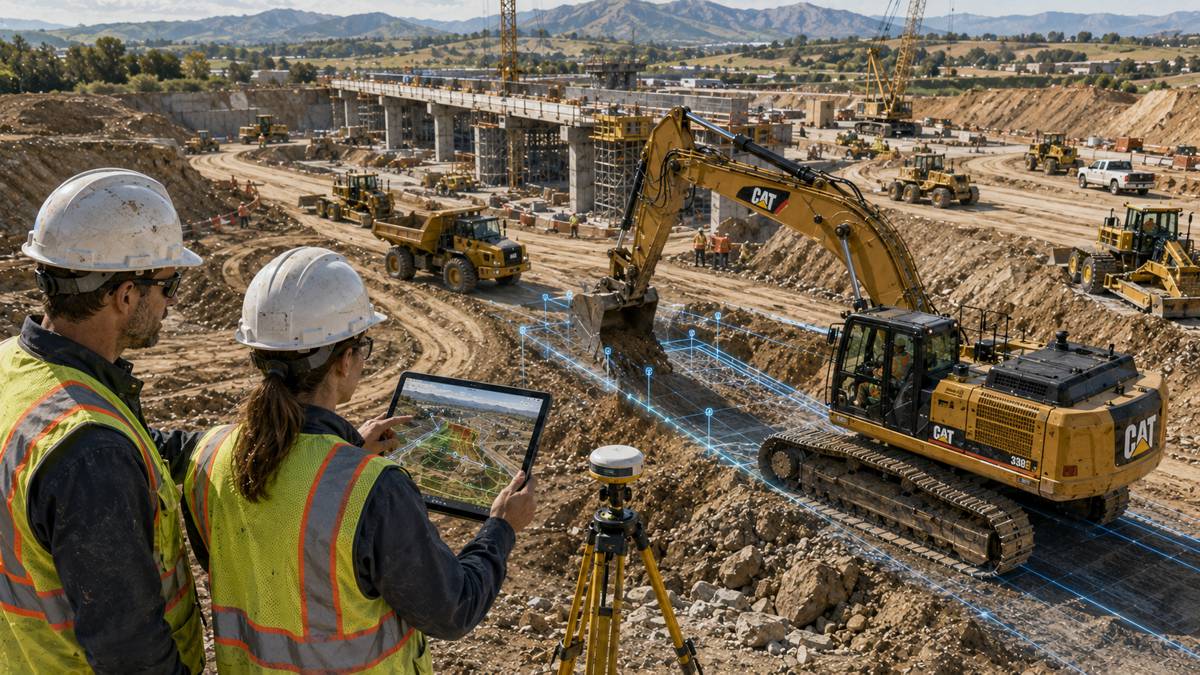
Projecting a decade forward carries obvious uncertainty, but the current trajectory supports some reasonably confident expectations. By 2035 the layered intelligence that is now optional is likely to be standard, with grade control, vision safety, telematics and operator assistance built into machines by default rather than specified as extras, much as reversing cameras and stability control became standard on road vehicles.
Mixed-fleet and brand-agnostic autonomy should be mature, so that a contractor can coordinate machines from several manufacturers on a single site platform, and the digital twin is likely to be the default operating environment rather than a premium feature. Coordinated multi-machine work, still at the frontier today in road paving and solar piling, should become considerably more common across general earthmoving, moving the sector closer to genuinely orchestrated sites rather than collections of individually clever machines.
Several enabling trends support this picture. Electrification is advancing in parallel with autonomy, with the electric construction machinery market projected by some analysts to exceed one hundred billion dollars by 2035, and electric drivetrains simplify aspects of automated control. Onboard compute will continue to grow more capable, pushing more perception and decision-making onto the machine, while the regulatory frameworks now taking shape in Europe and elsewhere should give buyers greater confidence that certified, cyber-secure autonomy can be deployed at scale.
None of this implies a fully unmanned construction industry by 2035, and the human role will remain central in supervision, judgement and complex or unstructured work. The more realistic vision is a site where intelligent machines handle the repetitive, hazardous and precision-critical tasks, people direct and oversee the work from safer positions, and the boundary between the two keeps moving steadily in the machines’ favour.
Five Technologies That Will Shape the Next Generation of Intelligent Equipment
Foundation AI Will Become the Machine’s Brain
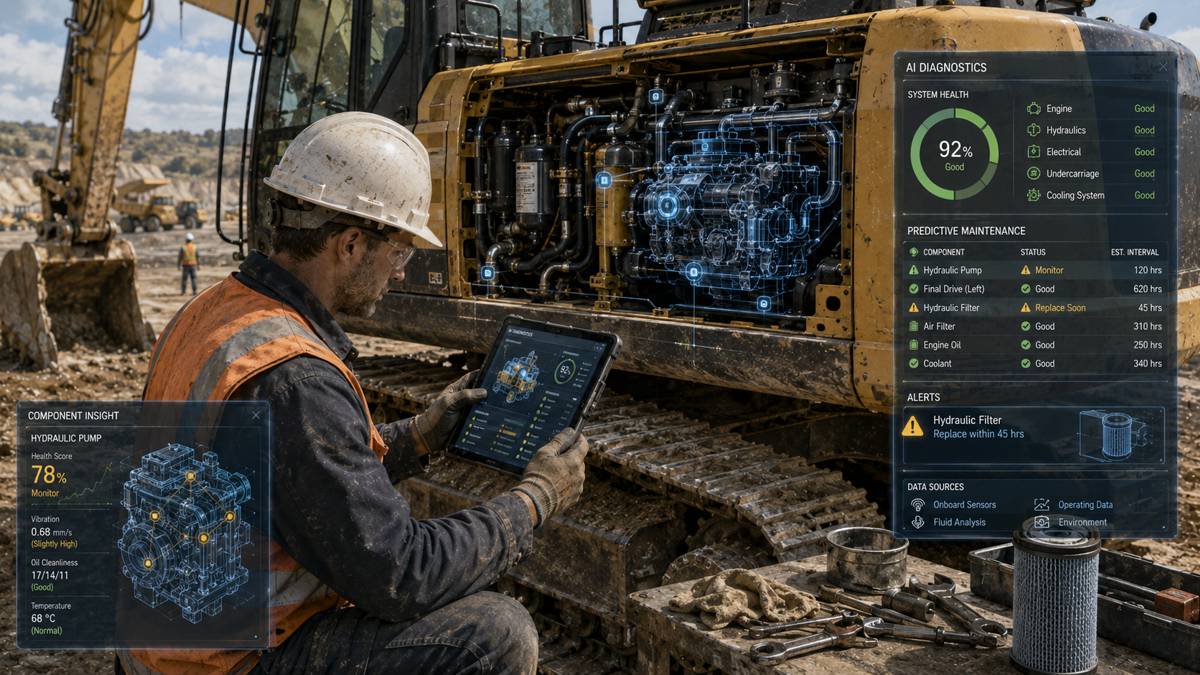
Today’s intelligent machines are built around collections of specialist systems. Grade control manages excavation accuracy, collision avoidance watches for hazards, predictive maintenance monitors component health, and telematics analyse fleet performance. Increasingly, these separate capabilities are beginning to converge around foundation AI models that act as a common intelligence layer.
Rather than switching between isolated software functions, future equipment will be able to understand the wider context of the jobsite, combining information from cameras, radar, GNSS positioning, hydraulic sensors, maintenance history and digital project models simultaneously. This allows the machine to make more informed decisions about how a task should be completed rather than simply following predefined rules.
Several manufacturers have already begun integrating more capable onboard AI processors and cloud-connected intelligence into production equipment, making this evolution less about a single breakthrough than a steady increase in machine capability. The result is equipment that understands not just where it is working, but why it is performing a particular task.
AI Copilots and Natural Language Will Simplify Operation
One of the biggest barriers to advanced automation has been the complexity of operating increasingly sophisticated machines. That is beginning to change through AI copilots and natural language interfaces.
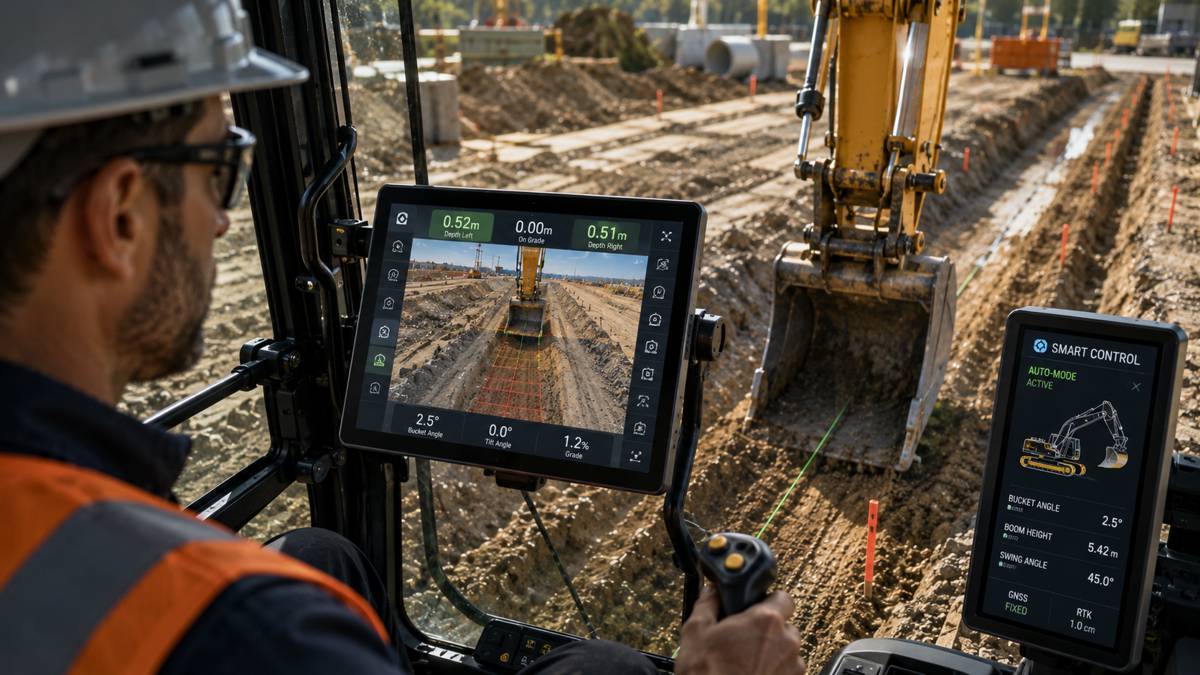
Instead of navigating multiple screens and menus, operators will increasingly be able to issue simple instructions such as “Excavate this trench to the design model,” “Prepare this pad for compaction,” or “Load these trucks evenly.” Behind those straightforward commands, AI systems interpret project data, machine capabilities and site conditions before translating the request into a sequence of controlled machine movements.
These digital assistants are also becoming real-time advisors. They can explain warning messages in plain language, recommend more efficient operating techniques, identify excessive fuel consumption, suggest maintenance actions and even coach less experienced operators through unfamiliar tasks. Early examples are already appearing in commercial products, offering a glimpse of how intelligent machines will become collaborative partners rather than simply responsive tools.
Digital Ecosystems Will Connect Every Machine on Site
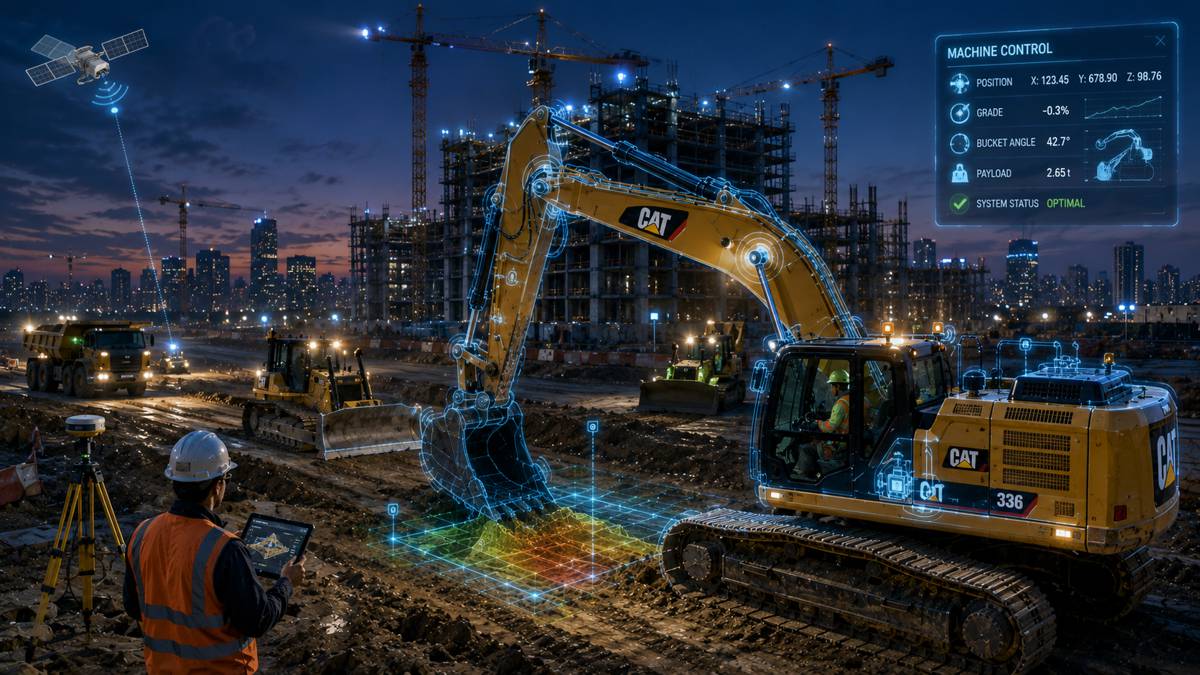
The next leap in productivity will come less from individual machines than from the way they share information. Construction sites are rapidly evolving into connected digital ecosystems where satellites, drones, machine control systems and digital twins operate as part of a continuous data loop.
Drone surveys captured in the morning can update a live digital twin within minutes, revised designs can be transmitted directly to excavators and dozers, while completed earthworks are automatically recorded and verified before the end of the shift. Rather than waiting days for survey updates or manually comparing drawings against site conditions, project teams increasingly work from a constantly refreshed picture of progress.
This convergence links together technologies from equipment manufacturers, software developers and geospatial specialists into a single operational environment. As connectivity improves, intelligent machines become active participants within that ecosystem, continuously exchanging information with neighbouring equipment, site managers and project platforms.
Robots Will Support the Workforce, Not Replace It
Automation is also expanding beyond traditional heavy equipment. Autonomous charging stations, robotic refuelling vehicles and mobile service robots are beginning to reduce the downtime associated with supporting large equipment fleets, particularly in mining and other continuous operations where every minute of availability matters.
At the same time, humanoid robots are moving cautiously from research laboratories into industrial trials. Their greatest value is unlikely to be replacing excavator operators, but performing the repetitive, hazardous or physically demanding tasks that conventional machinery cannot easily undertake. Inspection work, routine maintenance, material handling and operations inside confined or dangerous environments are all emerging applications where human-shaped robots can work alongside conventional equipment while using existing tools and infrastructure.
These developments point towards a future workforce in which people, machines and specialist robots each perform the tasks they are best suited to, improving both safety and productivity.
Virtual Training Will Accelerate Real-World Performance
As intelligent machines become more capable, they must also become better trained. Increasingly, that learning is taking place inside highly realistic virtual environments before software ever reaches a live construction site.
Synthetic training environments allow autonomous systems to experience thousands of operating scenarios, from changing ground conditions and severe weather to unexpected obstacles and equipment failures, without exposing people or machinery to unnecessary risk. The same simulations are transforming workforce development, enabling operators to practise complex procedures and become familiar with new technologies before entering active projects.
Digital twins, AI simulation and virtual testing are therefore becoming just as important as physical prototypes. Every hour spent learning inside a synthetic environment improves the performance, reliability and safety of the equipment that eventually arrives on site.
What the Arrival of the Intelligent Machine Actually Means
The claim that the intelligent machine has arrived is justified, provided it is read in industrial rather than science-fiction terms. Intelligence is already present as operator assistance, machine control, camera and radar vision systems, geofenced safety envelopes, remote command stations, quarry and mine autonomy, site digital twins, predictive diagnostics and the first commercially credible multi-machine orchestration.
The evidence is not one robot digging a perfect trench in a marketing clip. It is the cumulative weight of many commercial systems working together, from Caterpillar’s assist and command stack and Volvo’s Dig Assist and ActiveCare to Komatsu’s machine control, teleoperation, digital twin and 1,000 autonomous haul trucks, Hitachi’s operator-assist programmes, SANY’s road fleets, Built’s piling robots, Teleo’s supervised autonomy, Gravis’s earthmoving retrofit and Pronto’s mixed-fleet quarry haulage.
What remains uneven is not whether AI is deployed but where each system sits on the spectrum between assistance and autonomy, how deeply it is woven into mixed-fleet operations, and how confidently it can be certified, connected, serviced and trusted. The products most likely to scale fastest are those that augment people, work with installed fleets, exploit existing standards and tie machine-level intelligence into site-level twins and maintenance loops. The fully autonomous construction site is still emerging, and it will arrive site by site rather than all at once.
The more useful way to think about the decade ahead is to reverse the usual framing. The defining characteristic of the next ten years will not be the arrival of autonomous construction machinery so much as the gradual disappearance of equipment that lacks intelligence altogether. Just as GPS, telematics and machine control moved from optional extras to standard specification, AI is becoming another capability that buyers simply expect, and machines without it will look increasingly dated on a competitive tender.
The firms best placed to lead are those that learn to combine intelligent machines, connected data and skilled operators into a single coherent workflow, because that integration, rather than any individual robot, is what will define the industry’s next leap in productivity. The intelligent machine is already on the payroll, and the strategic question has shifted decisively from whether to adopt it to how quickly and how well it can be woven into the way the work is done.
Key Industry Questions
- Is AI in heavy equipment genuinely deployed today, or is most of it still trials? It is genuinely deployed and generating revenue, though the maturity varies by function. Operator assistance, machine control, vision safety systems and predictive maintenance are broadly commercial and shipping in serial production from Caterpillar, Volvo CE, John Deere and Komatsu. Autonomous haulage is proven at industrial scale in mining and increasingly in quarrying, with Komatsu commissioning its 1,000th autonomous haul truck in 2026 and Pronto running a mixed-fleet quarry that moved more than two million tons in under eight months. It is not confined to mining, either, with machine control now common on highway earthworks, autonomous excavators trialled for UK airport works, AI-guided tunnel boring machines on metro and rail projects, and autonomous site preparation appearing on heavy civil developments. Multi-machine coordination and end-to-end autonomous excavation remain the frontier, working on real sites but scaling unevenly. The honest summary is that the base of the pyramid is mature and the apex is still forming.
- Does operator assistance replace skilled operators, or support them? The dominant commercial design supports operators rather than replacing them, and vendors are explicit about this. Systems such as Grade with Assist, Volvo Active Control and SmartGrade are built to compress the gap between novice and expert, cutting rework, fatigue and cycle-time variability. The immediate business driver is the shortage of experienced operators, so the value lies in helping newer staff reach expert-level output faster. Remote operation extends the same logic by moving the operator into a safer environment and, in some cases, letting one person supervise several machines. The role is shifting toward supervision, exception handling, planning and quality assurance rather than disappearing. Over the longer term, autonomy will remove some seat-hours, but the near-term effect is augmentation and a widening of who can do the work.
- What is the real difference between machine control and true AI on a jobsite? Machine control is largely deterministic automation built on precise sensing, kinematic models and control logic, using GNSS, inertial sensors and joint-position data to hold a blade or bucket to a designed grade. It is highly capable but predictable and rules-based. The machine-learning component is strongest in perception, where camera and radar systems detect people and obstacles, and at the frontier in learning-based control that adapts to changing soil or terrain. The distinction matters commercially because the two carry different validation, explainability and regulatory burdens. A grade-control loop can be verified deterministically, whereas a self-adapting controller demands more sophisticated assurance. Buyers should ask suppliers precisely which functions are model-based and which are rules-based, because the answer affects certification, liability and how quickly the system will improve.
- How does remote operation change site safety and the labour equation? Remote operation removes the operator from the hazard zone, which is its clearest safety benefit. Repositioning a person away from vibration, dust, high walls, blasting areas and unstable ground reduces exposure to exactly the conditions that cause serious harm. Caterpillar reports that some remote dozing projects move up to 30 per cent more material per shift, so productivity and safety can improve together. On labour, remote and supervised operation lets one operator oversee more than one machine and, significantly, widens the pool of who can participate. A Montana pilot trained veterans with disabilities to operate loaders remotely, and retrofit kits allow contractors to convert existing machines rather than replace them. The main constraints are reliable site connectivity, robust command-centre design and the training needed to build operator trust in the system.
- What is a construction digital twin and what does it actually deliver? A construction digital twin is a live three-dimensional model of a jobsite built from design files, drone surveys and machine as-built data, rather than a static drawing. Komatsu’s Smart Construction Dashboard is a working example, creating a virtual site that supports progress tracking, quantity measurement and continuous comparison of plan against reality. The practical payoff is closed-loop control of earthworks, where deviations are caught early, rework is reduced and reporting is automated. In mining and quarrying, platforms such as MST Global’s HELIX add equipment health and personnel location for real-time decision support. The deeper value is that a site rendered as data becomes an environment that machine autonomy and fleet analytics can plug into directly, which is why twins are increasingly the foundation on which other intelligent-machine capabilities are layered.
- Can autonomy really work across a mixed fleet of different equipment brands? Yes, and this is one of the most commercially important recent developments. The Pronto deployment at Heidelberg Materials ran Caterpillar and Komatsu haul trucks on a single autonomous system, which its chief executive summarised as the ability to automate the iron a company already owns. Original-equipment-agnostic and retrofit approaches from Pronto, Teleo, Gravis and others allow autonomy to be layered over existing fleets rather than requiring a costly single-brand refresh. Interoperability standards such as ISO/TS 15143-3, known as AEMP 2.0, do the equivalent job for telematics and fleet data. The practical implication is that adoption does not demand fleet replacement, which lowers the barrier to entry substantially. The remaining challenges are integration engineering, dealer support, connectivity and building operator confidence across varied machine types.
- How will the EU Machinery Regulation and AI Act affect AI-equipped machines? The regulatory bar in Europe is rising, and manufacturers and buyers should plan for it now. The Machinery Regulation becomes the sole basis for placing machinery on the EU market from 20 January 2027, with explicit provisions on machine-learning behaviour, cybersecurity and lifecycle safety, and third-party conformity assessment for certain AI safety components. During 2026 the Digital Omnibus reworked the overlap between the AI Act and the Machinery Regulation, so AI-specific health and safety requirements for machinery will be handled through delegated acts amending the Machinery Regulation rather than through the AI Act directly, and the definition of a safety component was refined so that AI used purely for assistance or optimisation is not automatically high-risk. Substantially modifying a machine, physically or digitally, can also restart conformity obligations, which matters for retrofit autonomy.
- How quickly does intelligent construction equipment pay for itself, and which systems return fastest? The fastest and lowest-risk returns come from machine control and grade assistance, which commonly raise grading productivity by roughly a third to a half, cut fuel and survey costs, and reduce the rework that industry sources link to a large share of wasted spend. Predictive maintenance and connected telematics follow closely, converting avoided downtime into utilisation gains on expensive assets, while vision safety systems reduce the contact incidents that drive insurance and delay costs. These layers can usually be fitted to existing machines and tend to pay back within a single season, which makes them the sensible starting point. Retrofit remote operation and autonomous haulage deliver strong returns in repetitive or hazardous settings but ask for more commitment, and full multi-machine autonomy remains an early-stage investment. The disciplined path is to bank the quick wins first, then climb the autonomy ladder as confidence and infrastructure allow.
- How significant is China’s progress in intelligent construction equipment? It is substantial and moving quickly, and it is reshaping the competitive field for everyone. Thirteen of the world’s fifty largest construction machinery manufacturers were Chinese on the 2026 ranking, and the leading firms are pairing automation with aggressive pricing and wide export networks. SANY has fielded autonomous paving and compaction fleets, XCMG reports Level 4 operation in mining and paving and has deployed a hundred-unit autonomous electric mining haulage fleet, Zoomlion is building a robotics platform to automate its lineup, and LiuGong has shown commercial unmanned electric loaders. For infrastructure owners outside China, the effect is a broader choice of intelligent-equipment suppliers and a faster overall market tempo. The main caveat is that English-language documentation of these deployments is uneven, so specific performance figures are best treated as manufacturer-reported until independently confirmed.
- What do edge computing and onboard AI mean for machines on poor-connectivity sites? They are what make autonomy practical away from strong networks, which describes much of construction and mining. Edge computing processes sensor data on the machine in real time, so perception and control decisions do not depend on a round trip to the cloud, and the fleet keeps working when connectivity is weak or absent. Caterpillar’s 2026 partnership with NVIDIA, integrating the Jetson Thor platform to process data locally, and Komatsu’s Smart Construction Edge, which handles drone data and positioning corrections on site, both illustrate the shift. The same onboard capability supports in-cab voice assistants and faster safety responses. For buyers, the practical point is that compute capability now belongs in the procurement conversation, even though manufacturers seldom disclose the specific chips, models or validation behind their systems.
Strategic Takeaways
- The competitive frontier has moved from manual versus autonomous to integration capability, so the firms that win this cycle will be those that combine sensing, connectivity, autonomy, safety assurance and workforce redesign into daily operations rather than those that simply buy the cleverest single machine.
- Intelligence is now a corporate strategy across the entire manufacturer field, from Caterpillar’s edge-AI partnership with NVIDIA to Hitachi’s rebranding as LANDCROS and China’s rapid productisation, which means buyers face a widening and more competitive supplier base rather than a single dominant platform.
- Retrofit and brand-agnostic autonomy have removed fleet replacement as a barrier to entry, and the fastest, lowest-risk returns come from the mature layers, since machine control cuts the rework that can account for around a fifth of build cost and telematics-based predictive maintenance turns avoided downtime into utilisation gains, often paying back within a single season.
- Labour scarcity is proving a stronger adoption driver than pure cost reduction, and the operator’s role is being redefined toward supervision, exception handling and fleet oversight, so early investment in reskilling is likely to determine who captures the productivity gains first.
- Digital twins, interoperable telematics and the design-to-site software ecosystem are becoming the foundation on which higher-value autonomy is built, and the tightening European regulatory frame will reward suppliers that treat certification, cybersecurity and lifecycle assurance as design discipline rather than paperwork.