Develon to Spotlight AI Safety and Series 9 Heavy Excavators at steinexpo 2026
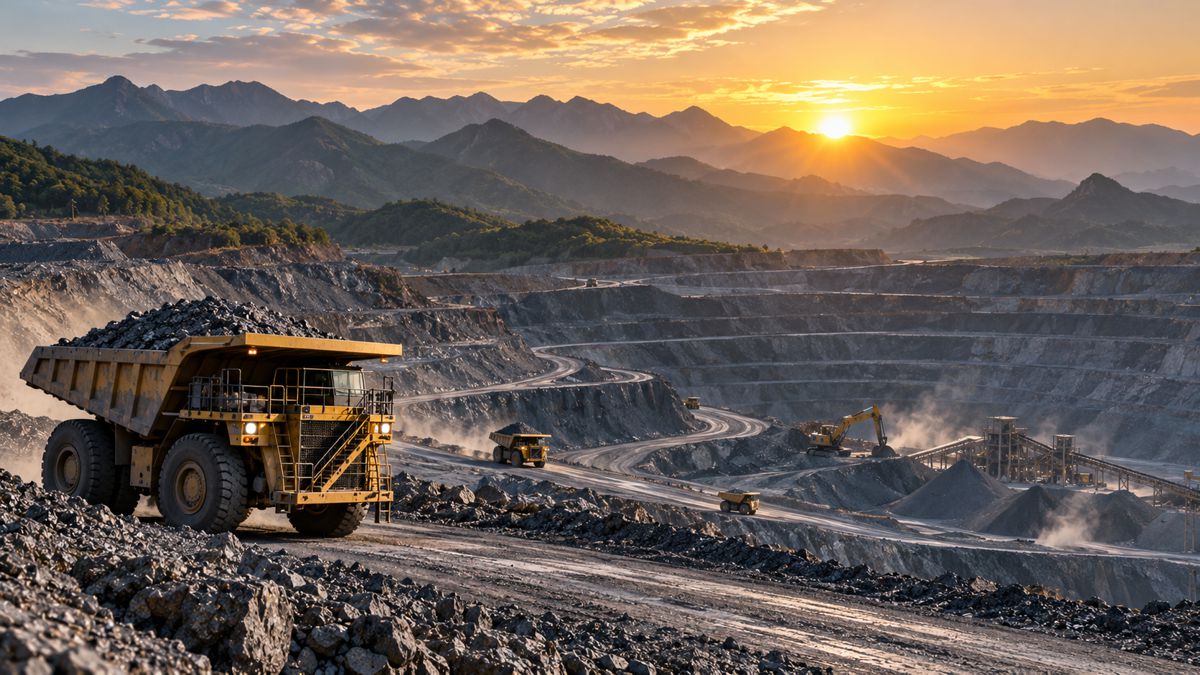
When Develon returns to steinexpo this September, the more revealing story is not the size of its stand but what the machines standing on it say about where quarry and construction equipment is heading. The manufacturer is bringing seven large machines to booth A21 and the adjacent demonstration area at Europe’s largest basalt quarry in Nieder-Ofleiden, and the line-up reads as a statement of direction rather than a simple product parade.
Radar-based emergency braking, camera systems with artificial intelligence built in, electronic hydraulic controls and a battery-electric excavator are all present in one place, aimed squarely at buyers who make their decisions by watching iron move earth rather than by reading a brochure.
That matters because steinexpo is unlike almost any other event in the calendar. Held from 2nd to 5th September 2026 in an active quarry operated by Mitteldeutsche Hartstein-Industrie AG, the show is built around live demonstrations rather than static halls, drawing more than 61,000 visitors to its previous edition in 2023. For a manufacturer, the setting is unforgiving in the best sense, since a machine either performs in front of a professional audience or it does not. Develon’s decision to occupy close to 500 square metres, only its second appearance at the show after debuting three years ago, signals how much commercial weight it is placing on the German-speaking quarrying and aggregates market.
“Our entire sales team will be on site,” says René Halter, a member of the management board at Develon Germany, adding that “Existing customers and many new prospects have already scheduled appointments with us,” which suggests the pipeline is already forming well ahead of the opening day.
Briefing
- Develon will exhibit seven large machines across booth A21 and a live demonstration area in Zone A at steinexpo 2026, held in Europe’s largest basalt quarry at Nieder-Ofleiden from 2nd to 5th September.
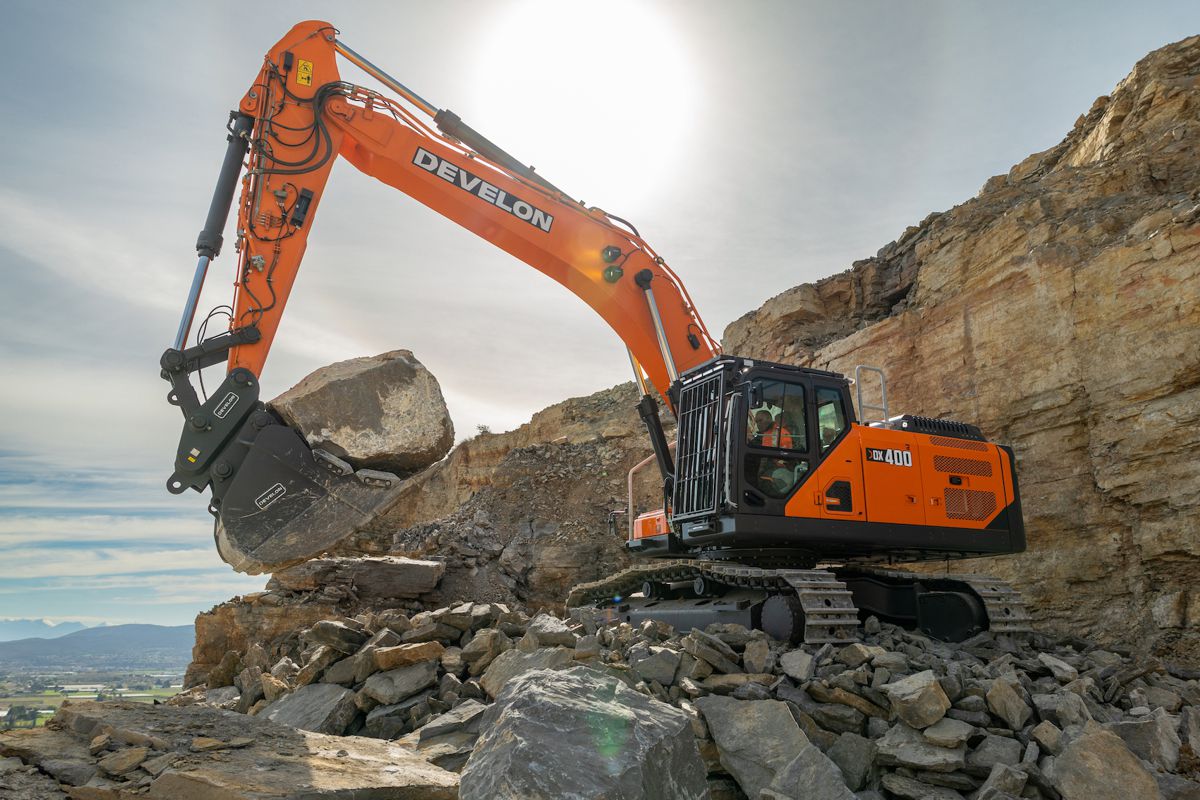
- The DX360LC-9 and DX400HD-9 crawler excavators make their steinexpo debut, extending the Series 9 smart excavator platform into the 37 and 42 tonne classes with integrated Smart AVM camera coverage and radar-based E-Stop automatic braking.
- The DX160WE battery-electric wheeled excavator brings zero point-of-use emissions and low-noise operation to urban and regulated worksites, using a lithium iron phosphate battery designed for a full working shift.
- Wheel loaders including the DL420CVT-7 and either the DL550-7 or DL580-7 will showcase the award-winning Transparent Bucket 2.0 vision system, alongside articulated dump trucks represented by the DA45-7 on the stand and the DA30-7 in live operation.
- The connected My Develon platform ties the physical fleet to digital fleet management, remote support and maintenance scheduling, reflecting the wider shift towards data-led aftersales in heavy equipment.
Heavy Iron Meets Automotive-Grade Safety
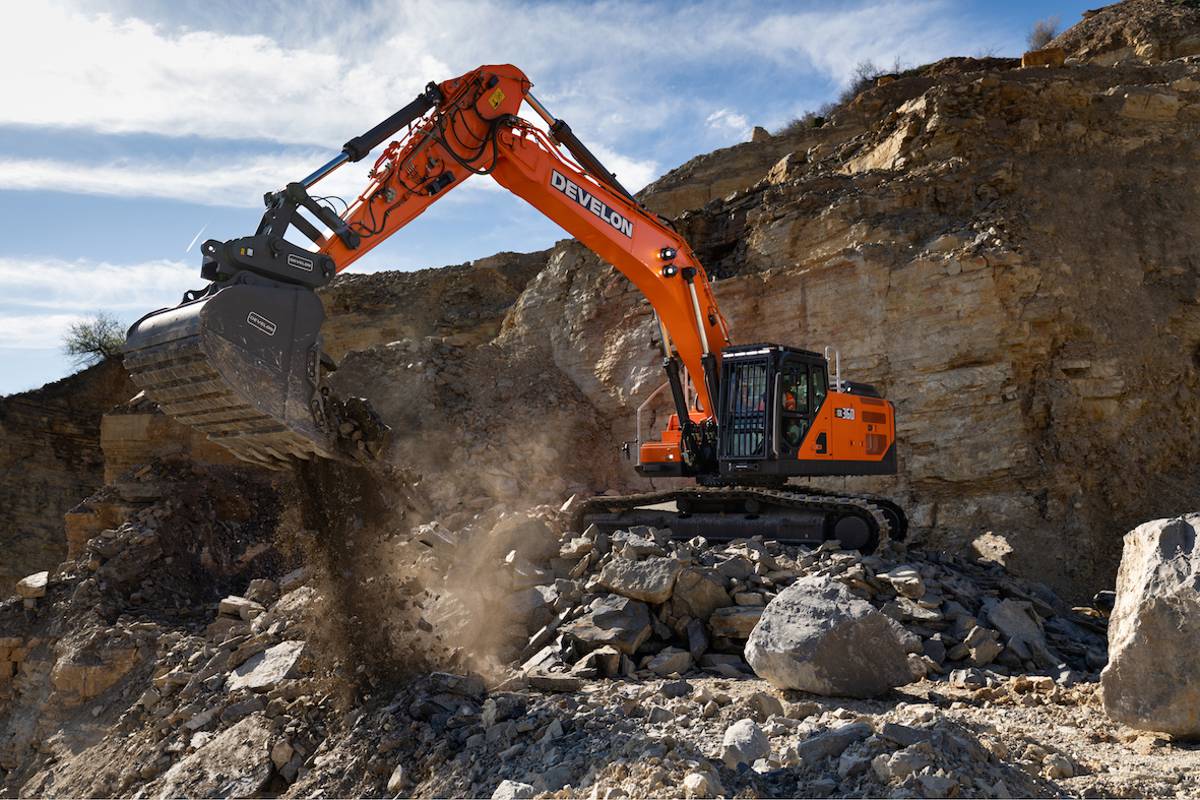
The two machines carrying most of the strategic message are the DX360LC-9 and the DX400HD-9, both making their first steinexpo appearance as the largest members of the Series 9 range. Develon first unveiled the platform at bauma 2025 with smaller 23 and 26 tonne models, and has since pushed it firmly into the heavy end of the crawler market, with the DX360LC-9 operating at 37,200 kilograms and the DX400HD-9 at 42,160 kilograms.
What sets the range apart is not raw digging force, considerable though that is, but the architecture underneath. The Series 9 machines move away from conventional hydraulic pilot controls to a full electronic hydraulic system, replacing mechanical signals from the cab levers with electrical ones. That change sounds incremental yet it reshapes how the machine behaves, allowing joystick sensitivity, response rates and control layouts to be tailored to the individual operator and, crucially, opening the door to assistance features that hydraulics alone could never support.
Safety is where that electronic foundation earns its keep, and it is the theme Develon is pushing hardest at Nieder-Ofleiden. The Smart AVM system draws on up to six cameras and AI-powered object detection to give the operator a full 360-degree view around the machine, addressing the blind spots that have long made large excavators dangerous to work around.
Sitting alongside it, the E-Stop function uses radar sensors to monitor a field of view of up to 330 degrees, triggering a visual and audible warning and automatically slowing the machine when a person or object comes within six metres. Should someone move within four metres, the system stops the machine and all its movements without operator intervention. Develon describes the approach as bringing automotive-grade thinking to construction equipment, and the comparison is apt, since the sensor fusion and automatic braking logic borrow directly from the driver-assistance systems now standard in road vehicles.
The commercial logic behind this is easy to underestimate until the numbers are considered. Across the wider construction sector, being struck by moving plant remains one of the most persistent causes of serious and fatal injury, and analysis from safety regulators in the United States has attributed roughly three-quarters of struck-by fatalities to heavy equipment such as trucks and machinery.
Quarries compound the risk through confined benches, reversing haulers and ground crews working close to swinging counterweights. A system that intervenes before a collision, rather than merely recording it afterwards, changes the risk calculation for site operators, insurers and the contractors who must satisfy increasingly demanding client safety requirements. For fleet buyers weighing total cost of ownership, technology that reduces the likelihood of a stoppage, an investigation or a claim carries a value that extends well beyond the specification sheet.
A New In-House Engine Under the Bonnet
The powertrain choice inside the Series 9 heavyweights deserves attention in its own right, because it marks a deliberate move towards vertical integration. Both the DX360LC-9 and the DX400HD-9 run on the new Develon DX08V engine, an in-house unit that replaces the Scania engine previously fitted to machines of this class. In the DX360LC-9 it delivers 227 kW, while the DX400HD-9 draws 254 kW, and both units are engineered for the heavy-duty, high-load cycles that quarry work demands while meeting current European emissions standards.
Owning the engine as well as the machine gives Develon tighter control over how the powertrain and the electronic hydraulic system are calibrated together, which tends to translate into smoother response and more predictable fuel consumption in the field.
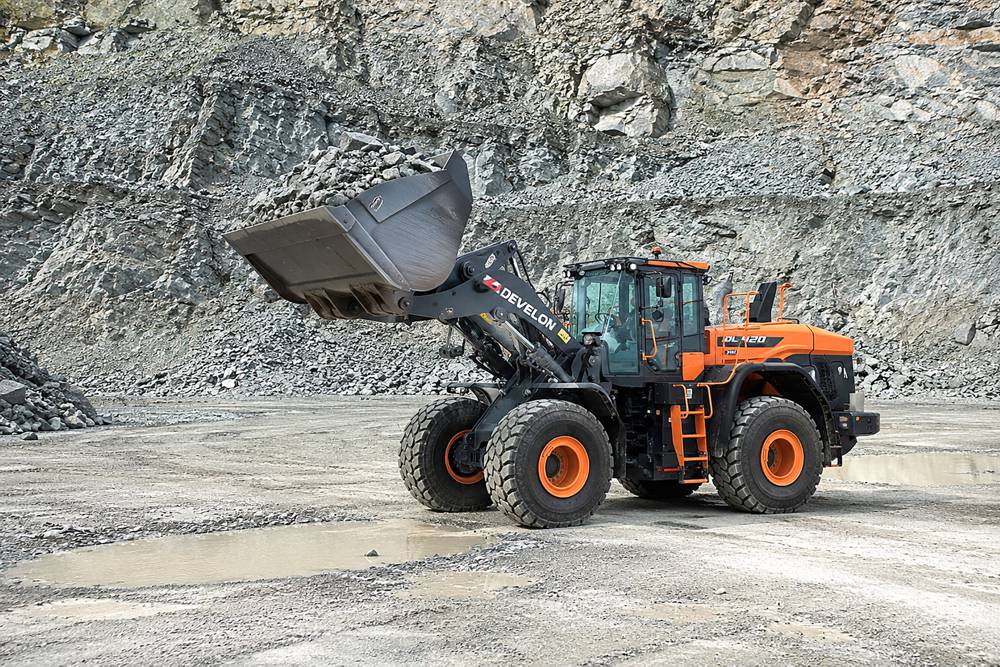
That shift is worth reading against the rest of the line-up, where the picture is more nuanced. The DL420CVT-7 wheel loader on show at steinexpo still relies on a 240 kW Scania D9 five-cylinder engine that meets Stage V requirements, a reminder that manufacturers rarely switch every platform at once and that proven supplier relationships continue where they make sense.
The loader pairs that engine with a continuously variable transmission that blends mechanical and hydrostatic drive, an arrangement designed to improve fuel efficiency across the varied load-and-carry cycles typical of aggregate handling. Seen together, the excavator and loader powertrains illustrate a manufacturer managing a measured transition, insourcing where it delivers the greatest control over its most advanced products while retaining established engines where they already perform.
Electric Power Steps Into the Quarry Conversation
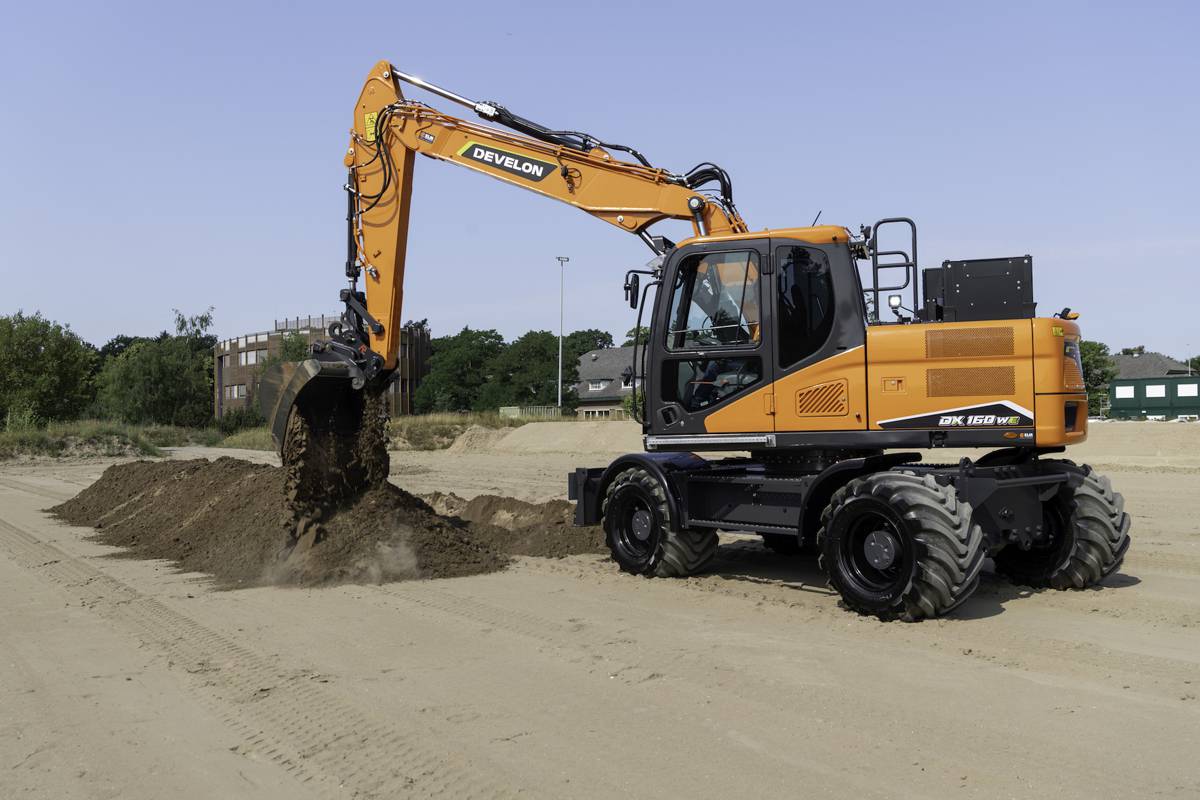
Among the seven machines, the DX160WE electric wheeled excavator carries an outsized significance relative to its 17 tonne class. Built on the company’s established wheeled excavator platform and fitted with a lithium iron phosphate battery, the machine is engineered to run a full working day on a charge while delivering the digging and handling capability buyers expect from a diesel equivalent.
Its permanent-magnet electric motor provides consistent torque and precise control, and the absence of an engine removes both exhaust emissions at the point of use and much of the noise that restricts where and when conventional machines can operate. Develon has developed its electric drivetrains in partnership with specialist European suppliers, and has pointed to early deployments across the Netherlands and Scandinavia as evidence that the technology is ready for wider introduction.
The relevance to a quarry demonstration show is less obvious than it might first appear, and that is precisely what makes it interesting. Electric machines remain a small share of global equipment sales, but adoption is climbing quickly in the Benelux and Nordic markets, driven by tightening urban emissions rules, low-emission zones and public procurement that increasingly rewards cleaner sites.
By bringing a battery-electric excavator to steinexpo, Develon is testing the appetite of a traditionally diesel-minded audience and positioning itself for the moment when regulation, rather than novelty, drives the purchasing decision. For contractors bidding on urban infrastructure, city-centre demolition or projects near hospitals and schools, a machine that offers diesel-equivalent output with predictable running costs and no tailpipe emissions is beginning to look less like an experiment and more like a competitive necessity.
Loaders, Trucks and the Battle Against Blind Spots
Visibility and productivity dominate the rest of the stand, and Develon’s Transparent Bucket 2.0 system is the clearest expression of that focus. Fitted to the wheel loaders on display, the system uses two cameras mounted at the top and bottom of the machine to capture the area in front of the loader, then combines the images in real time and projects them onto the cab monitor using a curved display method that effectively removes the blind spot created by a raised bucket.
On a busy quarry face or a congested construction site, where ground workers and light vehicles move constantly in front of loading machines, that continuous forward view addresses one of the more stubborn safety gaps in materials handling. The same loaders add Smart Load technology to guard against overloading and an automatic hydraulic differential lock to maintain traction on loose or uneven ground.
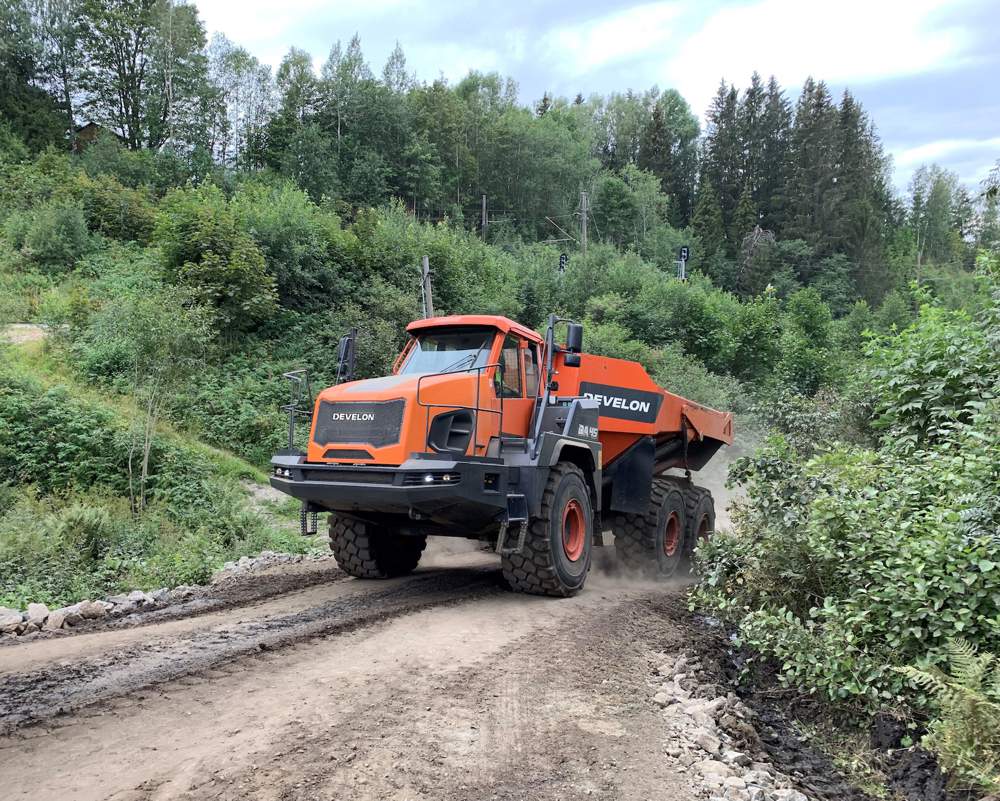
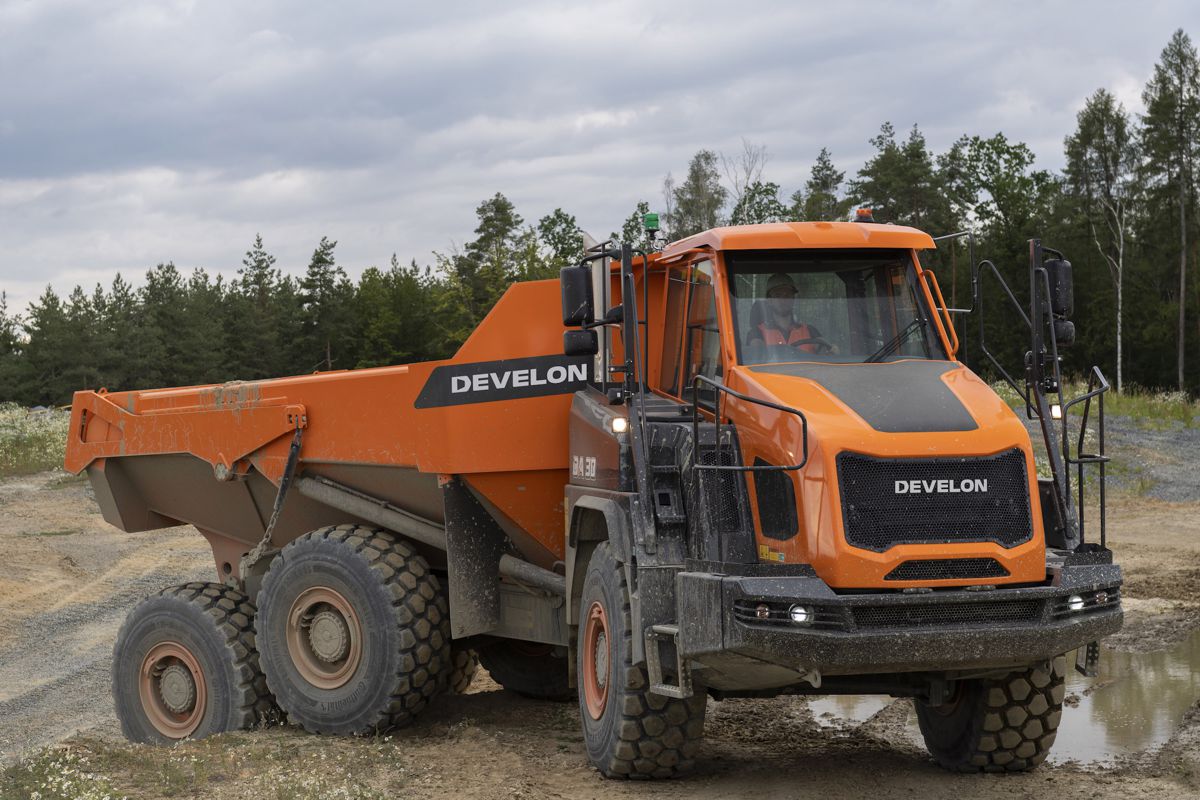
Develon is keeping some suspense over the largest loaders, confirming that either the DL550-7 or the DL580-7 will appear on the stand with the final choice made only shortly before the show opens, though whichever arrives will carry the Transparent Bucket 2.0 system. The articulated dump trucks complete the earthmoving picture, with the DA45-7 stationed on the stand and a DA30-7 working in the demonstration area to show how the range handles the wet, slippery and low-traction conditions where articulated haulers earn their reputation.
Operator environment is a recurring theme across these machines, from the class-leading cab space and air-suspension seating in the trucks to the quiet, low-vibration interiors designed to keep drivers alert through long shifts. That emphasis reflects a broader industry understanding that operator comfort and fatigue management are productivity and safety issues, not luxuries, particularly as the sector competes for skilled machine operators.
Connecting the Fleet Through My Develon
Behind the physical machines sits the My Develon digital platform, which the manufacturer is presenting as an integral part of the stand rather than an afterthought. Accessible through a website and a mobile application, the system lets customers view machine operating information, request product consultations and arrange maintenance, drawing the physical fleet into a connected service relationship.
Develon says the platform continues to evolve in response to customer feedback, and features already emerging across the Series 9 range, such as a Bluetooth digital key that lets operators unlock and start a machine without a physical key, hint at how deeply the digital and mechanical layers are becoming intertwined.
The strategic value of this connected approach lies in the aftersales economics of heavy equipment, where uptime, parts availability and predictable maintenance often matter more to a fleet owner than headline purchase price. Prognostics and health management functions that monitor hydraulic oil, engine oil and pump condition allow issues to be flagged before they become failures, shifting maintenance from reactive to planned and reducing the unscheduled downtime that erodes profitability on tight project timelines.
For Develon, a robust digital ecosystem also deepens the customer relationship beyond the point of sale, creating recurring touchpoints for service, parts and eventual replacement. In a market where several manufacturers offer broadly comparable machines, the quality of the surrounding digital and dealer support is increasingly where competitive advantage is won.
Reading the Wider Signal From Nieder-Ofleiden
Taken as a whole, Develon’s steinexpo presence tells a consistent story about the direction of quarry and construction equipment. The combination of electronic hydraulic control, AI-assisted vision, radar-based collision avoidance, in-house engines, battery-electric options and connected fleet management points to a market where machines are expected to be safer, cleaner, easier to operate and better integrated into digital workflows all at once.
None of these elements is unique to Develon, and rivals are pursuing similar paths, but assembling them into a coherent demonstration at Europe’s premier live quarry show is a clear bid for the attention of buyers making significant capital decisions. For a manufacturer formerly known as Doosan Construction Equipment and rebranded to Develon in recent years, a strong showing in the demanding German-speaking market is also an exercise in establishing the newer brand identity on its own terms.
The broader implication for the industry is that the definition of a competitive machine is broadening. Lifting capacity, breakout force and fuel efficiency remain essential, but they increasingly sit alongside expectations around worker protection, emissions performance and data connectivity that would have seemed optional a decade ago.
Site operators and infrastructure owners setting procurement standards, insurers pricing risk and contractors bidding for work under stricter safety and sustainability criteria are all pushing demand in the same direction. steinexpo 2026 offers an early, tangible look at how that shift is arriving in the heaviest and most conservative corners of the sector, and Develon is positioning its seven machines at Nieder-Ofleiden as proof that the transition is already underway rather than a promise for some distant future.
Key Industry Questions
- What makes the Develon Series 9 excavators different from earlier models? The defining change is the move from conventional hydraulic pilot controls to a full electronic hydraulic system, which replaces mechanical signals from the cab levers with electrical ones. This shift lets operators customise joystick sensitivity, response rates and control layouts, and it enables assistance features that hydraulic systems cannot support. On the Series 9 platform, that foundation underpins integrated safety technologies such as the Smart AVM camera system and radar-based E-Stop braking. The largest models, the DX360LC-9 and DX400HD-9, also introduce Develon’s new in-house DX08V engine in place of the previous Scania unit. Together these changes reposition the excavator from a purely mechanical tool towards a more responsive, assisted and connected machine.
- How does the E-Stop collision avoidance system actually work? E-Stop uses radar sensors to monitor a field of view of up to 330 degrees around the machine, working in concert with the Smart AVM camera coverage. When a person or object comes within six metres, the system issues a visual and audible warning to the operator and automatically slows the machine. If someone moves within four metres, it stops the machine and all its movements without waiting for the operator to react. The logic mirrors the automatic emergency braking systems found in modern road vehicles, applying sensor fusion and automated intervention to a construction context. The practical aim is to prevent a collision before it happens rather than simply record it, which is particularly valuable in the confined, congested conditions of a working quarry.
- Why is Develon bringing an electric excavator to a quarry demonstration show? Quarries are traditionally diesel territory, so showcasing the battery-electric DX160WE at steinexpo is partly a signal of intent and partly market testing. Electric machines remain a small share of global sales, but demand is rising sharply in the Benelux and Nordic regions, driven by low-emission zones, tightening urban regulation and public procurement favouring cleaner sites. The machine offers digging and handling performance comparable to a diesel equivalent, with a lithium iron phosphate battery sized for a full shift, zero point-of-use emissions and much lower noise. Presenting it to a conservative audience helps Develon gauge appetite and build familiarity ahead of the point where regulation, rather than early adoption, drives purchasing decisions across mainstream markets.
- What is the significance of Develon’s new in-house DX08V engine? The DX08V represents a move towards vertical integration, replacing the Scania engine previously used in this excavator class with a unit Develon designs and builds itself. In the DX360LC-9 it produces 227 kW and in the DX400HD-9 it produces 254 kW, both engineered for heavy-duty quarry cycles while meeting current European emissions standards. Owning the engine allows tighter calibration between the powertrain and the electronic hydraulic system, which generally improves throttle response and fuel predictability. It also gives the manufacturer greater control over supply, cost and future development. Notably, Develon has not switched everything at once, as the DL420CVT-7 wheel loader still uses a Scania engine, showing a measured transition rather than a wholesale change.
- How does Transparent Bucket 2.0 improve safety on site? Transparent Bucket 2.0 tackles one of the most persistent hazards in materials handling, the blind spot created when a raised loader bucket blocks the operator’s forward view. The system uses two cameras mounted at the top and bottom of the machine to capture the area ahead, then combines the images and projects them onto the cab monitor using a curved display method that effectively lets the operator see through the bucket. On congested quarry faces and construction sites, where ground workers and light vehicles move constantly in front of loaders, that continuous forward visibility reduces the risk of a strike. It also supports productivity, since operators can position and load more confidently without repeatedly repositioning to check their line of sight.
- What does the My Develon platform offer fleet owners? My Develon is a connected digital platform, accessible via website and mobile app, that links physical machines to fleet management, remote support and maintenance services. Owners can view operating information, request consultations and schedule servicing, while prognostics and health management functions monitor hydraulic oil, engine oil and pump condition to flag problems before they cause failures. For fleet operators, the value lies in uptime and predictable maintenance, which often matter more than purchase price over a machine’s working life. The platform also deepens the manufacturer relationship beyond the sale, creating ongoing touchpoints for parts, service and eventual replacement. In a market where machines are broadly comparable, the strength of this digital and dealer ecosystem is increasingly a competitive differentiator.
- Why does steinexpo matter to equipment manufacturers? steinexpo is a live demonstration fair held in an active basalt quarry at Nieder-Ofleiden, Europe’s largest, rather than a conventional exhibition in halls. Machines are shown working in real quarry conditions in front of a professional audience of contractors, quarry operators and fleet buyers, which makes performance immediately visible and difficult to overstate. The 2023 edition drew more than 61,000 visitors, underlining its reach in the German-speaking and wider European aggregates market. For manufacturers, the setting rewards genuine capability over marketing, and securing a large stand signals serious commercial commitment. Develon’s near 500 square metre presence, only its second appearance, reflects the priority it places on winning share in this demanding and influential segment.
- What are the operating specifications of the machines on display? The DX360LC-9 operates at 37,200 kilograms and the DX400HD-9 at 42,160 kilograms, powered by the DX08V engine at 227 kW and 254 kW respectively. The DL420CVT-7 wheel loader has an operating weight of 23,990 kilograms, a 4.5 cubic metre bucket, a breakout force of 171 kN and a 240 kW Stage V Scania engine paired with a continuously variable transmission. The DX160WE electric wheeled excavator sits in the 17 tonne class, running a permanent-magnet motor and a lithium iron phosphate battery sized for a full working day. Articulated dump trucks are represented by the DA45-7 on the stand and the DA30-7 in the demonstration area, with the largest wheel loaders, the DL550-7 or DL580-7, confirmed shortly before the show.
Strategic Takeaways
- Collision-avoidance technology is moving from optional extra to expected feature in heavy equipment, and radar-plus-camera systems that intervene automatically are reshaping how fleet buyers, insurers and site operators assess machine risk and total cost of ownership.
- Develon’s shift to an in-house DX08V engine signals a vertical-integration strategy that gives it tighter control over calibration, cost and future development, while its retention of Scania power in the wheel loader shows a deliberate, measured transition rather than a wholesale switch.
- Battery-electric machines are entering conservative quarry and aggregate settings ahead of firm demand, positioning early movers for the point when low-emission zones and green procurement make zero-emission plant a competitive requirement rather than a niche choice.
- Operator-facing technology, from electronic hydraulic controls to through-the-bucket vision, is increasingly framed as a productivity and workforce-retention tool, reflecting an industry response to skilled-operator shortages and fatigue-related risk.
- Connected platforms such as My Develon are turning aftersales into a strategic battleground, where uptime, predictive maintenance and digital support increasingly determine competitive advantage in a market of broadly comparable machines.