How Haul Road Data is Changing the Economics of Earthmoving
For most of the history of earthmoving, the haul road has been treated as something between the machines and the money: necessary, obvious and largely ignored until it failed. Operators graded it when it became visibly bad, and otherwise let it sit as background infrastructure with no line in the productivity ledger. A recent case study circulated by Komatsu’s Smart Construction team, drawn from a large-scale earthworks operation, quietly overturns that assumption.
By widening and resurfacing a single haul road identified through connected fleet data, the operation lifted daily truck cycles from 34 to 45, cut fuel consumption and unlocked the capacity to move an additional 176,000 tonnes of material a year. The intervention itself was unremarkable civil engineering. What had changed was the ability to see, in numbers, exactly what the poor road was costing.
That distinction matters more than the specific result, because it points to where commercial value is now concentrating across construction. The gains in this instance did not come from a new generation of machinery, a larger fleet or an autonomous system. They came from measurement, and from the discipline of treating the road surface as a variable to be managed rather than a fixed condition to be tolerated. This is a discipline that surface mining has understood for decades and has costed to the euro, yet it has been slow to reach general earthworks.
The connected telematics now spreading across civil sites are closing that gap, and in doing so they are shifting the question every site manager should be asking from how much iron to buy towards how much loss is hiding in plain sight.
Briefing
- A connected earthworks operation lifted daily haul cycles from 34 to 45 and freed capacity for an extra 176,000 tonnes of material annually by widening and resurfacing one haul road flagged through fleet data, with a reported fuel saving of roughly €26,520.
- Widening the road cut fuel consumption by 3.4 percent and resurfacing added a further 9.8 to 10.6 percent gain in fuel efficiency across the standard fleet, savings normally associated with buying newer machinery.
- Surface mining has long treated haul roads as production assets, where roads can represent well over half of total haulage cost and every one percent rise in rolling resistance adds an estimated two to three percent to fuel burn.
- Commercial value is migrating to the data and software layer, underlined by the November 2025 partnership between Bentley Systems and Komatsu’s EARTHBRAIN joint venture to embed digital-twin technology into Smart Construction.
- The connected construction market is consolidating around multi-brand platforms such as Caterpillar’s VisionLink and Trimble’s Earthworks ecosystem, with construction machinery telematics forecast to grow from around USD 1.39 billion in 2023 to USD 3.13 billion by 2031.
The Case For Reading Losses Before Spending On Machinery
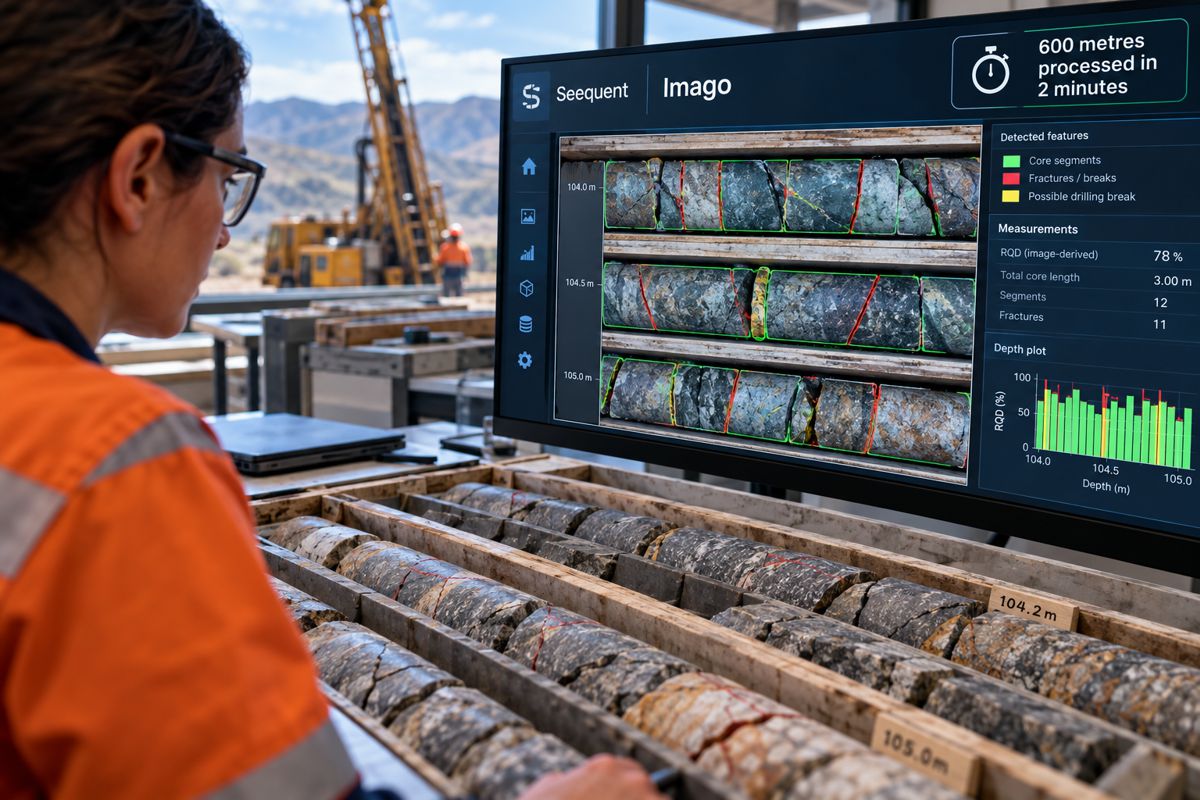
The strength of the Komatsu example lies in how ordinary the diagnosis was. Using Smart Construction Fleet to track vehicle speed against location, the team identified a haul road too narrow for efficient traffic flow, then ran that data alongside Smart Construction Dashboard to build a digital model of the site that exposed an uneven surface bleeding fuel on every pass. Geofences and alert zones let managers monitor traffic, manage speeds and isolate the two bottlenecks that mattered, rather than guessing at a dozen that did not.
Widening the road cut fuel consumption by 3.4 percent and pushed daily cycles from 34 to 45, while resurfacing delivered a further 9.8 to 10.6 percent improvement in fuel efficiency across the standard fleet. Taken together, the reported changes moved an additional 176,000 tonnes of material a year and trimmed fuel costs by an estimated €26,520 on a single road.
William Groven, Product Manager at Komatsu Smart Construction, frames the result as evidence that operational data can now rival hardware upgrades on return. A prime example of how data-driven site adjustments can deliver fuel savings typically associated with next-generation machinery. His wider point is that visibility, not effort, has been the missing ingredient, because most site managers already suspect where their operations slow down but cannot quantify the cost of the bottleneck or the value of fixing it. As more sites begin to measure the impact of operational changes, data like this will begin to help site managers make significant improvements that might otherwise be left unidentified.
The economics of earthmoving, he adds, are decided at a granular level that has historically gone unmeasured. Across construction sites, the pressure of earthworks operations is constant and the difference between an efficient operation and a costly one is often measured in litres of fuel, time of journey and the condition of the roads. Read commercially, the message is that the cheapest productivity gain on many sites is not parked in the machinery catalogue but buried in the road network, waiting to be surfaced by measurement.
What Surface Mining Already Priced Into Its Roads
None of the underlying physics is new, and that is precisely why the earthworks result deserves attention rather than scepticism. Surface mining has treated haul roads as production assets for years, backed by a substantial body of research that ties road condition directly to fuel, tyre life, cycle time and cost per tonne. Industry analysis summarised by Global Road Technology notes that haul roads can account for over half of total mining costs, and that a single percentage point increase in rolling resistance can slow a laden truck by as much as ten percent on ramps and around a quarter on flat sections.
The widely cited working rule in mining operations is blunter still, holding that each one percent rise in rolling resistance adds roughly two to three percent to fuel consumption. Those relationships turn road maintenance from a housekeeping task into a lever on the largest variable cost in the operation.
The savings on offer are large enough to have reshaped capital decisions in mining, which is what makes their migration into civil earthworks commercially significant. Research from South African operations has shown that reducing rolling resistance from eight percent to four percent on a 7.3-kilometre road at seven percent grade cut capital equipment costs by 29 percent and operating costs by 25 percent across a fleet of ninety-one-tonne trucks.
One Chinese operation reported a 17.4 percent fuel reduction after treating its roads, worth around USD 3.6 million a year, and independent testing by Michelin for Dust-A-Side found that a properly stabilised and sealed surface improved rolling resistance by twenty to thirty percent against unsealed ground, yielding average hourly fuel savings of three to five percent. The earthworks case study lands squarely inside that established range, which is the point. Civil sites are now beginning to capture returns that mining costed decades ago, because affordable connected sensing has finally made the same losses visible on a project that lacks a dedicated haulage engineering function.
Where The Commercial Value Is Migrating
The more consequential story sits above the road surface, in the layer that turns raw telemetry into a decision. In the Komatsu example, the value was created not by either tool alone but by pairing Fleet’s real-time traffic and speed tracking with Dashboard’s terrain model, so that a symptom of lost cycles could be traced to a physical cause and priced. That analytical pairing is where the margin now lives, and the major platform owners are investing accordingly.
Smart Construction, developed through the EARTHBRAIN joint venture of Komatsu, NTT Communications, Sony Semiconductor Solutions and Nomura Research Institute, is already deployed across more than thirty-five thousand job sites in Japan, and in November 2025 EARTHBRAIN struck a strategic partnership with Bentley Systems to fold open, AI-enabled digital-twin technology into the Smart Construction suite. That deal, which builds on Bentley’s ownership of the Cesium geospatial engine already embedded in the platform, signals that the contest is no longer about individual machines but about who owns the connected model of the whole site.
For infrastructure owners and contractors, the strategic implication is a change in where differentiation and lock-in are created. A digital twin that spans design intent, earthworks execution and as-built terrain converts one-off insights, such as a single road diagnosis, into a repeatable operating capability that compounds across projects. The road study becomes reproducible, benchmarkable and, in time, predictable, because the same data pipeline that flagged one narrow road can be pointed at every road on every site in the portfolio.
That shifts the basis of competition among suppliers from horsepower and payload towards the quality of the analytics, the openness of the platform to mixed fleets, and the ease with which insight is turned into a scheduled work order. It also explains why a machinery manufacturer is investing so heavily in software partnerships, since the recurring commercial relationship increasingly runs through the data layer rather than the iron.
The Contest For The Connected Site
Komatsu is far from alone in this repositioning, and the competitive field tells its own story about where purchasing power is heading. Caterpillar has rebuilt VisionLink into a multi-brand fleet-management environment that consolidates owned, leased and rented equipment across manufacturers, putting an equipment maker into direct competition with independent telematics providers. Trimble has pursued a parallel path through its Earthworks grade-control platform and Connected Construction strategy, positioning itself as a manufacturer-agnostic layer that manages machine and non-machine assets across the design-build-operate lifecycle, while its long-running control-technology venture with Caterpillar continues to supply the underlying guidance.
The common thread is a race to become the site’s system of record, because whoever owns that record captures the most durable revenue and the richest view of how competitors’ machines are actually being used.
The scale of that prize is growing quickly enough to justify the manoeuvring. Independent analysis puts the construction machinery telematics market at around USD 1.39 billion in 2023, rising towards USD 3.13 billion by 2031 at a compound annual growth rate near eleven percent, with Caterpillar, Komatsu, Volvo CE, John Deere, JCB, Trimble, Hexagon and others all contesting the space. E
qually important is the democratisation now under way, as machine control and connected sensing extend down from flagship earthmovers to compact equipment and skid-steer-class machines, bringing the road-as-asset discipline within reach of smaller contractors who never employed a haulage analyst. Interoperability standards such as ISO/TS 15143-3 are steadily loosening the grip of single-vendor data silos, which favours the buyers and raises the premium on platforms that treat mixed fleets as the norm rather than the exception.
Procurement Reframed Around Measurement And Maintenance
The clearest operational lesson for infrastructure owners is that the marginal capital pound may be better spent on measurement and road maintenance than on additional or newer machinery. When resurfacing a single haul road can deliver a near double-digit gain in fleet fuel efficiency, the comparison with a fleet upgrade becomes uncomfortable for the traditional procurement instinct, which reaches first for more or bigger iron.
The connected diagnosis reframes maintenance spending as a productivity investment with a measurable payback, and it does so in the same currency that finance directors already track, namely litres of fuel, cycle times and tonnes moved. That makes the business case unusually legible to non-technical decision-makers, which is often the difference between a good idea and a funded one.
There are second-order commercial effects that strengthen the case further. Smoother, better-maintained roads reduce shock loading and vibration on drivetrains, tyres and structures, extending component life and improving machine availability, all of which feed directly into lifecycle cost and residual value. Better road condition also lowers fuel burn and associated emissions, which matters increasingly as public infrastructure clients attach carbon conditions to contracts and as reporting obligations tighten.
The prudent response for asset owners is not to treat any single case study as a guaranteed template, since grade, haul distance, material and climate all shape the outcome, but to install the measurement capability that reveals which of their own roads are quietly eroding margin. The evidence base is now strong enough that failing to look has become the more expensive option.
The Measured Site Becomes The Default
The direction of travel is towards a construction sector in which the condition of the ground beneath the wheels is monitored as routinely as the fuel in the tank, and acted upon with the same discipline. The technology to do this is no longer experimental or confined to the largest mining houses, and the commercial logic has been demonstrated in numbers that translate cleanly from research into practice.
As connected platforms mature and extend across mixed fleets and smaller machines, the competitive gap will open between operations that measure their losses and those that continue to absorb them unseen. The most valuable asset on many earthworks sites may turn out to be the model of the site itself, and the humble haul road may be the clearest early proof of what that model is worth.
For industry leaders, the practical takeaway is optimistic rather than cautionary. The gains here are available to any operation willing to instrument its roads and read the results, they require conventional civil skills to capture, and they compound as the underlying data platforms improve.
A sector under constant pressure on cost, carbon and productivity now has a route to meaningful improvement that does not depend on waiting for the next machine or the next autonomy milestone. It depends instead on treating information as infrastructure, and on granting the haul road the same analytical respect long reserved for the fleet that runs on it.
Key Industry Questions
- Why are haul roads now being treated as production assets rather than site overhead? Because connected telematics can finally quantify what a poor road costs. Historically, road condition was managed by eye and repaired only when it visibly failed, leaving its impact on fuel, cycle times and tyre wear invisible on the balance sheet. Real-time fleet data paired with a terrain model exposes exactly where trucks slow down and burn extra fuel, converting road maintenance from a housekeeping chore into a measurable lever on the largest variable cost in earthmoving. Surface mining has costed this relationship for decades, but civil earthworks lacked the affordable sensing to do the same. Once the loss becomes a number, the road earns a line in the productivity ledger alongside the machines that run on it.
- How large are the fuel and productivity gains from improving haul roads? In the reported Komatsu earthworks case, widening one road cut fuel consumption by 3.4 percent and lifted daily cycles from 34 to 45, while resurfacing added a further 9.8 to 10.6 percent fuel-efficiency improvement across the standard fleet. Mining research points in the same direction, with Michelin testing for Dust-A-Side showing three to five percent average hourly fuel savings on sealed surfaces and one Chinese operation reporting a 17.4 percent reduction after road treatment. Actual results vary with grade, haul distance, material and climate, so no single figure is a guaranteed template. The consistent finding is that road interventions can deliver savings normally associated with buying newer machinery, at a fraction of the capital cost.
- What is rolling resistance and why does it dominate haulage economics? Rolling resistance is the retarding force between a tyre and the road surface, expressed as a percentage of vehicle weight, and it rises sharply on soft, uneven or loose ground where tyres effectively sink. It matters because it directly determines how hard an engine must work to move a laden truck. A common working rule in mining holds that each one percentage point increase in rolling resistance adds roughly two to three percent to fuel consumption, and analysis suggests a single point can slow a truck by around ten percent on ramps. Since fuel is often the largest variable cost in hauling, and haul roads can represent well over half of total mining cost, managing rolling resistance through road design and maintenance offers one of the highest-return interventions available.
- Does this evidence from mining transfer reliably to civil construction earthworks? The physics transfers directly, though the operating context differs. Mining haul roads are relatively fixed routes carrying very heavy, standardised trucks, which made the economics easy to isolate and cost. Civil earthworks roads change more often and carry mixed fleets, which historically made losses harder to attribute. The arrival of connected fleet tracking and site terrain modelling closes that measurement gap, allowing civil operations to locate high-consumption segments the way mines have long done. The Komatsu case study lands inside the range established by mining research, which supports the transfer. Owners should still validate on their own sites rather than assume a fixed percentage, since project-specific factors shape the result.
- Where is the commercial value concentrating in connected construction? Value is moving to the data and software layer that turns telemetry into decisions, rather than to individual machines. The Komatsu result came from pairing fleet tracking with a terrain model, and the platform owners are investing accordingly. EARTHBRAIN’s November 2025 partnership with Bentley Systems to embed digital-twin technology into Smart Construction illustrates the trend, as do Caterpillar’s multi-brand VisionLink and Trimble’s Connected Construction strategy. Whoever owns the site’s system of record captures the most durable, recurring revenue and the richest view of how mixed fleets perform. For contractors, this means differentiation increasingly rests on analytics quality and platform openness rather than on horsepower and payload alone.
- What should procurement teams change in response? They should weigh spending on measurement and road maintenance against the reflex to buy more or newer machinery. When resurfacing a single road can produce a near double-digit fuel-efficiency gain across the fleet, maintenance becomes a productivity investment with a quantifiable payback in fuel, cycle time and tonnes moved. The priority is to install the sensing and analytics that reveal which specific roads are eroding margin, then to prioritise interventions by measured impact rather than by appearance. Teams should also favour platforms that handle mixed fleets and support interoperability standards, since single-vendor data silos limit the visibility that makes the whole approach work. Machinery upgrades remain valuable, but they are no longer the only, or always the cheapest, route to higher output.
- How does better road maintenance affect emissions and compliance? Lower rolling resistance means less fuel burned per tonne moved, which reduces carbon emissions in direct proportion. As public infrastructure clients attach carbon conditions to contracts and reporting obligations tighten across jurisdictions, that reduction carries growing commercial weight beyond the fuel saving itself. Smoother roads also cut shock loading on drivetrains, tyres and structures, extending component life and lowering the embodied emissions associated with replacement parts and machine turnover. The measurement layer that identifies fuel losses simultaneously generates the data needed to evidence emissions reductions to clients and regulators. In effect, the same connected diagnosis that improves productivity also strengthens a contractor’s sustainability reporting, aligning cost and carbon objectives rather than trading one against the other.
- Which companies are competing to run the connected site, and why does it matter to buyers? The main contenders include Caterpillar with its multi-brand VisionLink platform, Komatsu through EARTHBRAIN and Smart Construction, and Trimble with its Earthworks and Connected Construction ecosystem, alongside Volvo CE, John Deere, JCB, Hexagon and independent telematics specialists. Each is racing to become the buyer’s system of record. This matters because the winning platform shapes how easily a contractor can manage a mixed fleet, extract insight and avoid vendor lock-in. Interoperability standards such as ISO/TS 15143-3 are gradually loosening single-vendor silos, which favours buyers. With the telematics market forecast to more than double towards USD 3.13 billion by 2031, the competition should improve capability and choice, provided purchasers prioritise open, manufacturer-agnostic platforms.
Strategic Takeaways
- The cheapest productivity gain on many earthworks sites is hidden in the haul road, and connected telematics now make that loss visible and prioritisable, shifting the first procurement question from how much machinery to buy towards how much unmeasured loss already exists.
- Road interventions can deliver fuel and cycle-time improvements comparable to a fleet upgrade at a fraction of the capital cost, which reframes maintenance as a measurable productivity investment rather than a discretionary expense.
- Commercial value and competitive lock-in are migrating from machines to the data and digital-twin layer, making platform ownership, analytics quality and mixed-fleet openness the decisive factors in supplier selection.
- The road-as-asset discipline that surface mining costed decades ago is now reaching general earthworks and, through compact-equipment machine control, smaller contractors, widening the pool of operations that can capture these returns.
- Buyers should favour interoperable, manufacturer-agnostic platforms and install measurement before committing capital, since the operations that instrument and read their losses will steadily outpace those that continue to absorb them unseen.