Quipli’s Growth Signals a Digital Shift in Equipment Rental
The equipment rental sector rarely treats a software vendor’s growth ranking as market news, yet Quipli’s placement at No. 419 on the 2026 Inc. 5000 list is worth pausing on for reasons that have little to do with the accolade itself. The more telling detail sits underneath the headline.
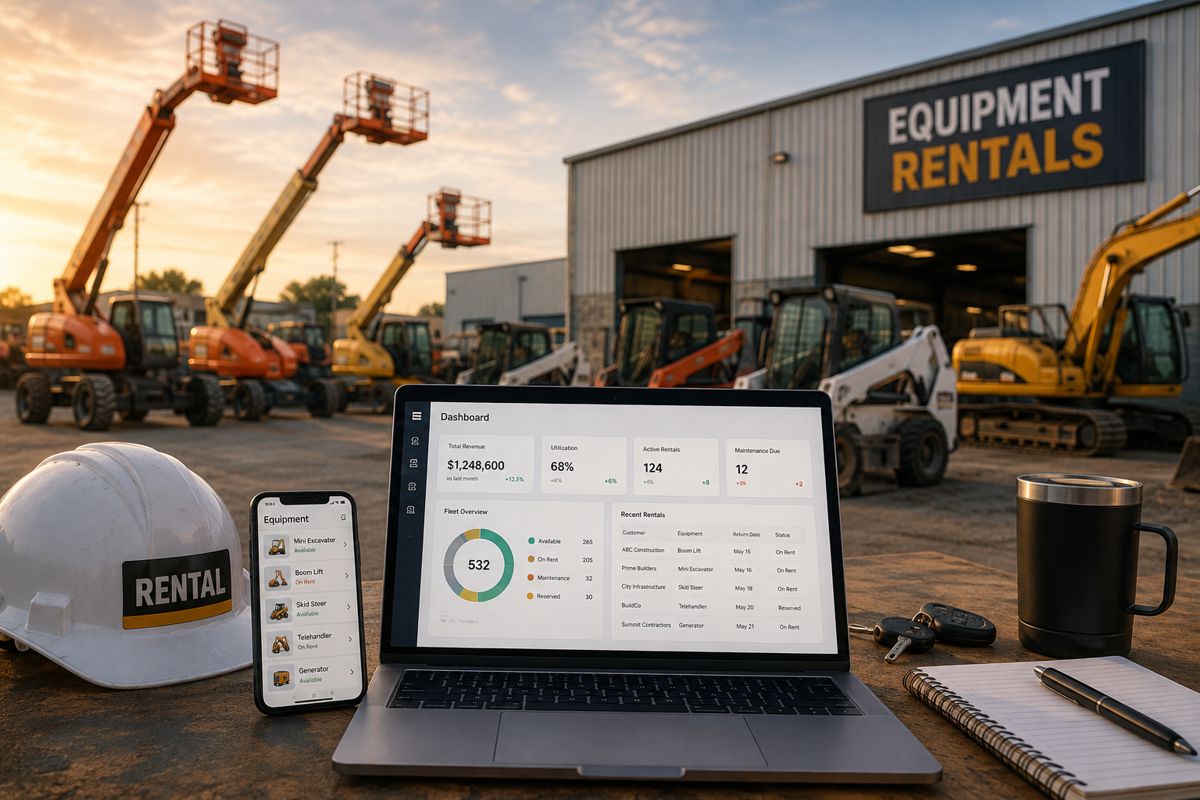
Quipli now reports supporting more than one billion dollars of fleet under management across upwards of 500 locations, having processed over one million rental transactions since launching in 2020. That is no longer the profile of a promising start-up serving a handful of yards. It is evidence that modern vertical software has moved from a nice-to-have for independent rental operators into something closer to essential operating infrastructure, purchased for competitive reasons rather than curiosity.
The timing sharpens the point. The American Rental Association projects the combined United States construction, industrial equipment and general tool rental market will reach 83.5 billion dollars in 2026, an upgraded forecast reflecting 3.6 per cent growth and a rental penetration rate that hit a record 59.5 per cent in 2025. A market that is both growing and structurally shifting toward rental is exactly the environment in which the gap between digitally equipped operators and everyone else starts to matter commercially.
National chains have spent years building integrated digital ecosystems, telematics estates and AI-assisted fleet management. The independents who make up the long tail of the sector are now buying the software layer that lets them compete on the same terms, and the pace of that adoption is what the Inc. 5000 number is really measuring.
Briefing
- Quipli reports more than one billion dollars of fleet under management, over one million processed rental transactions and a presence across 500-plus locations in the United States and Canada since its 2020 launch.
- The company was ranked No. 419 on the 2026 Inc. 5000, which it states makes it the fastest-growing equipment rental software company in the country, measured on 2022 to 2025 revenue growth.
- The American Rental Association forecasts the United States equipment rental market at 83.5 billion dollars in 2026, with rental penetration reaching a record 59.5 per cent as contractors continue shifting from ownership to hire.
- National chains including United Rentals have built substantial digital moats, with more than 85 per cent of applicable fleet telematics-enabled and a late-February 2026 integration linking Total Control data into Procore’s project platform.
- The rental software category is consolidating and attracting investment, with established names such as Point of Rental, Wynne Systems and the merged Texada-InTempo platform competing for operators who increasingly treat software as a purchasing decision rather than an experiment.
The Scale Behind the Growth Ranking
Inc. 5000 placement is calculated on percentage revenue growth from 2022 to 2025, which rewards young companies expanding from a modest base and says little on its own about durability. What lends Quipli’s ranking weight is the operational scale disclosed alongside it. Processing more than one million rental transactions and supporting over a billion dollars of fleet across 500-plus locations indicates that adoption has reached a level where the platform is handling meaningful commercial volume for real operators, not merely signing pilot accounts. For a category built to serve independent and regional firms, that breadth of deployment is the more reliable signal of product-market fit than the growth percentage itself.
Founder and chief executive Kyle Clements framed the milestone in terms of the operators the platform serves rather than the company’s own trajectory. “Being recognized on the Inc. 5000 is a reflection of the independent rental businesses that put their trust in us,” he said. “Our mission has always been to give them the same technology advantages the national chains have, and this milestone tells us we’re well on our way to delivering on it. And we’re just getting started.” The competitive framing matters more than the celebration. Positioning the product explicitly as a way for independents to match the capabilities of national chains identifies the commercial problem the software is being bought to solve, and that problem is intensifying rather than fading.
The Digital Moat the National Chains Have Built
The reason independents are reaching for modern software is visible at the top of the market, where the largest operators have turned digital tooling into a genuine competitive advantage. United Rentals describes more than 85 per cent of its applicable fleet as telematics-enabled and channels that data into its Total Control platform, giving customers a single view of owned and rented assets across engine hours, location and utilisation. In late February 2026 the company went further, integrating that telematics feed directly into Procore’s resource management tools so that contractors could orchestrate owned and hired fleet inside the software where project planning already happens. Capability of that depth changes what customers expect from any rental supplier, regardless of size.
For a regional operator running a clipboard-and-phone booking process, that expectation is a commercial threat as much as a technical one. Contractors who grow used to online reservations, real-time availability, remote off-hire and consolidated billing from a national branch will carry those habits to every yard they deal with.
The independent that cannot offer a comparable digital experience risks losing not on price or fleet quality but on friction, which is a harder disadvantage to see and a more expensive one to ignore. Vertical software closes that gap by giving smaller firms an e-commerce front end, self-service booking and unified back-office management without the capital and engineering budget that built Total Control. That is precisely why the adoption curve is steepening.
An 83.5 Billion Dollar Market That Rewards Digitisation
The economics of the wider market explain why software spend is rising even among operators who historically resisted it. The ARA’s upgraded 2026 forecast puts the combined United States rental industry at 83.5 billion dollars, ahead of its earlier 82.9 billion dollar projection, with growth of 3.8 per cent and 4.4 per cent pencilled in for 2027 and 2028.
Rental penetration, the share of equipment hours met by hire rather than ownership, rose for a fifth consecutive year to a record 59.5 per cent in 2025. ARA vice president Tom Doyle attributes the momentum to project uncertainty, market volatility, sustainability pressures, financial flexibility and the rising cost of owning equipment, all of which favour the rental model over outright purchase.
Rising penetration is a tailwind for the software category specifically, not just for rental revenue. As more contractors default to hiring, the operators who capture that demand are the ones who make renting frictionless, and frictionless renting is a software problem. Online catalogues, transparent availability, digital contracts, proof-of-insurance handling and integrated payments are the mechanisms through which an independent converts a growing market into booked revenue.
Inc. editor-in-chief Mike Hofman, describing the wider cohort of honoured companies, noted that “Every company on the Inc. 5000 has a story of perseverance, smart decision making, and a refusal to sit still — Their growth reflects more than strong financial performance — it reflects creativity, resilience, and the customer focus required to build companies that make a lasting impact. We congratulate all honorees on this significant achievement.” Within rental, that customer focus increasingly expresses itself as digital convenience, and the vendors enabling it are growing in step with the penetration rate.
A Software Category That Is Consolidating and Attracting Capital
Quipli is not competing in an empty field, and the shape of that competition is itself a marker of where value is concentrating. The rental software landscape now spans established enterprise systems such as Wynne Systems and Point of Rental, mid-market and multi-category platforms, and the combined Texada-InTempo business formed when the two firms merged to target mid-market and enterprise operators.
Newer entrants continue to appear alongside them. Consolidation and sustained new investment across this set point to a category that capital markets and strategic acquirers increasingly regard as durable rather than speculative, which is a meaningful shift for what was until recently a fragmented and under-served corner of construction technology.
That maturation carries practical consequences for operators weighing their options. Published pricing gives a sense of the commitment involved, with Quipli listing around 6,000 dollars per year per location, positioning modern rental software as a recurring operating cost rather than a one-off purchase. For an independent, the calculation is no longer whether to digitise but which platform to standardise on, how quickly it can be implemented, and how well it will integrate with payments, telematics and accounting.
Implementation timelines that run to a few weeks for mid-market tools make switching realistic, and the presence of multiple credible vendors gives buyers negotiating leverage they did not previously enjoy. A competitive, well-capitalised supplier base tends to accelerate product development, which benefits the operators these platforms serve.
From Booking Engine to Fleet Intelligence
The trajectory of the category points beyond online booking toward data-driven fleet management, and this is where the independent and national tiers may eventually converge. The first wave of vertical rental software solved the customer-facing problem of taking orders online and managing inventory in one place. The next wave layers in the operational intelligence that has so far been the preserve of the large chains, drawing on telematics, utilisation analytics and increasingly AI-assisted decision support to reduce downtime and improve dollar utilisation.
Quipli’s own maintenance module, tracking service history and repair costs per unit, is an early step along that path, and the direction of travel across the category is unmistakable.
Interoperability is the enabling condition for that shift, and standards are doing the quiet work of making it possible. The AEMP 2.0 telematics standard, formalised as ISO 15143-3, defines a common schema for exchanging core machine data such as location, hours, fuel and utilisation between manufacturer servers and third-party systems, which is what allows a rental platform to present a mixed-brand fleet in one dashboard.
As covered in this publication’s recent analysis of Skyjack’s ELEVATE programme and the race to own the connected rental machine, the competitive battleground is moving from raw connectivity toward the quality of insight layered on top. Vertical software vendors that can turn standardised machine data into utilisation intelligence for independents will be selling the capability that currently separates the national chains from everyone else, and doing so at a price point the long tail of the market can absorb.
What Rental Operators and Investors Should Take From This
For independent and regional operators, the strategic reading is that software is now part of competitive positioning rather than administrative overhead. The relevant question is no longer whether a modern platform justifies its cost but whether continuing without one is sustainable as contractors carry national-chain digital expectations into every transaction.
Operators evaluating platforms should weigh e-commerce capability, telematics and accounting integration, implementation speed and the vendor’s financial staying power, since standardising on a supplier that cannot fund continued development would simply relocate the disadvantage rather than remove it. The upside is that a genuinely competitive vendor market gives independents credible choices and real leverage for the first time.
For investors and strategic acquirers, the pattern visible in Quipli’s growth, the ARA’s penetration data and the consolidation among software vendors describes a category with structural tailwinds. Rental is taking a rising share of an expanding market, the operators capturing that demand increasingly depend on software to do so, and the tools themselves are climbing from booking engines toward higher-value fleet intelligence.
That combination of a growing addressable base, recurring revenue and an ascending value ladder is what draws capital toward vertical software, and equipment rental is now clearly on that map. The businesses best placed to benefit are those, whether operators or vendors, that treat the digital layer as the competitive infrastructure it has become.
Key Industry Questions
- Why does Quipli’s Inc. 5000 ranking matter beyond the company itself? The ranking is a proxy for how quickly independent rental operators are adopting modern software, which is the development with wider significance. Inc. 5000 placement measures 2022 to 2025 revenue growth, and rapid growth for a vendor serving independents indicates rising demand for tools that were once optional. The more informative figures are the operational ones Quipli discloses alongside the ranking, namely over a billion dollars of fleet under management and more than one million processed transactions across 500-plus locations. Together they suggest vertical software has reached the scale and adoption level at which it functions as competitive infrastructure for the independent segment rather than a discretionary experiment.
- How large is the United States equipment rental market and is it growing? The American Rental Association forecasts the combined United States construction, industrial equipment and general tool rental market at 83.5 billion dollars in 2026, an upgrade from an earlier 82.9 billion dollar projection and equivalent to 3.6 per cent growth. The association projects further growth of 3.8 per cent in 2027 and 4.4 per cent in 2028. Rental penetration, the proportion of equipment hours met by hire rather than ownership, reached a record 59.5 per cent in 2025 after rising for a fifth consecutive year. ARA attributes the shift to project uncertainty, financial flexibility, sustainability and the high cost of owning equipment, all of which favour rental over purchase.
- What competitive advantage do national rental chains hold over independents? The largest operators have built integrated digital ecosystems that independents have historically been unable to match. United Rentals describes more than 85 per cent of its applicable fleet as telematics-enabled and feeds that data into its Total Control platform, giving customers a unified view of owned and rented assets. A late-February 2026 integration placed that telematics data directly inside Procore’s project management tools. Capabilities of this depth reset customer expectations across the market. Contractors accustomed to online booking, real-time availability and consolidated billing from national branches carry those expectations to every supplier, which puts operators without comparable digital tools at a disadvantage measured in friction rather than price.
- Why is rising rental penetration good news for software vendors? Higher penetration means more contractors default to hiring equipment rather than buying it, and the operators who capture that demand are those who make renting frictionless. Frictionless renting is largely a software problem, solved through online catalogues, transparent availability, digital contracts and integrated payments. As penetration climbs, the commercial reward for offering a strong digital experience grows, and so does the cost of not offering one. That dynamic pulls software spend upward even among operators who previously resisted it, because the platform becomes the mechanism through which a growing market is converted into booked revenue rather than lost enquiries.
- How much does modern rental software cost an independent operator? Pricing varies by platform and scope, but published figures give a useful benchmark. Quipli lists around 6,000 dollars per year per location, which positions modern rental software as a recurring operating cost rather than a one-off capital outlay. Implementation timelines for mid-market tools typically run to a few weeks, making a switch practical for most operators. The presence of several credible vendors gives buyers negotiating leverage and choice. For an independent, the decision has shifted from whether to digitise to which platform to standardise on, how quickly it can be deployed, and how well it integrates with payments, telematics and accounting systems.
- Is the rental software market consolidating? The category shows clear signs of maturation. It now spans established enterprise systems such as Wynne Systems and Point of Rental, the merged Texada-InTempo platform aimed at mid-market and enterprise operators, and a range of newer entrants. Consolidation and continued investment across this field indicate that acquirers and capital markets increasingly regard rental software as a durable category rather than a speculative one. For operators, a competitive and well-funded vendor base tends to accelerate product development and improve the tools available. It also raises the importance of choosing a supplier with the financial staying power to keep investing, since platform longevity is now part of the purchasing decision.
- Where is rental software heading next? The category is moving beyond online booking toward data-driven fleet management. The first wave solved the customer-facing problem of taking orders and managing inventory digitally. The next layers in operational intelligence drawn from telematics, utilisation analytics and AI-assisted decision support, capabilities that have so far belonged mainly to the national chains. Interoperability standards such as AEMP 2.0, formalised as ISO 15143-3, make this possible by defining a common schema for exchanging machine data across manufacturer systems. Vendors that turn standardised telematics data into utilisation intelligence for independents will be selling the capability that currently distinguishes the largest operators, at a price the wider market can absorb.
- What should independent operators do in response to these trends? Treat software as part of competitive positioning rather than administrative overhead. The practical question is whether operating without a modern platform is sustainable as contractors bring national-chain digital expectations to every transaction. When evaluating platforms, operators should weigh e-commerce capability, telematics and accounting integration, implementation speed and the vendor’s financial durability. Standardising on a supplier unable to fund continued development would relocate the competitive disadvantage rather than remove it. The encouraging development is that a genuinely competitive vendor market now gives independents credible options and real negotiating leverage, allowing smaller firms to access capabilities that were until recently confined to the largest operators.
Strategic Takeaways
- Modern vertical software has crossed from optional tooling into competitive infrastructure for independent rental operators, and Quipli’s growth is best read as a measure of that adoption rather than a standalone corporate milestone.
- A United States rental market forecast at 83.5 billion dollars for 2026, with penetration at a record 59.5 per cent, creates a structural tailwind for software vendors because rising penetration rewards operators who make hiring frictionless.
- The digital ecosystems built by national chains, exemplified by United Rentals’ Total Control estate and its Procore integration, have reset customer expectations across the market and turned digital convenience into a determinant of where contractors rent.
- Consolidation and sustained investment across the rental software category signal that acquirers and capital markets now view it as durable, making vendor financial staying power a genuine factor in operators’ purchasing decisions.
- The category’s trajectory runs from online booking toward telematics-enabled fleet intelligence, and the vendors who deliver that capability to independents at accessible price points will close the gap that currently separates them from the national chains.