Satellite Tolling Turns the European Road Network into a Digital Charging Platform
The Netherlands changed the way heavy goods vehicles pay to use its roads on 1 July 2026. The Eurovignette disappeared, kilometre-based charging began and every affected truck became part of a digital road-pricing system capable of determining where it had travelled and what that journey should cost. Behind part of that process sits Kapsch TrafficCom’s Geo Location Platform, or GLP, which has entered live operation in the Netherlands alongside deployments in Belgium and Bulgaria, with Lithuania expected to follow.
The technology converts positioning data from vehicles into tolling transactions, replacing the fixed geography of conventional toll collection with charging based on verified road use. The Dutch system applies to N2 and N3 goods vehicles with a technical maximum mass above 3.5 tonnes, covering almost all motorways together with selected provincial and municipal roads. Rates can vary according to vehicle mass, Euro emissions standard and CO₂ emissions class, giving authorities considerably more flexibility than a time-based permit or a network of fixed toll points. The toll road has effectively become a geographically defined digital service.
Briefing
- The Netherlands introduced kilometre-based truck charging on 1 July 2026, replacing the Eurovignette.
- Kapsch TrafficCom’s Geo Location Platform is now operating in the Netherlands, Belgium and Bulgaria, with Lithuania expected to follow.
- The GLP converts GNSS location information into verified journeys and charging transactions through map matching, trip building and toll contextualisation.
- Kapsch says its Netherlands and Belgium operations cover approximately 14,000 km of roads.
- The architecture can support differentiated charging models including CO₂-based tolling and potentially external costs associated with air pollution and noise.
From Location Data to a Billable Journey
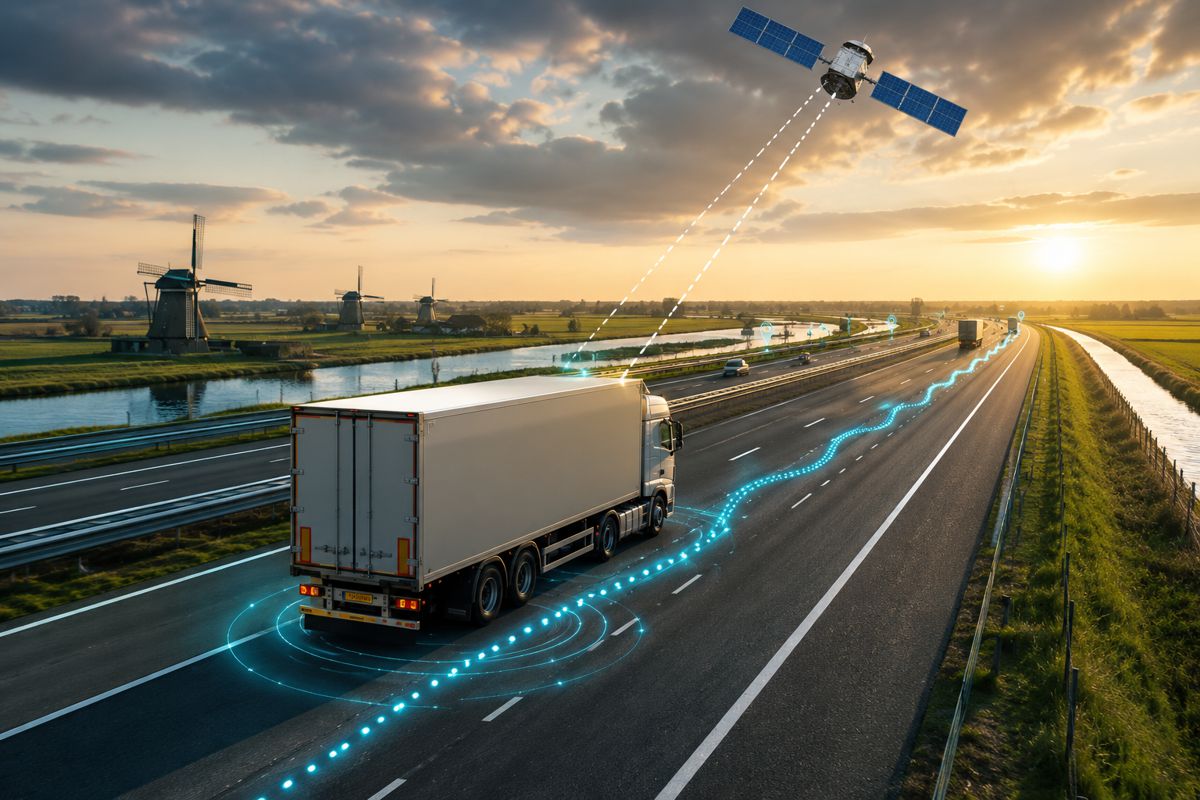
Satellite tolling begins with a relatively simple piece of information: where a vehicle is. Turning thousands of GNSS position records into an accurate bill is considerably more complicated. Kapsch’s GLP receives location information from sources including dedicated on-board units, smartphones, telematics equipment and connected vehicles. Map-matching software determines which roads the vehicle actually travelled on, after which the system constructs the journey, applies the relevant charging rules and produces rated trip and charge reports for subsequent processing and billing.
Raw location and verified road use are not the same thing. Positioning signals are neither perfectly continuous nor perfectly accurate. Tunnels can interrupt satellite reception, while dense urban areas, complex junctions and closely parallel roads can make identifying the correct carriageway more difficult. The geolocation system therefore has to reconcile positioning information with road network data before a journey can become a reliable charging transaction.
The Brussels road network provides a demanding operational environment for this type of processing. Kapsch says the combined Netherlands and Belgium implementation is creating tolling transactions across approximately 14,000 km of roads, including the dense Belgian capital network. Accuracy at this stage has a direct financial consequence: the digital record of where a vehicle travelled ultimately determines what its operator is charged.
The Dutch Truck Toll
Since 1 July, Dutch and foreign N2 and N3 goods vehicles above 3.5 tonnes have been charged for kilometres travelled on almost all Dutch motorways and a selection of provincial and municipal roads. Trucks require an approved on-board unit linked to a contract with a toll service provider, while the Eurovignette has ceased to apply in the Netherlands. Motor vehicle tax has also been abolished for trucks up to 12 tonnes and substantially reduced for heavier vehicles.
Charges are differentiated rather than uniform. Cleaner and lighter vehicles generally pay less, with the calculation incorporating technical maximum mass, Euro emissions classification and CO₂ emissions class. Under the rates applying from July to the beginning of September 2026, a vehicle above 32 tonnes in CO₂ emissions class 1 could attract rates ranging from €0.156 per kilometre for Euro 6 to €0.379 for Euro 0, while a vehicle of the same weight in CO₂ class 5 was charged €0.030 per kilometre.
The Netherlands introduced a temporary reduction in toll rates from 1 September in response to higher fuel costs, but changing the tariff does not require the charging infrastructure itself to be redesigned. A large proportion of revenue from the Dutch charge is intended to return to the road transport sector through programmes supporting electric trucks, charging infrastructure and more efficient transport.
Pricing Roads Through Software
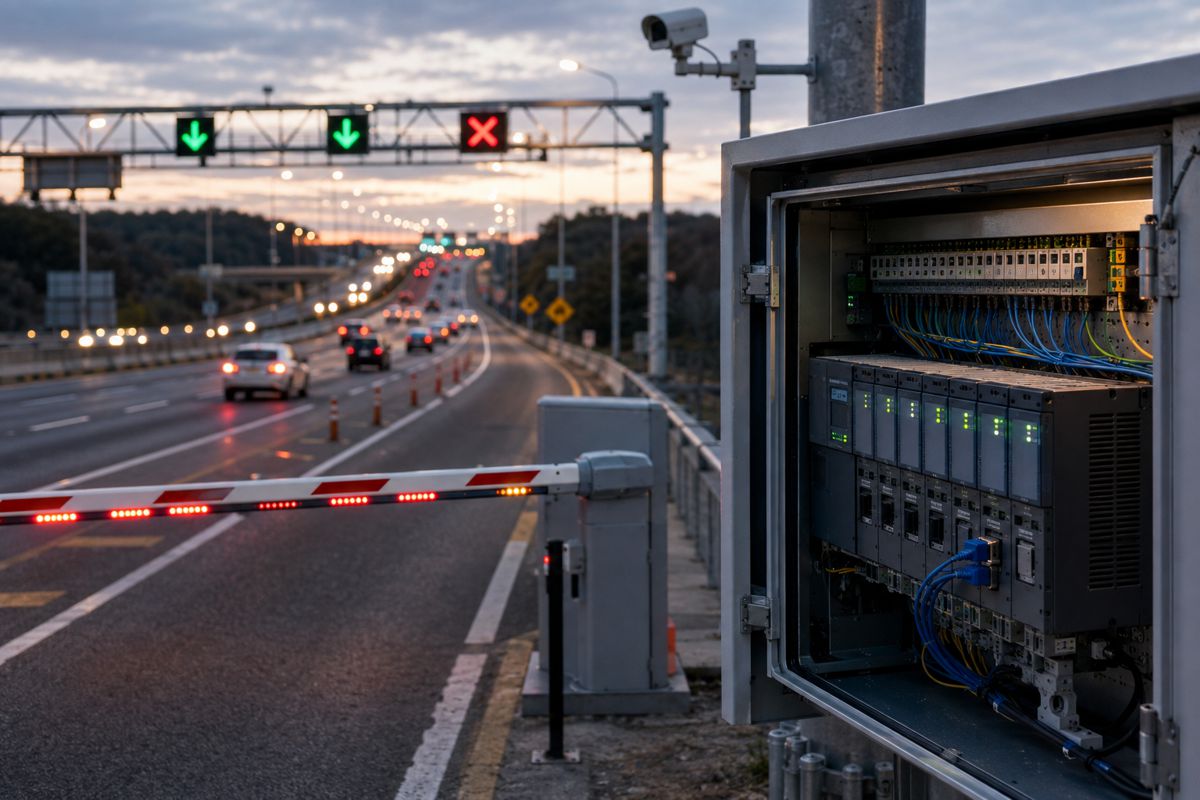
Conventional tolling makes road pricing highly visible. Drivers pass a toll booth, barrier or gantry and the charging point is physically apparent. GNSS-based charging separates that financial geography from the physical infrastructure used to collect the charge. Authorities can define chargeable roads within the digital system and apply different rules without installing collection equipment at every point where those rules begin or end. Vehicles provide positioning data and software establishes whether chargeable road use has taken place.
Kapsch’s architecture is device-agnostic, allowing the GLP to receive information from different sources while applying a common layer of map matching and charging logic. Separating the vehicle hardware from the transaction engine has obvious advantages in a European market where commercial vehicles routinely cross national borders. Toll regimes remain national or regional, but the positioning technology carried by a truck does not necessarily have to change every time it crosses a frontier.
“The expansion to the Netherlands is a key milestone because it shows that our technology is ready to support new tolling schemes at the level of accuracy and reliability that authorities and service providers require,” said Justin Hamilton, Director Location Based Charging at Kapsch TrafficCom. “With the GLP now operating in both the Netherlands and Belgium as well as Bulgaria and an upcoming launch in Lithuania, we are demonstrating that we can deliver the intelligence behind satellite tolling across different national schemes, regulatory environments and road networks.”
Those national differences remain considerable. A common geolocation engine has to accommodate different road definitions, tariff structures and regulatory requirements rather than treating Europe as a single tolling jurisdiction. Kapsch also occupies only one part of the wider system. Truck operators contract with approved toll service providers and use compliant on-board equipment, while Dutch authorities retain responsibility for the national charging framework and enforcement arrangements. The GLP performs the computational work required to convert vehicle movement into chargeable road use.
Roadside equipment and enforcement have not disappeared, nor are they likely to. What GNSS changes is the amount of tolling logic that needs to be physically tied to the road. A gantry can only exist where it has been built; a digitally defined charging zone can be altered through maps, rules and tariffs.
A Common Engine for European Tolling
CO₂ differentiation is already becoming part of heavy vehicle charging. Kapsch supports CO₂ tolling in Belgium and Bulgaria, while the Dutch scheme differentiates tariffs according to CO₂ emissions class. European legislation also provides for external-cost charging associated with traffic-generated air pollution and noise, and Kapsch says the GLP is prepared to support these additional charging models.
Once the system has identified the vehicle, established its characteristics, determined the road travelled and calculated the distance accurately enough for billing, different tariff variables can be applied where regulation permits. Two trucks travelling exactly the same kilometre of road can already incur different costs because of their emissions classifications. Other differentiated charging models can use the same underlying location and transaction architecture rather than requiring a new physical toll network for every change in policy.
That does not mean Europe is heading towards a single toll tariff. National governments have different road networks, transport policies, vehicle populations and charging priorities, making interoperability at the technological level more realistic than harmonisation of the charges themselves. A platform capable of accepting common forms of positioning data while applying country-specific maps and charging rules can operate across several schemes without requiring those schemes to become identical. Kapsch’s deployment across the Netherlands, Belgium and Bulgaria, followed by the planned Lithuanian operation, provides an example of that approach.
There are practical limits. Tolling transactions must be accurate enough to withstand financial and regulatory scrutiny, while positioning errors, incomplete data, tunnels, complicated urban roads and border conditions have to be handled reliably. Enforcement remains necessary, and national authorities still need clear rules governing vehicles, exemptions, tariffs and the treatment of data. Moving more of the charging process into software changes the infrastructure required to operate a tolling system, but it does not remove the need for dependable administration behind it.
Europe’s roads are acquiring a software layer capable of determining not simply whether a vehicle is permitted to use them, but how far it travelled, what type of vehicle it was and what that particular journey should cost.
The Dutch truck toll demonstrates how far that model has progressed. The barrier and toll booth are disappearing from the transaction, but the toll itself is becoming considerably more sophisticated.
Key Industry Questions
- How does satellite-based truck tolling work? An on-board unit or another GNSS-enabled device records vehicle positioning data. A geolocation platform matches that information against the road network, reconstructs the journey and applies the appropriate charging rules before producing a toll transaction.
- When did the Dutch truck toll begin? The Netherlands introduced its kilometre-based truck charge on 1 July 2026.
- Which vehicles are covered by the Dutch truck toll? The system applies principally to Dutch and foreign N2 and N3 goods vehicles with a technical maximum mass above 3.5 tonnes, subject to specified exemptions.
- Did the Dutch truck toll replace the Eurovignette? Yes. The Eurovignette ceased to apply in the Netherlands when kilometre charging began on 1 July 2026.
- Are all trucks charged the same rate per kilometre? No. Rates vary according to characteristics including technical maximum mass, Euro emissions standard and CO₂ emissions class.
- What does Kapsch TrafficCom’s Geo Location Platform do? The GLP converts GNSS positioning information into verified road journeys and charging records using processes including map matching, trip building, contextualisation and rating.
- Does satellite tolling eliminate roadside infrastructure? It can substantially reduce dependence on physical toll collection points, but enforcement equipment and other roadside systems may still form part of an overall tolling scheme.
- Can GNSS tolling support environmental charges? Yes. Once vehicle characteristics and road use are established, charging rules can differentiate tariffs according to variables such as CO₂ classification. European legislation also provides mechanisms for external-cost charging associated with air pollution and noise.
- Why is map matching important in tolling? Raw GNSS coordinates do not necessarily identify the exact road used, particularly around tunnels, parallel roads, junctions and dense urban networks. Map matching converts those coordinates into a defensible record of the vehicle’s route.
- Could the same tolling platform operate in several countries? Potentially. A common geolocation and transaction platform can apply different national maps, tariffs and charging rules. Kapsch’s GLP is already operating across several European tolling domains.
Strategic Takeaways
- GNSS tolling moves a substantial part of road charging infrastructure from the roadside into software and data processing.
- The replacement of the Eurovignette with kilometre charging gives the Netherlands much finer control over how individual heavy vehicle journeys are priced.
- Device-agnostic geolocation platforms allow vehicle hardware, toll service provision and transaction processing to become more modular.
- CO₂-based tariffs demonstrate how road charging can operate as an environmental policy mechanism as well as an infrastructure funding tool.
- Cross-border interoperability is more likely to emerge through common technological layers than through identical national tolling policies.