Mazavida Targets the Water Infrastructure Gap with Deployable Desalination
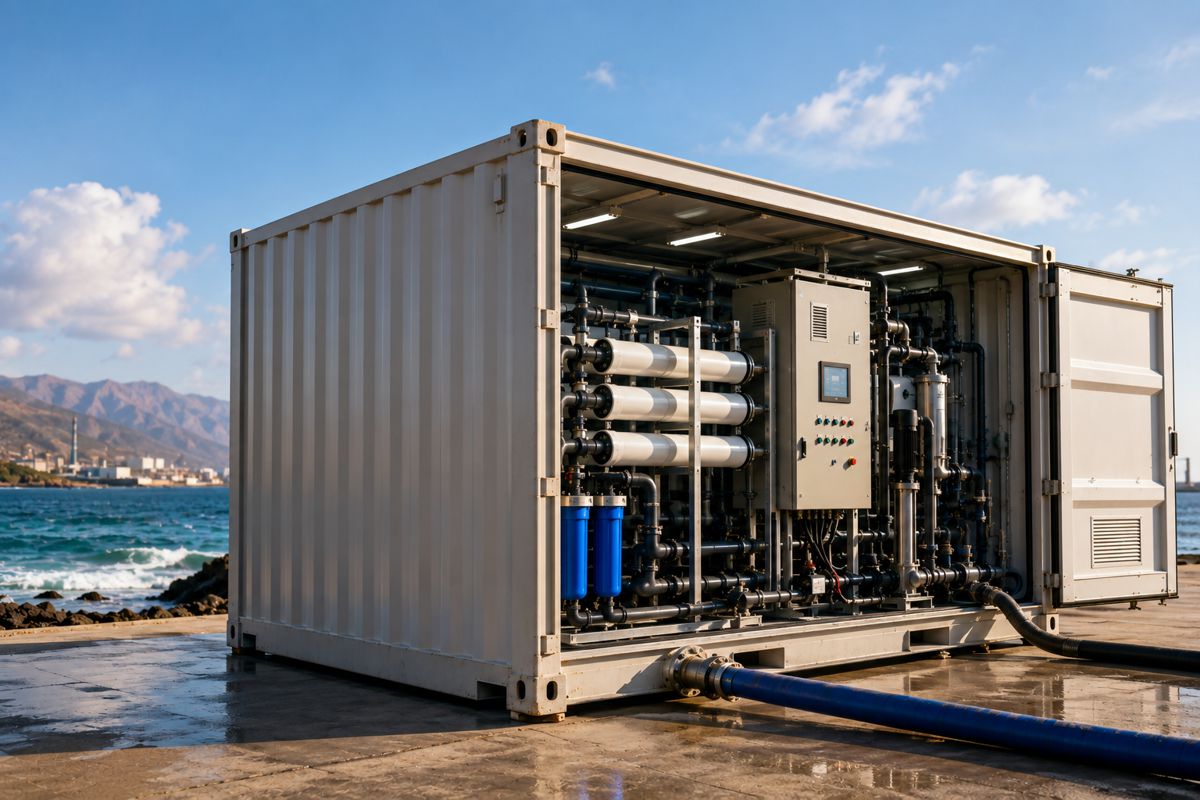
Large desalination plants can take years to finance, permit, build and commission. Mazavida is approaching the problem from the other direction, developing containerised water-treatment and desalination systems intended to put potable water capacity on the ground considerably faster.
The newly formed clean-water infrastructure venture brings together Abu Dhabi-headquartered Kinetic7 Technologies, Aquarius Capital, Dallas-based PIF Energy and PIF Capital. Its proposed market stretches from municipal and industrial water supply to agriculture, humanitarian relief and locations where conventional water infrastructure is unavailable, damaged or unable to keep pace with demand.
That places the company in a part of the water sector where mobility and deployment time can matter almost as much as treatment capacity. Rather than replacing major desalination works, reservoirs, pipelines and municipal treatment plants, modular systems can provide another layer of infrastructure, with capacity installed where it is required and expanded incrementally as demand changes.
The timing is difficult to ignore. In January 2026, the United Nations University Institute for Water, Environment and Health described the world as having entered an era of “global water bankruptcy”, arguing that many regions are consuming freshwater beyond the ability of natural systems to replenish it. Around four billion people experience severe water scarcity for at least one month each year, while the latest UN figures indicate that approximately 2.1 billion people still lack safely managed drinking water.
Briefing
- Mazavida has been formed by Kinetic7 Technologies, Aquarius Capital, PIF Energy and PIF Capital.
- The venture is targeting containerised desalination and potable-water treatment systems that can be deployed relatively quickly.
- Intended applications include municipalities, industry, agriculture, humanitarian operations and disaster response.
- Around four billion people experience severe water scarcity for at least one month each year.
- Mazavida says its systems will be engineered, manufactured, owned and operated within the PIF Energy and Kinetic7 group of companies.
Deployable Water Infrastructure
Containerisation is well suited to circumstances where constructing permanent water infrastructure immediately is impractical. Treatment equipment can be assembled and tested before deployment, transported using established freight networks and installed close to the source of water or point of demand.
Mazavida intends to apply that model to seawater desalination as well as contaminated, brackish and unreliable freshwater sources. Coastal communities represent an obvious market, but the potential applications extend to mines, industrial developments, remote settlements, agricultural operations and areas recovering from natural disasters.
The engineering challenge is more complicated than putting treatment equipment inside a shipping container. Feedwater conditions vary considerably, while desalination and purification require power, pretreatment, filtration, membrane management or other treatment processes, monitoring and maintenance. Concentrated brine from desalination also has to be handled appropriately. A rapidly deployed plant still needs the supporting infrastructure required to operate reliably.
Mazavida says its systems will be engineered, manufactured, owned and operated in-house using proprietary desalination and potable-water treatment technology. Details of individual system capacities, energy consumption, treatment processes and commercial deployments have not yet been disclosed, so the eventual performance of the platform will depend on specifications and operating evidence as projects emerge.
Standardising treatment equipment into repeatable modules can shorten part of the project-development process and allow capacity to be added progressively instead of waiting for an entire large plant to become operational.
Water Beyond Emergency Response
Rick Parish, the Australian entrepreneur behind Kinetic7 Technologies and Aquarius Capital, is positioning Mazavida across both humanitarian and commercial infrastructure markets: “Water security is no longer a distant development challenge — it is becoming a defining economic, humanitarian and geopolitical risk. Mazavida has been created to move beyond discussion and deliver engineered systems that can produce potable water quickly, reliably and at scale where conventional infrastructure is too slow, too costly or too vulnerable.”
Emergency response is perhaps the clearest application for transportable treatment equipment. Hurricanes, earthquakes, floods and conflicts can disable pumping, treatment or electricity supplies, leaving communities dependent on bottled water or tanker deliveries. Industrial developments, mines and remote construction projects face a different version of the same infrastructure problem when dependable water is required before surrounding networks exist or have sufficient capacity.
Agriculture offers another potentially large market, although with more demanding economics. Irrigation consumes water at a scale where treatment and energy costs become particularly important. Mazavida says it intends to pursue agricultural partnerships aimed at providing dependable irrigation water and protecting food production in areas where conventional sources are becoming unreliable. The UN University estimates that 170 million hectares of irrigated cropland are already under high or very high water stress, while more than half of global food production takes place in areas where total water storage is declining or unstable.
From Water Scarcity to Infrastructure Demand
The UN University’s choice of the term “water bankruptcy” is deliberately stronger than the familiar language of water stress. Its argument is that some regions are no longer experiencing temporary shortages from which their hydrological systems can simply recover. Aquifers have been depleted, wetlands lost, rivers over-allocated and groundwater extracted faster than it can be replenished.
Around 70% of the world’s major aquifers show long-term declines, according to the January 2026 report, while drought is estimated to cost the global economy around US$307 billion annually. Emergency restrictions and temporary supply measures are poorly suited to places where scarcity has become structural. New sources have to be developed, existing water reused more effectively and treatment capacity extended to water that previously would have been unsuitable or uneconomic to use.
Desalination is one part of that response, particularly in coastal regions, but large plants bring substantial capital requirements, energy demand and supporting infrastructure. Modular systems occupy another part of the spectrum. Their potential advantage lies less in competing directly with major plants than in serving applications where speed, geography, incremental capacity or temporary deployment alter the economics.
Mazavida’s eventual position will depend heavily on the numbers behind its technology: output, water quality, energy consumption, operating cost, membrane or treatment life, maintenance requirements and performance across different feedwater conditions. Those figures will provide a clearer basis for comparing the systems with permanent desalination plants, mobile treatment equipment and alternative water-supply methods.
Building the Operating Model
The companies behind Mazavida bring different capabilities to the venture. Kinetic7 has worked on distributed clean-energy and off-grid systems, while PIF Energy operates across infrastructure development, energy supply, marine logistics and international project relationships.
Mazavida says it intends to retain control of engineering, manufacturing and operation rather than simply supplying treatment equipment. Water infrastructure rarely ends with the equipment sale. Consumables, maintenance, monitoring, energy, spare parts, operator training and water-quality assurance continue throughout the life of a treatment plant, with remote installations making those requirements more demanding rather than less.
How that model translates into individual contracts remains to be seen. Owning and operating systems could create a longer-term infrastructure service business, but its commercial viability will ultimately depend on utilisation, operating costs and the performance achieved in the field.
Water, Food and Energy
Parish places water alongside food and energy as interconnected infrastructure requirements.
“Food, energy and water security now sit at the centre of national resilience,” Parish added. “Clean water is not just a humanitarian issue; it is the foundation for health, productivity, stability and investment. Mazavida is about meeting that need with practical systems that can be deployed where they are needed most.”
The relationship is particularly visible in desalination. Producing freshwater from seawater solves one resource constraint while creating requirements for electricity, equipment, maintenance and brine management. Supplying agriculture adds the economics of food production, while industrial water projects have to compete against other demands on local resources.
There is no single technology capable of resolving global water scarcity. Conservation, leakage reduction, wastewater reuse, groundwater management, storage, conventional treatment, desalination and better allocation all have roles, with the appropriate combination determined locally. Deployable treatment systems add another option, particularly where the alternative is delayed development, unreliable production, expensive transported water or a population without dependable supply.
The scale of Mazavida’s contribution cannot be judged until operating projects and technical specifications are available. What can already be seen is the infrastructure problem it intends to address. As more regions move from periodic shortage towards persistent water deficits, governments and industries will increasingly have to consider how quickly additional treatment capacity can be financed, installed and kept operating.
Key Industry Questions
- What is Mazavida? Mazavida is a clean-water infrastructure venture formed by Kinetic7 Technologies, Aquarius Capital, PIF Energy and PIF Capital to develop and deploy containerised water-treatment and desalination systems.
- What water sources are its systems intended to treat? The company says its technology is intended for seawater, brackish water, contaminated water and other unreliable sources, producing potable-grade water.
- Where could containerised water treatment be used? Potential applications include remote communities, municipalities, industrial sites, mines, agriculture, disaster response and locations where permanent water infrastructure is unavailable or takes too long to construct.
- Can modular desalination replace large desalination plants? The technologies address different requirements. Large permanent plants can provide very high volumes over long operating periods, while modular systems can be suited to faster deployment, distributed demand, incremental expansion and remote locations.
- What determines the economics of a containerised desalination system? Important factors include feedwater quality, treatment capacity, energy consumption, pretreatment requirements, maintenance, consumables, equipment life, brine management, transport and the cost of alternative water supplies.
- What does the UN mean by “water bankruptcy”? The United Nations University uses the term for a condition in which water consumption and degradation have gone beyond temporary stress, with natural water systems depleted or damaged to the point that returning to historic conditions may no longer be realistic.
- How widespread is severe water scarcity? Around four billion people experience severe water scarcity for at least one month each year, according to the United Nations University Institute for Water, Environment and Health.
- How many people lack safely managed drinking water? UN figures for 2024 indicate that approximately 2.1 billion people still lack safely managed drinking water.
- What technical information is still needed from Mazavida? Detailed specifications covering treatment capacity, energy consumption, feedwater tolerances, water recovery, operating costs and deployment performance would allow individual systems to be assessed against alternative treatment technologies.
Strategic Takeaways
- Modular water treatment is best understood as an additional infrastructure category rather than a direct replacement for major permanent desalination plants.
- Deployment speed can carry considerable economic value where conventional water infrastructure would take years to deliver.
- Owning and operating equipment as well as manufacturing it could shift the business towards long-term infrastructure services rather than one-off equipment sales.
- Agricultural desalination presents a potentially large market, but treatment and energy economics become particularly demanding at irrigation volumes.
- Mazavida’s commercial proposition will become substantially easier to assess once operating projects, capacities, energy requirements and lifecycle costs are published.