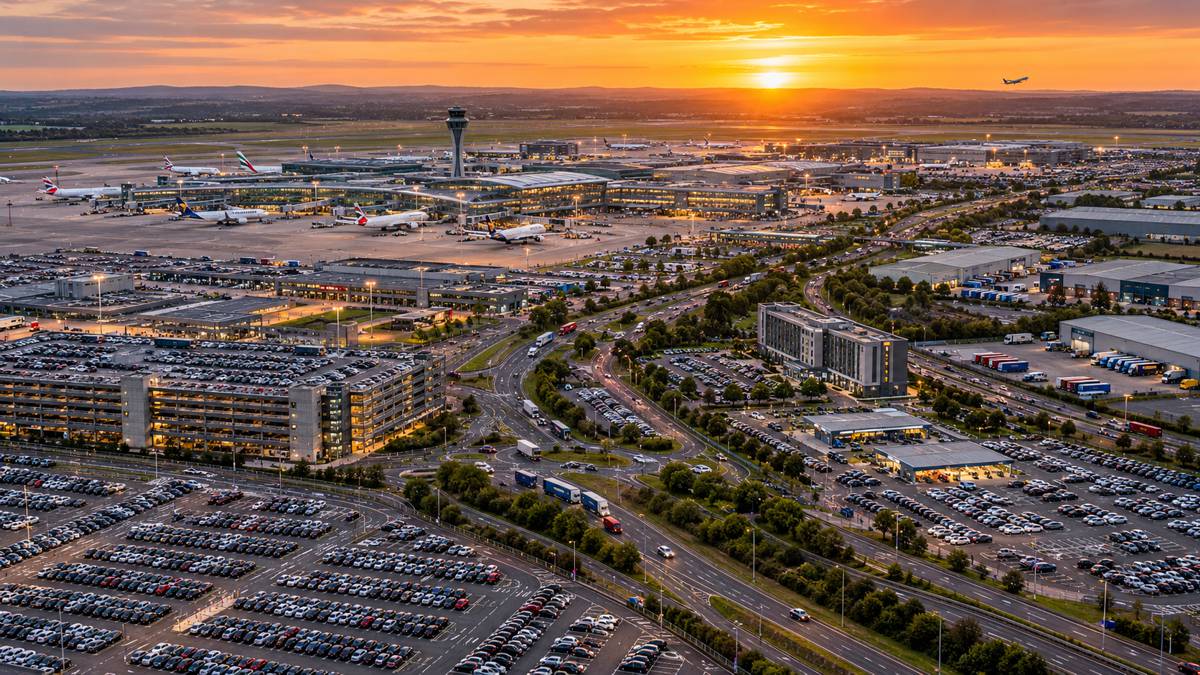
When Does an Airport Turn into a Giant Car Park?
Somewhere in the economics of modern aviation, the humble parking space became an extraordinarily valuable piece of infrastructure.
Airports are among the most complex transport facilities ever constructed. They require runways capable of accommodating aircraft weighing hundreds of tonnes, sophisticated air traffic systems, extensive security infrastructure, terminal buildings and thousands of people working around the clock. Yet some of their most commercially attractive assets are considerably less complicated: rectangular spaces where passengers leave their cars while travelling elsewhere.
During a press visit to Manchester Airport some years ago, a construction project manager offered a memorable assessment of the business. The airport, he suggested, was essentially an excuse to operate enormous car parks. In his view, parking offered considerably more attractive profit margins than aviation operations, making vehicle storage one of the airport’s most valuable commercial activities.
It was a deliberately provocative observation rather than a verified comparison of the airport’s financial accounts. Nevertheless, it captured something fundamental about the commercial structure of modern aviation. Aircraft bring passengers, passengers bring vehicles, and those vehicles create opportunities for revenue that extend well beyond the terminal building.
Beyond the airport perimeter, independent parking operators, car hire companies, freight warehouses, hotels and distribution centres compete for a share of the economic activity generated by air travel. Their combined development can transform surrounding communities, property markets and road networks, often with consequences extending considerably further than the original airport.
Briefing
- Airport operators generate income from aviation charges, car parking, retail concessions, property and other commercial activities, with the balance varying considerably between airports.
- Established parking facilities can offer attractive operating margins through high occupancy, automated operations and premium services.
- Independent parking operators create competition but can increase pressure on surrounding roads, land use and local infrastructure.
- Car hire, freight logistics, hospitality and commercial property development extend the airport economy beyond its perimeter.
- Government and local authorities influence airport ownership, planning permissions, infrastructure investment and the management of cumulative development impacts.
The Economics of an Airport Parking Space
The economics of aviation are demanding. Runways, taxiways, terminals and associated facilities require substantial capital investment, regular maintenance and extensive regulatory oversight. Airport operators must accommodate airlines with considerable negotiating power while maintaining facilities that meet strict operational and safety requirements, regardless of fluctuations in passenger demand.
A multi-storey car park is certainly not inexpensive to construct. Foundations, structural frames, drainage, lighting, fire protection, access controls and vehicle circulation systems all contribute to development costs. Ongoing expenditure includes maintenance, security, insurance, staffing, energy and periodic structural refurbishment. Once a facility is established, however, the incremental cost of accommodating another vehicle can be relatively modest. Automated number-plate recognition, online reservations, electronic payments and revenue management systems allow operators to handle substantial volumes without proportionate increases in staffing.
The commercial attraction becomes particularly apparent when spaces are sold repeatedly throughout the year. A space occupied for a fortnight generates revenue throughout that period, while a premium short-stay space near a terminal may serve numerous customers in a single day. Airport operators differentiate their products according to convenience, with long-stay parking competing primarily on price while terminal-adjacent facilities, covered parking, valet services and meet-and-greet operations command premiums from passengers prepared to pay for shorter transfer times.
Pricing has also become more sophisticated. At many airports, advance booking rates vary according to demand, season, duration and availability. The same physical parking space can generate substantially different revenue depending on when and how it is sold.
Manchester Airports Group provides a particularly revealing illustration of the commercial value of parking. According to its Annual Report and Accounts for the year ending 31 March 2026, the group generated £453.3 million from car parking, compared with £516.1 million in aviation income and £374.7 million from retail concessions. Parking alone accounted for almost 30% of the group’s £1.51 billion annual revenue, while total commercial income reached £998.6 million. These figures cover Manchester, London Stansted and East Midlands airports, together with the group’s wider travel services operations, rather than Manchester Airport alone.
The growth figures are equally interesting. MAG’s parking revenue increased by 11.6% during the financial year, outpacing the 9.9% increase in aviation income. In the first six months of that year, parking revenue had risen by 17.2% compared with the equivalent period in 2024. None of these figures establishes that parking generates higher profit margins than aviation, since the published revenue breakdown does not provide directly comparable operating margins for each activity. They do, however, demonstrate why the project manager’s observation was more than an amusing description of airport economics. At MAG, storing passengers’ cars has become a business generating hundreds of millions of pounds annually.
Revenue, however, is not the same as profitability. A surface car park developed on relatively inexpensive land has a different financial profile from a heavily financed multi-storey facility. Operating margins, return on invested capital and cash generation can tell different stories, particularly where infrastructure and financing costs are allocated across multiple business activities. Parking can generate substantial recurring income from passengers whose primary reason for visiting the airport has nothing to do with leaving a vehicle behind.
Charging for Access to the Terminal
Parking revenue increasingly begins before a vehicle has even stopped for the duration of a holiday or business trip.
Across the UK, airport operators have introduced or increased charges for dropping passengers directly outside terminal buildings. What was once a brief and often free interaction with airport infrastructure has become a chargeable service, frequently structured around short time allowances and escalating fees for longer stays.
Terminal forecourts are constrained environments. Arriving vehicles compete for limited kerbside capacity, while pedestrians, taxis, buses, emergency vehicles and service traffic must move safely through the same area. Charging can discourage prolonged stops, reduce congestion and encourage passengers to use public transport or designated remote drop-off facilities. It also creates a commercial opportunity by placing a price on access to the most convenient part of the airport.
Terminal access is a scarce resource, particularly where passengers place a premium on convenience. A short drop-off charge may appear modest in isolation, but the implied hourly rate can be substantial. The operator is effectively selling proximity to the terminal rather than a conventional parking service. Where forecourts and access roads already exist, the economics can be attractive. Payment infrastructure, enforcement, traffic management and maintenance still incur costs, but the service does not require an additional runway, aircraft stand or terminal extension.
Airports frequently promote public transport, reduced vehicle emissions and more sustainable surface access while continuing to earn income from private vehicle journeys. This creates a commercial tension that must be considered alongside the operational benefits of managing terminal congestion.
The Car Parks Beyond the Perimeter Fence
Around major airports, independent businesses have developed extensive parking operations offering lower prices in exchange for a longer journey to the terminal. Customers leave their vehicles at privately operated compounds before travelling to the airport aboard shuttle buses or minibuses. These businesses range from established operators with purpose-built facilities to smaller enterprises occupying former industrial premises, agricultural buildings and converted commercial land.
Their competitive advantage is often straightforward. Land beyond the airport boundary can be considerably cheaper than terminal-adjacent property, while operating costs may be lower than those associated with multi-storey structures. Regular transfers allow independent operators to offer a service that passengers regard as an acceptable compromise between cost and convenience.
A passenger using an off-site facility may travel through residential streets or along local roads that were not designed for substantial airport-related traffic. The subsequent shuttle transfer introduces another journey between the compound and terminal. Depending on occupancy, route design and the number of passengers sharing each transfer, shuttle services can consolidate vehicle movements or add to congestion. Frequent minibuses operating with few passengers may impose a disproportionate burden on local roads.
Land-use implications can be equally significant. Fields, yards and former industrial sites may be converted into extensive areas of vehicle storage. Surfacing, fencing, lighting, drainage and access arrangements can alter the character of surrounding areas, particularly where several operators establish facilities close together.
Local authorities must balance the economic benefits of these businesses against highway safety, environmental protection, planning policy and neighbouring communities. Where operations expand without appropriate permissions or infrastructure improvements, enforcement can become another pressure on public resources. Higher official airport parking prices can also make independent alternatives more attractive, encouraging further investment in off-site facilities. The airport may have limited direct control over these competing developments, even though its pricing decisions can influence the market.
The resulting traffic and infrastructure pressures do not necessarily appear within the airport operator’s own development boundary.
Car Hire and the Wider Commercial Property Market
Car hire introduces another substantial layer of commercial activity. At a busy international airport, rental companies manage large fleets moving between terminals, storage compounds, cleaning facilities, maintenance workshops and customer collection points. Vehicles require inspection, refuelling or charging, repairs and repositioning, while seasonal fluctuations can create substantial additional storage requirements.
Some airports incorporate consolidated rental car facilities into their masterplans, bringing competing companies together in dedicated buildings or compounds. Others rely on a mixture of terminal facilities and off-site depots connected by shuttle services. Consolidated facilities can reduce duplicated customer transport operations and simplify vehicle movements, although they require investment in buildings, access roads and circulation systems. Dispersed facilities may offer greater flexibility and lower property costs but can increase journeys between depots and terminals.
Fleet electrification adds another consideration. As rental companies introduce electric vehicles, depots may require charging infrastructure, electricity network upgrades and revised vehicle turnaround procedures.
The wider commercial economy extends into hospitality, maintenance and supporting services. Hotels serve passengers, airline crews and business travellers. Catering companies supply aircraft and airport facilities, while fuel suppliers, security companies and specialist engineering businesses establish operations within convenient travelling distance. These activities create employment and support local supply chains, but also generate traffic and demand for utilities, commercial premises and public services.
Property previously considered suitable for agriculture, light industry or conventional commercial development may become attractive for airport-related uses. Investors identify opportunities in hotels, warehouses, parking facilities and offices, while landowners may seek permission to redevelop sites for more valuable commercial activities. Over time, proximity to the airport can become an important influence on surrounding property markets.
Freight Warehouses and the Airport Logistics Economy
Airports with substantial cargo operations attract freight forwarders, customs brokers, express parcel companies, cold-chain specialists and distribution businesses that depend on rapid access to air transport.
Cargo facilities need loading docks, secure compounds, vehicle manoeuvring areas, warehouse floors capable of accommodating handling equipment and reliable connections to strategic highway networks. Temperature-controlled goods, pharmaceuticals and time-sensitive industrial components may require specialised storage and uninterrupted logistics operations. The resulting developments can occupy extensive areas beyond the airport itself.
Large freight vehicles place different demands on local infrastructure from passenger cars. Junction geometry, pavement construction, bridge capacity, turning radii and access arrangements must accommodate heavy goods vehicles, often operating around the clock. Where cargo facilities are located close to residential areas, noise, night-time deliveries and vehicle movements can create planning conflicts. Well-designed logistics parks with direct motorway access and appropriate freight routes can support substantial economic activity while reducing unnecessary traffic through neighbouring communities.
Not every warehouse near an airport necessarily depends on aviation. Distribution companies may be attracted by the same motorway junctions, labour markets and commercial property developments that serve the airport. Some facilities primarily support road-based logistics, with air freight representing only a small proportion of their business. Over time, the concentration of transport infrastructure can become an attraction in its own right, with subsequent development increasingly driven by road connectivity and the availability of commercial land.
This pattern is sometimes associated with the concept of the aerotropolis, where an airport becomes the organising centre of a wider commercial and industrial district. The term was popularised through the work of airport development researcher John Kasarda, although the relationship between transport hubs and surrounding economic activity is much older. Seaports, railway terminals and major highway interchanges have historically attracted businesses seeking access to transport networks. Airports extend this pattern into international passenger travel and time-sensitive logistics.
There are significant differences between a deliberately planned airport city and the gradual accumulation of businesses around an existing airport. The former may incorporate coordinated land-use policies and infrastructure investment. The latter can emerge through individual planning decisions made over decades, with limited overall coordination.
When Local Roads Become Airport Infrastructure
The cumulative impact of airport-related development can be difficult to measure. An airport operator planning a terminal expansion will typically assess passenger forecasts, vehicle movements, parking requirements and the capacity of principal access routes. Major projects may require transport assessments, environmental studies and agreements covering highway improvements.
Independent businesses outside the airport boundary complicate those calculations. A single parking compound may generate traffic that appears manageable in isolation. A nearby car hire depot, hotel and distribution warehouse may each reach a similar conclusion. Their combined traffic, however, can create substantial pressure on the same junctions and local roads.
Passenger parking movements follow holiday departure and arrival patterns. Hotels generate check-in, check-out and service traffic. Freight operators may schedule deliveries overnight, while rental car companies reposition vehicles according to flight arrivals and fleet requirements. The resulting traffic profile can extend across much of the day and night.
Road improvements are rarely simple. Widening a junction may require additional land, utility diversions and changes to pedestrian or cycling infrastructure. New access roads can affect drainage, habitats and neighbouring properties. Heavy vehicle movements can accelerate pavement deterioration where existing roads were not designed for sustained freight traffic.
Airport operators may fund infrastructure within their ownership boundaries and contribute towards wider transport schemes through planning agreements. Independent developers can face similar obligations where their projects create identifiable impacts. The cumulative effects of numerous smaller developments can be harder to attribute to individual businesses, particularly where airport-related activity extends across several local authority boundaries.
Government, Local Planning and the Airport Economy
Airports occupy an unusual position in public infrastructure. They may operate as private commercial businesses, public enterprises or partnerships between government and institutional investors, yet their development can influence regional transport policy, employment, land use and public investment for decades.
Manchester Airports Group provides a particularly interesting example. The ten Greater Manchester local authorities collectively own 64.5% of the business, with the remaining 35.5% held by IFM Global Infrastructure Fund. Manchester City Council alone holds 35.5%, giving local government a substantial financial interest in the performance of an airport operator that also manages London Stansted and East Midlands airports.
Public ownership introduces another dimension to airport economics. Successful commercial operations can generate investment returns for local authority shareholders, while airport expansion may support employment, tourism, international trade and regional economic development. Those same public authorities, acting through their statutory planning and transport functions, must also consider congestion, environmental impacts, housing pressures and the infrastructure requirements of neighbouring communities.
Ownership and planning responsibilities are legally distinct, and commercial interests do not remove the obligation to follow established planning procedures. Nevertheless, the relationship demonstrates how airport development can involve overlapping public and commercial interests.
In England, the planning framework distinguishes between airport projects of national significance and developments handled through conventional local planning processes. Major airport expansion schemes meeting statutory thresholds can require a Development Consent Order under the Planning Act 2008, while many surrounding commercial developments are considered through local planning procedures.
A major terminal or runway expansion may therefore undergo a comprehensive infrastructure planning process, while nearby hotels, car parks, warehouses and vehicle depots are assessed through separate applications, potentially across several local authority areas. Local planning authorities can require transport assessments, impose appropriate planning conditions and negotiate developer contributions where justified. Section 106 agreements, highway agreements and other planning mechanisms can help secure improvements, although contributions must meet relevant legal requirements and cannot simply be used to address unrelated infrastructure deficiencies.
A new warehouse may satisfy the transport requirements of its own planning permission, while several nearby parking compounds, hotels and distribution facilities collectively generate demand for improvements that no single project would justify funding independently.
Government involvement extends beyond planning permission. National transport strategies, regional economic policies, rail investment, strategic highway programmes and environmental regulations all influence the direction and scale of airport development.
Airport expansion can deliver considerable public benefits, including employment, international connectivity, inward investment and stronger regional supply chains. Yet these benefits are distributed across a wider economy, while congestion, road maintenance and environmental pressures may be concentrated in particular communities. Coordinating development at the scale of the economic activity being generated is therefore a continuing challenge for airport operators, government and local authorities.
Surface Access and the Public Transport Alternative
Airport expansion increasingly depends on the quality of connections beyond the runway. Rail services, express buses, local bus networks and dedicated airport transit systems can reduce dependence on private vehicles, particularly for employees and passengers travelling from major urban centres.
Their effectiveness varies according to geography, operating hours and the availability of connections. A passenger travelling from a city centre with frequent direct rail services may have little reason to drive. A family departing from a rural area before dawn, carrying several suitcases, may find public transport considerably less practical. Airport employees face similar constraints, with security staff, baggage handlers, cleaners, maintenance teams and logistics workers often operating shifts that begin or finish outside conventional public transport hours.
Surface access strategies must therefore accommodate the needs of the workforce and surrounding businesses as well as passengers. Every passenger who switches from an airport-owned car park to public transport potentially reduces parking demand, although the financial effect depends on capacity, pricing and whether another customer occupies the space.
Efficient public transport can also improve airport accessibility, support passenger growth and reduce the need for further road and parking infrastructure. For airports approaching the limits of their road capacity, investment in public transport may be commercially advantageous even where parking is profitable.
Planning Beyond the Airport Boundary
Airport investment decisions are generally presented in terms of passenger capacity, airline connectivity, operational efficiency and regional economic benefits. Those considerations are fundamental, but additional passengers can also increase demand for parking, retail concessions, hotels, car hire and other services. Expansion may increase the attractiveness of surrounding land for logistics and commercial development.
Airport operators with substantial property interests may benefit directly from these opportunities, while independent developers and businesses capture others. Aeronautical charges can be regulated, negotiated or constrained by competition, depending on the airport and jurisdiction. Commercial revenues may be subject to different pricing arrangements, giving operators greater flexibility in responding to demand. The treatment of commercial income within airport charging frameworks also varies, so additional parking revenue does not automatically translate into higher profits or lower airline charges.
Airport expansion can trigger investment decisions across a much wider area than the development originally proposed. Dedicated freight routes can keep heavy goods vehicles away from residential streets, while consolidated rental car facilities can reduce duplicated shuttle operations. Well-located public transport interchanges can make rail and bus travel practical for passengers and employees, and coordinated drainage, utilities and access planning can reduce the cost and disruption associated with piecemeal development.
Such measures require cooperation between airport operators, local authorities, highway agencies, transport providers, landowners and private developers. They also require an understanding that the airport’s economic influence extends beyond the boundaries shown on its masterplan.
The original observation about Manchester Airport being an excuse to operate giant car parks was memorable because it reduced an extraordinarily complex aviation business to one of its simplest commercial activities. Yet the surrounding landscape tells a more complicated story.
The car parks lead to shuttle operators, rental fleets, hotels and warehouses. Those businesses generate traffic, attract investment, change land values and create new demands on local infrastructure. Some developments are essential to aviation, while others emerge because the airport has created a commercially attractive location.
The runway remains the reason the airport exists. The economy that develops around it can become a substantial infrastructure undertaking in its own right. And while an airport operator can count the passengers passing through its terminals, accounting for the full economic and physical footprint of those passengers is a considerably more complicated exercise.
Key Industry Questions
- Why can airport parking generate attractive profit margins? Established parking facilities can benefit from automated operations, recurring demand and relatively low incremental costs. Profitability depends on occupancy, pricing, construction expenditure, financing and maintenance.
- How do independent airport parking operators compete with official facilities? Independent operators typically use lower-cost land away from terminals and provide shuttle transfers. Their services compete on price, convenience, security and booking flexibility.
- What is an aerotropolis? An aerotropolis is an airport-centred commercial district incorporating aviation facilities, logistics operations, business development and surrounding transport infrastructure.
- How does airport development affect local roads? Parking compounds, hotels, car hire depots and freight warehouses generate different traffic patterns. Their combined activity can increase demand for junction improvements, road maintenance, freight access and public transport.
- Who pays for infrastructure improvements associated with airport development? Responsibility depends on road ownership, planning agreements and national legislation. Airport operators and private developers may contribute towards improvements, while public authorities manage elements of the wider transport network.
- Can local authorities own airports while also regulating development? Yes. Public ownership and statutory planning responsibilities are legally distinct. Authorities must follow the applicable planning framework regardless of their commercial interests.
- Why do logistics companies establish warehouses near airports? Air freight businesses benefit from proximity to cargo terminals, customs services and international connections. Other distribution companies may primarily value nearby motorways, labour availability and established logistics infrastructure.
- How can airports reduce the impact of surrounding commercial development? Coordinated land-use planning, dedicated freight routes, consolidated transport facilities, public transport investment and cumulative traffic assessments can help manage growth across airport and local authority boundaries.
Strategic Takeaways
- Parking economics: High occupancy, automated operations and differentiated pricing can make established parking facilities commercially attractive, although capital and financing costs remain significant.
- Independent competition: Off-site parking operators can lower passenger costs while introducing additional transport and environmental pressures in surrounding communities.
- Commercial development: Airports attract businesses whose property and infrastructure requirements extend well beyond aviation operations.
- Public-sector involvement: Government and local authorities influence airport ownership, expansion, planning permissions and infrastructure investment, sometimes while holding substantial commercial interests.
- Infrastructure coordination: Managing cumulative development requires planning and transport investment across the wider airport district, rather than concentrating exclusively on the airport boundary.