Epiroc to Operate Autonomous Quarry Drill from Las Vegas at CES 2027
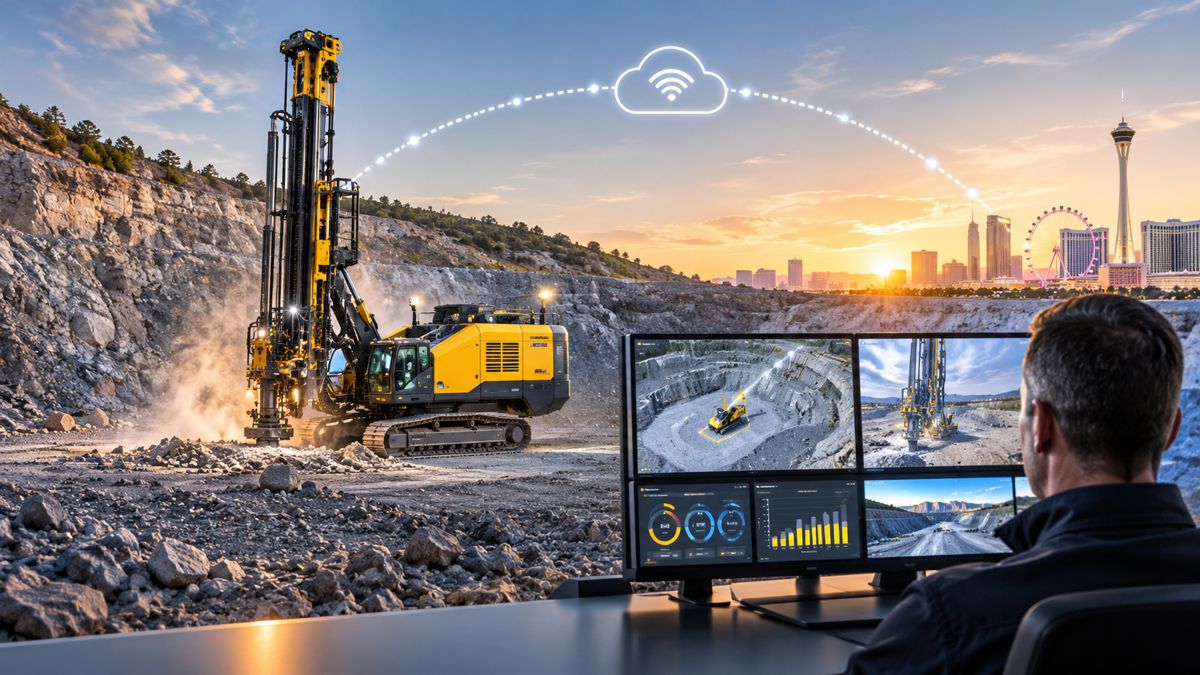
A surface drill working at a Virginia quarry will be operated remotely from Las Vegas in January, when Epiroc connects its CES 2027 exhibition stand to an operational SmartROC D65 more than 2,000 miles away. Developed with US aggregates producer Luck Stone, the demonstration will give visitors a live view of autonomous drilling operations, including the video feeds and performance data used by the remote operator.
The equipment is already working at Luck Stone’s Rockville quarry, where Epiroc deployed what it described as the first fully autonomous SmartROC D65 in the US aggregates market in September 2025. The CES presentation will bring that established operation to a wider technology audience, with a Luck Stone employee supervising drilling from the Las Vegas Convention Center while the machine continues its normal production activities in Virginia.
Briefing
- Epiroc and Luck Stone will demonstrate live remote quarry drilling at CES 2027, from 6 to 9 January.
- A SmartROC D65 in Rockville, Virginia, will be connected to an operator in Las Vegas, more than 2,000 miles away.
- The autonomous drill can execute programmed drilling patterns without an operator in the cab.
- Epiroc’s CAP and LinkOA technologies support remote supervision, drill planning and operational coordination.
- The demonstration builds on Luck Stone’s 2025 autonomous drilling deployment in the US aggregates sector.
Autonomous Drilling at Rockville
The SmartROC D65 is designed for surface drilling applications where accurate blasthole positioning is essential to subsequent rock excavation and processing. Its automation capabilities extend beyond individual drilling functions, allowing the machine to follow a planned drilling pattern with limited direct operator intervention.
In conventional quarry drilling, operators must position the rig, align the feed, manage the drilling cycle and move between hole locations. Automated systems progressively assume these repetitive functions, using machine controls and digital drill plans to maintain consistency across the bench. The SmartROC platform also incorporates automated drilling functions and rod handling, reducing the manual intervention required during production.
Epiroc’s autonomous configuration allows the rig to execute complete drilling patterns without an operator in the cab. When the Rockville installation was announced, Epiroc described the machine as meeting Level 4 autonomy under the Global Mining Guidelines Group framework, with remote supervision provided through its Common Automation Panel and Link Open Autonomy platform. That classification is the manufacturer’s stated assessment of the operating capability rather than a separately reported independent certification.
Quarry drilling still involves variable rock conditions, changing bench geometry, equipment wear and the coordination of drilling with blasting activities. Operators supervising autonomous equipment must account for those conditions while monitoring programmed drilling sequences and intervening when necessary. The machine handles routine drilling movements, leaving personnel to oversee the operation and respond to conditions requiring human judgement.
For the CES demonstration, a Luck Stone employee stationed at Epiroc’s exhibition stand will supervise drilling at Rockville. Visitors will see the same live video and real-time performance information available to the operator, providing a direct view of the relationship between autonomous machine functions and remote human supervision.
Remote Supervision and the Changing Operator Role
A remotely operated drill may still require an operator to command individual movements, whereas an autonomous machine can execute programmed tasks under supervision. Epiroc’s system combines these capabilities, allowing routine drilling sequences to proceed automatically while retaining the ability to monitor and control equipment from another location.
The company has been developing this approach across surface mining and quarrying applications. In November 2026, Epiroc confirmed that autonomous SmartROC D65 MKII rigs were operating at several customer sites, including Fortescue’s Solomon and Eliwana operations in Australia, KGHM’s Robinson Mine in the United States and Luck Stone’s Rockville quarry. These installations operate in different production environments, but each demonstrates how automated drilling can be incorporated into commercial mineral extraction.
Luck Stone’s operators are also taking on responsibilities that extend beyond conventional drilling. Personnel familiar with operating equipment from the cab are increasingly working with digital production information, supervising programmed processes and coordinating drilling activities with blasting and production teams.
Chuck Stilson, Senior Director of Engineering at Luck Stone, said: “This is about more than machines. It’s about empowering our associates and creating new opportunities for them. As we introduce drill automation, our associates are learning new skills, taking on new roles, and working more closely with our blasting and production teams. Our work with Epiroc is a true partnership. We challenge each other to get better, and that makes us both stronger.”
The transition requires operators to understand both the machinery and the systems directing it. Personnel still need the practical knowledge to recognise unexpected ground conditions, drilling difficulties and changes in the working environment, even when they are no longer controlling every movement. Training therefore encompasses digital supervision and production coordination alongside established drilling and quarrying skills.
For aggregates producers, where equipment fleets and operating teams are often considerably smaller than those at major mining operations, introducing autonomy also requires careful consideration of how personnel are deployed. Remote supervision creates opportunities to reorganise work, although the appropriate operating arrangements will depend on the site’s production requirements, equipment configuration and safety procedures.
Connecting Equipment Across the Quarry
Alongside the remote drilling demonstration, Epiroc will present its approach to integrating autonomous equipment from different manufacturers. The company’s Link Open Autonomy platform, known as LinkOA, is designed to coordinate autonomous drilling, haulage, blasting and staffed vehicle operations within a common operational environment.
The Common Automation Panel, or CAP, provides an interface for supervising autonomous and remotely operated drilling equipment, including Epiroc’s SmartROC and Pit Viper platforms. LinkOA works at a broader level, supporting drill plan management, equipment coordination, fleet monitoring and the exchange of operational information between different applications.
Quarry and mine operators frequently work with mixed fleets acquired over many years. Drilling equipment, loaders, haulage vehicles and support machinery may come from several manufacturers, while replacement cycles rarely coincide. Introducing automation across an established operation therefore raises questions about compatibility, communications infrastructure and how individual machines exchange information.
Epiroc’s OEM-agnostic architecture is intended to accommodate equipment from multiple manufacturers rather than restricting automation to its own machinery. This could allow operators to introduce autonomous equipment while retaining compatible existing assets, although integration remains dependent on machine controls, available interfaces, communications systems and site-specific safety requirements.
The broader LinkOA development programme extends into autonomous haulage and the coordination of different mining activities. Bringing these functions together allows drilling plans, equipment movements and production information to be managed within a shared operational framework, rather than relying entirely on separate systems for each machine or process.
For an established quarry, the ability to introduce automation incrementally may be as valuable as the capabilities of any individual machine. Operators can evaluate where autonomous functions offer practical benefits without necessarily committing to the wholesale replacement of their existing equipment fleets.
Production Economics and the CES Demonstration
Accurate blasthole drilling has consequences throughout quarry production. Hole positioning, depth and consistency influence blast design and execution, which in turn affect fragmentation and the material subsequently handled by loaders, haulage equipment and crushing plants. More consistent execution of drilling patterns can help support predictable blasting operations, provided that geological conditions, survey information and blast design are properly accounted for.
The commercial assessment extends to equipment utilisation, personnel deployment and operating costs. Autonomous drilling offers opportunities to maintain repeatable production cycles and reduce the time personnel spend aboard equipment working in exposed extraction areas. However, suitable machinery, reliable site communications, digital drilling plans, workforce training and specialist maintenance support all contribute to the cost of implementation.
When Epiroc and Luck Stone announced their autonomous drilling installation in September 2025, the companies indicated that performance information would be shared following implementation. Subsequent announcements have confirmed the Rockville machine’s place within Epiroc’s expanding autonomous fleet, although detailed, independently comparable figures for productivity improvements, operating costs and return on investment have not been established in the published material reviewed.
There is also an interesting precedent for the CES presentation. Epiroc demonstrated a live connection to Luck Stone’s autonomous SmartROC D65 during CONEXPO-CON/AGG 2026 in Las Vegas, using its Common Automation Panel to bridge approximately 2,400 miles between the exhibition and the Virginia quarry. The CES appearance therefore builds on an earlier trade-show demonstration rather than introducing the remote connection for the first time.
The difference is the audience. CES traditionally brings together consumer electronics manufacturers, software developers and companies working with emerging digital technologies. Epiroc will use the event to show how connectivity, automation and real-time data processing are already supporting commercial mineral extraction, from the production of construction aggregates to the wider mining operations that supply industrial raw materials.
Jess Kindler, Business Area President, Equipment and Services at Epiroc, said: “We’re excited to bring our technology to CES and share it with a wider audience. Autonomy, electrification and connectivity are opening up new possibilities in mining, and operating a drill rig on the East Coast live from Las Vegas shows what that looks like at a working site today. We want people to see why mining matters and the part technology now plays in it. As a technology partner, our ambition is to excel, and we’re here to find inspiration for what we build next.”
Epiroc will exhibit at Booth 7031 in the West Hall of the Las Vegas Convention Center during CES 2027, which runs from 6 to 9 January. Guided presentations are scheduled daily at 10:00 and 13:00 Pacific Standard Time, each lasting approximately 20 minutes. Live drilling from Rockville is planned between 09:00 and 14:00 Pacific Standard Time from Wednesday to Friday, during the quarry’s normal operating hours.
The demonstration will place a remote operator more than 2,000 miles from the drill, but the machine’s everyday work at Rockville provides the more useful measure of the technology. Luck Stone is incorporating autonomous drilling into routine aggregates production, with operators increasingly responsible for supervising equipment rather than controlling every movement from the cab.
Key Industry Questions
- What will Epiroc demonstrate at CES 2027? Epiroc will connect its Las Vegas exhibition stand to an autonomous SmartROC D65 surface drill operating at Luck Stone’s Rockville quarry in Virginia. A Luck Stone employee will remotely supervise operations using live video and machine performance data.
- Is the SmartROC D65 fully autonomous? The autonomous SmartROC D65 MKII configuration can execute programmed drilling patterns without an operator in the cab. Epiroc describes the Rockville installation as meeting Level 4 autonomy under the Global Mining Guidelines Group framework.
- What is the difference between remote drilling and autonomous drilling? Remote drilling allows an operator to control equipment from another location. Autonomous drilling enables the machine to execute planned tasks with limited human intervention while remaining under human supervision.
- What is Epiroc’s Common Automation Panel? CAP is a common interface for monitoring and supervising autonomous and remotely operated drilling equipment. It supports equipment including Epiroc’s SmartROC and Pit Viper platforms.
- What does Link Open Autonomy do? LinkOA is Epiroc’s automation platform for coordinating equipment and exchanging operational information across drilling, blasting, haulage and other mining activities.
- Can LinkOA integrate equipment from different manufacturers? LinkOA is designed for mixed-manufacturer fleets, although compatibility depends on machine controls, available interfaces, communications infrastructure and site requirements.
- How can autonomous drilling benefit quarry operations? Potential benefits include consistent blasthole execution, reduced personnel exposure in active extraction areas and improved equipment utilisation. Actual performance depends on site conditions and implementation.
- Where is Epiroc’s autonomous SmartROC D65 operating? As of November 2026, Epiroc has reported autonomous SmartROC D65 MKII operations at Luck Stone’s Rockville quarry, KGHM’s Robinson Mine and Fortescue operations in Australia.
- When and where can visitors see the CES demonstration? Epiroc will exhibit at Booth 7031 in the Las Vegas Convention Center’s West Hall from 6 to 9 January 2027. Live quarry drilling is scheduled from Wednesday to Friday during the Virginia site’s operating hours.
Strategic Takeaways
- Commercial maturity: Luck Stone’s installation demonstrates autonomous drilling within an established aggregates operation, rather than a purpose-built experimental environment.
- Workforce development: Remote supervision changes the responsibilities of drilling personnel, increasing the importance of digital systems knowledge and production coordination.
- Mixed-fleet compatibility: OEM-agnostic automation offers a potential route to modernising existing quarry fleets without replacing every machine simultaneously.
- Production consistency: Repeatable blasthole drilling can support downstream blasting and materials processing, although results remain dependent on geology and operating conditions.
- Investment decisions: Equipment utilisation, safety, training and lifecycle costs provide more meaningful measures of autonomous drilling performance than the distance separating an operator from the machine.