Danang to Hoi An Metro will Reshape Central Vietnam
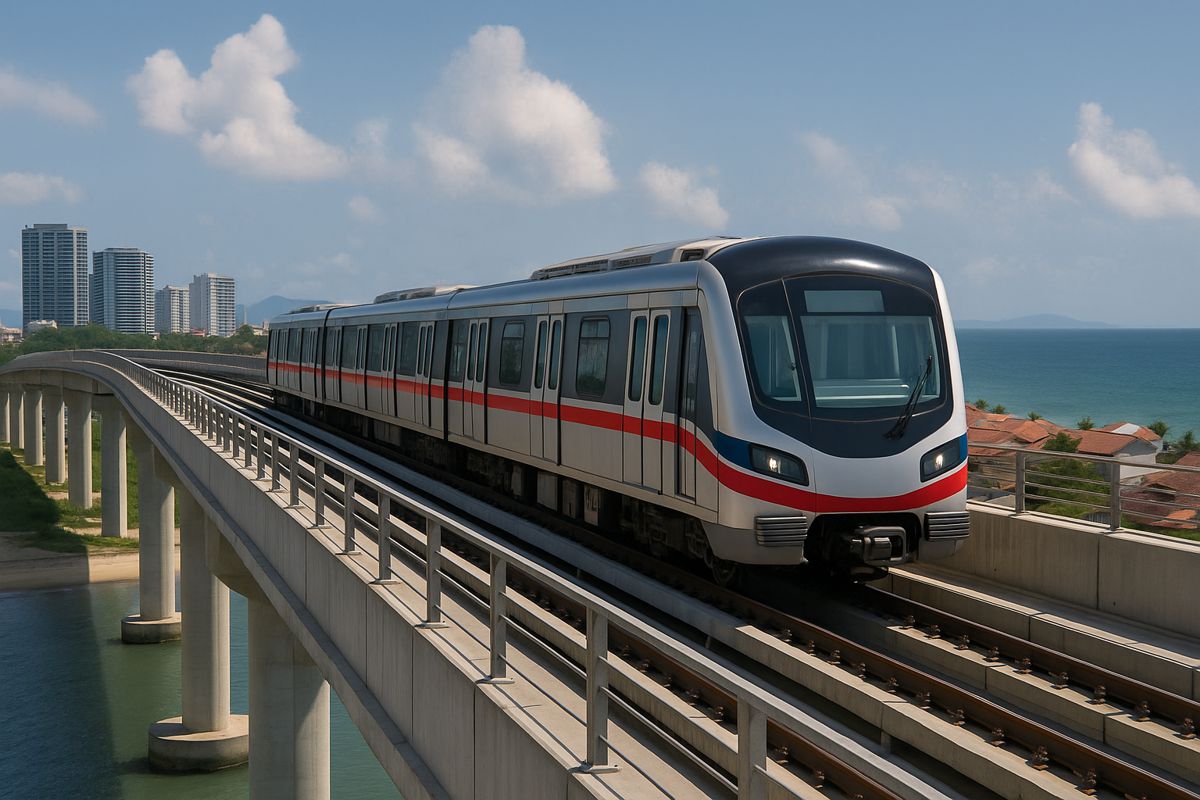
In a bold move emblematic of Vietnam’s transport modernisation, Deo Ca Group has placed on the table a sweeping proposal: a metro line linking the coastal city of Danang with the UNESCO‑protected ancient town of Hoi An.
This isn’t just about easing congestion, it’s a bet on urban renewal, regional cohesion and long‑term economic returns.
Ambition Meets Strategy
Deo Ca is proposing a public private partnership (PPP) model, layered with transit‑oriented development (TOD), to deliver this arterial link. In short: private capital and operations, but with land development, mixed uses, and infrastructure aligned to boost ridership and real estate returns.
In its planning dossier, the company carefully reviewed multiple alignments and systems. It arrived at the conclusion that Mass Rapid Transit (MRT) or monorail systems best suit the local geography, existing infrastructure, and financial bandwidth. The coastal route connecting Danang and Hoi An is heavily trafficked by residents and visitors alike, and it already suffers from capacity stress. A modern, high-capacity system could relieve that pressure dramatically.
The metro is aiming for a 2030 completion, with future phases envisioned to extend service to Tam Ky and Chu Lai. Importantly, the route is not being designed in isolation: TOD efforts, residential, retail, light industrial growth, are being woven into the corridor. Land parcels along the line are slated for development to underpin the project’s financial viability.
A joint‑venture structure already includes heavyweight participants: Kita Group, Futa Group, China Design Group, CRRC Chongqing, Arup, A2Z, Kim Long Motors, and financial support from VPBank and TPBank.
As Vice Chairman Le Quynh Mai noted during a working session with Da Nang authorities: “The technological and technical factors to implement the Project are ready, ensuring the possibility of completion by 2030.”
Municipal authorities seem receptive. Le Quang Nam, the Vice Chairman of Da Nang’s People’s Committee, affirmed the city would evaluate tender eligibility with transparency.
Danang’s Rail Ambitions in a Wider Master Plan
The Danang–Hoi An link is not an isolated dream but part of a sweeping vision laid out in Danang’s transport master plan. The city intends to roll out:
- By 2030: two metro lines totalling 24 km
- By 2040: expansion to three lines reaching 49 km
- By 2045: a full network of 11 lines spanning 131 km
Already, Danang is courting project finance for an urban rail link connecting its international airport to central My Khe Beach. That route is slated to follow a PPP + TOD model as well, and matches broader regional connectivity ambitions linking to Hoi An and beyond.
If all goes to plan, the Danang–Hoi An line would slash the 30 km journey to just 20 minutes. Extensions toward Chu Lai (approx. 90 km) could be accomplished within 40 minutes, fast enough to alter commuting and logistics patterns in central Vietnam.
This is big. It signals a pivot away from car dependency and toward integrated, rail‑driven urbanism.
Risks, Challenges, and Stakes
As with any large transport project, the devil lies in execution. Several challenges loom:
- Regulatory and approval hurdles: The project dossier must satisfy Vietnam’s PPP law and Railway Law, and the city must approve land‑use plans and capital allocations.
- Financing complexity: Blended funding models, BOT, BTL, BOO, are under consideration. The balance between state subsidies, land contributions and private returns will need careful calibration.
- Terrain, alignment, and engineering: While MRT or monorail are technically feasible, elevating or surface lines will need to negotiate coastal constraints, land acquisition and local sensitivities.
- Ridership and revenue risk: The TOD component is critical; without robust uptake in housing, commerce and real estate value, the line could struggle to generate sufficient returns.
- Coordination across agencies and jurisdictions: With extensions planned toward Quang Nam province areas (Tam Ky, Chu Lai), cross‑jurisdictional governance challenges are inevitable.
Yet, the upside could be transformative: the Danang–Hoi An metro could emerge as a showcase of modern transport-led development in Vietnam. It could also shift investor perceptions: this is not a tourist gimmick, but core infrastructure.
International Comparisons & Lessons
Globally, many cities have leaned on PPP + TOD models to deliver transit lines:
- In Taiwan, the Taoyuan Metro blends rail and property development to recoup capital costs.
- Hong Kong’s MTR famously profited from real estate development around stations, maintaining lower fares and financial resilience.
- In Singapore, the MRT and urban redevelopment go hand in hand, stations become nodes of dense mixed‑use precincts.
Vietnam’s context is distinct, land acquisition norms, regulatory frameworks and capital markets differ, but the global lessons are instructive: TOD is not an optional extra; it must be baked in from day one.
From the passenger perspective, an elevated or surface metro (rather than fully underground) would likely yield scenic views and lower capital costs. That seems to be the plan: “you won’t be stuck underground” for the Danang–Hoi An link.
Another critical lesson: transparent tendering and oversight. PPP projects often run aground when governance falters.
A Model for Vietnam’s Next Wave
If realised, the Danang–Hoi An metro could set a benchmark for transport infrastructure in Vietnam’s emerging cities. The integration of TOD, land development, tourism demand and urban growth dynamics makes the project more than a transit corridor, it becomes a spine for development.
For investors, this is an opportunity to engage early in land, property and service nodes along the corridor. For policymakers, it is a test case in balancing public benefits with private returns. And for local communities, it could remake how people move, live and invest.
Vietnam is racing ahead in urban rail, Ho Chi Minh City alone plans a network of nearly 27 lines covering some 940 km. Yet Danang–Hoi An could be the moment when transport infrastructure and tourism converge into something truly new: efficient mobility, sustainable growth and regional integration.
A pivotal question remains: will the ambition translate into real rails on the ground by 2030? If so, central Vietnam may well be redefined by its metro.
A New Rail Era Dawns
This proposed Danang–Hoi An metro line is more than engineering or transport, it represents Vietnam’s evolving approach to infrastructure.
By combining PPP models with TOD foresight, investing in connectivity, and aligning municipal vision with regional aspirations, this project could catalyse a new chapter in sustainable urban development across Southeast Asia.