O’Hare Flyer Plans 15-Minute Chicago Airport Express on Existing Rail Corridors
Chicago has spent more than two decades trying to find a convincing way of getting passengers between its downtown and O’Hare International Airport considerably faster than the existing transport network allows. Its latest proposal takes a markedly different approach: rather than building an entirely new railway or experimenting with an unproven transport system, it would assemble a route from infrastructure that is already there.
The proposed O’Hare Flyer is a privately financed airport express railway intended to connect a new downtown station near Chicago’s Old Post Office with Terminal 2 at O’Hare in 15 minutes. Trains would depart every 15 minutes, running predominantly along existing freight railway rights-of-way controlled by CSX, Canadian National and Union Pacific.
The project is being promoted by a group of Chicago business and civic figures led by founder and chief executive Dave Lundy. Its developers say they are not seeking government subsidies or funding that might otherwise be available to the Chicago Transit Authority (CTA) or commuter railway operator Metra.
Independent reporting puts the anticipated investment at approximately $2.25 billion. The financing proposition is ambitious, but the engineering concept is relatively conventional. Existing railway corridors would do much of the geographical work, while battery-electric trains and dedicated infrastructure would provide the speed and service frequency required for an airport operation.
Chicago has heard ambitious airport express proposals before. Whether this one progresses will depend upon securing the railway agreements, permissions, financing and construction programme needed to turn three freight corridors into a coherent passenger railway.
Briefing
- O’Hare Flyer proposes a 15-minute journey between downtown Chicago and O’Hare International Airport.
- Trains would operate every 15 minutes using battery-electric traction.
- The route would use rights-of-way owned by CSX, Canadian National and Union Pacific.
- O’Hare Flyer has agreed terms through a Letter of Intent with CSX and is progressing discussions with the other railway companies.
- The privately financed project has been reported at approximately $2.25 billion and is targeting launch within five years.
Building a Passenger Railway from Freight Corridors
Battery-electric passenger rolling stock is increasingly established technology, particularly where relatively short sections of non-electrified railway need to be operated without diesel traction. The more consequential part of the O’Hare Flyer concept is its proposed route.
Rather than acquiring an entirely new corridor across one of America’s largest metropolitan areas, the developers intend to combine rights-of-way belonging to three Class I freight railways. According to the project, an agreement on terms has already been memorialised through a Letter of Intent with CSX, while discussions with Canadian National and Union Pacific are continuing.
“By combining three existing but underused freight rights-of-way into a dedicated express rail service, we will create the best airport transportation experience in America – and one of the best in the world,” said O’Hare Flyer founder and chief engineering officer Mark Walbrun.
Using existing corridors could remove one of the largest obstacles facing urban railway development: finding a continuous route through established neighbourhoods and commercial districts. It does not eliminate the difficult work. Passenger operations bring their own requirements for track, signalling, safety, stations, interfaces and regulatory approval, while assembling a route across infrastructure controlled by three major freight operators introduces a substantial commercial and operational negotiation.
The proposed railway would be dedicated to the airport service rather than simply inserting express passenger trains into normal freight traffic. Reports on the scheme indicate that approximately the first mile leaving downtown would run underground before the route joined existing railway rights-of-way.
The trains themselves would recharge at the downtown and O’Hare stations. O’Hare Flyer has described continuous rail, comfortable seating and luggage accommodation in every car, reflecting a service designed specifically around airport passengers rather than conventional urban commuting.
A 15-Minute Journey
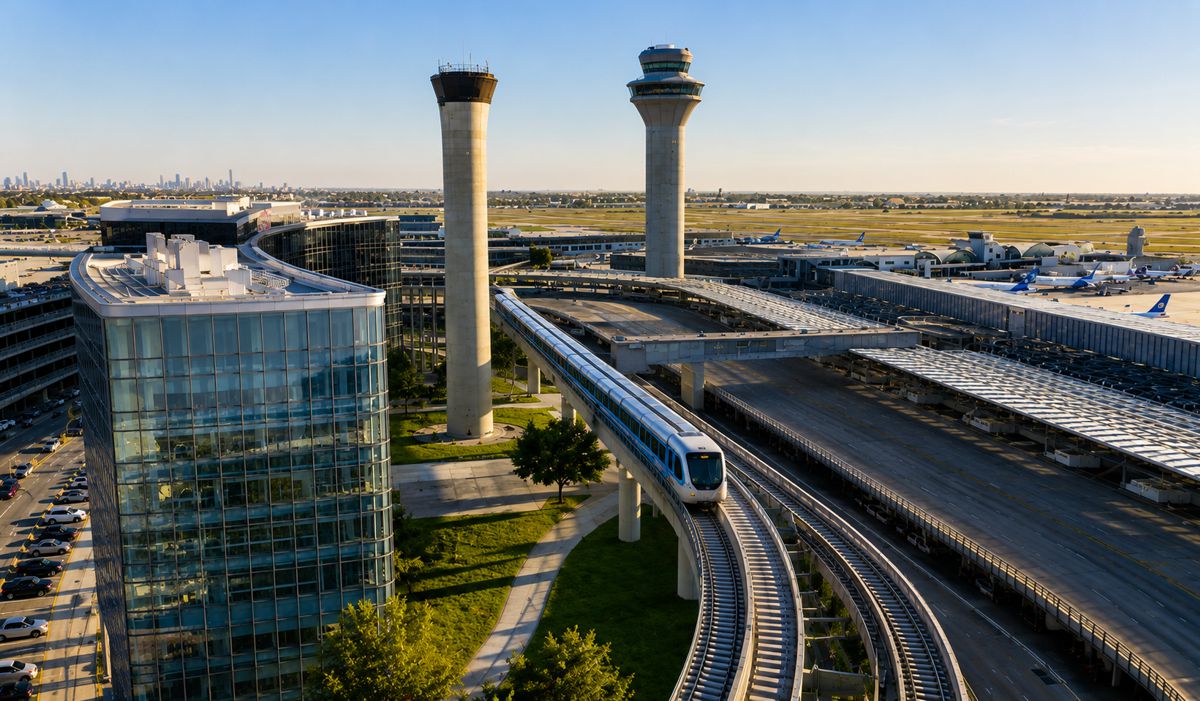
Chicago already has a railway to O’Hare. The CTA Blue Line provides direct rapid-transit service between the airport and downtown, so the case for an express railway rests on journey time, reliability and the passenger experience rather than providing a connection that does not currently exist.
The ambition stretches back decades. During the Richard M. Daley administration, Chicago began developing the Block 37 superstation beneath the city centre as the prospective hub for express services to O’Hare and Midway. Construction began in the mid-2000s but the airport railway never materialised, leaving a costly unfinished station beneath downtown Chicago.
The Chicago Metropolitan Agency for Planning subsequently recorded airport express service among the city’s long-considered transport concepts, including proposals involving underused freight rights-of-way and Metra infrastructure.
A much more conspicuous attempt arrived in 2018, when Mayor Rahm Emanuel’s administration selected Elon Musk’s Boring Company to develop the Chicago Express Loop. That proposal envisaged electric passenger vehicles travelling through newly constructed tunnels between Block 37 and O’Hare in approximately 12 minutes, without public subsidy.
It generated enormous attention but no railway. The proposal faded following the change in mayoral administration in 2019.
O’Hare Flyer therefore arrives in a city with considerable institutional memory of airport express schemes. Its developers are making similarly bold promises on journey time and private financing, but the physical proposition is different. Instead of depending primarily upon a new tunnel system and a novel form of transport, much of its route would be assembled from railway infrastructure that has existed in Chicago for generations.
The O’Hare Market
O’Hare recorded 857,392 aircraft movements during 2025, according to Federal Aviation Administration data published by the Chicago Department of Aviation, returning it to the position of America’s busiest airfield by aircraft movements. The airport currently offers direct connections to 197 US cities and 69 international destinations.
Passenger volumes have also been growing strongly. More than 24.3 million passengers passed through O’Hare during June, July and August 2025, the busiest summer in the airport’s history. The airport handled more than eight million passengers in June alone.
O’Hare is simultaneously undergoing a major capital programme. The wider O’Hare 21 programme includes substantial terminal and concourse investment, with construction of the new Concourse D beginning in 2025.
An express railway would consequently be entering a large and expanding aviation market rather than attempting to generate its own underlying demand. The harder question will be how much of that market is willing to pay for a premium 15-minute service when a direct CTA connection already exists.
Fare levels have not yet been announced publicly. Neither have sufficiently detailed ridership and revenue projections been released to judge how the proposed $2.25 billion investment would perform commercially.
Private Finance and Public Infrastructure
O’Hare Flyer describes itself explicitly as a private endeavour. Its developers say it will not seek government subsidies or compete for funds that might otherwise support CTA or Metra.
That does not make the project independent of government.
A railway connecting central Chicago with one of the world’s busiest airports will require extensive interaction with public authorities, regulators, railway companies and infrastructure owners. The development team says it is now meeting public officials as well as business, finance, government and community organisations, with wider regional outreach planned.
The project’s private-finance structure could nevertheless be politically attractive in a city where previous airport express proposals have become associated with public expenditure and unfinished infrastructure.
Chicago Mayor Brandon Johnson has already responded positively to the concept, according to local reporting, while emphasising the attraction of private investment.
The developers have also started addressing the construction model. O’Hare Flyer says it intends to give local contractors opportunities to participate and has signed a memorandum of understanding with the Chicago and Cook County Building and Construction Trades Council as a precursor to negotiating a Project Labor Agreement.
“O’Hare Flyer will be a job creation engine and an investment in working families and communities across Greater Chicago,” said council president Mike Macellaio. “Our MOU is an important first step toward a Project Labor Agreement that will help ensure this landmark project is built by Greater Chicago’s highly skilled unionized construction workforce while expanding opportunities for local workers and delivering lasting economic benefits throughout the region.”
A $2.25 billion programme would potentially encompass far more than railway track. Stations, underground works, structures, signalling, power and charging infrastructure, communications, civil works and modifications along existing corridors could all form part of converting the route into a dedicated airport railway, although the detailed scope has yet to be published.
Agreements Before Construction
The CSX Letter of Intent is one of the more tangible developments in a project still relatively early in its development.
“CSX is pleased to work with the O’Hare Flyer team to support a safe and reliable transportation option for Chicago travelers,” said Andy Daly, CSX senior director of passenger operations.
One agreement does not produce a railway across three companies’ infrastructure. Equivalent progress with Canadian National and Union Pacific will be necessary before the route proposition becomes substantially more concrete.
Nor does a proposed $2.25 billion private investment constitute secured financing. Detailed engineering, environmental and regulatory processes, railway agreements and the economics of the eventual operating model all sit between the present proposal and construction.
The developers say the project has already spent three years in exploratory development and assembled engineering, legal, architectural, planning, design and professional-services partners. The objective is to launch the railway within the next five years.
That timetable is aggressive for a major urban rail project, although extensive use of established corridors could avoid some of the property acquisition and civil engineering that make entirely new urban routes so difficult to deliver.
Chicago’s history gives good reason to judge airport express proposals by milestones rather than renderings. Securing all three railway agreements would be one. Completing engineering and regulatory work would be another. Financial close would be considerably more significant.
Yet the underlying proposition is relatively straightforward. Chicago already possesses the airport, the passenger market, a dense railway network and much of the physical corridor the project says it needs. O’Hare Flyer is proposing to reorganise pieces of that existing infrastructure around a dedicated airport transport service.
Key Industry Questions
- What is the O’Hare Flyer? It is a proposed privately financed express railway connecting downtown Chicago with O’Hare International Airport.
- How fast would the journey be? The developers are targeting a 15-minute journey between downtown and Terminal 2 at O’Hare.
- How frequently would trains operate? The proposal calls for departures every 15 minutes.
- Would an entirely new railway need to be constructed? Not entirely. The scheme proposes combining existing freight railway rights-of-way owned by CSX, Canadian National and Union Pacific, alongside new infrastructure required to create the dedicated passenger service.
- Has the route been secured? Not yet in its entirety. O’Hare Flyer says terms with CSX have been memorialised through a Letter of Intent and discussions with the other railway companies are progressing.
- How much is the project expected to cost? Independent reporting places the proposed investment at approximately $2.25 billion.
- Will taxpayers fund it? O’Hare Flyer says it is a private project and is not seeking government subsidies or funding that might otherwise be directed towards CTA or Metra.
- Does Chicago already have rail service to O’Hare? Yes. The CTA Blue Line directly serves O’Hare. O’Hare Flyer is intended as a faster, premium airport-specific service.
- When could the O’Hare Flyer open? The development team has stated an objective of launching the project within the next five years, but detailed approvals, financing, engineering and construction milestones have not yet been published.
- What are the principal hurdles? Securing agreements across the complete railway corridor, completing engineering and regulatory processes, arranging private financing and demonstrating a viable commercial model remain among the major requirements before construction.
Strategic Takeaways
- Reusing freight rights-of-way could materially reduce the corridor acquisition challenge normally associated with major urban rail development.
- The CSX Letter of Intent provides an early tangible milestone, although agreements with all required railway owners remain essential.
- Battery-electric traction could avoid the need for continuous overhead electrification along the complete route.
- O’Hare provides an unusually large underlying market, but the commercial case will depend partly upon fares and the proportion of travellers prepared to pay for a faster alternative to the CTA Blue Line.
- Private financing reduces direct competition for public transit capital, but the railway will still require extensive public-sector, regulatory and infrastructure-owner cooperation.