AI Physics Pushes Engineering Simulation Towards a New Compute Model
Engineering simulation is beginning to acquire a second workload alongside the computational fluid dynamics, finite element analysis and other numerical models that have occupied high-performance computing systems for decades. Increasingly, the results of those simulations are themselves becoming training data for AI models capable of predicting engineering behaviour without rerunning the complete numerical calculation every time.
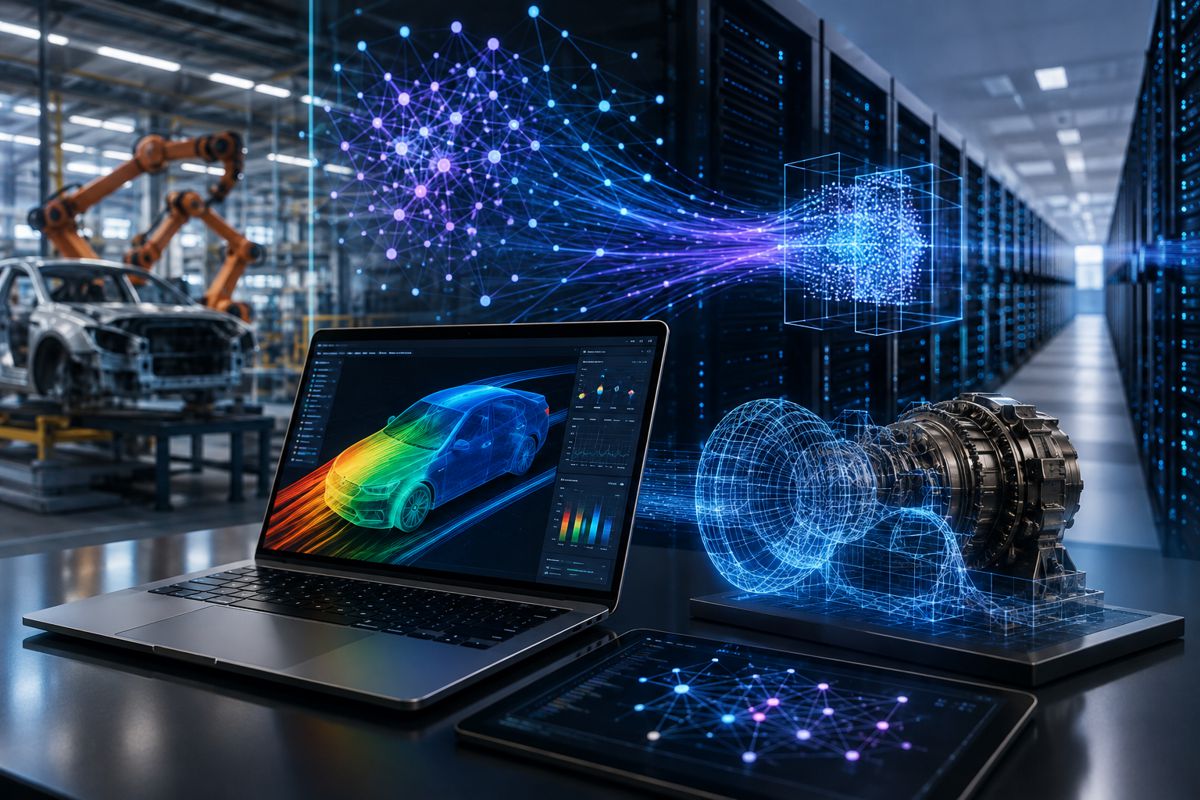
That combination places unusual demands on computing infrastructure. Conventional simulation remains important, often requiring large CPU clusters and tightly coupled multi-node workloads, while AI physics adds GPU-intensive model training and high-speed inference. Agentic engineering introduces another layer, with software agents handling parts of the workflow around configuration, troubleshooting, data preparation and analysis.
Rescale’s expansion onto CoreWeave Cloud brings those workloads together on infrastructure originally built primarily around large-scale AI. Through CoreWeave Kubernetes Service, Rescale customers will be able to run distributed engineering simulations alongside AI models and emerging AI-assisted engineering processes.
The announcement covers aerospace, automotive, energy, life sciences and manufacturing, but its relevance extends into the engineering industries serving construction, infrastructure and heavy equipment. Digital product development is steadily becoming more computationally intensive, particularly where manufacturers are using simulation to investigate aerodynamics, thermal behaviour, structural performance, hydraulics, electrification and increasingly autonomous systems.
Briefing
- Rescale is expanding its digital engineering platform onto CoreWeave Cloud for simulation, HPC and AI workloads.
- The integration uses CoreWeave Kubernetes Service for containerised orchestration, networking and storage.
- Rescale already supports multi-node MPI workloads on CoreWeave for CPU-based HPC jobs.
- Rescale’s AI Physics platform converts simulation data into surrogate models capable of much faster inference.
- Agentic engineering adds specialised AI agents to tasks surrounding engineering simulation and HPC operations.
Simulation Meets AI Infrastructure
Rescale has spent much of 2026 extending its platform beyond conventional cloud HPC. Its engineering environment now combines modelling and simulation, data management, AI Physics and purpose-built engineering agents. The CoreWeave relationship provides another infrastructure layer beneath that expanding software stack.
The companies describe the integration around CoreWeave Kubernetes Service, or CKS, which provides container orchestration with high-performance networking and storage. For Rescale, the objective is to allow distributed simulations and AI workloads to run without engineering teams having to manage the underlying cloud infrastructure directly.
There is already more behind the announcement than a future integration. In July, Rescale introduced support for multi-node Message Passing Interface workloads on CoreWeave, allowing CPU jobs to extend across multiple nodes through its existing submission workflow. MPI remains fundamental to many large engineering simulations because individual processors or nodes must continually exchange information while solving different parts of the same computational problem.
“As Rescale customers move deeper into AI physics and agentic engineering workflows, the compute demands are fundamentally different from traditional simulation,” said John Moonshower, chief revenue officer at Rescale. “CoreWeave’s AI cloud platform is purpose-built for those workloads, and this collaboration ensures engineers on the Rescale platform have the infrastructure to match.”
From Numerical Simulation to AI Physics
Traditional engineering simulation generally asks a numerical solver to calculate the physical behaviour of a design from first principles or established mathematical models. Computational fluid dynamics might calculate airflow around a vehicle or through a turbine, while finite element analysis can model stresses, deformation, heat transfer or crash behaviour.
These calculations can be extraordinarily demanding. Changing a design parameter and examining the result can require another simulation, and exploring thousands of possible configurations can consume substantial amounts of compute capacity and engineering time.
AI surrogate models offer a different approach. Rather than replacing the underlying physics used to establish trustworthy engineering data, a machine-learning model can be trained on existing simulation results and then used to estimate outcomes for new combinations of parameters.
Rescale launched its AI Physics Operating System in 2026 to provide an integrated environment for preparing simulation data, training and validating surrogate models, managing versions and deploying them for inference. In July, the company extended the system to transient finite element analysis applications including crash simulation, where the model can predict sequences across multiple time steps rather than producing only a static result.
Once a sufficiently accurate surrogate model has been developed for an appropriate problem, engineers can investigate considerably larger design spaces without submitting a full conventional simulation for every candidate. High-fidelity numerical simulation remains available for validation and for cases outside the useful domain of the surrogate.
Numerical simulation generates engineering data; that data trains AI models; those models allow much faster exploration; selected designs can then return to high-fidelity simulation for verification.
Engineering Agents Enter the Workflow
A similar development is occurring around the simulation rather than inside it. Rescale introduced its Agent Library in June 2026, with specialised AI agents designed to perform tasks including input validation, diagnosing failed jobs, solver troubleshooting, hardware configuration and report generation. These are relatively bounded engineering and administrative processes rather than autonomous design systems.
That distinction is useful because much of the immediate opportunity for agentic engineering lies in the repetitive work surrounding sophisticated simulation. A CFD or structural calculation may involve advanced engineering, but running large simulation programmes also creates substantial operational work: preparing inputs, selecting compute resources, managing files, investigating failed runs, organising outputs and producing reports. Those are tasks that can consume specialist engineering time without necessarily requiring engineering judgement at every stage.
The combination also changes infrastructure demand. Some tasks remain heavily CPU dependent. Others benefit from accelerators. Training AI models can require substantial GPU capacity, while inference may involve shorter but latency-sensitive workloads. Large engineering campaigns can generate considerable quantities of data that must remain accessible across several stages of the process.
CoreWeave Moves Further into Physical Engineering
CoreWeave’s origins and recent growth have been associated primarily with accelerated computing for AI, but the company has increasingly positioned its infrastructure around physical AI: systems in which artificial intelligence interacts with, predicts or controls the physical world.
The company has highlighted workloads involving autonomous driving, robotics, industrial AI and simulation, including work associated with Wayve, NEURA Robotics and Nissan. Engineering simulation fits into that expansion as the boundary between simulation and AI training becomes less distinct in some development programmes.
“The engineers using Rescale are running some of the most demanding simulations in the world,” said Jon Jones, chief revenue officer at CoreWeave. “Rescale gives its customers access to CoreWeave’s AI-optimized cloud services with the performance and flexibility their engineering workloads demand. That’s what CoreWeave is built to deliver.”
Rescale provides an abstraction between that infrastructure and engineers. Instead of requiring an engineering organisation to assemble cloud resources, simulation applications, data management and AI tooling independently, its platform provides a common environment through which those resources can be selected and operated.
The Changing Engineering Compute Stack
For manufacturers, engineering consultancies and technology developers, the evolution of cloud simulation has often been discussed principally in terms of capacity. Cloud HPC allows an organisation to obtain additional processors when a simulation campaign demands them rather than building enough internal infrastructure to accommodate occasional peaks.
AI physics changes the composition of that demand. A programme might require CPU-heavy simulation at one stage, GPU resources for model training at another, relatively rapid inference while engineers explore alternatives, and then another round of detailed simulation to validate promising designs.
The engineering data connecting those stages becomes valuable in its own right. Results accumulated over years of CFD, FEA and other modelling programmes can potentially contribute to training datasets rather than remaining archived outputs from completed projects.
For construction equipment manufacturers, automotive groups and infrastructure technology companies, this could gradually alter the economics of digital development. The immediate gain does not depend on eliminating conventional simulation. It comes from using expensive high-fidelity calculations more selectively while extracting more value from the information they produce.
There are limitations. Surrogate models remain dependent on their training data and the engineering problem for which they were developed. Predictions outside the represented design space require particular care, and safety-critical applications still demand appropriate verification and validation. AI-assisted engineering does not make the underlying physics optional.
The emerging architecture places conventional simulation, AI models and engineering automation beside one another. Rescale’s addition of CoreWeave is therefore more interesting as an infrastructure development than as a cloud partnership, with engineering computing increasingly requiring platforms capable of moving between numerical physics, data-intensive AI and automated workflows.
The machines being designed have not suddenly become less physical. The computing used to understand them is becoming considerably more varied.
Key Industry Questions
- What is AI Physics? AI Physics uses machine-learning models trained on trusted simulation or engineering data to predict physical behaviour. Surrogate models can provide results considerably faster than rerunning a complete numerical simulation for every design variation.
- Does AI Physics replace CFD or finite element analysis? Not necessarily. High-fidelity numerical simulation remains important for generating training data, investigating new conditions and validating designs. AI surrogate models can complement those calculations by accelerating repeated exploration within an established design space.
- Why does engineering AI need different computing infrastructure? Engineering workloads can combine CPU-intensive numerical simulation, GPU-intensive AI training, high-speed inference, large datasets and automated software agents. These activities have different compute, networking and storage requirements.
- What is CoreWeave Kubernetes Service? CoreWeave Kubernetes Service is the company’s managed Kubernetes environment. Rescale is using it to provide scalable containerised orchestration for distributed simulation and AI workloads alongside high-performance networking and storage.
- Can Rescale run conventional HPC workloads on CoreWeave? Yes. Rescale introduced support for multi-node MPI CPU workloads on CoreWeave in July 2026, allowing distributed HPC jobs to span multiple nodes.
- What are engineering agents? In Rescale’s implementation, they are purpose-built AI agents designed to automate defined activities such as validating simulation inputs, diagnosing failed jobs, troubleshooting and generating reports.
- Where could this be relevant to construction equipment? Manufacturers increasingly use simulation for structures, thermal management, fluid systems, aerodynamics, electrification, operator environments and autonomous machinery. Combining simulation with AI models could allow more design candidates to be investigated before physical prototypes are produced.
- Are AI surrogate models suitable for safety-critical engineering? They can form part of an engineering workflow, but their predictions need appropriate validation and governance. Their reliability depends on the model, training data, intended operating domain and application.
Strategic Takeaways
- Engineering cloud demand is becoming more heterogeneous as conventional HPC, AI training and inference occupy the same development workflow.
- Simulation data can become a reusable engineering asset when it is organised for surrogate-model training rather than treated solely as the output of individual analyses.
- AI Physics is more likely to augment high-fidelity simulation than eliminate it, allowing computationally expensive solvers to be concentrated where their fidelity is most valuable.
- Engineering agents currently have a practical role in automating operational work surrounding simulation, where repetitive specialist tasks consume engineering time.
- Platforms capable of abstracting complex compute infrastructure may become more valuable as engineering organisations combine CPUs, GPUs, simulation software, AI models and agents.