






Procore and NVIDIA Bring Digital Twin Simulation into Construction Planning
Procore Technologies has expanded its collaboration with NVIDIA to introduce simulation capabilities into construction project management, allowing teams to examine how weather, equipment movements and scheduling disruptions could affect complex projects before problems emerge on site.
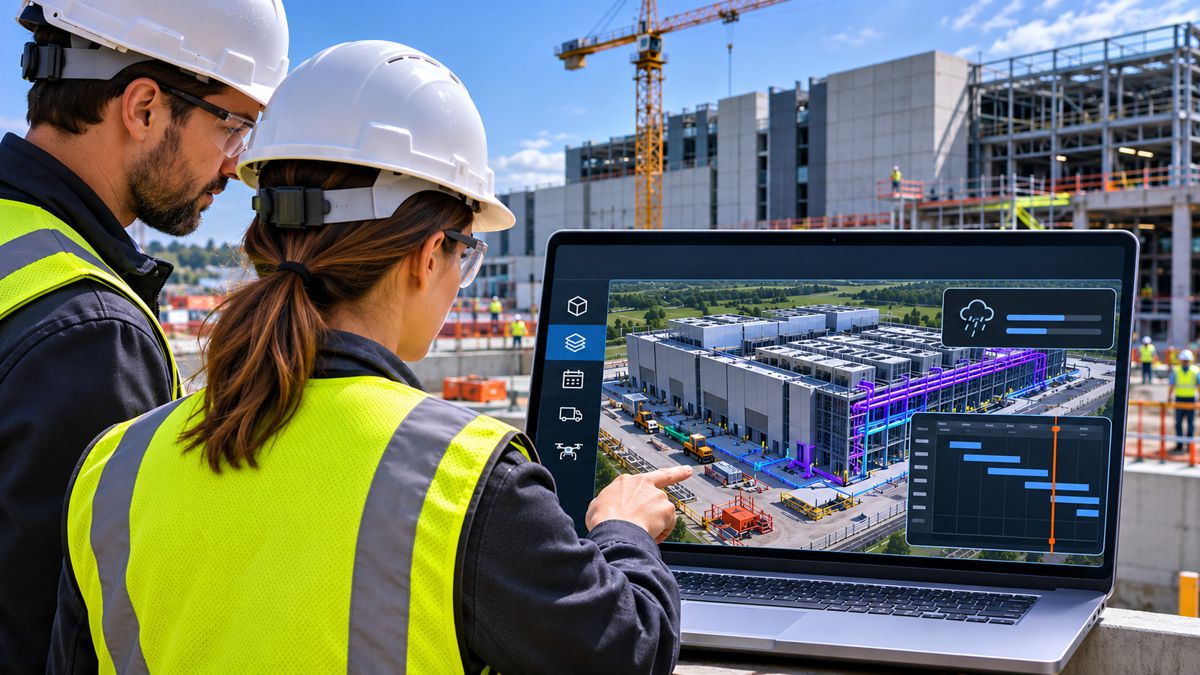
Announced at Groundbreak 2026, the development connects Procore’s Model Manager with Realism Mode, powered by NVIDIA Omniverse libraries, to provide realistic three-dimensional environments linked to construction information. The integration is currently in closed beta, with the companies positioning it particularly towards large, technically demanding projects such as AI data centres.
The approach brings together several established elements of construction technology: building information modelling, reality capture, project scheduling and simulation. Its ambition is to make these systems work together so that changes in one part of a project can be examined against the wider construction programme.
Briefing
- Procore and NVIDIA have expanded their collaboration to integrate Omniverse-powered digital twin capabilities into construction management.
- The closed-beta integration connects Procore Model Manager with Realism Mode for realistic 3D project visualisation.
- Proposed applications include weather scenarios, equipment movements, construction sequencing and procurement disruption.
- DroneDeploy reality capture is intended to connect actual site conditions with digital project models.
- Procore is also developing commissioning and asset management capabilities, including a planned integration with IBM Maximo.
Connecting Construction Models with Real-World Conditions
Construction teams already use digital models to coordinate design information, identify geometric clashes and communicate the intended arrangement of buildings and infrastructure. The difficulty is maintaining that relationship as construction progresses and conditions begin to depart from the original plan.
Procore’s collaboration with NVIDIA is intended to extend the model into a more operational environment. Through NVIDIA Omniverse, project teams can examine three-dimensional representations of construction sites and explore the potential effects of environmental conditions and changes to the planned sequence of work.
The announced capabilities include scenarios involving extreme weather, sun exposure and the movement of workers and equipment. These could be particularly useful where construction activities compete for limited space or where temporary works, access routes and installation sequences require close coordination.
Realistic visualisation and validated engineering simulation are different capabilities. The predictive value of any scenario depends on the quality of the underlying information, the assumptions used and the physical behaviour represented. Procore has outlined the functions being developed through the closed beta but has not published independently validated performance results demonstrating reductions in project costs, delays or rework.
Steve Davis, president of product and technology at Procore, described the direction of the collaboration: “Construction is inherently physical, but in the future, the most successful and resilient megaprojects will be built digitally first,” he said. “As the leader in construction management software, Procore is deepening our collaboration with AI leader NVIDIA, to empower teams to visualize projects, simulate real-world conditions, and test variables before a single shovel hits the ground.”
Bringing Reality Capture into the Digital Twin
An important element of Procore’s wider strategy is its acquisition of DroneDeploy, which provides aerial and ground-based reality capture capabilities.
Construction models describe what should exist. Reality capture records what has actually been built, providing photographic, spatial and other site information that can be compared with the design.
Combining these datasets could allow project teams to identify discrepancies between planned and actual construction, examine installation progress and understand whether site conditions remain consistent with the programme.
For example, a digital model might show the intended location of a major mechanical installation, while captured site information reveals that surrounding work has progressed differently from the approved sequence. Bringing both views into the same environment would allow teams to investigate the discrepancy before the installation crew arrives.
The usefulness of this approach depends on how frequently site information is captured, how accurately it is aligned with the design model and whether changes are incorporated into the project record. A digital twin based on outdated information can reproduce the same misunderstandings as an outdated drawing.
Examining the Consequences of Schedule Disruption
One of the more commercially interesting capabilities described in the announcement is the connection between three-dimensional project models and procurement and scheduling information.
Large construction projects depend on sequences of interrelated activities. A delayed equipment delivery can affect installation work, testing, access for other trades and ultimately commissioning. Conventional scheduling software can identify dependencies, but those relationships are not always immediately apparent when reviewing a complex construction programme.
Procore’s proposed integration would allow teams to explore such disruptions within the spatial context of the project.
A late delivery of electrical equipment, for instance, might require an installation sequence to be rearranged. The model could help planners examine whether alternative work areas remain accessible, whether other activities can proceed and how the revised sequence might interact with equipment movements or temporary construction arrangements.
Weather exposure, equipment positioning and workforce movements are also among the scenarios identified by the companies. Exploring alternative arrangements before work begins could help project teams identify potential conflicts, although the accuracy of any assessment would depend on the information and assumptions used.
The Data Centre Construction Challenge
The collaboration has a particularly relevant application in the expanding market for AI data centres, where construction programmes must accommodate substantial electrical, mechanical and cooling infrastructure alongside increasingly demanding computing equipment.
According to McKinsey’s research into global data centre investment, companies could invest nearly $7 trillion in data centre infrastructure by 2030. The scale of investment reflects the capital required to expand computing capacity, although such estimates should not be interpreted as construction expenditure alone.
The physical delivery challenge is substantial. Data centre construction requires close coordination between building works, electrical distribution, mechanical systems, cooling infrastructure and specialist technology installations. Long-lead equipment can create dependencies that are difficult to resolve once construction is underway.
For these projects, the relationship between the building and the technology it houses is unusually close. Changes to computing equipment, cooling arrangements or power distribution can affect spatial requirements and installation sequences, sometimes after construction has already started.
NVIDIA’s involvement reflects its interest in the infrastructure supporting AI computing, extending beyond the processors themselves into the planning and operation of the facilities in which they are installed.
Vladimir Troy, vice president of AI Infrastructure at NVIDIA, said: “Building an AI factory requires thousands of decisions across power, cooling, compute, networking and physical infrastructure,” he explained. “NVIDIA Omniverse lets teams simulate these systems before construction begins, identify problems earlier and make better decisions before they become costly changes in the field. Together, Procore and NVIDIA are connecting simulation with project data to reduce risk and move faster from design to operation.”
Experience from Data Centre Operator Switch
Switch, a designer, builder and operator of advanced data centres, is a customer of both Procore and NVIDIA and was identified in the announcement as an organisation interested in the potential of the technology.
Its involvement provides an example of the type of construction environment the companies are targeting, although the announcement does not provide a detailed deployment case study or quantified operational results from Switch.
Corine Winfield, vice president of data operations at Switch, said: “When building at the pace and scale our customers require, there is no room for surprises in the field,” she explained. “By visualizing a project in 3D, our teams gain greater clarity into construction progress, make better-informed decisions earlier and keep complex initiatives on schedule.”
The connection between construction planning and subsequent operation is especially relevant for data centres, where equipment configuration, maintenance access and commissioning requirements need to be considered throughout the project.
A digital representation developed during construction could retain value after handover, provided that the information remains accurate and can be transferred into operational asset management systems.
Extending Digital Information Beyond Construction
Procore is also progressing additional spatial and asset capabilities, including Model Manager and Commissioning, through beta development. The company has identified a planned integration with IBM Maximo as part of this work.
IBM Maximo is used for enterprise asset management, including maintenance planning and the management of operational equipment. Connecting construction information with such systems could support the transfer of equipment records, asset data and commissioning documentation from project delivery into facility operations.
That transfer has traditionally been difficult because design models, construction records and maintenance systems often use different information structures and are managed by separate organisations.
For infrastructure owners, the opportunity is to preserve useful information generated during design and construction rather than reconstructing asset records after handover. The quality of that information, together with interoperability between systems, will determine how practical the approach becomes.
The planned IBM Maximo integration remains separate from the currently announced NVIDIA closed beta, and Procore has not provided a general availability timetable for the complete set of capabilities.
From Digital Models to Construction Decisions
Moving these capabilities into everyday construction management will require more than sophisticated visualisation. Large projects involve multiple contractors, specialist designers, equipment suppliers and project management teams, each maintaining information for different purposes and often using different software.
Establishing which information represents the current approved position, maintaining access permissions and ensuring that simulation results are interpreted correctly will be essential. Computing requirements, implementation costs and compatibility with established workflows will also influence adoption.
For contractors already managing substantial digital project information, the integration could provide a more useful way to examine relationships between design, procurement and construction activity. Organisations with less mature modelling and reality capture processes may need to invest in those foundations before obtaining comparable benefits.
The closed beta offers an opportunity to test how effectively the technology performs on real projects. Its longer-term prospects will depend on whether teams can use the resulting information to make better decisions without adding another layer of complexity to construction management.
For now, Procore and NVIDIA have outlined a technically ambitious integration. The next test will be how well it works when construction programmes change, equipment arrives late and site conditions refuse to follow the model.
Key Industry Questions
- What have Procore and NVIDIA announced? An expanded collaboration integrating NVIDIA Omniverse-powered digital twin capabilities with Procore’s construction management environment, initially through a closed beta.
- How does the integration differ from conventional BIM? It aims to connect three-dimensional project models with scenario simulation, site conditions, procurement information and construction schedules. Existing BIM workflows may already support some of these functions, but the proposed integration brings them into a connected environment.
- What role does DroneDeploy play? DroneDeploy provides aerial and ground-based reality capture information that can be compared with digital project models to examine actual construction progress and identify discrepancies.
- Can the system predict construction delays? The announced capabilities are intended to help teams examine how disruptions could affect project schedules. Their predictive accuracy and practical effectiveness have not yet been independently established.
- Why are AI data centres a focus? They involve complex electrical, mechanical, cooling and computing infrastructure, often with demanding construction programmes and significant equipment dependencies.
- Can the technology be applied to civil infrastructure? The underlying modelling, reality capture and simulation approaches are relevant to civil engineering, although the announcement does not establish specific deployment results for roads, bridges or other infrastructure projects.
- How does IBM Maximo fit into Procore’s strategy? A planned integration could connect construction and commissioning information with operational asset management, potentially supporting maintenance and facility management after handover.
- When will the integration be generally available? Procore has confirmed that the NVIDIA integration is in closed beta but has not announced a general availability date.
Strategic Takeaways
- Connecting project models with construction records could make existing digital information more useful for operational decisions.
- Reality capture can help identify differences between design intent and actual construction, provided that observations remain accurate and current.
- Spatially informed schedule analysis could help teams examine alternative work sequences when procurement or installation plans change.
- Data centre construction provides a demanding environment for evaluating integrated modelling, simulation and project management.
- Commercial adoption will depend on demonstrated performance, manageable implementation costs and reliable integration with existing construction workflows.