Ultralytics Unifies Vision AI Workflows from Data to Deployment
Across construction sites, logistics hubs, manufacturing plants and transport networks, computer vision has quietly become one of the most transformative technologies of the decade. From detecting safety hazards on highways to optimising material flows in quarries, the ability for machines to interpret visual data in real time is no longer experimental. It is operational.
Yet for all the progress in model performance, the journey from proof of concept to production remains stubbornly fragmented. Engineering teams can now train highly accurate object detection models in hours, but deploying those models reliably across real-world infrastructure environments often takes weeks or months. The friction lies not in the algorithms, but in the workflow surrounding them.
That bottleneck is precisely what Ultralytics is aiming to eliminate with the launch of its new end to end vision AI platform. Rather than introducing another isolated tool, the company has taken a broader view of the ecosystem, focusing on the entire lifecycle from raw data to live deployment. For infrastructure sectors where time, cost and reliability are tightly intertwined, that shift could prove significant.
From Open Source Powerhouse to Integrated Platform
Ultralytics is no stranger to the global AI landscape. Its YOLO family of object detection models has become one of the most widely adopted frameworks for real time vision tasks. With billions of daily uses and widespread integration across industries including manufacturing, transport and autonomous systems, YOLO has effectively set the benchmark for speed and efficiency in object detection.
The scale of adoption is difficult to ignore. With over 125,000 GitHub stars and more than 225 million Python package downloads, YOLO has evolved into a default starting point for developers building vision based applications. In sectors such as construction and infrastructure, where rapid deployment and edge performance are critical, that accessibility has played a key role in accelerating adoption.
However, success at the model level exposed a deeper structural issue. Teams could build powerful detectors quickly, but the surrounding processes remained disjointed. Annotation tools, training environments, deployment pipelines and monitoring systems often existed as separate services, stitched together with custom integrations. Each transition introduced delays, inconsistencies and operational risk.
Why Infrastructure Needs End to End Vision AI
For industries like construction, mining and transport, the implications of this fragmentation go beyond developer inconvenience. These sectors operate in environments where conditions change rapidly and decisions must be made in real time. A delay in deploying a safety monitoring system or a failure to scale an inspection model can have tangible operational consequences.
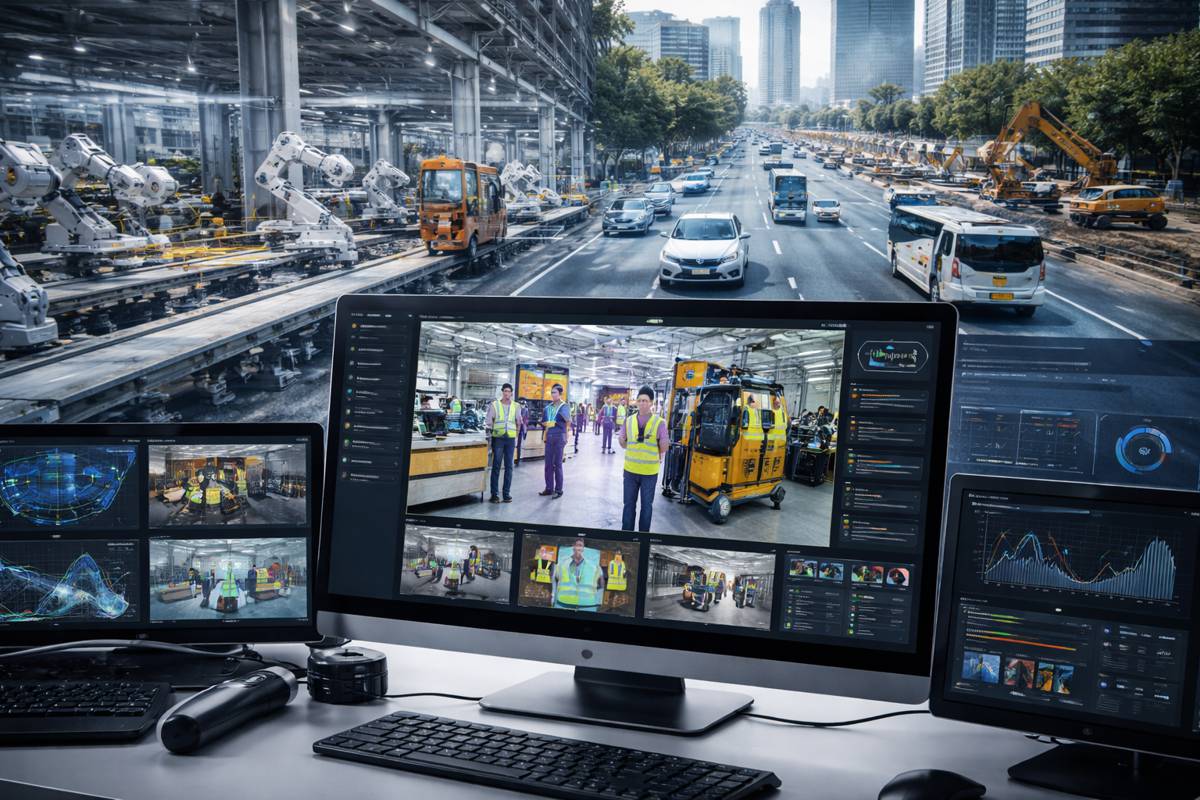
Take highway construction as an example. Vision AI can be used to detect unsafe worker proximity to heavy machinery, monitor traffic flow through temporary diversions or assess pavement conditions using mobile sensors. But for these systems to deliver value, they must move seamlessly from pilot to production, often across multiple geographic regions and hardware environments.
Research from organisations such as McKinsey has highlighted that a significant proportion of AI projects fail to scale beyond pilot stages, not because of poor model performance, but due to integration complexity and operational barriers. In this context, simplifying the workflow is not just a technical improvement. It is a commercial necessity.
Ultralytics appears to have built its platform with this reality in mind, focusing less on incremental model improvements and more on removing friction across the deployment pipeline.
A Platform Built by Model Creators
One of the defining characteristics of the Ultralytics Platform is its origin. Unlike many AI platforms that integrate third party models, this system has been developed by the same team responsible for the underlying algorithms. That distinction carries weight.
Because Ultralytics has designed the YOLO model family in house, it has deep insight into how these models behave during training, how they perform across different hardware configurations and where they are most likely to encounter issues in production. This knowledge has been embedded directly into the platform architecture.
The result is a tightly integrated workflow where each stage feeds naturally into the next. Annotation outputs align directly with training requirements. Training pipelines are optimised for the specific characteristics of YOLO models. Deployment formats are pre validated for a wide range of environments, from cloud infrastructure to edge devices.
This level of integration reduces the need for format conversions, custom scripts and manual interventions. For engineering teams working under tight deadlines, that simplicity can translate into faster deployment cycles and lower operational overhead.
Accelerating Data Preparation with Smart Annotation
Data remains the foundation of any successful AI system, and in computer vision, annotation is often the most time consuming step. Labelling images with bounding boxes, segmentation masks or object classifications can take days or even weeks for large datasets.
Ultralytics addresses this challenge through a smart annotation system powered by the Segment Anything Model, widely recognised for its ability to generate high quality segmentation masks with minimal input. By integrating this capability directly into the platform, users can create precise annotations with just a few interactions.
The system supports multiple vision tasks, allowing teams to generate bounding boxes, segmentation masks and oriented boxes within a single interface. It also accommodates common dataset formats such as YOLO and COCO, enabling organisations to import existing data without additional preprocessing.
For infrastructure applications, where datasets may include aerial imagery, roadside cameras or drone footage, this flexibility is particularly valuable. Faster annotation not only accelerates development, but also enables more frequent model updates, improving performance over time.
Flexible Training Across Cloud and Edge Environments
Training remains a critical stage in the AI lifecycle, and Ultralytics has focused on providing flexibility without sacrificing performance. The platform offers access to a wide range of GPU configurations, allowing users to scale compute resources based on project requirements.
At the same time, it supports local training for organisations that prefer to keep data on premise, a consideration that is increasingly important in regulated industries and sensitive infrastructure projects. Real time metric tracking ensures that teams can monitor performance as training progresses, rather than waiting for completion.
Interactive dashboards provide detailed insights into model behaviour, including precision recall curves and confusion matrices. This level of visibility helps engineers identify issues early and refine models more efficiently.
From a commercial perspective, the ability to compare experiments and preserve training checkpoints reduces the risk of lost work and enables more structured development processes. For companies managing multiple projects or clients, that organisation becomes a key advantage.
Global Deployment at Scale
Perhaps the most critical stage in the lifecycle is deployment. This is where many AI initiatives falter, particularly when moving from controlled testing environments to real world conditions.
Ultralytics Platform introduces a global deployment framework with endpoints across dozens of regions. This geographic distribution allows organisations to deploy models closer to their operational environments, reducing latency and improving performance.
For infrastructure applications such as traffic monitoring or autonomous vehicle systems, latency can be a decisive factor. Real time decision making requires near instant processing, and the ability to deploy models at the edge or within regional cloud environments is essential.
The platform also supports export to a wide range of formats, enabling compatibility with different hardware ecosystems. Whether running on embedded devices, mobile platforms or large scale cloud infrastructure, models can be adapted to suit the deployment context.
Built in monitoring completes the picture, providing visibility into how models perform once they are live. This feedback loop is crucial for maintaining reliability and identifying issues before they escalate.
Industry Implications for Construction and Transport
The introduction of a unified vision AI platform arrives at a time when infrastructure sectors are under increasing pressure to improve efficiency, safety and sustainability. Digital transformation is no longer optional, and technologies such as AI, IoT and digital twins are becoming integral to modern operations.
In construction, vision AI can support automated progress tracking, quality assurance and safety compliance. In transport, it enables smarter traffic management, predictive maintenance and enhanced situational awareness. In mining and logistics, it drives operational efficiency and reduces downtime.
By simplifying the path from data to deployment, platforms like this could accelerate adoption across these sectors. Smaller organisations that previously lacked the resources to manage complex AI workflows may find it easier to implement vision based solutions.
At the same time, larger enterprises can benefit from reduced integration costs and improved scalability. As AI becomes more deeply embedded in infrastructure systems, the ability to deploy and manage models efficiently will become a competitive differentiator.
A More Practical Path to Production AI
Ultralytics has positioned its platform as a response to a widely recognised challenge within the AI community. As Glenn Jocher, Founder and CEO, explained: “Most computer vision projects today never make it past the pilot stage, not because the models aren’t good enough, but because the path from experiment to production is still too complex. We built the Ultralytics Platform to make that path simpler. One platform, from first label to live endpoint.”
That observation aligns with broader industry trends. The gap between technical capability and operational deployment has been a recurring theme in AI adoption, particularly in sectors with complex workflows and stringent reliability requirements.
Paula Derrenger, VP of Growth at Ultralytics, added further context: “We didn’t set out to build another annotation tool or another training service. We built the platform that should have existed from the beginning. It’s the only end-to-end vision AI platform native to the world’s most deployed object detection models. A platform designed around how vision AI actually moves from idea to production.”
The Road Ahead for Vision AI in Infrastructure
As infrastructure systems become increasingly digitised, the role of vision AI is set to expand. From autonomous construction equipment to intelligent transport systems, the ability to interpret visual data will underpin many of the next generation solutions shaping the industry.
However, technology alone is not enough. The success of these systems will depend on how effectively they can be deployed, managed and scaled in real world environments. Platforms that reduce complexity and streamline workflows are likely to play a central role in this evolution.
Ultralytics has taken a step in that direction by bringing together annotation, training, deployment and monitoring into a single environment. Whether it becomes a defining standard for the industry remains to be seen, but the direction of travel is clear.
For construction professionals, investors and policymakers, the message is straightforward. The future of AI in infrastructure will not be defined solely by model performance, but by the systems that enable those models to operate reliably at scale. And in that respect, the race is only just beginning.