CDE Pushes Circular Boundaries as PFAS Challenge Demands Urgent Action
The construction and infrastructure sector is facing a reckoning. Soil contamination, once treated as a site-specific nuisance, has evolved into a systemic risk with global implications. Among the most complex of these challenges are per- and polyfluoroalkyl substances, better known as PFAS. These persistent chemicals, often referred to as “forever chemicals”, are now firmly on the radar of regulators, investors and contractors alike.
CDE is now stepping forward with a combination of engineering, research and industry collaboration that signals a shift in how contaminated materials are managed. With its upcoming CIRCLE symposium, the company is positioning itself not merely as a technology provider, but as a convener of expertise aimed at accelerating circular material recovery while confronting PFAS contamination head-on.
For an industry built on extracting, moving and repurposing materials at scale, the stakes couldn’t be higher. Waste streams once considered unusable are now being re-evaluated as potential resources, provided contamination can be effectively managed. That’s where innovation in wet processing and material recovery is beginning to reshape expectations across infrastructure delivery.
Briefing
- CDE has invested more than seven years and significant capital into developing PFAS remediation solutions
- A dedicated taskforce has analysed 60 contaminated sites and developed 30 trial approaches
- One million tonnes of material have already been recovered across six projects
- PFAS contamination affects tens of thousands of sites globally and carries major long-term costs
- The CIRCLE symposium aims to build a global community focused on circular economy and PFAS solutions
The Scale of PFAS Contamination Becomes Impossible to Ignore
PFAS contamination is not a marginal issue. It is widespread, persistent and increasingly costly to address. These synthetic chemicals have been used for decades in industrial processes and consumer products, from firefighting foams to coatings and textiles. Their resistance to degradation has made them valuable in manufacturing, yet deeply problematic once released into the environment.
According to the European Environment Agency, there are an estimated 23,000 contaminated sites across Europe alone, with around 2,300 classified as hotspots posing potential risks to human health. When combined with data from the United States, the scale expands dramatically, reinforcing the notion that PFAS contamination is a transatlantic and, indeed, global issue.
The economic burden is equally striking. Estimates suggest that remediation could cost as much as €2 trillion over the next two decades. For infrastructure investors and public authorities already grappling with budget constraints, this introduces a new layer of complexity. It’s not just about building new assets; it’s about dealing with the legacy of past industrial activity.
Engineering a Response Through Data and Field Experience
CDE’s approach to PFAS has not been theoretical. Over a period exceeding seven years, the company has channelled significant investment into research, testing and field deployment. Central to this effort is a specialised taskforce of engineers focused on understanding how contaminated soils behave and how they can be treated effectively.
Led by Eunan Kelly, the team has analysed materials from 60 contaminated sites across Europe. These investigations have involved hundreds of laboratory tests and the development of 30 trial solutions, each designed to tackle different contamination profiles and material compositions. It’s a process grounded in iteration rather than assumption, reflecting the complexity of PFAS chemistry.
“When it comes to PFAS, we’re once again at the forefront, just as we have consistently been ahead of the curve in tackling some of the industry’s most complex waste challenges, from contaminated soils to hydrovac waste and trommel fines. Our focus has always been on pushing the limits of what materials can be safely recovered and reused for high-value applications within the construction industry,” said Eunan Kelly.
The results are beginning to take shape. Across six customer projects, CDE reports that one million tonnes of material have been successfully recovered. In addition, two patent-pending solutions are emerging from the programme, suggesting that the company is moving beyond experimentation into scalable technology.
The Hidden Complexity of PFAS Precursors
One of the more challenging aspects of PFAS contamination lies in what cannot easily be seen. While traditional testing focuses on so-called legacy PFAS compounds, a growing body of research highlights the importance of precursor substances. These are chemicals that can break down over time into more persistent PFAS forms.
This dynamic complicates remediation efforts. Materials that appear compliant based on standard testing may still pose a long-term risk as precursors transform into regulated compounds. It’s an issue that has begun to attract attention from both regulators and scientists, particularly within the field of environmental chemistry.
For contractors and developers, the implication is clear. Due diligence around contaminated land is becoming more stringent, and the margin for error is narrowing. Technologies that can account for both legacy PFAS and their precursors are likely to become increasingly valuable as regulatory frameworks evolve.
Circular Economy Pressures Reshape Material Strategies
The push towards circularity in construction is not new, but it is gaining urgency. Governments across Europe are tightening waste regulations, while clients are demanding more sustainable delivery models. Reusing materials is no longer just an environmental aspiration; it is becoming a commercial necessity.
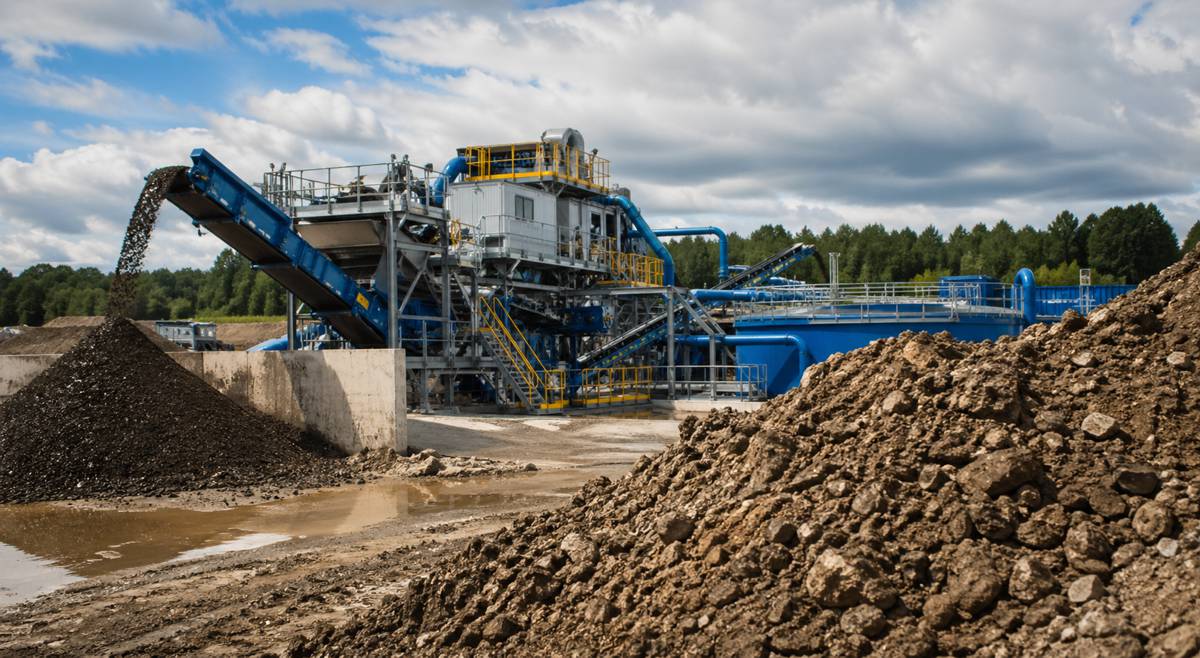
Within this context, soil washing and wet processing technologies are taking on a more strategic role. By separating contaminants from usable aggregates, these systems allow contractors to recover value from materials that would otherwise be sent to landfill. This reduces both disposal costs and the need for virgin resources.
CDE’s work sits squarely within this shift. By focusing on high-value recovery, the company is aligning environmental objectives with economic incentives. The ability to transform contaminated waste into usable construction materials could prove decisive in projects where margins are tight and sustainability targets are non-negotiable.
CIRCLE Symposium Signals a Collaborative Approach
Rather than presenting its work in isolation, CDE is using the upcoming CIRCLE symposium to bring together a wider network of stakeholders. Scheduled as an online event, the symposium will explore the intersection of waste recycling, circular economy principles and PFAS remediation.
“CIRCLE is the precursor to a bigger movement in the industry,” Eunan commented. “It’s the incubator for a new connected community of global experts with a singular focus: to improve the implementation of the circular economy and tackle PFAS. The event is just the beginning; a space where we’ll come together to share insights. It’s beyond May 7th when the real work starts. That’s when the community we’re building will come to the fore and lead the charge on forever chemicals.”
The format reflects a broader trend within the infrastructure sector, where collaboration is increasingly seen as essential to solving complex challenges. PFAS contamination cuts across disciplines, involving chemistry, engineering, policy and finance. No single organisation can address it alone.
Infrastructure Investment Meets Environmental Accountability
For policymakers and investors, PFAS introduces a new dimension to infrastructure planning. Projects that involve brownfield redevelopment or large-scale earthworks must now account for contamination risks that could significantly affect timelines and costs.
At the same time, there is growing pressure to demonstrate environmental responsibility. Regulatory scrutiny is intensifying, and public awareness of chemical contamination is rising. This combination is driving demand for solutions that are both technically robust and transparent in their outcomes.
CDE’s emphasis on data-driven processes and measurable recovery outcomes speaks to this requirement. By quantifying the volume of material recovered and advancing patent-backed technologies, the company is contributing to a more structured approach to contamination management.
A Defining Moment for Material Recovery Innovation
The construction industry has always adapted to new challenges, whether driven by economic cycles, technological change or regulatory shifts. PFAS contamination represents a different kind of test. It is pervasive, scientifically complex and deeply intertwined with public health concerns.
What’s emerging, however, is a sense that the tools to address it are beginning to take shape. Advances in wet processing, combined with a stronger focus on circular economy principles, are creating pathways to manage contaminated materials more effectively.
The upcoming CIRCLE symposium marks a step in that direction. By bringing together expertise and showcasing practical progress, it underscores a growing recognition that PFAS cannot be treated as a peripheral issue. It sits at the heart of how infrastructure will be delivered in the years ahead, influencing everything from project design to material sourcing.