Ancient Chinese Symbols Shaping the Future of Smart Materials
Engineering rarely looks to language for structural inspiration, yet a new line of research suggests it might be time to reconsider that boundary. A study led by researchers at the University of Edinburgh has demonstrated that Chinese characters, long valued for their cultural and visual significance, can also serve as the foundation for advanced mechanical metamaterials.
Published in The Journal of Applied Physics by AIP Publishing, the research explores how the geometry embedded in written symbols can influence structural performance under load. Rather than focusing on chemical composition alone, the team examined how shape, symmetry, and internal architecture dictate material behaviour. It is a subtle shift in thinking, but one with implications that stretch from infrastructure design to next-generation construction materials.
At a time when the construction sector is pushing for smarter, lighter, and more adaptable materials, this research offers something different. It draws from history and culture, yet lands firmly in the realm of applied engineering. The idea is simple enough on the surface. Look at symbols not just as communication tools, but as structural blueprints. What follows is a rethinking of how materials can be designed from the ground up.
Briefing
- Researchers developed mechanical metamaterials using the geometry of Chinese characters
- Structural performance was tested under compression, revealing load distribution patterns
- Crossbeams and curvature within characters influenced stiffness and failure behaviour
- The approach highlights new pathways for lightweight, high-performance materials
- Cultural geometries could inspire future engineering designs across multiple industries
Rethinking Material Design Through Geometry
Metamaterials are not new to engineering. Their defining characteristic lies in the fact that their performance depends more on structure than on substance. By carefully arranging internal patterns, engineers can create materials that behave in ways not typically found in nature. These include negative Poisson’s ratio materials, enhanced energy absorption systems, and structures that can deform in controlled ways under stress.
What sets this research apart is its source of inspiration. Instead of relying on conventional geometric patterns such as lattices or honeycombs, the team turned to written language. Chinese characters, with their balanced proportions and intricate stroke arrangements, offered a ready-made library of structural forms.
“Certain Chinese characters have strong, distinctive geometries, and these are shapes that ‘felt’ like they could exhibit unique mechanical properties and behaviours,” said author Parvez Alam.
This perspective challenges the conventional boundaries of engineering design. It suggests that useful geometries are not confined to textbooks or CAD libraries. They can be found in art, language, and cultural expression, waiting to be reinterpreted through an engineering lens.
From Calligraphy to Structural Performance
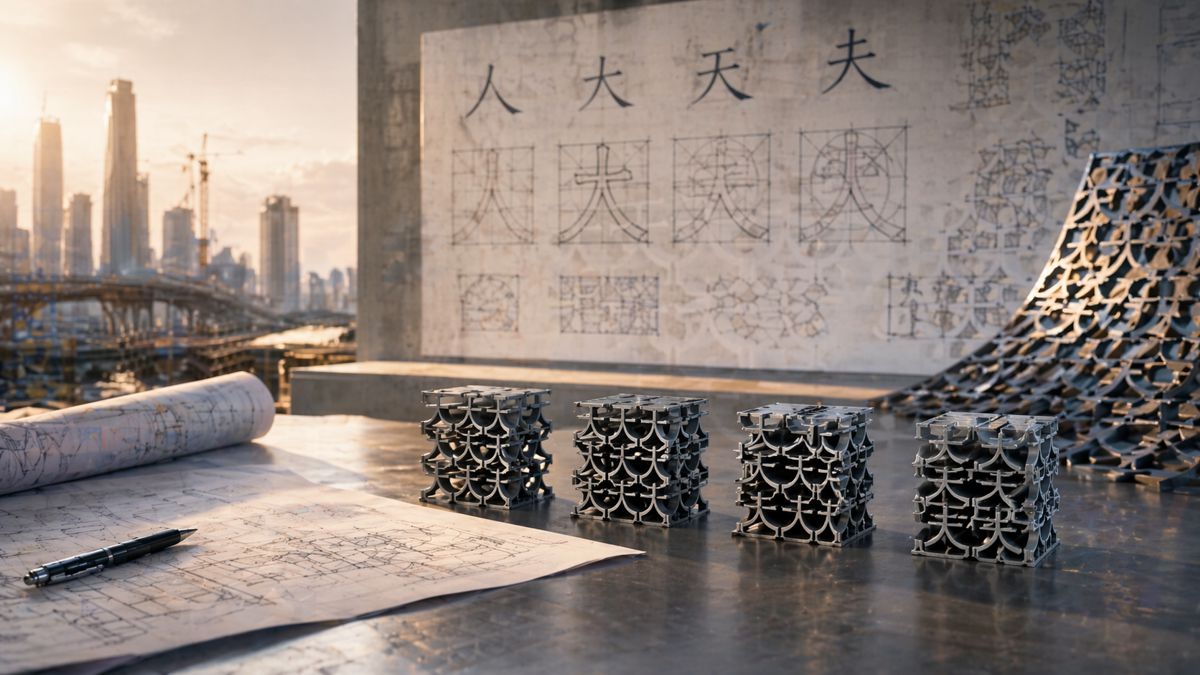
The study focused on four related Chinese characters, each building on the structure of the previous one. These included forms representing “man,” “large,” “sky,” and “husband.” While simple in appearance, their structural differences provided a controlled way to analyse how geometry influences mechanical behaviour.
Each character was translated into a repeating unit cell, forming a patterned metamaterial. These structures were then subjected to compressive loading to observe how they responded under stress. The results offered a clear demonstration of how subtle geometric variations can lead to significantly different performance outcomes.
The “man” character, with its diverging strokes, acted as a baseline. Under load, its thinner, angled components deformed first. This revealed how curvature and tapering can introduce flexibility into a structure, allowing it to absorb energy before failure.
Adding horizontal strokes, as seen in the “large” and “sky” characters, changed the picture. These crossbeams redistributed forces across neighbouring units, increasing stability and delaying structural collapse. The effect is familiar to engineers working with trusses or reinforced frameworks, where horizontal members play a critical role in load distribution.
The final variation introduced a slight asymmetry, demonstrating how even small changes in geometry can influence how stress propagates through a material. This level of control is precisely what makes metamaterials so valuable in modern engineering applications.
Implications for Construction and Infrastructure
For the construction and infrastructure sectors, the findings are more than an academic curiosity. They point toward new ways of designing materials that are lighter, stronger, and more adaptable. In large-scale projects, where weight reduction can translate into significant cost savings, such innovations carry real commercial value.
Consider prefabricated components, bridge elements, or protective barriers. Materials engineered with tailored internal geometries could offer enhanced performance without increasing mass. They could absorb impact more effectively, resist deformation under load, or adapt to changing conditions over time.
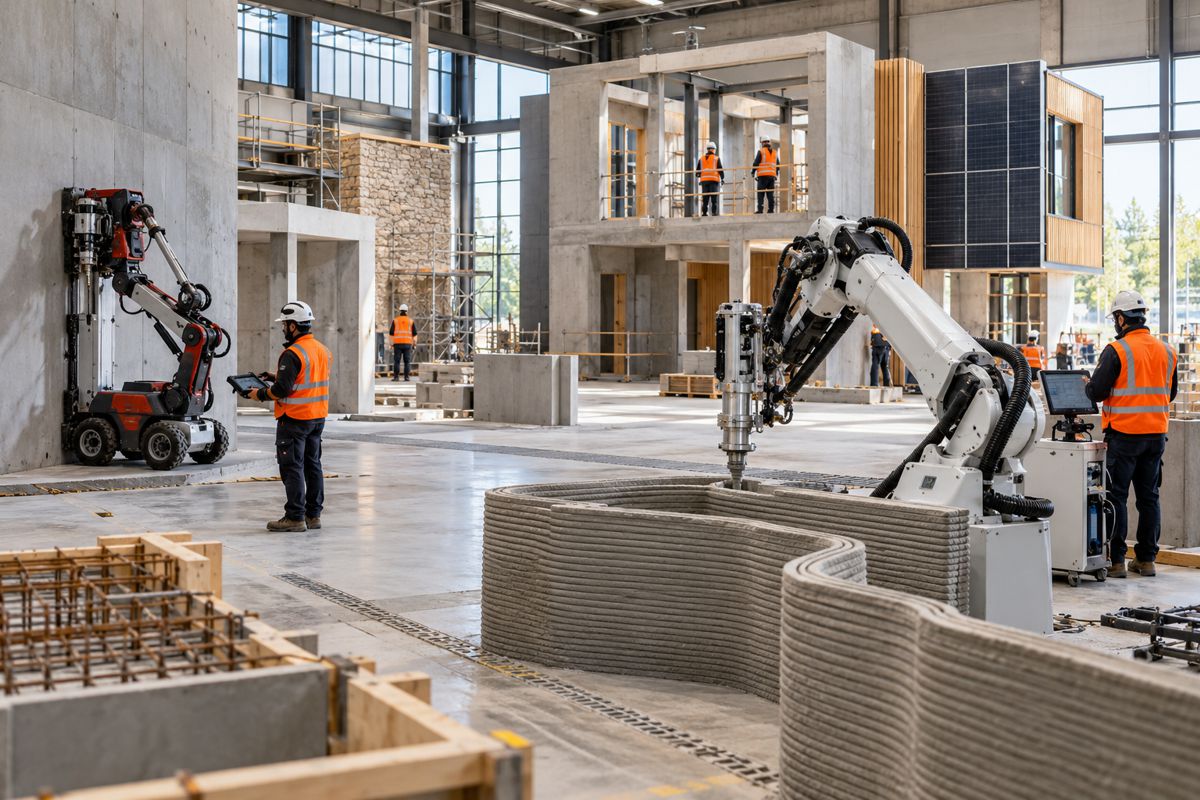
The concept also aligns with the growing emphasis on digital design and advanced manufacturing. With the rise of additive manufacturing and automated fabrication techniques, creating complex internal structures is no longer a constraint. Engineers can now translate intricate designs directly into physical components, opening the door to more experimental geometries.
In that sense, the use of symbol-based design is not a limitation but an opportunity. It expands the design vocabulary available to engineers, introducing forms that might not emerge through conventional optimisation processes.
Bridging Engineering and Cultural Heritage
Beyond its technical implications, the research highlights the value of interdisciplinary thinking. By drawing from cultural and historical sources, the study creates a bridge between engineering and the humanities. It suggests that innovation does not always require new ideas. Sometimes, it involves reinterpreting existing ones.
“These are architectural qualities that we see applied to metamaterials in general, and a question that came to mind was whether these ancient characters might also serve as unconventional metamaterial architectures with specialized properties and behaviours,” Alam explained.
This approach could extend far beyond Chinese characters. Scripts such as Arabic calligraphy or Bengali lettering also contain rich geometric structures. Each offers a different set of design possibilities, shaped by centuries of artistic and cultural development.
The potential is vast. Thousands of characters exist, each with its own geometry and structural logic. As Alam noted, the four studied characters represent only a small sample.
“The utility of symbols, while having value in engineering design, should also generate a different type of learning interest, and I hope we can encourage more interdisciplinary interactions through this,” he said. “STEM is fun, but so is everything else.”
Expanding the Metamaterial Design Toolkit
In practical terms, the study contributes to a broader shift in how engineers approach material design. Traditionally, the focus has been on composition and processing techniques. While these remain important, the role of geometry is becoming increasingly prominent.
Modern simulation tools allow engineers to model complex structures and predict their behaviour under various conditions. This makes it possible to explore unconventional designs with a level of precision that was not previously achievable. Symbol-based geometries could become part of this exploratory process, offering new starting points for optimisation.
There is also potential for customisation. By selecting different symbols or modifying their geometry, engineers could tailor materials to specific applications. A structure designed for energy absorption might favour more flexible, curved forms, while one intended for load-bearing applications could prioritise stability and stiffness.
In sectors such as transport infrastructure, where materials must perform under diverse and often extreme conditions, this flexibility is particularly valuable. It allows for more targeted solutions, reducing the need for over-engineering and improving overall efficiency.
A New Direction for Smart Materials
The research arrives at a time when the demand for smart materials is accelerating. From resilient infrastructure to adaptive building systems, the industry is looking for materials that can do more than simply bear loads. They must respond, adapt, and perform under changing conditions.
Metamaterials, with their geometry-driven properties, are well positioned to meet this demand. The introduction of culturally inspired designs adds another dimension to their development. It broadens the pool of potential structures and encourages a more creative approach to engineering challenges.
For policymakers and investors, the implications are equally significant. Innovations in material design can influence everything from construction costs to lifecycle performance. They can reduce resource consumption, improve safety, and extend the lifespan of critical infrastructure.
What emerges from this research is not just a novel idea, but a shift in perspective. It invites engineers to look beyond traditional boundaries and consider new sources of inspiration. In doing so, it opens up possibilities that are both technically compelling and culturally resonant.