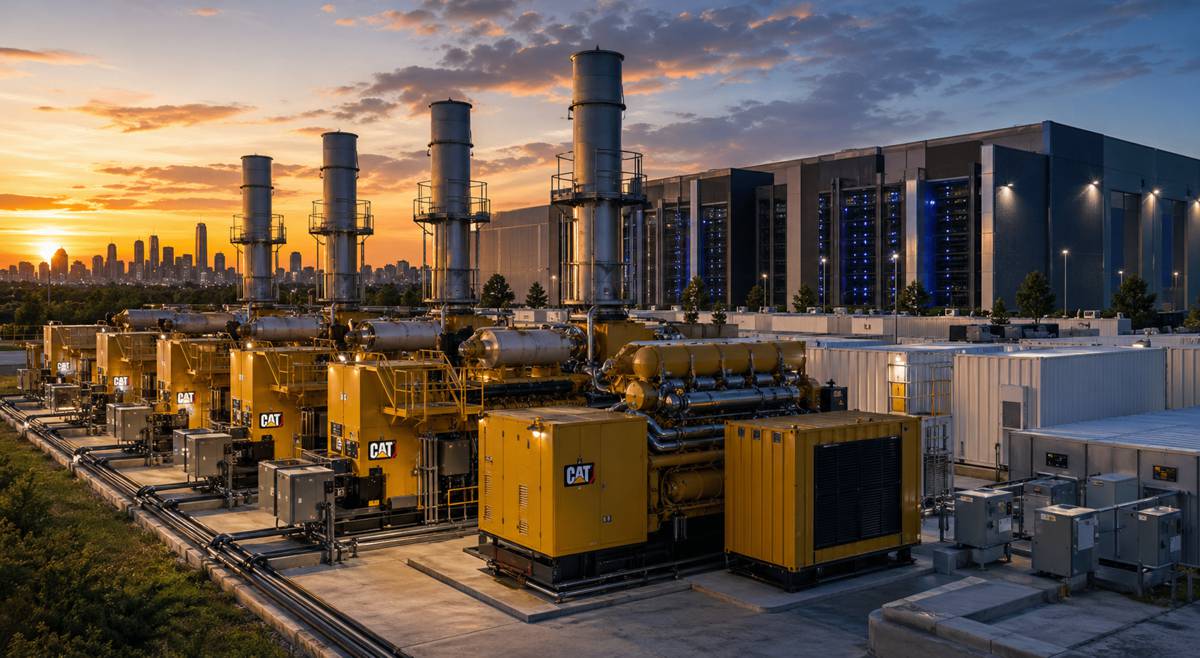
ProPetro and Caterpillar Scale Gigawatt Power for Data Centres and Industry
Power shortages are no longer a niche concern. Across North America and beyond, grid constraints, rising electricity demand and the explosive expansion of hyperscale data centres are forcing businesses to rethink how power is sourced, financed and deployed.
Against this changing landscape, ProPetro Holding Corp. has signed a strategic framework agreement with Caterpillar Inc. to acquire up to 2.1 gigawatts of additional power generation assets over the next five years through its PROPWR division.
That headline figure is substantial. To put it into perspective, 2.1 gigawatts is broadly equivalent to the output capacity of multiple utility-scale power stations, or enough electricity to support large industrial clusters and significant data centre campuses depending on load profiles. Combined with approximately 550 megawatts already ordered, PROPWR expects to have around 2.6 gigawatts of generation capacity delivered by the end of 2031 and fully deployed in 2032.
For infrastructure markets, the agreement signals something larger than a straightforward equipment order. It underlines the rapid emergence of decentralised power-as-a-service models, where mobile or modular generation is used to bridge grid delays, support remote industrial sites, and provide immediate energy resilience where utility connections lag behind demand.
Briefing
- ProPetro Holding Corp. will purchase at least 1.5GW of new generation assets from Caterpillar Inc., with an option to increase to 2.1GW.
- Total expected PROPWR fleet capacity could reach 2.6GW by 2031, fully deployed in 2032.
- Demand is driven by data centres, oil and gas operations and industrial customers needing fast, reliable power.
- The deal highlights growing use of modular off-grid and behind-the-meter generation systems.
- Financing will combine internal cash flow, equity strength and flexible external facilities.
Data Centres Are Rewriting the Power Market
Few sectors have altered electricity forecasts as dramatically as data centres. The rapid growth of cloud computing, artificial intelligence workloads and digital services has created a wave of power demand that many utilities were not ready for. In the United States, several grid operators have already warned of tightening reserve margins, while new hyperscale campuses often face multi-year waits for firm grid connections.
That has opened the door for companies able to deliver temporary, supplementary or long-duration on-site power. Gas-fired reciprocating engines, turbines and modular generator packages are increasingly being viewed as a practical bridge solution. They can be installed faster than new grid infrastructure, scaled in phases and integrated with battery storage or renewable sources later.
PROPWR appears to be positioning itself directly into that gap. By securing long-term access to proven Caterpillar generation technology, the business is building a fleet that can respond to urgent customer needs rather than waiting for conventional utility timelines.
Construction and Infrastructure
For contractors, developers and investors, power availability is becoming a critical early-stage project risk. A data centre cannot operate without dependable electricity. A mining project loses money if production is interrupted. A manufacturing facility delayed by energy bottlenecks can derail investment returns before commissioning even begins.
That means power procurement is increasingly tied to project delivery schedules. In practical terms, generation suppliers are becoming part of the infrastructure supply chain alongside civil contractors, EPC firms and logistics specialists.
Construction markets may also feel secondary benefits. Large temporary generation deployments often require site preparation, fuel systems, electrical integration, control rooms, substations, acoustic barriers and access works. In short, buying engines is only one part of the value chain. Civil engineering, installation and maintenance demand follows closely behind.
Caterpillar Strengthens Its Strategic Position
For Caterpillar Inc., the agreement reinforces a strategic shift often overlooked by those who associate the company solely with yellow iron machinery. While widely recognised for construction and mining equipment, Caterpillar is also a major supplier of engines, turbines and distributed power systems.
The company reported 2025 sales and revenues of $67.6 billion, reflecting the breadth of its industrial footprint. Its power business gives Caterpillar exposure to one of the fastest-growing segments of the global infrastructure economy: resilient electricity supply.
As utilities struggle to expand networks quickly enough, established engine manufacturers with global service networks stand to benefit. Reliability, spare parts availability and maintenance support are crucial when customers are operating mission-critical assets. That dealer network, built over decades, becomes a competitive moat.
Financing Growth Without Overstretching
Rapid expansion in capital-intensive sectors often raises one immediate question: who pays? ProPetro has sought to address that directly. The company says funding for the programme will primarily come from free cash flow generated by its completions business, supplemented by growth from the power segment itself.
Additional financing facilities remain available, while a recent equity offering has strengthened liquidity and balance sheet flexibility. That blended model matters. It suggests management wants to grow aggressively without taking on destabilising short-term leverage.
Investors usually reward disciplined capital allocation more than reckless expansion. In volatile energy and industrial markets, preserving optionality can be as valuable as headline growth figures.
Oil and Gas Demand Still Matters
Although data centres dominate the narrative, oil and gas remains a core customer base. Remote drilling and production sites frequently need dependable power in locations where grid access is limited or non-existent. Electrification of operations, emissions management and fuel efficiency are also reshaping how operators think about on-site energy systems.
Modern gas-to-power fleets can use available natural gas streams, reducing reliance on diesel while potentially lowering operating costs and emissions intensity. That makes such assets attractive across shale basins and industrial zones.
For a company with roots in completion services, expanding into power allows ProPetro to diversify revenue while staying close to familiar customer networks. It is a logical adjacency rather than a random pivot.
A Bigger Theme Is Emerging
The broader story here is the industrialisation of private power markets. For decades, many businesses assumed utilities alone would meet rising demand. That assumption is being tested by AI growth, manufacturing reshoring, electrification and ageing grids.
As a result, independent power fleets, rental generation, microgrids and behind-the-meter assets are moving from contingency planning into mainstream infrastructure strategy. Companies able to finance, install and operate these systems at scale may become increasingly influential over the next decade.
This agreement places PROPWR firmly in that conversation. If execution matches ambition, the company could evolve from a specialist energy-services offshoot into a meaningful power infrastructure operator.
Building Capacity Where It Is Needed Most
The race for digital and industrial growth increasingly depends on something old-fashioned but essential: dependable electricity. While software and automation attract headlines, physical power remains the gatekeeper of progress.
By pairing ProPetro’s market ambition with Caterpillar’s manufacturing depth, the two companies are betting that speed, flexibility and reliability will command a premium in the years ahead. Judging by current demand trends, that looks like a wager many in the infrastructure world will be watching closely.