Hongqi Accelerates Global Expansion with New SUV Range and Market Push
Chinese premium automotive marque Hongqi has used Auto China 2026 as the stage to outline a significantly broader international growth strategy, pairing new export-focused SUV models with an ambitious dealer network expansion plan. The announcement underlines how China’s automotive manufacturers are moving beyond volume production and aggressively targeting higher-margin global premium segments once dominated by established European, Japanese and North American brands.
For infrastructure professionals, investors and policymakers, the move is about far more than a new model launch. It reflects the continued reshaping of global vehicle manufacturing supply chains, the rapid internationalisation of Chinese industrial brands, and rising competition in the premium electric and hybrid mobility space. As automotive investment increasingly overlaps with battery production, charging networks, logistics hubs and digital services, developments such as this have consequences well beyond the showroom floor.
Hongqi, the flagship luxury brand of FAW Group, confirmed plans to widen its international footprint while tailoring products for regional markets. That approach, once considered optional, has now become essential as manufacturers pursue growth in markets with differing regulations, consumer tastes and steering configurations.
Briefing
- Hongqi unveiled a new overseas SUV range at Auto China 2026
- Expansion plans target more than 110 countries and regions by 2028
- Dealer network is expected to exceed 650 locations worldwide
- Right-hand-drive models signal stronger focus on the UK and Asia-Pacific markets
- Strategy highlights China’s growing challenge to established premium carmakers
China’s Premium Automotive Ambitions Go Global
Hongqi occupies a distinctive place in China’s industrial landscape. Founded in 1958, the brand has long been associated with official state transport and prestige motoring. In recent years, however, it has evolved into a commercially focused premium marque seeking international recognition. That transformation mirrors China’s wider industrial strategy, where domestic champions are encouraged to compete globally in advanced manufacturing sectors.
The global automotive market is currently undergoing its biggest reset in decades. Electrification, software-defined vehicles, autonomous technologies and new ownership models are eroding long-standing brand loyalties. This creates an opening for newer entrants with strong manufacturing capacity and competitive pricing. Chinese brands have moved quickly to exploit that gap, particularly in electric vehicles, where domestic scale has lowered production costs.
Hongqi’s latest announcement suggests the company intends to compete not merely as a Chinese exporter, but as a fully fledged international luxury brand.
New SUV Portfolio Targets Multiple Global Markets
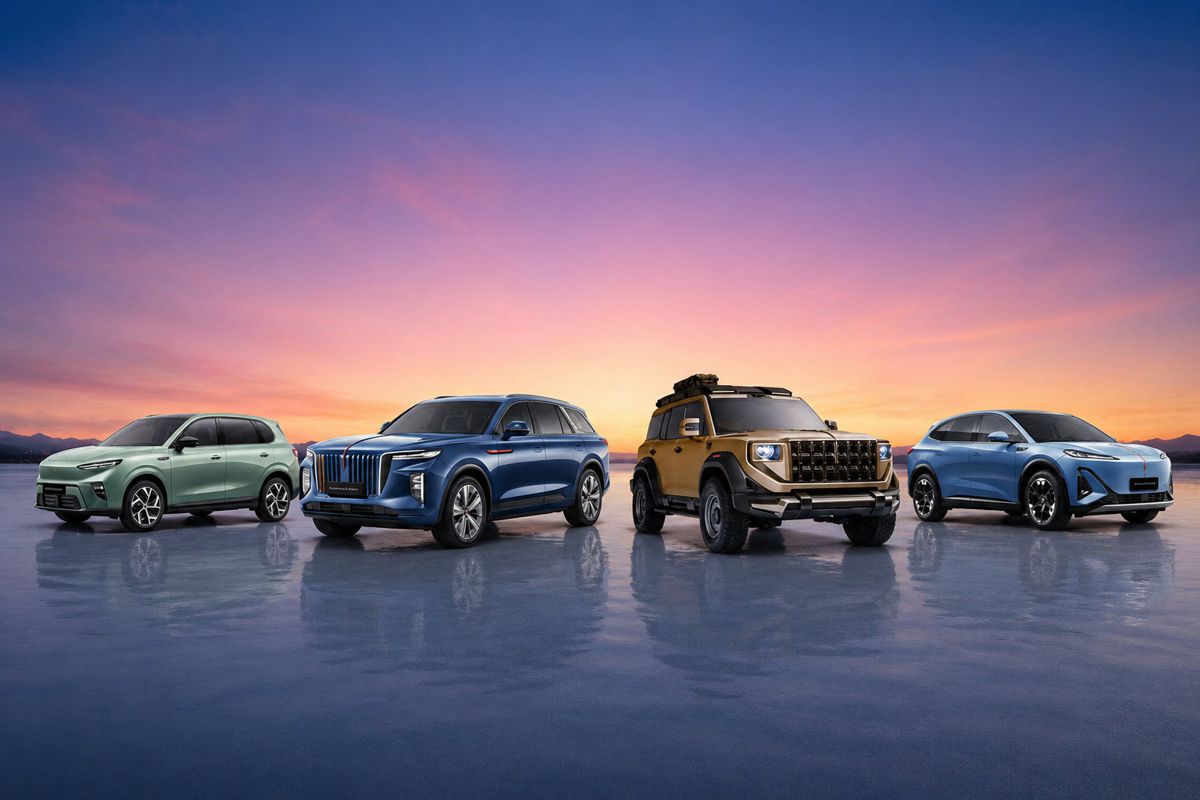
The newly presented overseas SUV line-up spans several market segments and use cases, showing a deliberate attempt to broaden appeal rather than rely on a single halo model.
The range includes Hongqi Offroad, Hongqi Global SUV, the right-hand-drive version of the Hongqi E-HS9, and the Hongqi EHS5 in both left-hand-drive and right-hand-drive formats. That mix allows Hongqi to target everything from executive transport and urban commuting to leisure and off-road use.
This matters commercially because regional demand differs sharply. In parts of the Middle East, large SUVs with status appeal remain highly desirable. In dense urban Asian markets, buyers often prioritise technology, comfort and practicality. In the UK and other right-hand-drive territories, steering layout alone can determine whether a brand is commercially viable.
By launching both LHD and RHD products in parallel, Hongqi appears keen to avoid the delays that often slow international rollouts.
Right Hand Drive Signals Serious UK Intent
One of the clearest takeaways from the announcement is Hongqi’s focus on right-hand-drive markets. These include the UK, Indonesia, Singapore and Macao, with the company specifically highlighting suitability for British buyers and business users.
That is strategically significant. The UK remains one of Europe’s most influential premium automotive markets despite its modest size relative to China or the United States. Success in Britain can help shape perceptions across other export regions. UK buyers are also increasingly open to new EV brands, particularly when design, range and technology stack up against established competitors.
The inclusion of the E-HS9 RHD model is notable because full-size premium electric SUVs remain a lucrative niche. Buyers in that segment often seek space, comfort, advanced driver assistance systems and strong brand identity. If competitively priced, Hongqi could attract interest from fleet operators, executive transport firms and early adopters wanting alternatives to incumbent marques.
Design Strategy Blends Chinese Identity with Local Preferences
Hongqi said the new models retain its “Eastern luxury DNA” while integrating local cultural preferences and user needs. That phrasing reflects a wider challenge facing expanding automotive brands: remain authentic enough to stand out, but localised enough to be accepted.
The company’s design leadership includes Giles Taylor, formerly associated with leading British luxury automotive design programmes. His involvement has helped draw international attention to Hongqi’s styling direction in recent years.
For many Chinese brands, earlier export attempts stumbled because products felt generic or insufficiently tuned to local expectations. Today’s successful entrants tend to invest heavily in design studios, software localisation, dealer experience and aftersales support. Hongqi’s language suggests it understands that premium buyers expect more than attractive specifications.
Community Building Becomes a Competitive Tool
Alongside products, Hongqi launched the “Hongqi Bonded Friends” user co-creation initiative, inviting more than two million owners across 34 countries and regions into a global community platform.
That may sound like a marketing exercise, but in practical terms it reflects how modern automotive competition has changed. Vehicle brands increasingly compete through ecosystems that combine software updates, owner clubs, lifestyle experiences, digital services and loyalty programmes.
Premium customers often value access and experience as much as horsepower figures or battery range. Exclusive events, concierge-style services and active owner communities can improve retention while lowering acquisition costs through referrals and advocacy.
For a growing international brand, building community also helps overcome the trust gap that newer entrants sometimes face in mature markets.
Industrial Impact Beyond Passenger Cars
Announcements like this ripple across multiple industrial sectors. International vehicle expansion requires supply chain resilience, homologation expertise, logistics networks, charging infrastructure partnerships and skilled retail technicians. It can also stimulate inward investment where assembly, distribution or service hubs are established.
As Chinese automotive exports continue to rise, ports, rail freight operators, warehousing groups and battery supply chains all stand to benefit. In Europe and the UK, policymakers are watching closely as new entrants intensify competition while raising questions around industrial strategy and local manufacturing capacity.
For investors, the premium segment is especially important because margins are typically stronger than mass-market passenger vehicles. If Chinese brands can secure credible positions there, revenue quality improves significantly.
2028 Vision Raises the Stakes
Hongqi stated that by 2028 it plans to operate in more than 110 countries and regions with over 650 dealerships. Those are substantial targets and would place the brand among far more established international automotive networks.
Execution, of course, is the hard part. Dealer quality, spare parts availability, software support, warranty confidence and residual values all influence long-term success. New market entry is one thing; sustained profitability is another.
Still, the direction of travel is unmistakable. Chinese manufacturers are no longer content supplying domestic demand or competing only on price overseas. They are climbing the value ladder, entering premium territory and building global identities with increasing confidence.
A New Era of Luxury Competition
Hongqi’s Auto China 2026 presentation signals that the next battleground in global automotive competition will not be confined to entry-level EVs or budget mobility. It will increasingly centre on premium SUVs, technology-rich ownership experiences and brands capable of blending heritage with innovation.
For established luxury manufacturers, complacency would be risky. For consumers, more choice is coming. For investors and policymakers, the rise of Chinese premium mobility brands marks another chapter in the redistribution of industrial influence.
Hongqi’s ambitions remain to be fully tested in international markets, yet one point is already clear: the global luxury automotive map is being redrawn.