Autonomous Freight Reshaping America’s Food Supply Chain
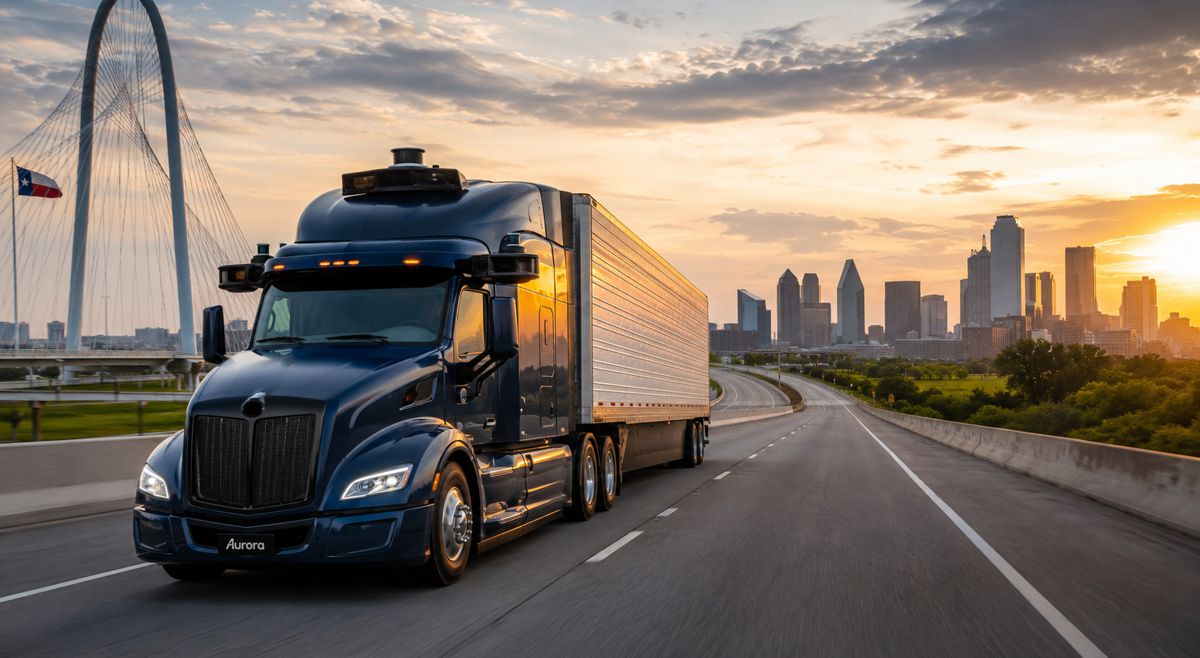
The race to automate long-haul freight has shifted out of the testing phase and onto live commercial corridors, with autonomous trucking company Aurora Innovation
beginning driverless freight operations for McLane Company in Texas. The move marks another significant milestone for autonomous logistics in North America and offers a glimpse into how artificial intelligence, automation and freight technology could reshape supply chains over the coming decade.
For the construction, infrastructure and transport sectors, the implications stretch far beyond food distribution. Autonomous trucking is increasingly being viewed as a strategic tool to tackle labour shortages, improve freight reliability and increase asset utilisation across overstretched road networks. As governments and logistics operators wrestle with ageing driver populations, rising operating costs and mounting pressure for faster delivery times, driverless freight corridors are beginning to move from pilot projects into commercially viable operations.
Aurora and McLane have agreed to launch fully driverless hauls between Dallas and Houston using the Aurora Driver, an SAE Level 4 autonomous driving system developed for long-haul trucking operations. McLane, a Berkshire Hathaway subsidiary and one of America’s largest distributors, supplies restaurant chains, retailers and convenience stores across the United States. The company’s freight volumes and strict delivery windows make it a demanding proving ground for autonomous systems.
Texas has emerged as one of the most active states for autonomous freight deployment thanks to its extensive highway network, strong freight economy and comparatively supportive regulatory environment. The Dallas to Houston corridor alone handles enormous commercial traffic volumes every day, linking manufacturing, distribution and retail hubs critical to the American economy.
Briefing
- Aurora and McLane are launching driverless freight operations between Dallas and Houston using SAE Level 4 autonomous trucks
- Aurora logged more than 280,000 autonomous miles and completed 1,400 loads for McLane during supervised operations
- The partnership focuses on middle-mile logistics, with human drivers continuing local customer deliveries
- Autonomous refrigerated freight operations could improve supply chain reliability and ease labour shortages
- Texas continues to establish itself as a major testing ground for autonomous freight transportation
Texas Becomes Ground Zero for Autonomous Freight
The autonomous trucking industry has spent years navigating technical challenges, regulatory scrutiny and investor scepticism. Yet recent developments suggest the sector is now entering a more commercially focused stage, particularly in the Sun Belt states where weather conditions, road infrastructure and freight demand create favourable operating conditions.
Aurora’s move into driverless operations with McLane reflects broader momentum across the autonomous freight landscape. Companies including Kodiak Robotics, Gatik and Waabi have all expanded commercial partnerships in recent years, while major truck manufacturers such as Volvo, PACCAR and Daimler Truck continue investing heavily in autonomous systems and software integration.
Texas offers an attractive environment because of its large-scale freight activity and long motorway corridors connecting distribution centres and ports. Interstate highways linking Dallas, Houston, San Antonio and El Paso form some of the busiest trucking arteries in North America. Freight movement across these routes underpins retail supply chains, food distribution networks and industrial production throughout the southern United States.
The deployment also arrives at a time when logistics operators face increasing pressure to maintain delivery performance despite ongoing workforce shortages. The American Trucking Associations has repeatedly warned of persistent driver shortages, particularly in long-haul operations where extended time away from home continues to deter recruitment.
Building Confidence Through Real World Operations
Aurora and McLane began their supervised autonomous pilot programme in 2023, giving both companies time to evaluate operational reliability before transitioning to fully driverless freight movements. During that period, the Aurora Driver accumulated more than 280,000 autonomous miles and completed 1,400 deliveries for McLane across Texas.
Those numbers matter because commercial logistics depends heavily on consistency rather than isolated demonstrations. Retailers and restaurant operators require dependable schedules, temperature-controlled freight handling and strict timing discipline. A missed delivery window can quickly disrupt inventory planning and customer operations.
Aurora claims the programme achieved 100 per cent on-time performance during the pilot phase, helping secure McLane’s approval for driverless operations between Dallas and Houston. The route will continue operating under a hybrid logistics model in which autonomous trucks handle the long-haul middle-mile section while human drivers continue managing final deliveries to customers.
“The business of moving food is essential to our economy and our way of life. With a 134-year legacy, McLane is deeply woven into the American distribution industry,” said Ossa Fisher, president at Aurora. “We’re excited to enter the next chapter with McLane and transform the American food supply chain with autonomous trucks. Our collective momentum in logistics is palpable.”
The use of refrigerated autonomous freight is especially significant because food logistics demands tight operational control. Temperature-sensitive loads leave little margin for delays, breakdowns or inconsistent scheduling. Reliable autonomous freight capacity could therefore become increasingly attractive to food distributors operating around-the-clock supply chains.
The Rise of the Autonomous Middle Mile
Much of the autonomous trucking sector has focused on the so-called middle mile rather than urban deliveries. Long motorway stretches are generally more predictable than dense city traffic, making them better suited for current autonomous systems.
Aurora’s partnership with McLane reflects that strategy. Human drivers continue handling local deliveries, customer interactions and more complex urban environments, while autonomous systems take over the repetitive long-distance sections between distribution hubs.
This hybrid model is becoming one of the most commercially realistic approaches to freight automation. Rather than eliminating drivers entirely, companies are reallocating human labour toward local and regional operations where flexibility and customer service remain essential.
“We’ve been thoroughly impressed with Aurora’s technology, exceptional safety performance and commitment to operational excellence,” said Susan Adzick, president of McLane Restaurant. “Autonomous technology helps us drive greater efficiency across the supply chain, while our drivers remain focused on the critical last mile—and continuing to serve as the face of our company to customers.”
For logistics operators, middle-mile automation could unlock several operational advantages:
- Higher vehicle utilisation through near-continuous operations
- Reduced idle time during mandatory driver rest periods
- Improved delivery schedule consistency
- Greater freight capacity during seasonal demand spikes
- Lower exposure to driver recruitment challenges
Those benefits could eventually ripple into construction supply chains as well. Aggregates, cement, steel, asphalt materials and prefabricated components increasingly depend on precise logistics coordination. Autonomous freight systems may ultimately help stabilise transport capacity for infrastructure projects operating under tight timelines.
Safety Remains the Industry’s Defining Challenge
Despite the commercial progress, autonomous trucking still faces intense scrutiny over safety and public trust. The freight sector operates on public roads carrying high traffic volumes, meaning every deployment attracts attention from regulators, insurers and local authorities.
Aurora’s SAE Level 4 system is designed to operate autonomously within specific operating conditions and geographic boundaries. Unlike lower-level driver assistance technologies, Level 4 systems can handle driving tasks without human intervention within designated environments.
The company says its autonomous platform uses a combination of lidar, radar and high-resolution cameras to interpret surrounding traffic conditions and roadway environments. Advanced computing systems then make real-time driving decisions based on traffic behaviour, lane positioning and obstacle detection.
Industry analysts increasingly believe safety performance will determine which autonomous trucking companies survive the next decade. Investors and freight operators are showing growing preference for firms capable of demonstrating measurable operational reliability rather than simply showcasing technological capability.
Aurora’s commercial partnerships also reflect the growing importance of ecosystem collaboration in autonomous freight. The company works with organisations including FedEx, Schneider, Ryder, PACCAR, Volvo Trucks, Uber Freight and Werner, highlighting how automation increasingly depends on coordinated relationships between software developers, vehicle manufacturers and logistics operators.
Infrastructure Networks Face a Digital Future
Autonomous trucking deployment also raises wider questions about infrastructure readiness. Roads originally designed for human-operated vehicles may require upgrades as automated freight systems expand across national transport networks.
Digital mapping, roadside connectivity, smart traffic management systems and clearer lane markings all become increasingly important in supporting autonomous operations. Several US states are already exploring how intelligent infrastructure investments could complement autonomous vehicle deployment over time.
Construction and infrastructure stakeholders are watching these developments closely because autonomous freight could eventually influence future highway design standards, logistics hubs and industrial corridor planning.
There is also growing interest in how autonomous trucking could intersect with electrification and alternative fuels. Several freight technology firms are examining how autonomous driving systems might improve battery efficiency, route optimisation and fleet energy management for electric heavy vehicles.
Texas, meanwhile, appears determined to maintain its position at the centre of freight innovation. The state’s extensive motorway system, industrial growth and expanding logistics economy continue attracting investment from automation developers eager to commercialise autonomous transport systems.
A Turning Point for Commercial Autonomy
The launch of driverless freight operations between Dallas and Houston may prove to be one of the clearest signs yet that autonomous trucking is transitioning from experimental technology into commercial infrastructure.
There are still substantial hurdles ahead. Regulatory frameworks remain fragmented, insurance models continue evolving and public acceptance is far from universal. Weather limitations, cybersecurity concerns and infrastructure inconsistencies also present long-term operational challenges.
Even so, the direction of travel is becoming increasingly difficult to ignore. Freight operators are under mounting pressure to improve efficiency while maintaining delivery reliability across increasingly complex supply chains. Autonomous middle-mile logistics offers one possible answer to those pressures.
For the broader infrastructure sector, the implications extend well beyond trucking alone. Autonomous transport systems are gradually becoming part of a wider digital transformation that includes smart highways, connected logistics platforms, AI-driven traffic management and increasingly automated industrial operations.
What began as a technology experiment in Texas is steadily becoming a live operational model for the future of freight movement across America.