Smarter Copper Extraction Drives Ideon Launch In Chile
Chile sits at the centre of the global copper economy, supplying the metal that underpins electrification, renewable power networks, electric vehicles, data centres and modern infrastructure. So when a specialist technology company chooses Santiago as the next stage of its international growth, the move deserves attention well beyond Latin America. Canadian subsurface intelligence firm Ideon Technologies has officially launched into the Chilean market, bringing advanced underground imaging tools designed to help miners make faster and more accurate decisions in increasingly complex ore environments.
For the global mining industry, timing is everything. Many of the world’s easiest-to-access deposits have already been developed, leaving producers to chase deeper, lower-grade and geologically challenging resources. Meanwhile, demand for copper continues to strengthen as countries expand power grids, charging networks, transport electrification and digital infrastructure. According to the International Energy Agency, demand for critical minerals used in clean energy technologies has risen sharply in recent years, with copper among the most strategically important materials for the energy transition.
That creates a commercial squeeze. Mining companies must increase production, but do so safely, efficiently and with tighter environmental controls. Ideon’s proposition is straightforward: improve what operators know about the rock mass beneath their feet, reduce uncertainty, and allow better operational choices. In an industry where drilling campaigns, production delays or instability events can cost millions, better information can quickly become a competitive edge.
Chile is therefore a logical destination. The country remains the world’s largest copper producer and one of the most sophisticated adopters of large-scale mining technology. From autonomous haulage and remote operations centres to desalination-backed water systems and digital planning tools, Chilean miners have shown a willingness to invest when technology can improve output and resilience.
Briefing
- Canadian technology firm Ideon Technologies has officially launched operations in Chile.
- Chile is the world’s leading copper producer and a key market for advanced mining solutions.
- Ideon uses cosmic-ray muon tomography to generate 3D and 4D subsurface models.
- Applications include cave mining, heap leaching, geotechnical risk management and exploration.
- The expansion strengthens Ideon’s presence across Latin America amid rising copper demand.
Chile and the Global Mining Economy
Copper has become one of the most closely watched industrial commodities in the world. It is essential in electrical wiring, transformers, renewable generation, battery systems, rail infrastructure, telecoms networks and construction. Analysts at S&P Global and other market researchers have repeatedly warned that future supply growth may struggle to keep pace with long-term demand unless new mines and expansions come online.
Chile occupies a unique position in that story. The country accounts for a substantial share of global copper reserves and production, while also hosting some of the largest and most technically advanced mines on earth. Operations in the Atacama Desert and Andean mining belt are engineering achievements in their own right, often working at altitude, in arid conditions and across highly complex geology.
Yet Chile’s miners also face mounting challenges. Ore grades have declined over time at some mature deposits. Water constraints remain a strategic issue. New developments are expensive and technically demanding. In short, operators need to extract more value from every tonne while reducing surprises underground.
That is where subsurface intelligence tools become increasingly relevant. If operators can see structures, voids, fluid movement or density changes earlier and more clearly, they can improve planning, recovery rates and safety outcomes.
How Muon Tomography Changes Underground Visibility
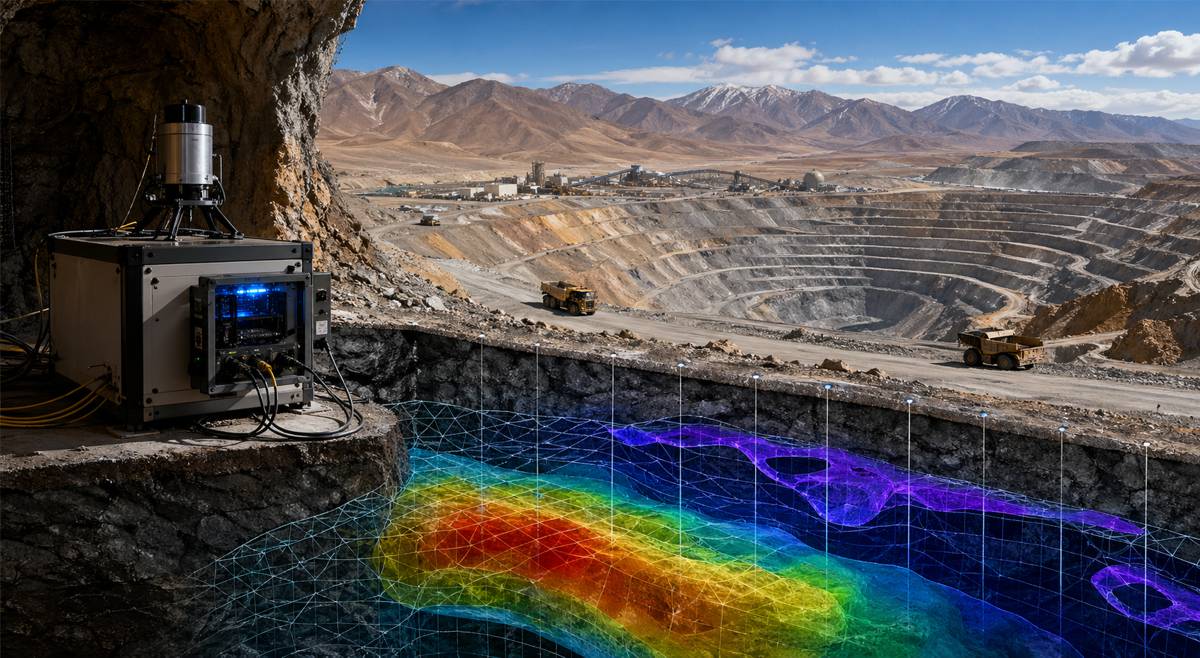
Ideon’s core technology relies on naturally occurring muons, subatomic particles created when cosmic rays interact with Earth’s atmosphere. These particles constantly pass through the planet and can be measured after travelling through rock. By analysing how muons are absorbed or deflected, imaging systems can estimate density variations underground and create detailed models of what lies below.
It sounds futuristic, but muon imaging has been studied for decades and has previously been used in scientific and archaeological settings, including investigations of Egypt’s pyramids. Ideon has focused on industrialising the concept for mining and resource applications, turning advanced physics into practical field tools.
The commercial value is clear. Traditional subsurface investigation often depends heavily on drilling, sampling and inference between data points. Drilling remains essential, but it is expensive, time-consuming and spatially limited. A complementary imaging platform that improves understanding between boreholes or in inaccessible zones can sharpen decisions and potentially reduce unnecessary drilling.
Ideon says its REVEAL platform combines ruggedised hardware, integrated imaging systems and AI-supported analytics to generate 3D and 4D models. In practical terms, that means operators can observe change over time, not just static conditions.
Applications With Immediate Mining Relevance
The company has outlined several Chile-ready applications, each aligned with major industry priorities.
In block cave mining, REVEAL for Caving is intended to monitor cave propagation, air gaps and material flow. Chile is a global leader in caving methods, particularly for deep copper deposits. Better visibility of cave behaviour can support production planning and reduce geotechnical risk.
Heap leach operations could benefit from REVEAL for Leaching, which aims to map fluid distribution through time-lapse density models. Leaching efficiency matters enormously in copper recovery economics. If solution flow can be better controlled, recovery rates may improve while reducing waste.
Resource definition remains another major cost centre. REVEAL for Resources is designed to improve orebody delineation and resource-to-reserve conversion. In a market hungry for future copper supply, faster and more reliable reserve development carries obvious strategic value.
Geotechnical applications are equally important. Ground instability, slope failure or underground hazards can halt production and threaten lives. Enhanced structural imaging may help mine planners identify risk earlier and refine support strategies.
Finally, exploration use cases could shorten the search cycle for new deposits. Discoveries are becoming harder to make, and investors increasingly favour technologies that improve targeting discipline before large drilling budgets are committed.
Building a Latin American Growth Platform
To support expansion, Ideon has appointed Santiago-based executive Manfredo Manfredi as Business Development Director for Chile and Latin America. With more than two decades in mining technology markets, his background spans several established industrial and mining software businesses.
That matters because mining technology adoption is rarely about software alone. It requires local trust, operational understanding, procurement navigation and the ability to demonstrate measurable value on site. Latin America’s mining sector is substantial, but relationship-driven and highly practical. Companies want evidence, uptime and return on investment.
Manfredi noted Chile’s significant share of global copper reserves and output, alongside projected mining investment exceeding US$100 billion by 2034. Those figures underline why technology vendors are increasingly targeting the country as a strategic regional hub.
For Ideon, Chile could become more than a national market. It offers a springboard into Peru, Brazil, Argentina and other mining jurisdictions seeking productivity gains and more sustainable extraction methods.
Mining Smarter in an Era of Scarcity
The next chapter of mining will not be defined solely by bigger trucks or deeper pits. It will be shaped by information. Operators able to understand geology faster, predict behaviour more accurately and optimise recovery more precisely are likely to outperform peers.
That shift mirrors wider trends across construction and infrastructure, where digital twins, AI analytics and sensor intelligence are steadily replacing guesswork with measurable insight. Mining, once seen as slower to digitise, is now moving decisively in the same direction.
Ideon’s arrival in Chile therefore signals something larger than a market entry announcement. It reflects how critical mineral supply chains are modernising under pressure from electrification, investment demand and operational complexity.
If the world wants more copper for grids, railways, EV charging corridors and clean energy systems, the rock must be understood before it is moved. That simple truth may give subsurface intelligence technologies an increasingly prominent role in the decade ahead.