Newfoundland Rock Now Underpins Tampa’s Growth
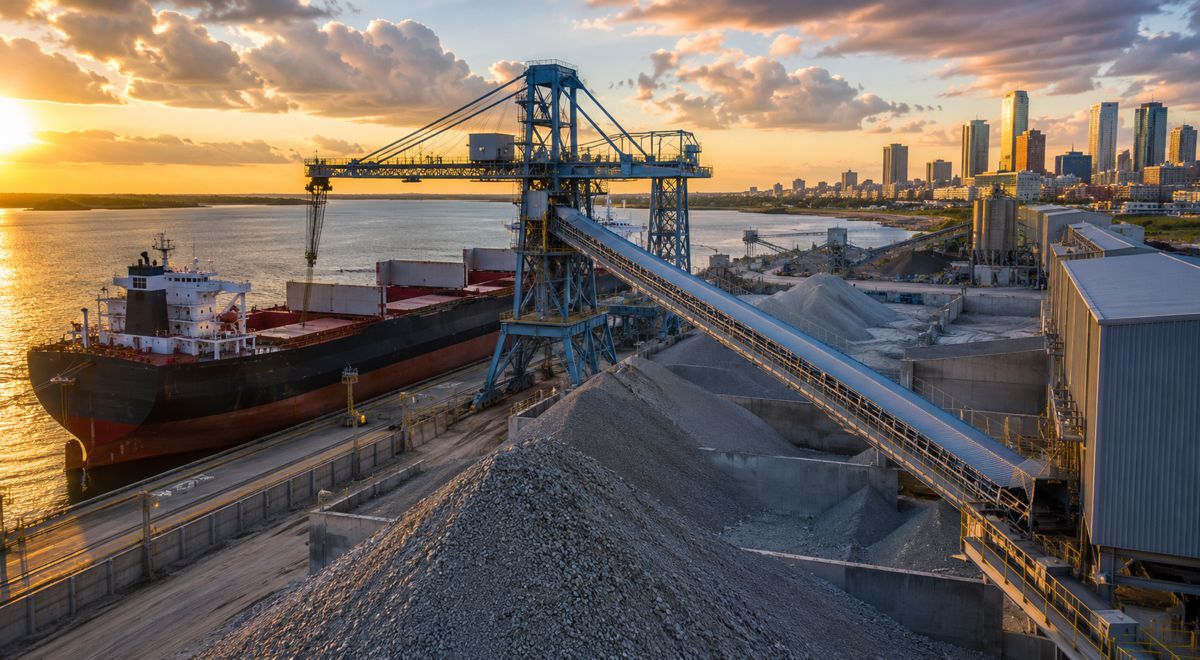
Florida builds fast, and it builds with rock it largely can’t dig out of its own ground. That awkward truth sat quietly behind a ribbon-cutting at Port Tampa Bay on 28 May 2026, where Cemex US and the port authority, with Tampa Mayor Jane Castor on hand, opened an expanded marine aggregate terminal that now pulls crushed stone across the water from Newfoundland and channels it into the region’s concrete and asphalt supply. Cemex US and Port Tampa Bay, joined by Tampa Mayor Jane Castor, celebrated the opening of the newly expanded Cemex Aggregate Terminal at a deepwater facility that has become central to how the Gulf coast keeps its building sites fed.
The headline figure is modest next to a marquee megaproject, yet the logic behind it is anything but. A $29 million investment from Cemex, topped up by a $7 million grant from the Florida Department of Transportation, has lifted the terminal’s capacity to receive, store and distribute the gritty raw material that every road, slab and foundation depends on. For an industry that quietly frets about whether the next shipload will turn up on schedule, that’s the part worth watching, and it’s why a working dock in Tampa carries weight far beyond the waterfront.
Briefing
- A roughly $36 million expansion of Cemex’s aggregate terminal at Port Tampa Bay opened on 28 May 2026, funded by $29 million from Cemex and a $7 million FDOT grant.
- The terminal imports aggregate from Newfoundland through the port’s deepwater berths, with a conveying system sized at 5,000 tons an hour and expected throughput near 1.5 million tons a year.
- It’s now the only Cemex site in Florida combining an aggregate terminal, a cement terminal and a ready-mix concrete plant in one location.
- The grant flows from Florida’s Aggregate Grant Program, which has committed $77.5 million to seaport and rail storage since its 2024 launch.
- Florida consumes around 143 million tons of aggregate a year, more than its own quarries comfortably supply, which keeps seaborne imports a structural fixture.
Why Florida Keeps Shipping In Its Rock
Florida’s geology is generous with soft limestone but stingy with reliable, high-spec hard stone, and the sums tell the story. The state gets through an estimated 143 million tons of aggregate each year, with roughly 120 million tons scooped from domestic mines, about 55 million of that from the Lake Belt district west of Miami. When the courts have leaned on Lake Belt operations over worries about the region’s drinking-water wellfields, the whole supply picture has wobbled, and contractors have felt the pinch in both price and certainty. A federal judge once shut down most rock mining in the Lake Belt, citing grave concern about contamination of a primary public water supply.
So a terminal on Tampa’s waterfront isn’t a vanity project, it’s a pressure valve. Newfoundland’s west coast has long shipped crushed stone south, with enormous quarries on the island loading barges and ships bound for distant markets. There’s a regulatory quirk that makes Canadian rock especially attractive, too. Because the Jones Act bars foreign-built or foreign-flagged vessels from carrying cargo between two US ports, stone moved from a Canadian quarry on an international ship slots neatly into the gap that domestic shipping can’t easily fill. Loaded at a quarry on one side of the Atlantic seaboard and unloaded at a Tampa berth, the material arrives without ever competing for the scarce, costly coastwise tonnage that hems in so much American bulk freight.
The Engineering Behind The Throughput
Capacity is the quiet engineering achievement here. The expansion gives Cemex extra room to receive aggregates through Port Tampa Bay’s deepwater berths and shift them from ship to storage on a conveying system designed to handle 5,000 tons an hour. That conveyor speed matters because demurrage, the cost of a vessel idling at the quay, is where margins quietly bleed away. Empty a bulk carrier faster, and you free the berth, cut the bill and keep the whole chain moving.
Annual flow tells the rest of the tale. Cemex expects the terminal to handle roughly 1.5 million tons of aggregate a year, depending on shipping conditions, creating a steadier source of the critical material for projects across the Tampa Bay region. Stockpiling at scale near the point of demand is the kind of unglamorous buffer that doesn’t make headlines, yet it’s precisely what keeps a paving crew working when a single delayed delivery would otherwise leave equipment and labour standing idle.
One Site, Three Materials Under A Single Roof
Strip away the ribbon-cutting and what’s left is a fairly shrewd piece of vertical logistics. The Tampa site now combines an aggregate terminal, a cement terminal and a ready-mix concrete plant in a single location, the only integrated Cemex operation of its kind in the state. Co-locating the three means stone, binder and finished concrete share one footprint, trimming the truck miles, handling steps and coordination headaches that usually sit between a quarry shipment and a poured slab.
For the wider market, that integration reads as resilience. Cemex, the Houston-based US arm of the Mexican group Cemex, S.A.B. de C.V., already runs deep in the region’s project history.
The company supplied materials for the Howard Frankland Bridge and has shipped to FDOT projects across the state. Jesus Gonzalez, president of Cemex US, framed the opening squarely around dependability: “The completion of our Aggregate Terminal at Port Tampa Bay strengthens Cemex’s ability to serve one of Florida’s fastest-growing regions with the essential materials needed to build and maintain critical infrastructure—from roads and schools to hospitals and housing. By improving supply reliability, we help keep projects on schedule and support cost stability for families, businesses and communities. We are proud to deepen our partnership with Port Tampa Bay and appreciate the support of the Florida Department of Transportation in making this investment possible.”
The Policy Push Behind The Concrete
None of this happened in a policy vacuum. The state’s Aggregate Grant Program, championed by Governor Ron DeSantis, hands up to $20 million a year to seaport and rail partners to expand the movement and storage of construction aggregate, with a 2025 round of more than $19.5 million expected to add over 4.2 million tons of storage. Cemex’s terminal was among that cohort, and the rationale from Tallahassee has been consistent: keep the material flowing and infrastructure projects stay on time rather than stalling on a missing truckload. The expansion also dovetails with Port Tampa Bay’s Vision 2030 master plan, the long-range blueprint guiding investment across the port’s industrial acreage.
Local leaders tied the dock straight back to bricks and mortar. Mayor Castor put the demand case plainly when she pointed to the public works pipeline driving it: “If you look at FDOT and all of the road work that they’re doing, that involves CEMEX,” she said. “At the airport, we’re building a new international terminal. We’re going to build runways in the future. That requires concrete.” She returned to affordability in her formal remarks: “Tampa is one of the fastest-growing cities in America, and that growth requires reliable access to the materials that build our roads, schools, hospitals and housing. This expansion at Port Tampa Bay helps keep construction costs in check and supports the affordability our families and businesses depend on,” Castor said.
Port Tampa Bay’s Wider Hand
The host carries serious heft of its own. Port Tampa Bay bills itself as a leading economic engine for Florida, and on its own accounting it generates about $34 billion in annual economic impact while supporting more than 192,000 jobs. As Florida’s largest seaport by tonnage, acreage and cargo throughput, it spreads across more than 5,000 acres of industrially zoned, deepwater-served land and moves everything from bulk and breakbulk to containers, refrigerated goods and roll-on, roll-off freight, all while running as a top-10 US cruise port.
Paul Anderson, the port’s president and chief executive, cast the terminal as proof of the model working. “Port Tampa Bay is proud to support Cemex’s growing operations and the broader Tampa Bay economy. This expansion demonstrates the power of partnership and the role our deepwater port plays in keeping Florida’s supply chain efficient, resilient and ready for the region’s continued growth,” Anderson said.
Coming from a port that already underpins a swathe of the state’s maritime, logistics and energy activity, it’s a reminder that the unglamorous business of moving rock sits at the base of nearly everything else built nearby.
Where The Material Flows From Here
For construction professionals, investors and policymakers, the read-through is straightforward enough. Florida’s growth isn’t slowing, its domestic stone is constrained, and the levers left to pull run through ports, conveyors and storage rather than new quarries. A terminal that can land 1.5 million tons a year and empty a ship at 5,000 tons an hour is a hedge against exactly the supply shocks that have rattled the sector before, and it ties Tampa’s building costs more tightly to predictable, seaborne logistics than to the fortunes of any single inland mine.
The trade dimension is the variable worth keeping an eye on. Sourcing from Canada brings the question of cross-border tariffs and shipping economics into every concrete pour, and those costs can move. Still, the broader trajectory points one way. State money, private capital and a deepwater berth have lined up behind the simple proposition that the cheapest delay is the one that never happens, and on that score the expanded terminal looks built to last well into the region’s next building cycle.