Harare’s US$3 Billion Light Rail on Track for 2029
The Zimbabwean government has moved its most ambitious urban transport plan in a generation from aspiration towards execution, granting National Project Status to a US$3 billion light rail scheme intended to reconnect Greater Harare by rail for the first time in decades.
Approved by the Zimbabwe Investment and Development Agency (ZIDA), the designation places the network among the country’s strategically important infrastructure initiatives and unlocks advantages that matter far more than the headline figure. Schemes carrying the status gain accelerated investment facilitation, coordinated support across government ministries and simplified regulatory approvals, and those three levers routinely decide whether large transit projects reach financial close or stall somewhere in the planning phase.
The timing is deliberate. Zimbabwe won the right to host the permanent headquarters of the Intra-African Trade Fair (IATF) and will stage the 2029 edition, an event that hands the capital both a firm deadline and a reason to compress work that might otherwise drift across a decade. Harare once ran a functioning suburban rail service under the National Railways of Zimbabwe, linking the centre with communities such as Ruwa, Dzivaresekwa and Norton through the 1980s and much of the 1990s, before underinvestment and ageing assets allowed those services to fade. Rebuilding a rail spine for a metropolitan area now well beyond two million people is therefore as much a recovery of lost capability as it is a new build, and the commercial and engineering questions it raises will interest anyone tracking African urban mobility.
Briefing
- ZIDA has approved the US$3 billion Harare Light Rail Project and granted it National Project Status, unlocking fast-tracked facilitation, coordinated government support and streamlined approvals.
- Delivery is structured as a public-private partnership, with the lead investor mobilising roughly US$5 million for a preparatory phase supported by the African Development Bank.
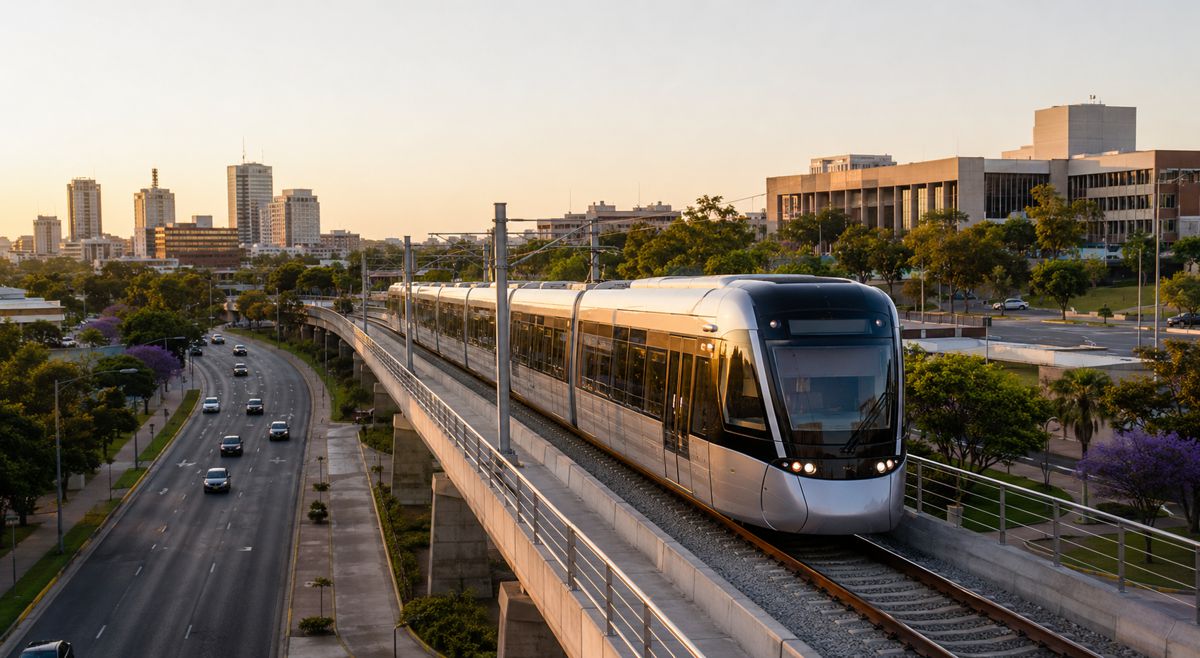
- The network will be built in five phases; Phase One, valued at US$1 billion, links the central business district to Kuwadzana with elevated sections, battery- and solar-powered trains, passenger stations and the main maintenance depot.
- The scheme anchors Harare’s urban-renewal programme ahead of the 2029 Intra-African Trade Fair, alongside a planned convention centre seating between 8,000 and 15,000 delegates and a drive to close a hotel-room shortfall estimated near 11,000.
- Buses are planned as feeders to rail stations, positioning light rail as the high-capacity backbone of an integrated Greater Harare transport system.
A Financing Architecture Built to De-Risk the Build
The commercial substance of this announcement sits in how the project finance is being structured rather than in the US$3 billion topline. The network will be delivered through a public-private partnership, and the lead investor is currently assembling around US$5 million to fund a preparatory phase, with backing expected from the African Development Bank.
That preparatory money is modest against the eventual cost, yet it pays for the work that determines whether the wider scheme becomes bankable: feasibility studies, detailed engineering designs, environmental and social impact assessments, and transaction advisory services. Investors and lenders in this asset class rarely commit large sums until that groundwork exists, so the sequencing matters, and getting it right is precisely how comparable African transit deals have crossed from concept to construction.
Harare City Council’s acting director of town planning, Engineer Samuel Nyabeza, framed the approval as the trigger for that process, noting: “the project has already been approved by ZIDA and has been accorded National Project Status. It is being spearheaded through a partnership involving Government, local authorities and private sector players.” He added: “the investor is currently mobilising approximately US$5 million required for project preparations, with funding support expected from the African Development Bank.”
The involvement of a multilateral lender at the preparatory stage carries weight beyond the cash, because development-finance institutions typically bring procurement discipline, governance expectations and technical scrutiny that strengthen a project’s credibility with commercial co-financiers. National Project Status then layers on the domestic facilitation, aligning ministries and regulators behind a single timetable and reducing the approval friction that so often inflates cost and delay on megaprojects of this scale.
Phase One and the Shape of the First Corridor
Phasing is the mechanism that makes a US$3 billion ambition financeable, and the Harare plan leans on it heavily. The scheme will be delivered in five distinct phases, with Nyabeza confirming: “the estimated cost of the entire project stands at approximately US$3 billion and will be implemented in five distinct phases.” Phase One, valued at US$1 billion, will build the first rail corridor between the central business district and the western high-density suburb of Kuwadzana, and it carries the assets that anchor the whole system: elevated railway sections, battery- and solar-powered trains, modern passenger stations and the project’s main maintenance depot. Concentrating the depot and rolling-stock base in the opening phase is sound practice, since it gives later corridors somewhere to run from and creates a demonstrable, revenue-generating line that de-risks subsequent fundraising.
The later phases sketch the intended reach of the network across Greater Harare. The second phase would extend the railway to Highfield and on to the satellite city of Chitungwiza, while the third connects the city centre with Mabvuku-Tafara to the east. Phase Four would link Cranborne with Robert Gabriel Mugabe International Airport, and the fifth and final phase would join Kuwadzana with the new city rising at Mt Hampden.
The airport and new-city termini are significant for commercial reasons that go beyond geography, because lines serving an international gateway and a planned government district imply a level of service quality aimed at business travellers, officials and visitors, not only mass-market commuters. For engineering and construction firms, the phased structure translates into a sequence of discrete work packages spanning viaduct construction, stations, depot facilities, systems integration and rolling stock, spread over several years of procurement.
The Technical Bet on Battery and Solar Traction
The choice of battery- and solar-powered trains is one of the more consequential technical decisions embedded in the plan, and it separates Harare from the model most often cited on the continent. Addis Ababa’s pioneering light rail, the first in sub-Saharan Africa when it opened in 2015, runs on grid-supplied overhead electrification drawing on Ethiopia’s largely renewable power.
Harare’s proposed reliance on onboard battery power and solar generation reflects a different set of constraints and opportunities, since it reduces exposure to overhead-line infrastructure and grid reliability, both of which have proved challenging in the region. Elevated alignment through the first corridor further limits interference with road traffic and land acquisition along congested routes, a practical advantage in a dense city rebuilding its transport network largely from scratch.
The approach is forward-looking, yet it introduces engineering questions that the preparatory studies will need to answer with care. Battery traction shifts the maintenance burden towards energy storage, charging systems and lifecycle replacement, disciplines that demand robust depot capability and a dependable spares pipeline.
The cautionary reference point is instructive rather than discouraging: Addis Ababa’s fleet reliability suffered over time as spare-part shortages left a large share of its trams out of service, a reminder that traction technology is only as good as the maintenance regime and supply chain behind it. Harare has the chance to design those systems in from the outset, and a battery-and-solar specification, properly supported, could allow the network to leapfrog straight to a lower-carbon, grid-light operating model that newer entrants across Africa are now weighing.
Rail as the Spine of an Integrated Network
Light rail only delivers its promised value when it operates as part of a coherent whole, and the Harare plan is explicit that trains are meant to be the high-volume spine rather than a standalone showpiece. The design envisages buses acting as feeders that carry passengers to rail stations, while trains handle heavier commuter flows over longer distances between suburbs, industrial zones, commercial hubs and government institutions.
The government has been expanding the public bus fleet as part of this integration drive, and reports point to the acquisition of more than 200 buses intended to knit road and rail into a single system. Getting that interchange right, with aligned ticketing, sensible station siting and reliable feeder frequencies, is what separates transit networks that shift travel behaviour from those that simply add a line to a map.
Nyabeza was careful to place the scheme in its proper institutional context, describing it as “part of the city’s long-term plan to improve urban transport and connect key parts of the city, including the CBD, residential areas, industrial zones and major economic corridors.” He also stressed that delivery reaches well beyond a single local authority, clarifying: “this is not a project that the City of Harare can implement on its own. The development of a light rail system is a national-level infrastructure project that will be undertaken in collaboration with relevant Government ministries and State entities responsible for rail transport and major infrastructure development, with possible participation from private sector partners through public-private partnerships.”
The immediate municipal task, safeguarding transport corridors and aligning land-use planning with future routes, is unglamorous but decisive, because protecting alignments early prevents the encroachment that later forces costly diversions or expropriation. That corridor-protection discipline is where a city can quietly add or destroy value long before the first pile is driven.
The 2029 Deadline and Harare’s Wider Renewal Pipeline
The light rail scheme sits inside a much larger urban-renewal programme geared towards the 2029 Intra-African Trade Fair, coordinated at the level of the Office of the President and Cabinet. The event is a genuine forcing function for investment, a point Acting Town Clerk Advocate Warren Chiwawa captured when he argued: “the Intra-African Trade Fair is not simply an event. It is a catalyst for development. It gives Harare an opportunity to accelerate projects that might otherwise take years to implement.”
Alongside the railway, the programme includes a new convention centre seating between 8,000 and 15,000 delegates at Robert Mugabe Square, a redevelopment of the exhibition grounds, and a concerted push to attract private capital into hospitality, retail and mixed-use property. The city expects the fair to draw more than 2,100 exhibitors and well over 100,000 international delegates, a volume that turns transport and accommodation from civic aspiration into hard logistical requirement.
The accommodation gap illustrates the scale of the opportunity for investors and developers. Chiwawa has been candid: “the establishment of the IATFCO (Intra-African Trade Fair Company) Secretariat has exposed a critical gap: Harare currently faces a shortfall of approximately 11 000 hotel rooms,” while Mayor Jacob Mafume has indicated that hosting the fair “requires at least 27,000 rooms at a minimum.” Estimates of the deficit vary across officials and industry bodies, but the direction is consistent and the implication is clear: several years of sustained construction in hotels, exhibition facilities, mixed-use developments and the supporting road, water and power upgrades.
For the wider construction and infrastructure ecosystem, the light rail is best read not in isolation but as the transport backbone of a capital-city renewal pipeline that the 2029 deadline is actively pulling forward.
Where Harare Sits in Africa’s Urban Rail Moment
Harare is stepping into a market that has gathered real momentum after decades of thin investment. Addis Ababa opened sub-Saharan Africa’s first modern light rail in 2015, Abuja followed with West Africa’s first rapid transit line, Morocco has built some of the continent’s largest tram networks across Casablanca, Rabat and Salé, and Senegal’s Dakar Regional Express Train has demonstrated appetite for modern suburban rail.
The common driver is rapid urbanisation outpacing road capacity, combined with financing options that have widened as multilateral lenders, export credit agencies and private partners have grown more comfortable with African transit risk. Harare joining that cohort strengthens a regional pipeline that suppliers of rolling stock, signalling, viaduct systems and depot equipment have every reason to watch.
The comparators also carry practical lessons that a well-prepared Harare programme can absorb. Many of the earlier systems leaned heavily on single-source financing and turnkey delivery, which accelerated construction but sometimes left host operators short on maintenance capacity, local skills and spare-part resilience once the contractors moved on.
Harare’s structure, built around a PPP, African Development Bank preparatory support and a phased corridor plan, points towards a more diversified model, and the emphasis on domestic institutional coordination suggests awareness that long-term operations matter as much as the ribbon-cutting. If the preparatory studies deliver credible ridership forecasts, a realistic maintenance and spares strategy, and transparent procurement that satisfies its development-finance partners, the project has a stronger foundation than a headline figure alone would suggest.
From Approval to Groundbreaking
National Project Status is a meaningful milestone, yet the distance between an approval and a running railway is measured in financial close, procurement integrity and disciplined delivery rather than in announcements. The nearest test is Phase One, where the US$1 billion CBD-to-Kuwadzana corridor must attract firm investment on the back of the preparatory studies now being funded.
Alongside that sits the question of timeline realism, because the ambition to complete the wider network within a few years is stretching against a phased scope of this magnitude and against the fixed 2029 fair date that anchors the surrounding renewal programme. Managing those expectations honestly, and sequencing the corridors so that early wins build confidence, will do more for the project’s credibility than any single financing headline.
The wider prize is worth the rigour it demands. A functioning light rail spine, integrated with an upgraded bus fleet and protected corridors, would give Greater Harare a mobility platform capable of supporting economic activity long after the trade fair has moved on, connecting workers to industry, businesses to markets and the capital to its airport and new city.
The construction and infrastructure sector stands to gain from a multi-year pipeline of viaduct, station, depot and rolling-stock work, while investors gain visibility into a coordinated renewal of a capital positioning itself at the centre of continental trade. Delivery will be the true measure, and the coming preparatory phase is where Harare will show whether the ambition can be converted into steel, concrete and reliable service.
Key Industry Questions
- What does National Project Status actually give the Harare Light Rail Project? National Project Status designates the scheme as strategically important to Zimbabwe, which in practice unlocks accelerated investment facilitation, coordinated support across government ministries and simplified regulatory approvals. For a project of this size, those administrative advantages are frequently the difference between reaching financial close and stalling in planning. The status aligns regulators, land authorities and state entities behind a single timetable, reducing the approval friction that inflates cost and delay on major transit builds. It does not, by itself, provide construction finance, but it materially improves the environment in which that finance can be raised and deployed.
- How will the US$3 billion project be financed? The scheme is structured as a public-private partnership involving government, local authorities and private-sector investors. The lead investor is mobilising around US$5 million for a preparatory phase supported by the African Development Bank, funding feasibility studies, detailed engineering, environmental and social impact assessments, and transaction advisory work. That preparatory stage is what makes the larger raise possible, because lenders and equity partners typically require credible studies before committing to a project of this scale. The involvement of a multilateral development bank early also signals governance and procurement discipline that can attract commercial co-financiers to the subsequent, far larger funding rounds.
- Why are the trains battery- and solar-powered rather than grid-electric? Battery and solar traction reduces reliance on continuous overhead electrification and grid stability, both of which have been challenging across the region. Onboard energy storage and solar generation allow the network to operate with lighter fixed infrastructure and a smaller carbon footprint. The trade-off shifts the maintenance emphasis towards battery lifecycle management, charging systems and depot capability, which the preparatory studies will need to plan for carefully. If the supporting maintenance regime and spares supply are designed in from the start, the specification could let Harare adopt a cleaner, more modern operating model than earlier grid-dependent African systems.
- How does the light rail connect to the rest of Harare’s transport system? The plan positions rail as the high-capacity spine and buses as feeders that carry passengers to and from stations. Trains handle longer, heavier commuter flows between suburbs, industrial zones and commercial hubs, while an expanded bus fleet extends coverage to areas the rail network will not reach in its initial phases. Successful integration depends on aligned ticketing, sensible interchange design and reliable feeder frequencies. The city’s immediate role includes safeguarding transport corridors and aligning land-use planning with future routes, work that protects the network’s value long before construction begins.
- What is the connection between the railway and the 2029 Intra-African Trade Fair? Harare will host the 2029 IATF and the permanent headquarters of the trade fair company, an event expected to attract thousands of exhibitors and well over one hundred thousand delegates. That deadline is accelerating a broad urban-renewal programme that includes the railway, a large convention centre at Robert Mugabe Square, exhibition upgrades and a significant expansion of hotel capacity. The fair effectively converts long-term civic ambitions into time-bound logistical requirements, giving transport and accommodation projects a firm delivery horizon. The light rail is best understood as the transport backbone of that wider renewal pipeline rather than a standalone initiative.
- What opportunities does the project create for construction and infrastructure firms? The phased structure generates a sequence of discrete work packages over several years, spanning elevated viaduct construction, passenger stations, the main maintenance depot, systems integration and rolling-stock supply. Beyond the railway, the surrounding renewal programme adds convention and exhibition facilities, hotels, mixed-use developments and supporting road, water and power upgrades. For engineering consultancies, contractors, equipment suppliers and financiers, the combined pipeline represents sustained multi-year activity in a capital city positioning itself as a continental trade hub. Early corridor and preparatory work also creates openings for feasibility, design and advisory specialists.
- How realistic is the delivery timeline? Officials have indicated an ambition to complete the network within a few years, which appears stretching against a five-phase scope of this magnitude and a fixed 2029 fair date. Large light rail systems elsewhere have typically taken several years per major corridor, even with concentrated financing. The more credible near-term measure is Phase One reaching financial close and breaking ground on the back of the funded studies. Readers should treat headline completion dates as indicative until feasibility and engineering work confirms sequencing, procurement and funding, and until the private partner and financing package are formally in place.
- What are the main risks the project must manage? The principal risks are financing, procurement transparency, maintenance capability and timeline realism. Reaching financial close on Phase One depends on credible ridership forecasts and a bankable structure, while satisfying development-finance partners will require transparent, competitive procurement. Operational sustainability hinges on a robust maintenance regime and spare-part supply, a lesson underscored by reliability struggles on some earlier African systems. Corridor protection and disciplined land-use planning must keep pace so that alignments are not encroached upon before construction. Managing expectations on schedule, and sequencing corridors to deliver early, demonstrable results, will be central to sustaining investor and public confidence.
Strategic Takeaways
- National Project Status and African Development Bank preparatory backing matter more than the US$3 billion headline, because they signal a credible pathway to bankability and the procurement discipline that commercial financiers look for before committing.
- Phase One, the US$1 billion CBD-to-Kuwadzana corridor carrying the depot and rolling-stock base, is the decisive near-term test; its financial close and groundbreaking will indicate whether the wider network is genuinely deliverable.
- The battery-and-solar traction choice could let Harare leapfrog to a lower-carbon, grid-light operating model, but its success depends entirely on a maintenance regime and spares strategy designed in from the outset rather than retrofitted later.
- The 2029 Intra-African Trade Fair is functioning as a forcing mechanism that pulls forward a multi-year renewal pipeline in rail, convention facilities, hotels and mixed-use property, creating sustained opportunity for contractors, suppliers, developers and investors.
- Harare enters a growing African urban-rail market at a moment when financing models and technology have matured, and a PPP-based, multilateral-supported, phased structure gives it a stronger long-term footing than the single-source turnkey approach that left some earlier systems short on maintenance resilience.