Monotch Brings European TLEX Connected Mobility to US Traffic Networks
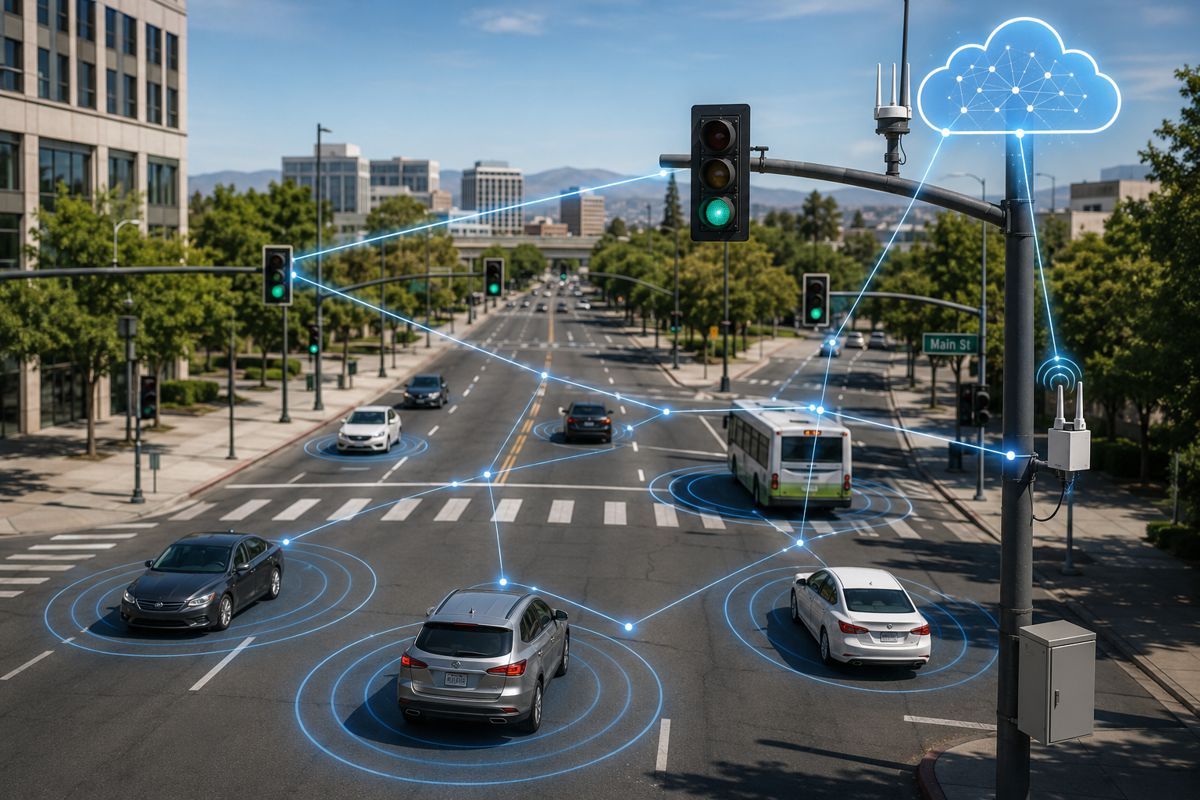
A proven European traffic-data platform is about to meet the messier reality of American signal infrastructure, and the outcome matters well beyond a single boulevard in the San Francisco Bay Area. Monotch and the Contra Costa Transportation Authority (CCTA) have set out a one-year live demonstration in Concord, California, that will connect the Dutch company’s TLEX platform to US traffic signal controllers using American, rather than European, communication standards.
On the surface it is a modest pilot on one road. In practice it is a test of whether the continent that industrialised connected mobility first can export that model into a market with different standards, different spectrum rules and a different procurement culture.
The commercial significance sits in the phrase “existing infrastructure.” Road authorities across North America are under pressure to deliver safer, more responsive networks without ripping out the signal cabinets they already own and maintain. If a cloud-based data layer can sit on top of installed controllers and turn them into sources of real-time, machine-readable information, the economics of connected mobility change for thousands of agencies that could never justify a wholesale hardware replacement. That is the proposition being stress-tested in Concord, and it is why an announcement about one intersection corridor is being watched by planners, suppliers and investors across the intelligent transport sector.
Briefing
- Monotch and CCTA are running a one-year live demonstration on Treat Boulevard in Concord, California, connecting the TLEX platform to Cubic traffic signal controllers under US standards, with backing from the City of Concord and the Dutch Enterprise Agency (RVO).
- The project stems from the Coast2Coast transatlantic collaboration, which Monotch joined in 2024, following a CCTA delegation’s visit to the Netherlands to see TLEX operating at national scale.
- Phase one establishes the technical groundwork: intersection topology, real-time bidirectional data exchange and automated data-quality control in a US environment.
- Phase two moves to services, including Green Light Optimised Speed Advisory (GLOSA) and Time-to-Green, holistic priority and pre-emption, maintenance support and multi-jurisdictional operation.
- CCTA is no ordinary county agency; it operates GoMentum Station in Concord, one of the largest secure connected and automated vehicle proving grounds in the United States.
A proven European platform tests the American market
Monotch built TLEX as the real-time data-sharing layer beneath the Netherlands’ national connected-mobility programme, and the scale of that deployment is what gives this Californian step its weight. In the Netherlands the platform connects the country’s smart traffic lights to road users and authorities in what the company describes as the first countrywide implementation of its kind, handling billions of messages a day and underpinning services such as nationwide emergency-vehicle alerts to millions of connected cars.
The platform has since been extended into Belgium’s Flanders region, Finland and Sweden. For a company founded in 2015, that footprint represents an unusually deep operational record in a field where most connected-vehicle activity still lives in pilots rather than production systems.
Bringing that track record to bear on the US market is the strategic point of the Concord demonstration. Menno Malta, CEO at Monotch, framed the deployment as a proof of adaptability rather than a fresh start, noting: “TLEX already supports large-scale connected mobility ecosystems in Europe. This deployment demonstrates that the same platform approach is adaptable to US standards and infrastructure.” He went further on the commercial implication for road authorities, arguing: “It proves that any and all road authorities can build on existing traffic infrastructure while preparing for the next generation of connected mobility services.” That “build on what you have” message is calibrated for a market where budgets are tight and the installed base of signal equipment is vast, and it is the argument most likely to resonate with the agencies Monotch now hopes to reach across North America.
Why the signal-standards gap is the real technical hurdle
The engineering challenge here is not that traffic signals are exotic, but that Europe and the United States speak different data languages at the roadside. European connected-mobility systems, TLEX among them, exchange messages built on ETSI standards. The American ecosystem is organised around a separate stack: the SAE J2735 message set that defines Signal Phase and Timing (SPaT) and intersection geometry (MAP) messages, the NTCIP 1202 object definitions that govern how signal controllers report their status, and IEEE 1609 security credentials.
Adapting a platform proven under one regime to operate cleanly under the other is a genuine integration task, not a cosmetic relabelling, because the semantics of how an intersection describes itself and its timing differ in ways that matter for safety-critical services.
This is why phase one of the Concord project concentrates on unglamorous but essential groundwork rather than headline applications. Establishing intersection topology means building an accurate, machine-readable description of the corridor’s lanes, movements and geometry so that any downstream service knows exactly what it is looking at.
Real-time bidirectional exchange with the Cubic controllers proves that the platform can both read live signal state and, where appropriate, feed information back. Automated data-quality control, a discipline Monotch has emphasised in its European deployments, continuously checks that the messages flowing through the system are conformant and reliable. Get these prerequisites right and everything else becomes possible; get them wrong and the clever services built on top will quietly fail in ways that erode trust in the whole approach.
The spectrum backdrop that makes a cloud layer attractive
The timing of a cloud-based approach is not incidental, because the United States has spent the past few years unsettling the ground beneath roadside connected-vehicle hardware. In 2020 the Federal Communications Commission reduced the spectrum reserved for intelligent transport systems in the 5.9 GHz band from 75 MHz to 30 MHz, reallocating the remainder to unlicensed Wi-Fi use.
In November 2024 the Commission followed up with final rules mandating a transition from the older Dedicated Short-Range Communications technology to Cellular Vehicle-to-Everything (C-V2X), setting a two-year sunset for legacy DSRC operations. For agencies that had invested in roadside units built around the older approach, that regulatory churn has been costly and disorienting.
Against that backdrop, a platform that moves signal data through the network rather than depending solely on dedicated roadside radios has an obvious appeal. A cloud data-exchange layer decouples connected-mobility services from the specific radio technology broadcasting at the kerbside, which means the services can keep running while the spectrum picture continues to shift.
It also lets a single intersection’s data reach many consumers at once, from in-vehicle systems to fleet operators to city management platforms, without each requiring its own line-of-sight roadside installation. None of this makes direct short-range communication redundant, but it does explain why a network-centric model is a pragmatic fit for the current American moment, and why demonstrating it on real US controllers is worth doing now rather than later.
From foundation to functionality in phase two
Once the groundwork is proven, the second phase turns to the services that road users and agencies actually notice. GLOSA and Time-to-Green advise drivers on the speed that will let them meet the next green, smoothing flow and cutting the stop-start driving that wastes fuel and raises emissions; these are among the most mature connected-mobility services in Europe and a natural first proof point in the US.
Holistic priority and pre-emption extend the same real-time link to buses, emergency vehicles and other designated traffic, allowing signals to respond to what is approaching rather than running blind to it. The phase also covers support for management and maintenance processes and multi-jurisdictional capabilities, the latter mattering enormously in a country where a single commuter corridor can cross several municipal and county boundaries, each with its own equipment and operating practices.
Tim Haile, Executive Director of CCTA, positioned the work as foundational rather than finished, emphasising the collaborative model behind it. He observed: “This project shows what is possible when public agencies, technology providers, and international partners work together on practical connected mobility innovation. By demonstrating real-time, bi-directional data exchange with existing traffic signal infrastructure, we are laying the groundwork for safer, smarter and more coordinated mobility services.”
The value of a one-year demonstration is not a single dramatic feature but a validated, repeatable method for turning existing signals into connected assets, from which priority, pre-emption, emergency alerts and speed advisories can all be built. Proving the method on one corridor is the precondition for scaling it across many.
Contra Costa’s connected-vehicle pedigree raises the stakes
The choice of partner gives the demonstration credibility that a less experienced agency could not provide. CCTA is the transportation planning and congestion-management agency for Contra Costa County, but it is best known in intelligent-transport circles as the operator of GoMentum Station, a former naval weapons station in Concord that it converted into one of the largest secure connected and automated vehicle proving grounds in the country.
The site has hosted testing by major automakers and technology developers and has been a designated federal proving ground, giving the authority more than a decade of hands-on exposure to the vehicles and systems that connected infrastructure is meant to serve. That history means CCTA understands both the roadside and the vehicle side of the equation in a way few local agencies do.
Situating the TLEX demonstration on public streets in Concord, rather than inside the controlled confines of GoMentum, is itself a statement of intent. It signals a move from closed-course experimentation toward real-world municipal deployment, on the same equipment and under the same constraints that any city faces.
The involvement of the City of Concord grounds the project in day-to-day operations, while the Dutch Enterprise Agency’s support reflects a wider strategy of positioning Dutch mobility technology in export markets. For a company building its US presence, having a first American reference customer with CCTA’s standing is worth considerably more than a pilot with an agency the sector has never heard of.
The wider signal for road authorities and suppliers
Read in isolation, a one-year test on Treat Boulevard is a small thing; read against the state of the market, it is a marker of where connected mobility is heading. The transatlantic route matters because it shifts the question from whether large-scale, standards-based connected mobility can work to whether a working model can be transplanted across regulatory and technical borders.
If Monotch can show that a platform hardened in Europe operates cleanly on US controllers and US standards, it lowers the perceived risk for every American agency weighing a connected-mobility programme, and it hands suppliers a template for competing on integration and services rather than on proprietary hardware. The Coast2Coast collaboration that seeded the project also points to a growing appetite for pooling connected-vehicle experience across the Atlantic instead of each market relearning the same lessons.
The more durable theme is the move toward interoperable, infrastructure-light connected mobility. A model that upgrades existing signals into data sources, survives shifting spectrum rules and serves many consumers from a single feed is well suited to a public sector that must modernise without heavy capital outlay. Whether the Concord demonstration ultimately scales will depend on the numbers it produces over its live year and on how cleanly the second-phase services perform on American streets.
What is already clear is that the project is testing the right thing at the right time, and that its results will inform procurement and technology choices well beyond one Californian county.
Key Industry Questions
- What is the TLEX platform and what does it actually do? TLEX, developed by the Dutch company Monotch, is a real-time data-sharing layer that connects road infrastructure, road users, applications and data networks. Rather than being a traffic-signal system itself, it sits above installed signal controllers and exchanges standardised messages bidirectionally, so that live signal state can be shared with vehicles, fleets and city platforms while relevant data flows back. In the Netherlands it underpins the national connected-mobility programme, linking the country’s smart traffic lights and supporting services such as emergency-vehicle alerts to millions of connected cars. The Concord demonstration tests whether that same architecture can operate on US controllers using American standards.
- Why does adapting a European platform to US standards matter? Europe and the United States use different technical standards for connected mobility. European systems, including TLEX, are built on ETSI messaging, whereas the US ecosystem uses the SAE J2735 message set for SPaT and MAP data, NTCIP 1202 for controller communication and IEEE 1609 for security. These are not interchangeable, so a platform proven under one regime must be genuinely re-engineered to work under the other. Demonstrating that adaptation on live US equipment reduces the technical uncertainty for American agencies and shows that European connected-mobility experience can be transferred rather than rebuilt from scratch, which has direct commercial implications for market entry.
- How does the FCC’s 5.9 GHz spectrum transition affect this project? The FCC cut the spectrum reserved for intelligent transport in the 5.9 GHz band in 2020 and, in November 2024, finalised rules moving the sector from DSRC to C-V2X, with a two-year sunset for the older technology. That churn has complicated investment in roadside radio hardware. A cloud-based data layer such as TLEX is attractive precisely because it moves signal data through the network and does not depend solely on a particular short-range radio standard, so connected-mobility services can continue operating as the spectrum picture evolves. The Concord project reflects this network-centric logic without making direct communication obsolete.
- What are GLOSA and signal priority, and why are they included? Green Light Optimised Speed Advisory (GLOSA) and Time-to-Green tell drivers the speed likely to let them catch the next green, smoothing traffic flow and reducing unnecessary stopping, braking and idling. Signal priority and pre-emption give designated vehicles, such as buses and emergency services, favourable treatment at intersections by letting signals respond to their approach in real time. Both are among the most established connected-mobility services in Europe, which makes them logical first services to validate in a US setting once the underlying data foundation is proven. They translate the abstract benefit of connected infrastructure into outcomes drivers and agencies can measure.
- Why is CCTA a significant partner for a demonstration like this? CCTA is the transportation planning and congestion-management agency for Contra Costa County, but its wider reputation rests on operating GoMentum Station in Concord, one of the largest secure connected and automated vehicle proving grounds in the United States. That gives the authority more than a decade of experience with both connected infrastructure and the vehicles it serves, and a federal-proving-ground pedigree that few local agencies can match. Running the TLEX demonstration on public streets rather than inside GoMentum signals a deliberate move from closed-course testing toward real municipal deployment, which makes CCTA a credible first American reference customer for Monotch.
- Could this approach scale beyond a single corridor? Scaling is the explicit ambition. The project is structured so that phase one establishes a repeatable method for connecting existing controllers, and phase two proves the services that method enables, including the multi-jurisdictional capability needed where corridors cross municipal and county lines. Because the platform is cloud-based and standards-driven, extending it in principle means onboarding more intersections rather than deploying bespoke hardware at each one. Whether it scales in practice will depend on the operational data gathered over the live year, the cleanliness of the standards integration and the business case agencies can build once real performance figures exist.
- What does this mean for road authorities that cannot afford new hardware? The central pitch is that connected mobility need not require replacing installed signal equipment. If a data layer can upgrade existing controllers into real-time information sources, agencies that could never justify a wholesale hardware programme gain a lower-cost route into connected services. That reframes connected mobility from a capital-heavy infrastructure project into a largely software and integration exercise, which matters for the many authorities operating under constrained budgets. The Concord demonstration is intended to provide the evidence base for that argument, though each agency will still need to weigh integration effort, data-quality assurance and ongoing operating costs.
- How does the Coast2Coast collaboration fit into the wider picture? Coast2Coast is a transatlantic collaboration that brings together public agencies, industry and research organisations in Europe and North America to advance connected and clean mobility, and Monotch joined it in 2024. The Concord project grew directly out of that network, following a CCTA delegation’s visit to the Netherlands to see TLEX operating nationally. The collaboration matters because it institutionalises the exchange of connected-vehicle experience across the Atlantic, allowing markets to share hard-won operational lessons rather than each relearning them independently. For the sector, it points to a more coordinated international approach to a technology whose value grows with interoperability.
Strategic Takeaways
- The decisive commercial idea is upgrading existing signal controllers into real-time data sources, which reframes connected mobility as a software and integration exercise rather than a capital-heavy hardware replacement, opening the market to budget-constrained agencies.
- Standards adaptation is the true technical test; proving that a Europe-hardened platform works cleanly under US SAE J2735, NTCIP and IEEE frameworks de-risks connected mobility for American authorities and rewards suppliers who compete on integration rather than proprietary equipment.
- A cloud-based, network-centric data layer is well matched to the post-2024 US environment, where the FCC’s shift from DSRC to C-V2X has made investment in roadside radio hardware more uncertain and infrastructure-light approaches correspondingly more attractive.
- CCTA’s standing as operator of GoMentum Station gives the demonstration unusual credibility, and moving it onto public streets in Concord marks a deliberate transition from closed-course testing toward scalable municipal deployment that other agencies will watch closely.
- The transatlantic route, seeded by the Coast2Coast collaboration, signals a maturing model in which connected-mobility experience is exported and shared across regulatory borders, likely influencing procurement, standards alignment and technology adoption well beyond a single Californian corridor.