The Green Steel Bottleneck Is Demand, Not Supply
For most of the past decade, the argument over decarbonising steel has been framed as a supply problem: how to build the hydrogen plants, secure the renewable power and prove that iron ore can be reduced without coal. Northern Europe has now largely answered that question, with large-scale near-zero plants moving from blueprint to commissioning.
A new assessment from the Finnish civil society organisation Just Shift shifts the spotlight to the other side of the ledger, and its conclusion is uncomfortable for an industry that consumes vast tonnages of the metal. The binding constraint on Europe’s green steel transition is no longer whether the material can be made, but whether the companies best placed to buy it are willing to commit.
The Sustainable Steel Scoreboard 2026, the third annual edition of the exercise, ranks 15 large publicly traded Nordic steel buyers on how closely their steel supply chains align with a pathway consistent with limiting warming to 1.5°C. The headline finding matters well beyond Scandinavia. Steel accounts for roughly 5% of the European Union’s greenhouse gas emissions and more than a quarter of its industrial emissions, so the buying decisions of a relatively small number of heavy industrial firms carry disproportionate weight in whether the bloc hits its climate targets.
Just Shift calculates that if the best practices already visible somewhere in the group were adopted across all of it, demand for near-zero steel could roughly triple, a demand signal large enough to underpin the multi-billion-euro plants now being built, and one that current corporate behaviour is not yet sending.
Briefing
- Just Shift’s Sustainable Steel Scoreboard 2026 assesses 15 major Nordic steel buyers and identifies weak private-sector demand as the main bottleneck holding back a Paris-aligned steel sector.
- The average steel supply-chain score across the group is 23%, up sharply from just 3% a year earlier, but adopting existing best practice across all 15 companies could lift the average to 83% and roughly triple green steel demand.
- Machinery firms lead the field, with Sweden’s SKF top on 65%, while all three construction contractors assessed, Skanska, YIT and Veidekke, score below 20%.
- Country-level averages diverge sharply: Denmark leads on 29% and Sweden follows on 28%, well ahead of Finland on 13% and Norway on 4%.
- The report lands as CBAM takes effect and the European Commission’s proposed Industrial Accelerator Act moves to require at least 25% low-carbon steel in publicly procured construction and infrastructure from 2029.
Why buyers, not producers, now set the pace
The commercial logic behind the report is straightforward, and it is one that infrastructure owners and contractors will recognise from their own capital planning. Producers of near-zero steel are asking investors to underwrite plants costing several billion euros each, against a product that carries a price premium and competes in a notoriously low-margin, price-driven commodity market. What de-risks that investment is not a subsidy or a slogan but a firm order book: binding offtake agreements that give lenders confidence the output will be sold.
Every large buyer that commits to fossil-free steel therefore does more than clean up its own supply chain; it shortens the odds on the next plant reaching a final investment decision. Just Shift’s central argument is that Nordic buyers, sitting alongside the emerging producers, are unusually well placed to send exactly this signal and are not doing so at anything like the scale the moment requires.
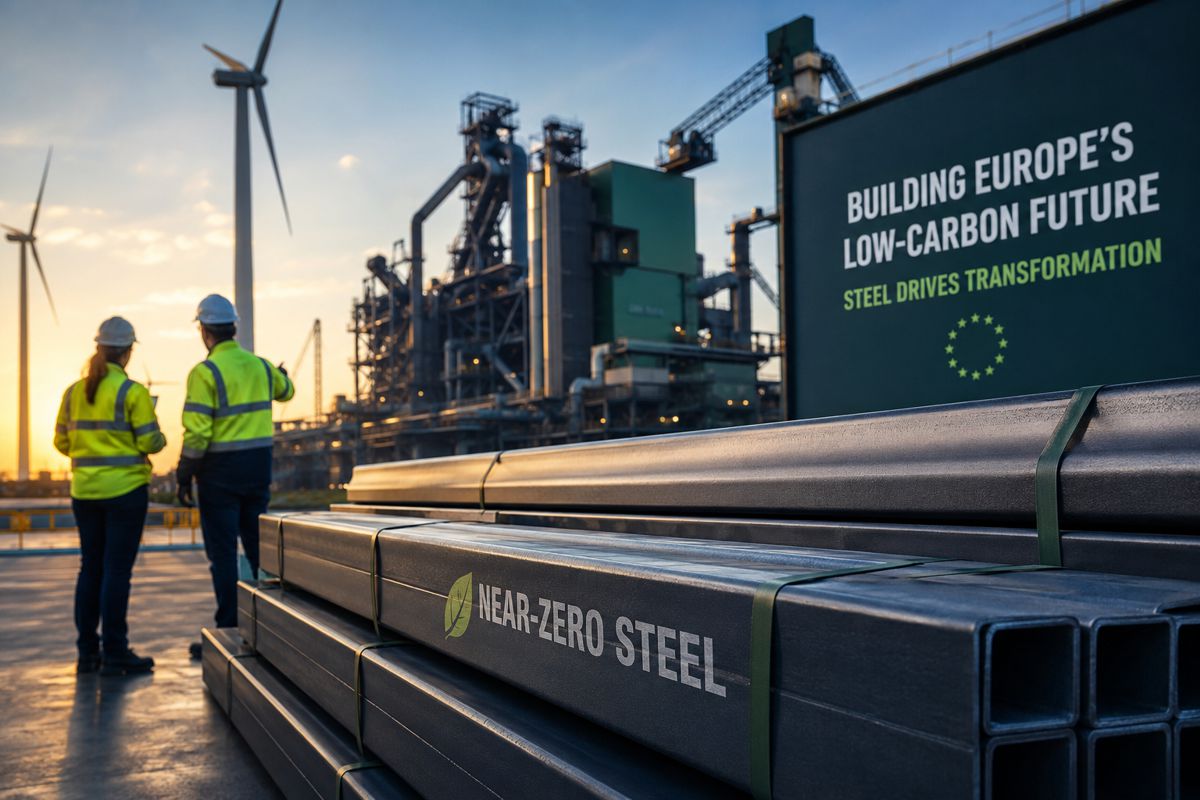
That gap is thrown into relief by what is happening on the supply side within a few hundred kilometres of most of these companies’ headquarters. Sweden’s Stegra, formerly H2 Green Steel, has raised close to €6.5 billion and is bringing the world’s first large-scale green steel plant at Boden towards production, initially at around 2.5 million tonnes a year and rising towards five million, using hydrogen-based direct reduction to cut emissions by up to 95%. It has already signed customer agreements spanning automotive, packaging and consumer goods, including deals connected to Volvo Group, Scania and IKEA’s Ingka Group.
In parallel, the HYBRIT venture backed by SSAB, LKAB and Vattenfall continues to develop the ore-based hydrogen route, albeit with well-documented delays to LKAB’s demonstration plans. Both projects illustrate the same point: the technology risk is being retired, the financing is being assembled, and the remaining uncertainty is demand. Recent funding nerves around Stegra, including state-aid friction and write-downs, only sharpen the case that steady, contracted buyers are what the sector most needs.
Machinery leads while construction and carmakers disappoint
The most striking pattern in the scoreboard is that the sector doing most to pull green steel through the market is not the one theory would predict. Machinery companies, not usually seen as prime candidates to create lead markets, top the table. Sweden’s SKF, a bearings and industrial engineering group employing more than 38,000 people, leads on 65%, well ahead of the pack.
Its position reflects a view of the material that its Group Circularity Manager, Daniel Bosson, sets out: “Steel is SKF’s most important raw material and the single largest contributor to our upstream carbon footprint. That makes decarbonising the steel value chain essential to achieving our net-zero ambition by 2050. We do not see low-carbon steel as a niche or premium option, but as a foundational industrial material that must scale rapidly.” Smaller machinery firm Lindab, with around 5,000 staff, also performs relatively well, evidence that even mid-sized buyers can exert leverage over producers, while Valmet’s improvement is attributed largely to the discipline of building a credible climate transition plan. The Danish wind majors Vestas and Ørsted score competitively too, underlining how far the renewables industry has moved to anchor demand for fossil-free steel.
The disappointment sits precisely in the sectors that ought to be leading. Automotive, construction and white goods are widely regarded as the most promising creators of lead markets for near-zero steel, yet the companies representing them perform only moderately at best. The heavy-vehicle manufacturers Volvo Group and Scania score 24% and 22% respectively, and Electrolux, the sole consumer-facing name on the list, manages just 22% despite the visibility of household products.
The construction result is the sharpest of all: the three contractors assessed each score below 20% for their steel supply chains, placing the sector at the bottom of a field it might have been expected to shape. The context makes the finding less surprising but no more comfortable, since construction combines thin margins with high steel intensity, leaving it with the least ambitious implied decarbonisation pathway of any major steel-using sector in Europe. Set against an overall average that has climbed from a negligible 3% only a year ago to 23% today, the improvement is real, but the distance still to travel is considerable, and the laggards are concentrated where the tonnages are largest.
A Nordic advantage the region is not fully using
Geography hands the assessed companies a strategic advantage that the report argues is being left on the table. The Nordic region hosts an outsized share of Europe’s emerging fossil-free steel capacity, which gives local buyers unusual proximity, familiarity and negotiating access when it comes to securing early offtake. Locking in binding agreements now would position these firms among the first global buyers of near-zero steel and hand them a genuine first-mover position in a market that regulation is about to reshape. Yet the country-level scores show the opportunity being seized unevenly.
Denmark leads on an average of 29%, with Sweden close behind on 28%, both drawing on active corporate engagement and the presence of ambitious renewable and industrial players. Finland trails on 13% and Norway sits at the bottom on just 4%, a striking spread within a region often treated as a single, uniformly progressive bloc.
The divergence is instructive because it is not explained by access to supply, which is broadly shared, but by corporate willingness to act on it. Swedish and Danish firms are already using procurement practices, supplier engagement and transition planning to move ahead, while several Finnish and Norwegian names have been slower to translate stated ambition into supply-chain decisions.
The report also assesses a broader category of general supply-chain sustainability, where performance is more even and the average has edged up from 23% to 27%, with Metso taking the lead. That gap between a reasonably steady general performance and a far more volatile steel-specific one suggests the problem is not a lack of sustainability capability in the abstract, but a failure to carry it into the specific, harder commitments, offtake deals, fossil-free steel targets, supplier requirements, that actually shift demand from coal-based production to near-zero technology.
Procurement mandates and the coming demand floor
The policy backdrop is what turns this from an ESG scorecard into a commercial early-warning for the construction and infrastructure sector. The report’s steel specialist, Ninni Kähkönen, frames the core problem in terms of incentives rather than tools: “Public procurement is not enough to create lead markets for green steel. Companies already have powerful tools at their disposal, but there is not enough incentive to use them.” That observation cuts both ways as European rules tighten.
The Carbon Border Adjustment Mechanism took effect in January 2026, and the phased withdrawal of free emissions allowances between 2026 and 2034 will steadily raise the cost of high-emission steelmaking within the EU, narrowing the price gap that has long protected conventional material. On the demand side, the European Commission’s proposed Industrial Accelerator Act, published in March 2026, would from 2029 require at least 25% of the steel used in publicly procured buildings, infrastructure and vehicle projects to qualify as low-carbon, alongside thresholds for concrete and aluminium.
For contractors bidding on public work, that is a demand floor written into procurement law rather than a voluntary aspiration, and it lands directly on the sector currently scoring worst in the Just Shift assessment. The important caveat is that the Act remains a proposal moving through the legislative process, and a shared EU definition of “low-carbon steel” has yet to be settled, which leaves the eventual stringency of the rule genuinely uncertain.
There is also tension between the two threads of the story worth flagging: the report insists public procurement alone cannot build lead markets, while the Commission is betting heavily that public procurement mandates can. The likely resolution is that neither works in isolation. Market data through early 2026 showed green steel demand thin and buyers resisting premiums, with producers quoting figures of several hundred euros a tonne against buyer willingness to pay a fraction of that, and spot activity close to absent. Regulation may set a floor, but it is contracted corporate demand, the very thing the scoreboard measures, that turns a floor into a functioning market.
What the next procurement cycle will decide
Read together, the report and its policy context describe a narrow but real window. The plants are being built, the carbon-cost trajectory is turning against conventional steel, and procurement rules are being drafted that will eventually oblige large parts of the construction and infrastructure supply chain to specify low-carbon material whether or not it commands a voluntary premium today.
The firms that move first, negotiating offtake, embedding fossil-free steel targets into procurement criteria and requiring emissions data from suppliers, stand to secure both preferential access to constrained early volumes and a defensible position when mandates bite. Those that wait risk being exposed on two fronts at once, paying rising carbon costs on high-emission material while scrambling to meet content thresholds against a supply base that others have already contracted.
The construction sector’s low scores are therefore less a verdict on the past than a signal about the next few procurement cycles. Nordic contractors and their peers across Europe have the proximity to producers, the balance-sheet capacity and, increasingly, the regulatory reason to act, and the assessment shows that the tools to close most of the gap already exist within the group. The open question is one of incentive and timing rather than technology or availability.
Whether the demand signal materialises at the scale required will be settled not in climate strategies or annual reports but in the specifications, tenders and offtake agreements written over the coming two to three years, and the companies that treat near-zero steel as a foundational material rather than a premium option are the ones likely to define the terms of that market.
Key Industry Questions
- Why does weak steel demand matter to construction and infrastructure specifically? Steel is one of the most emissions-intensive materials in any major project, and it sits at the heart of most corporate Scope 3 footprints for contractors. Weak demand from large buyers slows the scaling of near-zero production, which keeps premiums high and availability limited for everyone downstream. For construction firms this creates a double exposure: rising carbon costs on conventional steel as EU allowances phase out, and looming procurement rules that will require low-carbon content on public work. Firms that fail to build supplier relationships and offtake positions early may find themselves competing for scarce certified tonnage later, at a moment when demand across sectors is rising simultaneously and producers favour buyers who committed when the market most needed the signal.
- What is “near-zero” or “fossil-free” steel, and how is it made? Near-zero steel is produced through routes that largely eliminate the coal used in conventional blast-furnace steelmaking. The leading primary route uses hydrogen produced from renewable electricity to reduce iron ore into direct-reduced iron, which is then processed in an electric arc furnace, cutting emissions by up to around 95% versus the traditional process. A second route relies on electric arc furnaces charged mainly with recycled scrap and powered by clean electricity, which is commercially mature but constrained by scrap availability and quality. Definitions vary, and pricing agencies commonly reference an emissions threshold of roughly 0.8 tonnes of CO2 equivalent per tonne of steel. The absence of a single agreed European definition remains a practical obstacle to procurement and certification.
- How significant is the Nordic supply base for European green steel? It is disproportionately important relative to the region’s size. Sweden hosts both the large-scale Stegra plant at Boden, which is moving towards production with capacity building towards five million tonnes a year, and the HYBRIT venture developing the ore-based hydrogen route. This concentration gives Nordic steel buyers proximity, familiarity and early access to negotiate offtake that buyers elsewhere lack. The Just Shift report argues this advantage is being underused, particularly by Finnish and Norwegian companies. For the wider European market, the region functions as a proving ground: if local buyers cannot generate sufficient contracted demand next to the production, the case for replicating such plants elsewhere becomes harder to finance.
- What is an offtake agreement and why does it de-risk green steel investment? An offtake agreement is a binding commitment by a buyer to purchase a defined volume of output, often at an agreed price or premium, over a set period. For producers building multi-billion-euro plants, these contracts are what convince lenders and investors the output will sell, transforming a speculative project into a financeable one. They matter more for green steel than for conventional commodities because near-zero producers carry higher upfront costs and charge a premium that must be underwritten by committed demand. The Just Shift report treats the presence or absence of such agreements as a key indicator, because a company can make climate pledges yet still fail to send the concrete demand signal that actually moves capital into new production.
- How will the EU’s Industrial Accelerator Act affect steel procurement? The Act, proposed by the European Commission in March 2026, would introduce low-carbon content requirements into public procurement and support schemes. From 1 January 2029, at least 25% of the steel used in covered buildings, infrastructure and vehicle projects would need to qualify as low-carbon, with separate thresholds for concrete and aluminium. Notably, steel is subject to a low-carbon threshold but not an EU-origin requirement, unlike some other materials. The proposal is still moving through the legislative process, and the definition of “low-carbon steel” and its supporting delegated acts have yet to be finalised, so the eventual stringency is uncertain. Contractors on publicly funded work should nonetheless begin mapping which packages are most exposed and preparing verifiable emissions data.
- Why are premiums for green steel proving so hard to sustain? The premium reflects the higher cost of hydrogen-based or scrap-based clean production, but it collides with a low-margin, price-competitive market in which many buyers are unwilling or unable to pay extra. Through early 2026, producers were quoting premiums of several hundred euros a tonne while buyers indicated willingness to pay only a fraction of that, and spot activity was minimal. Demand has concentrated in sectors where emissions are visible and costs can be passed to end customers, such as automotive and data-centre construction. Broader adoption depends on carbon costs rising through the EU emissions system, procurement mandates creating guaranteed demand, and production scaling to narrow the cost gap over the coming decade.
- Which sectors are best and worst positioned to lead green steel demand? On the Just Shift assessment, machinery firms lead unexpectedly, headed by SKF, with renewable-energy companies also performing well. The theoretically strong candidates disappoint: heavy-vehicle makers Volvo Group and Scania score in the low twenties, the sole consumer-goods firm assessed scores similarly, and all three construction contractors fall below 20%. Construction’s position reflects structurally thin margins and high steel intensity, which leave it with limited capacity to absorb premiums and the least ambitious implied decarbonisation pathway among major steel users. This matters because construction and infrastructure account for a large share of steel consumption, so the sector’s reluctance has an outsized effect on overall demand — and it is precisely the sector that forthcoming procurement rules will target first.
- What practical steps close the gap between a company’s ambition and its steel demand signal? The report points to a consistent set of measures that separate leaders from laggards. These include entering binding offtake or purchasing agreements with near-zero producers, setting time-bound targets for fossil-free and recycled steel, embedding greenhouse gas criteria directly into procurement and supplier selection, and requiring emissions data from suppliers through mechanisms such as environmental product declarations. Joining multi-buyer initiatives that aggregate demand also strengthens the signal to producers. The common thread is moving beyond general sustainability reporting into specific, contractual commitments on steel itself. The scoreboard’s finding that companies perform far more evenly on general sustainability than on steel-specific action suggests the capability exists; what is missing is the decision to apply it to this material.
Strategic Takeaways
- The constraint on Europe’s green steel transition has shifted from production to demand, which means the buyers who sign early offtake — not the producers — now hold the decisive lever over whether new near-zero plants get financed and built.
- Construction and infrastructure contractors sit at the bottom of the demand league table just as EU procurement rules prepare to mandate low-carbon steel content, creating a compliance and competitiveness exposure that will grow through the 2029 threshold and beyond.
- Proximity to Nordic production is a first-mover advantage that most assessed buyers are underusing; securing contracted volumes now offers preferential access to constrained early supply before mandate-driven demand tightens the market.
- Carbon economics are turning structurally against conventional steel as CBAM operates and free EU emissions allowances phase out to 2034, steadily eroding the cost advantage that has justified buyer resistance to green premiums.
- The likely path to functioning lead markets combines regulatory demand floors with contracted corporate demand; firms that treat near-zero steel as a foundational material and act before definitions and mandates are finalised will help set the terms others must later follow.