China’s Coal Mining Reinvention to go on Show at Beijing’s CICEME Expo 2026
China mines and burns more coal than the rest of the world combined, and the way it chooses to modernise that output will shape equipment markets, safety standards and emissions trajectories far beyond its own borders.
The 19th Beijing International Coal Mining Technology and Equipment Exhibition, trading as CICEME Expo 2026, arrives as more than a routine trade fair. Scheduled for 27 to 29 October 2026 at the Shunyi Hall of the Capital International Convention and Exhibition Center, the event has been running since 2003 and now enters its nineteenth edition, positioning itself as a barometer for how the world’s largest coal producer intends to reconcile energy security with decarbonisation.
For international suppliers, buyers and investors, the exhibition offers a concentrated read on where procurement budgets and technical priorities are heading.
The timing is significant because the underlying market is moving in two directions at once. Chinese coal output reached a record 4.83 billion tonnes in 2025, up 1.2 per cent on the previous year, yet coal-fired power generation fell for the first time in roughly a decade as wind and solar finally outpaced demand growth. That divergence, rising extraction alongside softening thermal demand, is precisely the tension CICEME 2026 is built to address.
The organisers have framed the programme around intelligent mining and low-carbon transformation, themes that reflect a national strategy to extract more value and safety from each tonne while lowering the carbon intensity of the whole chain. The exhibition therefore functions as a live inventory of the technologies China is betting on to keep coal viable in a decarbonising economy.
Briefing
- CICEME Expo 2026 runs from 27 to 29 October 2026 at the Capital International Convention and Exhibition Center in Beijing, marking the nineteenth edition of an exhibition first staged in 2003.
- China produced a record 4.83 billion tonnes of coal in 2025, roughly half the global total, even as coal-fired power generation posted its first annual decline in around ten years.
- By the end of 2025, some 1,066 Chinese coal mines had adopted intelligent systems, supporting more than 65 per cent of national coal production capacity, while autonomous mining trucks in service passed 4,000 units.
- Concurrent technical conferences cover underground 5G, high-precision positioning, obstacle avoidance, tunnelling-machine guidance and driverless auxiliary transport, mapping the priorities of the next investment cycle.
- Overseas mining associations from Germany, the United Kingdom, Australia, Chile, Poland and South Africa have been invited, underlining the event’s role as a supply-and-demand matching hub for international vendors.
Intelligent and Unmanned Mining Take Centre Stage
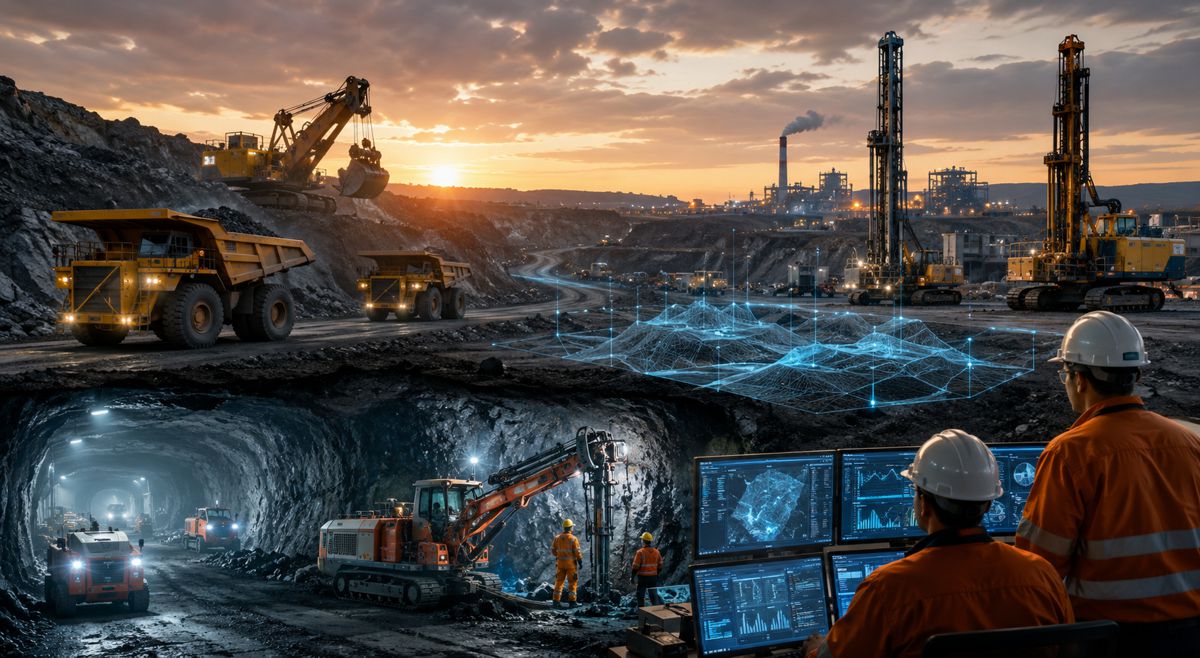
The commercial heart of CICEME 2026 sits in its Intelligent Mining Technology zone, and for good reason. China has moved from pilot projects to large-scale deployment at a pace few markets can match, with the China National Coal Association reporting 1,066 mines running intelligent systems by the close of 2025, a base that now underpins more than 65 per cent of the country’s coal production capacity.
The clearest signal of momentum is in haulage. Autonomous vehicles operating in open-pit mines rose from just 88 in 2020 to more than 4,000 in 2025, roughly doubling year on year, a build-out that has turned China into the largest testing ground on earth for driverless heavy equipment. In May 2025 the Yimin open-pit mine in Inner Mongolia deployed what was billed as the world’s first fleet of 100 autonomous electric mining trucks, a milestone that demonstrated the technology at genuine industrial scale rather than in isolated trials.
For equipment makers and their customers, the economics behind this shift are straightforward and compelling. Automated haulage, remote-controlled shearers and AI-driven monitoring reduce the number of workers exposed to hazardous underground conditions, cut labour costs and lift utilisation of expensive assets.
Provincial data illustrates the ambition: Shanxi built 400 intelligent coal mines during the 2021 to 2025 planning period and has set a target of basic intelligentisation across all normally operating mines by 2027. The direction of travel is captured by a Shanxi mining specialist named Hao, quoted by People’s Daily Online, who observed that fully unmanned mining is no longer a distant vision.
That confidence is now feeding an export story, as Chinese vendors package integrated systems that pair domestically developed hardware with AI and cloud platforms, a proposition CICEME 2026 is designed to place in front of international buyers.
Clean Utilisation and the Dual-Carbon Framework
If intelligent mining is the productivity story, clean utilisation is the licence-to-operate story, and the exhibition’s dedicated zone reflects how central it has become. China’s dual-carbon policy, which commits the country to peaking carbon dioxide emissions before 2030 and reaching neutrality before 2060, has pushed carbon capture, ultra-low-emission coal power, coal-to-chemicals and advanced coal washing from the margins into mainstream procurement.
National policy has moved in step. The National Development and Reform Commission approved 148 national demonstration projects across 2024 and 2025 spanning green hydrogen, carbon capture, utilisation and storage, and low-carbon steelmaking, while a coal-power retrofit programme targets an average 20 per cent cut in emissions per kilowatt hour against 2023 levels from 2025, rising to 50 per cent for a further tranche from 2027.
What this means in practice is that coal is being re-engineered rather than abandoned, and the CICEME 2026 clean utilisation exhibits show where the money is flowing. Carbon capture, storage and utilisation technologies, high-end coal chemical products and efficient processing equipment such as flotation machines, banana screens and centrifuges all feature prominently.
The commercial logic is durable because coal still supplied roughly 54.6 per cent of China’s electricity in 2025 and remains the backbone of grid reliability, even as its share slowly cedes ground to renewables. Under the Energy Law that took effect in 2025, coal is formally cast in a supporting role to renewable energy, which sharpens the incentive to lower the carbon footprint of every remaining tonne.
For international suppliers of emissions-control and coal-chemical technology, that regulatory clarity translates into a defined and sizeable addressable market.
Underground Connectivity and Safety Drive the Conference Agenda
The concurrent conference programme is where the exhibition’s technical ambitions are most sharply defined, and it reads as a roadmap of the next capital cycle. Sessions dedicated to underground 5G high-speed wireless communication, high-precision positioning systems, obstacle avoidance based on precision navigation, tunnelling-machine guidance and driverless auxiliary transport vehicles collectively describe the connective tissue that makes unmanned mining possible.
Underground environments strip away the satellite signals and telecoms coverage that autonomy relies on at the surface, so reliable low-latency communication and centimetre-grade positioning are the enabling layer beneath every driverless truck and remotely operated cutter. China’s early lead here is instructive, with the first commercial 5G network beneath a coal shaft commissioned at Yangquan’s Xinyuan mine as far back as 2020, a deployment that allowed one underground working team to shrink from more than 170 workers to around 90 while maintaining output.
Safety sits alongside connectivity as the second organising principle, and the exhibition’s Safety Management Technology zone reflects a market shaped by hard regulatory pressure. Disaster monitoring and early-warning systems, digital-twin safety platforms, refuge chambers and self-rescue equipment are grouped together because Chinese regulators have made accident prevention a precondition of licensed operation, most visibly through waves of safety inspections that curbed production in the second half of 2025.
For vendors, safety and connectivity are increasingly sold as a single stack, since the same 5G backbone and positioning grid that enable automation also feed the sensors and analytics that keep workers out of harm’s way. That convergence is a meaningful commercial signal, because it points to integrated bids rather than piecemeal equipment sales, favouring suppliers who can deliver an entire digital layer rather than a single component.
Beijing’s Convening Power and the International Sourcing Dimension
The choice of Beijing as host is a deliberate part of the commercial proposition, and the organisers lean heavily on the city’s status as a nexus for energy sector decision-making. They note that Beijing hosts the headquarters of the great majority of China’s central energy enterprises alongside branches of the world’s leading energy companies, and that proximity to Zhongguancun Science Park and national energy research institutes places buyers, suppliers and researchers within reach of one another.
For an international vendor, the appeal is access to concentrated purchasing authority in a single window, with the exhibition’s precise invitation model designed to put suppliers in front of qualified buyers rather than casual footfall. That structure matters more in a slower global capital-goods market, where face-to-face matching that shortens sales cycles carries real value.
The international guest list reinforces the point. Mining and coal machinery associations from Germany, the United Kingdom, Australia, Chile, Poland and South Africa have been invited, signalling an intent to position CICEME as a two-way conduit rather than a purely domestic showcase. That flow runs in both directions, since overseas suppliers of specialist components, sensing and emissions technology can pursue Chinese demand, while Chinese vendors of integrated intelligent-mining systems increasingly look outward for export markets.
The exhibitor zones map neatly onto that trade, covering production equipment such as shearers, hydraulic supports and conveyors, underground transport including explosion-proof and trackless vehicles, and the electromechanical materials, cables and drill bits that make up the long tail of mining procurement. For infrastructure and industrial technology firms tracking where mining capital is concentrating, the breadth of that catalogue is itself a useful market map.
Planning an Exhibiting or Sourcing Strategy for October
For companies weighing participation, the practical framework is clear and worth acting on early. Registration and booth setup take place on 25 and 26 October 2026, with the opening ceremony on the morning of 27 October and the exhibition running through to a closing ceremony on the afternoon of 29 October.
The organisers are also offering structured technical exchange seminars inside the venue, each running 25 minutes for 60 to 80 attendee, with content set by the exhibiting company and titles, summaries and speaker names due by 28 September 2026. Slots are limited and allocated on a first-come basis, which puts a premium on early commitment for vendors who intend to use the platform for technical thought leadership rather than static display.
Beyond logistics, attendance carries a strategic read that extends well past the three days in Shunyi Hall. The exhibition’s eight zones, from intelligent mining and clean utilisation through to smart digital platforms and coal e-commerce, together sketch the shape of a coal sector being rebuilt around automation, data and lower carbon intensity.
Firms in construction, infrastructure and industrial technology that supply into mining, or that compete for the same pools of automation and connectivity talent, will find in CICEME 2026 a concentrated preview of procurement trends likely to ripple across adjacent heavy industries.
Treated as intelligence-gathering as much as a sales channel, the event offers a rare vantage point on how the world’s biggest coal economy intends to keep a legacy resource commercially and politically viable in a decarbonising decade.
Key Industry Questions
- How large is China’s coal sector relative to the rest of the world, and why does that matter for equipment suppliers? China produced a record 4.83 billion tonnes of coal in 2025, roughly half the global total, and consumes more than half of the world’s supply. That scale means Chinese procurement decisions effectively set the pace for global mining equipment markets, from shearers and hydraulic supports to autonomous haulage systems. For international suppliers, the practical implication is that technical standards, price benchmarks and product roadmaps validated in China tend to influence specifications elsewhere. Even as coal’s share of electricity slowly declines, the sheer volume of extraction sustains substantial demand for replacement, upgrade and automation equipment, making events such as CICEME 2026 a meaningful commercial venue rather than a niche gathering.
- What is driving the rapid adoption of unmanned and intelligent mining in China? Three forces are converging: labour safety, cost efficiency and national policy. Autonomous haulage and remote-controlled cutting remove workers from hazardous underground conditions while raising asset utilisation, a combination that improves both safety records and margins. Government guidance has designated intelligent mining as a core pillar of the sector’s development, prompting provinces such as Shanxi to target near-universal intelligentisation of operating mines by 2027. The result has been a jump in autonomous mining trucks from 88 in 2020 to more than 4,000 in 2025, and the deployment of the first 100-strong driverless electric truck fleet at Inner Mongolia’s Yimin mine in 2025, evidence that the technology has reached genuine industrial scale.
- Does the dual-carbon policy mean China is phasing out coal? Not in the near term. China’s dual-carbon commitments target peak emissions before 2030 and neutrality before 2060, but coal still supplied around 54.6 per cent of the country’s electricity in 2025 and remains central to grid reliability. Rather than abandonment, the policy has driven re-engineering, with carbon capture, ultra-low-emission power and coal-to-chemicals moving into mainstream investment. The National Development and Reform Commission approved 148 demonstration projects across 2024 and 2025, and coal-power retrofit programmes target progressively deeper emissions cuts from 2025 and 2027. The strategic reality is that coal is being made cleaner and more efficient while renewables scale, so demand for clean-utilisation and emissions-control technology is rising, not falling.
- Why is underground 5G and precision positioning so prominent at CICEME 2026? Automation underground depends on connectivity and location data that surface operations take for granted. Satellite positioning does not reach beneath a coal shaft, and conventional telecoms coverage is limited, so reliable low-latency 5G and centimetre-grade positioning form the enabling layer for driverless vehicles and remotely operated equipment. China commissioned its first commercial under-shaft 5G network at Yangquan’s Xinyuan mine in 2020, which helped cut one working team from over 170 to around 90 people. The concurrent conferences on 5G communication, high-precision positioning, obstacle avoidance and tunnelling guidance reflect that these technologies are the foundation on which the wider automation business case is built.
- What commercial opportunities does the exhibition offer international vendors? The event functions as a supply-and-demand matching hub, using a targeted invitation model intended to connect suppliers with qualified buyers rather than general visitors. Overseas mining associations from Germany, the United Kingdom, Australia, Chile, Poland and South Africa have been invited, signalling a genuine international dimension. Opportunities run both ways: overseas suppliers of specialist sensing, emissions-control and component technology can pursue Chinese demand, while Chinese vendors of integrated intelligent-mining systems seek export markets. Beijing’s concentration of central energy enterprise headquarters and research institutes gives exhibitors access to significant purchasing authority in one location, which can meaningfully shorten sales cycles in a competitive global capital-goods environment.
- How do safety technologies fit into the market being showcased? Safety is increasingly sold as part of the same digital stack that enables automation. The exhibition’s Safety Management Technology zone gathers disaster monitoring, early-warning systems, digital-twin platforms, refuge chambers and self-rescue equipment, reflecting regulatory pressure that has made accident prevention a condition of licensed operation. Waves of safety inspections curbed Chinese output in the second half of 2025, underlining how directly regulation shapes purchasing. Because the same 5G networks and positioning grids that enable driverless equipment also feed safety sensors and analytics, vendors are moving towards integrated bids that combine automation and protection. That convergence favours suppliers able to deliver a complete digital layer rather than isolated components.
- What should a company do to make the most of exhibiting? Early planning is essential. Booth setup runs on 25 and 26 October 2026, with the exhibition opening on 27 October and closing on 29 October. Companies wanting to lead technical discussion can book 25-minute seminars for 60 to 80 attendees at 10,000 RMB per session, but titles, content and speaker names must be submitted by 28 September 2026, and limited slots are allocated first come, first served. Beyond the mechanics, exhibitors benefit most by treating the event as intelligence-gathering as well as a sales channel, using the eight product zones and the conference programme to map procurement trends across mining and adjacent heavy industries before committing capital.
- How relevant is a coal mining exhibition to construction and infrastructure firms? More relevant than the sector label suggests. The automation, connectivity, positioning and safety technologies on show at CICEME 2026 overlap heavily with those transforming construction sites, tunnelling projects and industrial logistics. Driverless haulage, digital-twin safety platforms and precision positioning are common threads across mining, civil engineering and infrastructure delivery, and firms often compete for the same automation talent and supplier base. Coal-to-chemicals and clean-utilisation technologies also feed materials and energy supply chains that infrastructure projects rely on. For construction and industrial technology companies, the exhibition offers a concentrated preview of heavy-industry automation trends likely to influence their own procurement and project delivery.
Strategic Takeaways
- China’s simultaneous record coal output and first decline in coal-fired generation in a decade signals a market that is consolidating around efficiency and automation rather than contraction, sustaining strong demand for intelligent mining equipment through the rest of the decade.
- The leap to more than 4,000 autonomous mining trucks and over 1,000 intelligent mines positions China as the primary proving ground for driverless heavy equipment, and vendors who validate systems there will hold an advantage in export markets.
- Dual-carbon policy is reshaping coal into a re-engineered rather than a stranded asset, opening a defined and durable market for carbon capture, ultra-low-emission power and coal-chemical technology backed by concrete national demonstration programmes.
- Underground 5G, precision positioning and safety analytics are converging into a single digital stack, shifting procurement towards integrated bids and rewarding suppliers who can deliver a complete connectivity and safety layer rather than standalone components.
- For construction, infrastructure and industrial technology firms, CICEME 2026 is best read as a strategic intelligence exercise, offering an early view of automation and decarbonisation trends set to ripple well beyond the coal sector into adjacent heavy industries.