BYD SHARK Takes On the Ford Ranger PHEV in a Reformed Pickup Market
The double-cab pickup has long held an unusual place in the British and European fleet, prized as much for its favourable tax treatment as for its ability to haul a tonne of aggregate up a site access road. That settlement has now broken down, and BYD has chosen the moment to enter the segment for the first time.
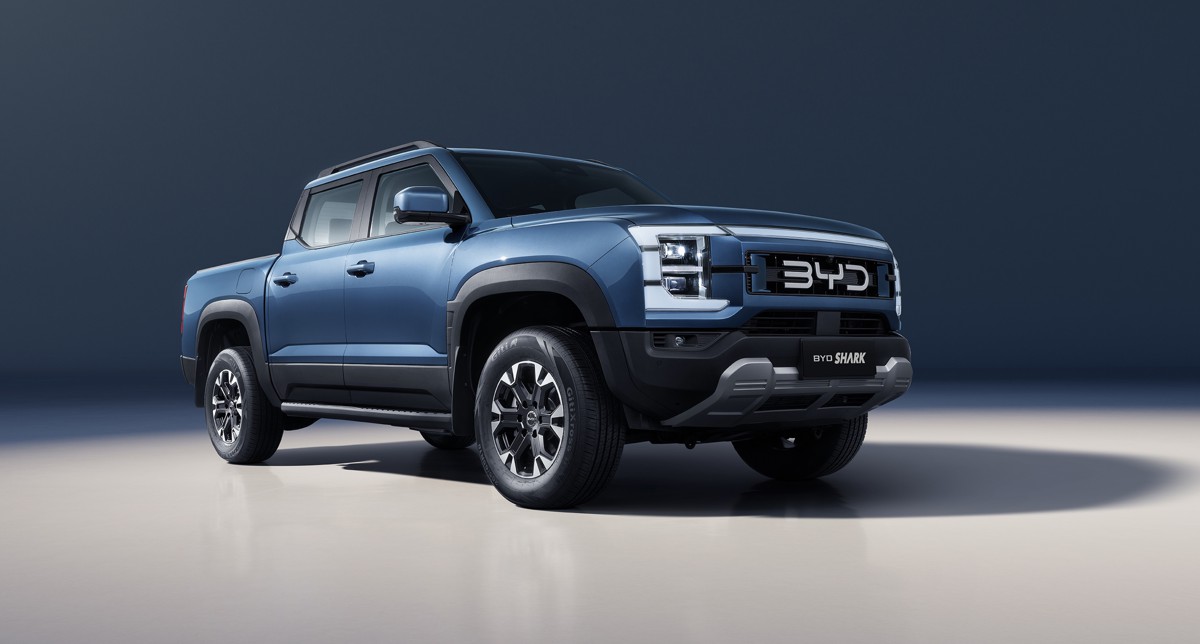
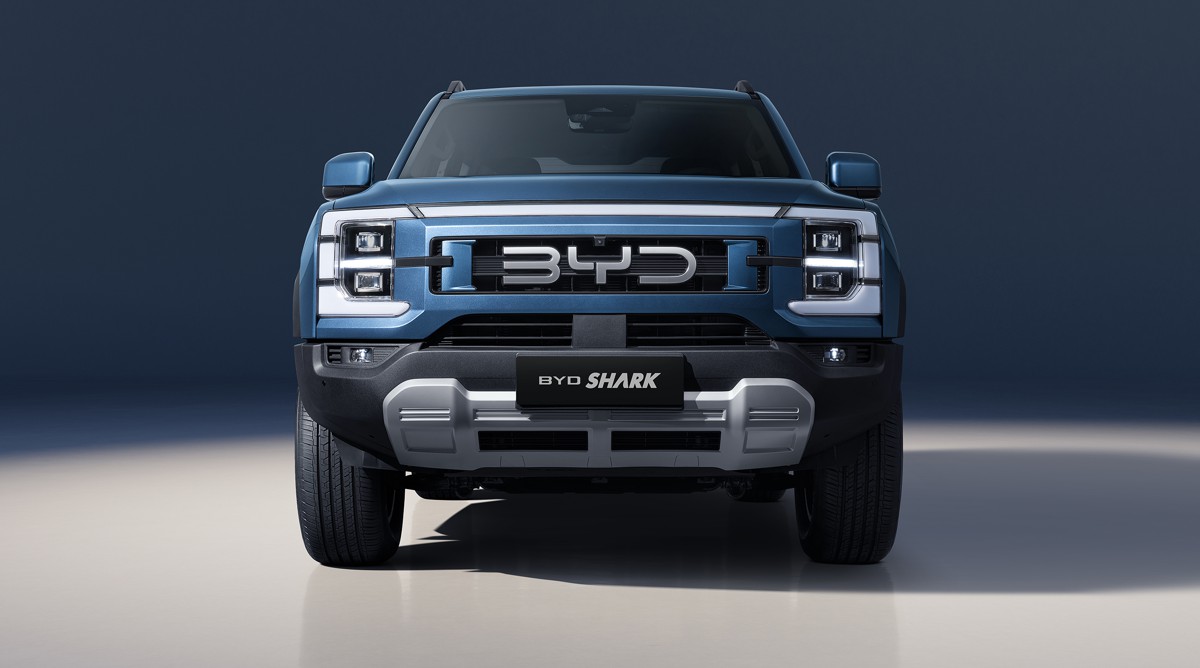
The company, which closed 2025 as the world’s largest manufacturer of new-energy vehicles, is bringing its SHARK plug-in hybrid to UK and European buyers from £47,290 including VAT, with orders open and first deliveries scheduled for the fourth quarter of 2026. For construction firms, utilities, local authorities and the leasing companies that supply them, the vehicle matters less as a novelty than as a test of whether an electrified pickup can make commercial sense under a reformed tax regime.
The timing is not incidental. Since April 2025, most double-cab pickups in the UK have been treated as cars rather than commercial vehicles for benefit-in-kind and capital allowance purposes, a change that has sharply raised the running cost of the high-emission diesels that dominate the class.
That single administrative shift has done more to open the door to plug-in and electric pickups than any product launch, and it forms the backdrop against which the SHARK’s specification should be read. BYD arrives with the longest official electric range in the segment, a low carbon dioxide figure and a level of onboard technology unusual for a working vehicle, all of which speak directly to buyers now recalculating the total cost of a company truck.
Briefing
- BYD, now the world’s largest new-energy vehicle maker, is bringing its first pickup, the SHARK, to UK and European buyers from £47,290 including VAT, with orders open and deliveries due in the fourth quarter of 2026.
- The launch lands into a UK double-cab market reshaped by the April 2025 reform that reclassified most double-cabs as cars for benefit-in-kind, penalising high-emission diesels and favouring low-emission plug-in hybrids and electric models.
- The plug-in DMO powertrain produces 436PS, a class-leading official electric range of 55.9 miles and carbon dioxide emissions of 23 grams per kilometre, positioning the SHARK for the lower company-car tax bands.
- At 790 kilograms of payload the SHARK sits below the one-tonne threshold HMRC still applies for VAT, so it is generally treated as a car for VAT and does not offer the input-tax recovery available on heavier commercial pickups.
- Onboard 6.6kW Vehicle-to-Load, a 32.2kWh Blade Battery and 55kW DC charging position the SHARK as a working power source as much as a means of transport, although its 2,500-kilogram towing rating trails diesel rivals rated at 3,500 kilograms.
A Tax Change That Rewrites the Fleet Case
The commercial significance of the SHARK cannot be separated from the reform that reshaped its market. From 6 April 2025, following a Court of Appeal ruling in the long-running Coca-Cola case, HMRC stopped treating most double-cab pickups as vans and began assessing them as cars, on the reasoning that a four-door, five-seat vehicle is no longer predominantly suited to carrying goods.
Where a double-cab was previously taxed on a flat van benefit of £4,020 a year, it is now taxed on its list price multiplied by a percentage tied to carbon dioxide emissions, a scale that reaches as high as 37 per cent for the diesels that fill the segment. For a higher-rate taxpayer running a typical diesel double-cab, that revaluation can add several thousand pounds a year to a personal tax bill, and it has left fleets hunting for vehicles that fall into the lower bands.
That is precisely the gap the SHARK is engineered to occupy. With official carbon dioxide emissions of 23 grams per kilometre and a quoted electric range of 55.9 miles, the plug-in BYD sits toward the bottom of the company-car tax table rather than the top, in the territory occupied by low-emission plug-in hybrids and battery-electric cars.
Ford has already proven the logic by launching a plug-in hybrid Ranger, which industry reporting places at roughly a 19 per cent benefit-in-kind band, far below the ceiling its diesel siblings now attract. The SHARK’s longer electric range and lower emissions suggest it should land at least as favourably, though the precise band will depend on its final UK homologation.
It is worth noting that a sub-one-tonne pickup such as the SHARK would have been classed as a car for benefit-in-kind even under the old rules; the reform’s real effect is to strip the diesel double-cab of its former van-tax advantage, levelling a field on which the BYD’s low-emission banding suddenly looks competitive.
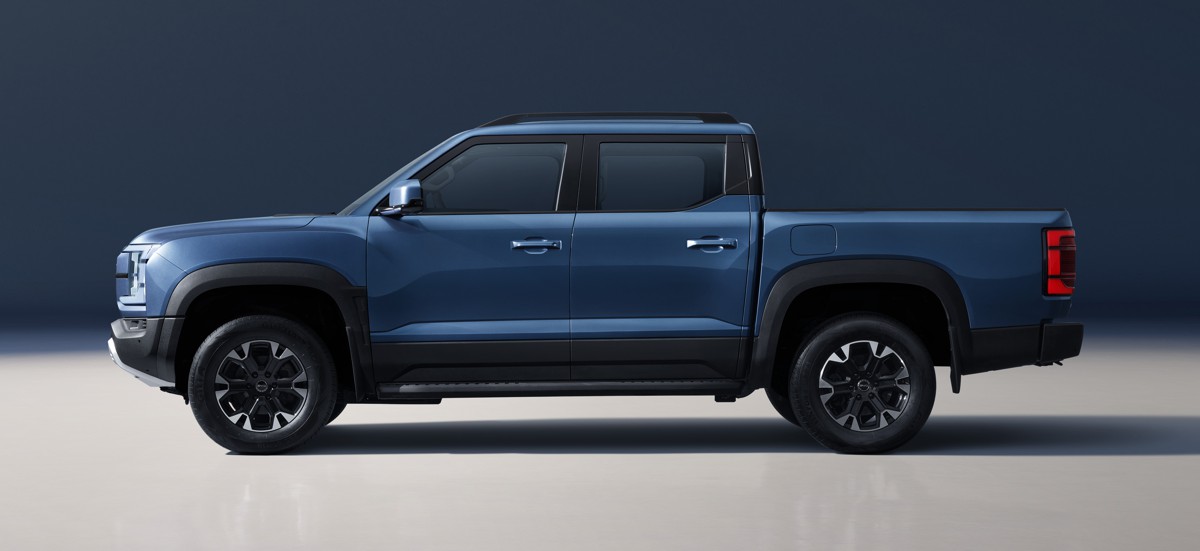
The Payload Line and the VAT Question
Where the reform gives on benefit-in-kind, the detail of the SHARK’s construction complicates the picture on VAT, and this is where fleet buyers will need to look most closely. HMRC retained the one-tonne payload test for VAT purposes even as it abandoned that test for benefit-in-kind, which means a double-cab must be able to carry at least 1,000 kilograms to be treated as a commercial vehicle for input-tax recovery.
The SHARK’s payload is quoted at 790 kilograms, comfortably below that line, so a VAT-registered business would generally be unable to reclaim the VAT on its purchase in the way it could on a heavier pickup. The Ford Ranger, rated at a full tonne, sits on the commercial side of that boundary, and the distinction has a direct bearing on net cost.
The way BYD has presented the price reflects this positioning. The SHARK is quoted at £47,290 inclusive of VAT, following the convention for passenger cars, rather than the ex-VAT pricing used for commercial pickups such as the Ranger PHEV, which lists from around £40,830 before tax. For a private buyer the BYD undercuts a comparably specified Ranger once VAT is added to the Ford, while for a VAT-registered business able to reclaim on the Ranger the calculation can move the other way.
None of this makes the SHARK the wrong choice; it makes it a different kind of choice, aimed at buyers who value electric range, refinement and low benefit-in-kind over the maximum payload and towing figures that define a pure trade workhorse. Towing capacity tells the same story, with the SHARK rated to pull 2,500 kilograms braked against the 3,500 kilograms offered by the diesel and plug-in Rangers, Hiluxes and Amaroks it will share a car park with.
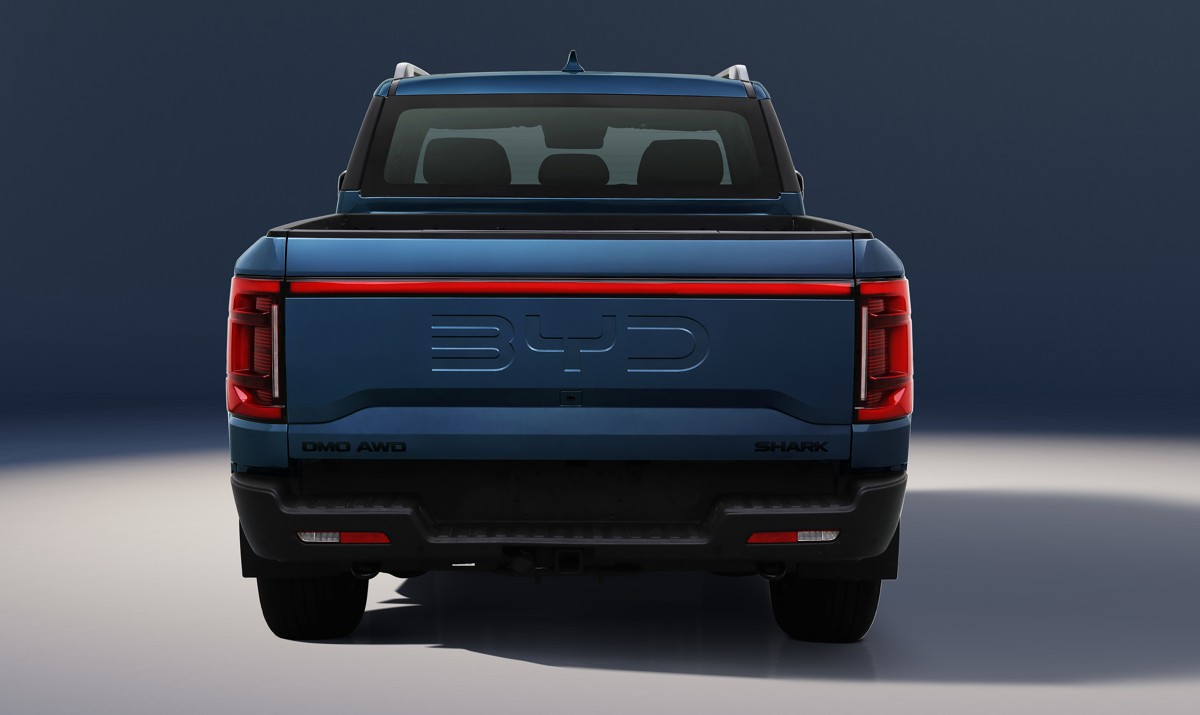
A Powertrain Built for Electric-First Running
Beneath the styling sits the more consequential engineering story, a plug-in system BYD calls DMO, short for Dual Mode Off-road, adapted from the DM-i hybrid technology already selling in volume across the company’s passenger range. Two electric motors provide drive, one on each axle, with the front rated at 231PS and the rear at 204PS, for a combined system output of 436PS and 650Nm of torque.
That is enough for a 0 to 62 miles per hour time of 5.7 seconds, a figure that would embarrass most sports saloons and comfortably outruns any diesel pickup on sale. A 1.5-litre turbocharged four-cylinder petrol engine is mounted longitudinally, but for much of the time it does not drive the wheels at all; instead it works as a generator, feeding either the motors directly or the battery, in the series-hybrid manner that has become BYD’s signature.
The battery is central to the SHARK’s case. At a rated 32.2kWh in UK specification, it is far larger than the packs fitted to rival plug-in pickups, roughly treble the capacity of the only other plug-in hybrid the class has offered to date, and BYD integrates it into the ladder-frame chassis using cell-to-chassis construction that allows the pack to add to structural rigidity while sitting low for protection off-road.
The company quotes an official weighted fuel consumption of 80.7 miles per gallon and a combined range of 419 miles on a full tank and a full charge, falling to 29.4 miles per gallon once the battery is depleted and the petrol engine carries the load. Charging runs to 55kW on direct current, enough to move the battery from 30 to 80 per cent in 21 minutes, while an 11kW three-phase alternating-current supply refills it from 15 per cent in a little over three hours. The system moves between four operating modes, running as a pure electric vehicle, as a series hybrid in town, in parallel hybrid under hard acceleration, and with the engine driving directly at a motorway cruise where that proves the most efficient option.
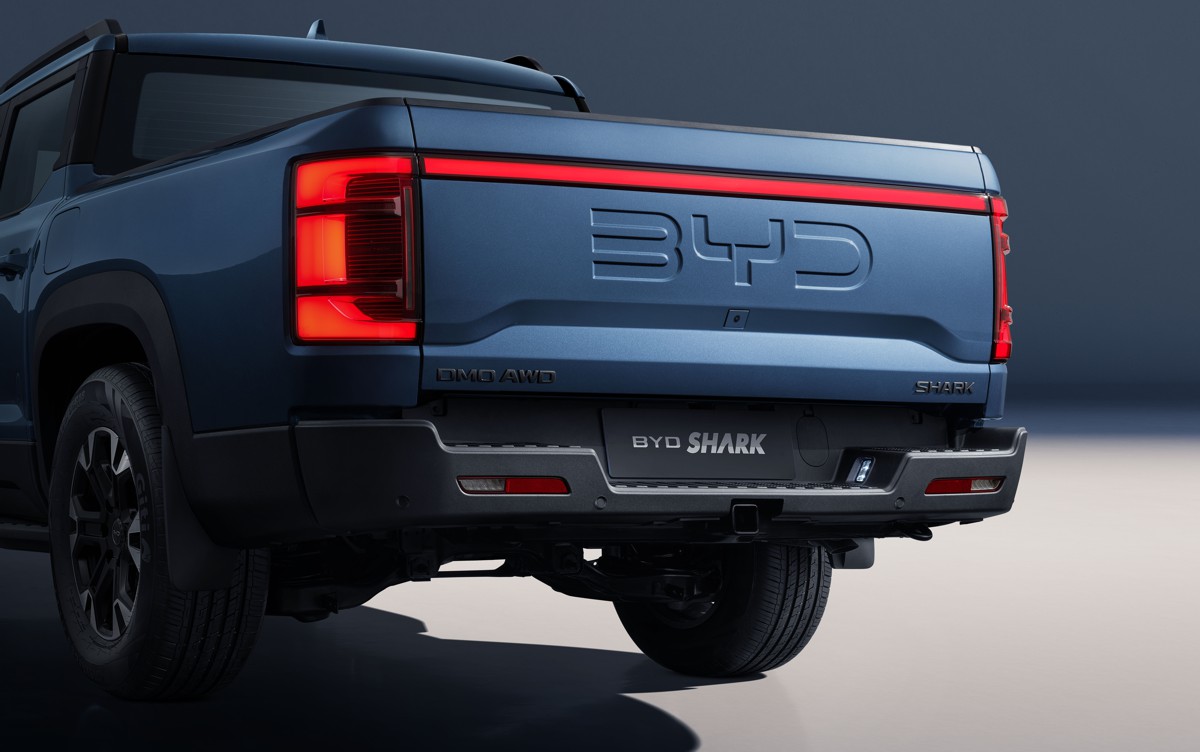
Vehicle-to-Load and the Working Site
For a construction or utilities audience, the SHARK’s most immediately useful feature may be the one that has nothing to do with how it drives. The vehicle carries a Vehicle-to-Load system rated at 6.6kW, drawing on the Blade Battery to power external equipment through two sockets, one reached via the charging port and one built into the load-bed wall.
In practice that turns the pickup into a mobile power source capable of running site tools, lighting or welfare equipment away from a mains supply, a role fleets have previously filled with separate petrol or diesel generators. The same output will run domestic appliances for leisure users, from a coffee machine to a power washer, but its value on a working site, where grid access is often the first constraint, is the more significant point for a business buyer.
BYD frames the SHARK as a vehicle that declines the usual compromise between capability and efficiency. Stella Li, the company’s executive vice president, said: “We’re thrilled to bring Super Hybrid to the pickup segment with the SHARK. This type of vehicle really benefits from our DMO Super Hybrid technology, offering pure-electric capability, the most power in the class, excellent off-road capability, outstanding efficiency and long-distance flexibility. And our innovative approach to technology delivers stand-out features, including V2L that can really help at work and play. The market for plug-in hybrid pickups is expanding rapidly, and we’re confident that the SHARK will be really appreciated by customers across Europe who want this type of vehicle but aren’t willing to compromise on efficiency or comfort.”
The hardware behind that claim includes double-wishbone suspension at both axles, an intelligent all-wheel-drive system with dedicated sand, mud, snow and gravel settings, hill descent control fitted as standard, and 210 to 230 millimetres of ground clearance, with approach and departure angles of 31 and 19.3 degrees respectively.
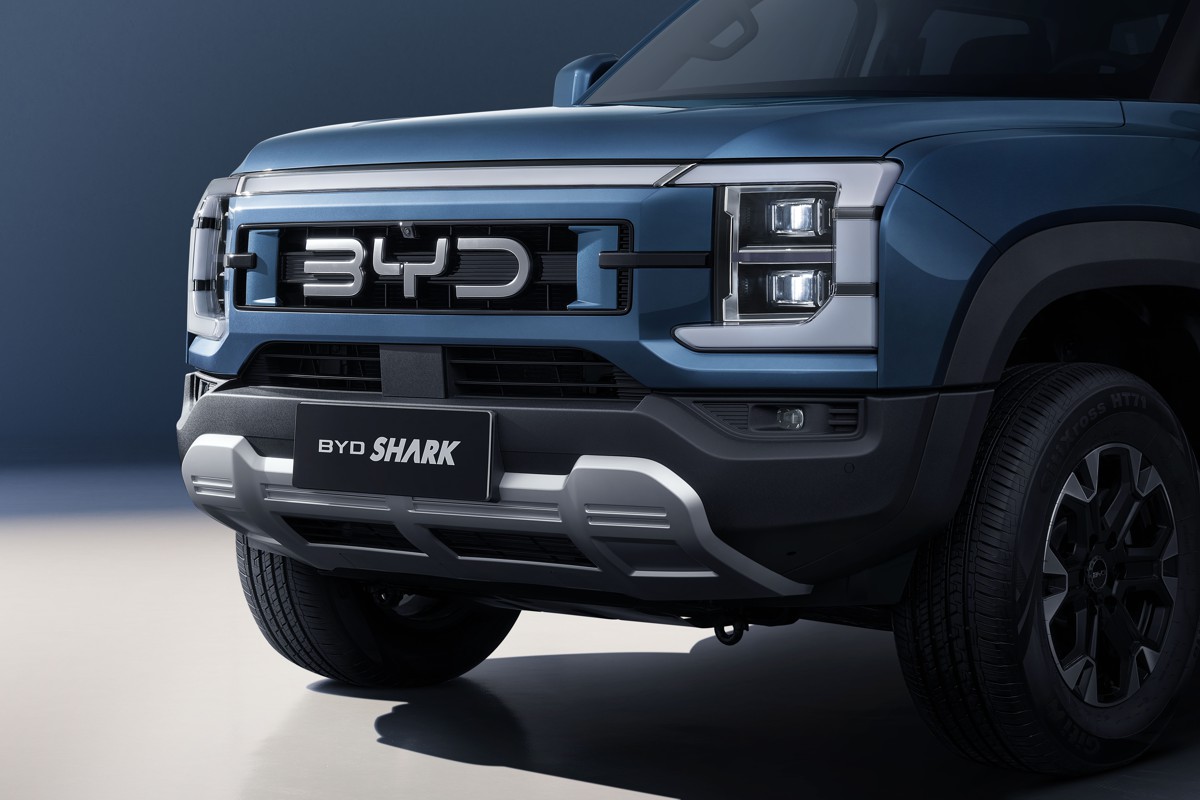
Cabin, Safety and Standard Specification
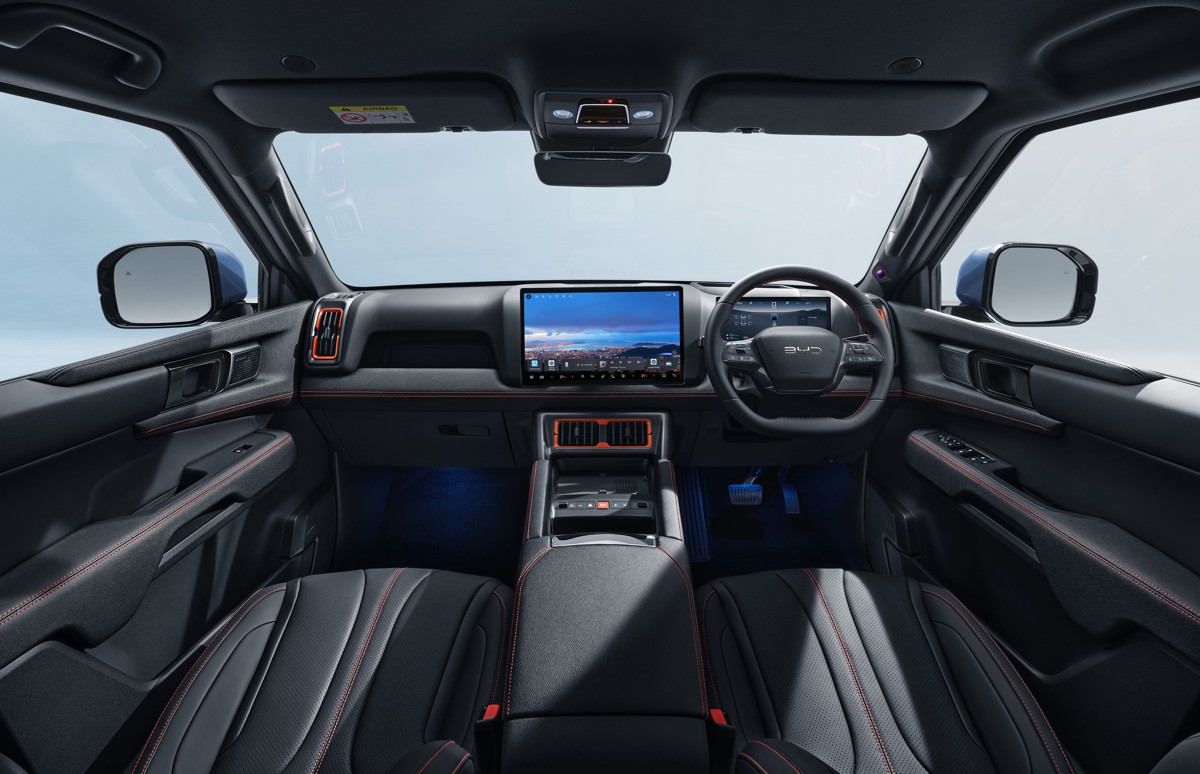
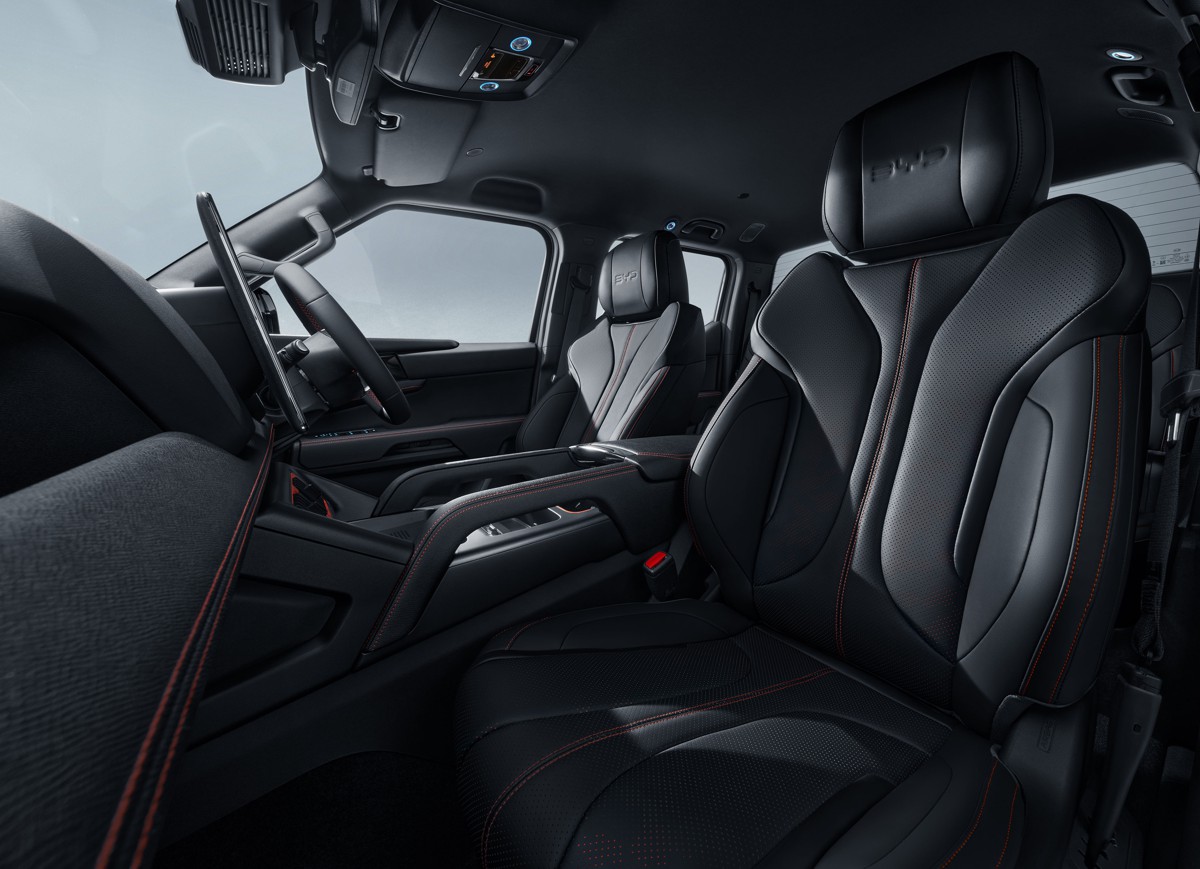
BYD is offering the SHARK in a single, heavily equipped trim, a strategy that has served the brand well across its passenger range and simplifies the fleet ordering decision. The cabin leads on a 15.6-inch rotating infotainment screen, the largest in the class, paired with a 10.25-inch digital instrument panel and a head-up display, neither of which is common in a pickup.
Standard equipment runs to vegan-leather upholstery, heated and ventilated front sports seats, a 12-speaker Dynaudio system, wireless Apple CarPlay and Android Auto, a 50W wireless charging pad, a 360-degree camera with front and rear sensors, and app-based remote climate control. Rear passengers benefit from a fully flat floor, close to 90 centimetres of legroom and a reclined seat-back angle, giving the second row more of the feel of a family SUV than the afterthought bench of a conventional double-cab.
Safety provision is similarly generous for the segment, with seven airbags, ISOFIX mounts, child presence detection and a tyre-pressure monitoring system supported by a full suite of driver-assistance features. Those include adaptive cruise control, front and rear cross-traffic alert with braking, forward and rear collision warning, lane-departure assistance with emergency lane keeping, blind-spot detection and hill-hold control.
The SHARK rides on 18-inch alloy wheels and is offered in five exterior colours, led by Atlantis Blue, with the specification pitched to suit both the business user weighing tax exposure and the private buyer treating the pickup as a lifestyle vehicle. Taken together, the equipment list reinforces the sense of a vehicle designed to be judged against SUVs and premium cars as much as against traditional trucks.
Where the SHARK Fits in a Shifting Pickup Field
BYD’s arrival in the segment is a statement of intent from a manufacturer whose scale now shapes the wider market. The company finished 2025 as the world’s largest seller of new-energy vehicles, delivering more than 4.6 million cars across its battery-electric and plug-in hybrid ranges, and its overseas sales passed one million units for the first time, up around 200 per cent year on year.
A European headquarters established in Hungary, new plants under construction across Thailand, Indonesia, Uzbekistan and Mexico, and a UK market share approaching two per cent by the middle of 2025 all point to a business intent on contesting mainstream segments rather than niche ones. Entering the pickup class, long one of the last strongholds of the diesel engine, fits that pattern, and it does so with a product engineered around the tax logic now facing every fleet manager.
The competitive field is forming quickly around the same forces. Ford’s plug-in hybrid Ranger established the template, an electric Isuzu D-Max is on the way, KGM is weighing a Musso EV for the UK, the electric Maxus eTerron 9 and its MG-badged sibling are already on sale, and the next-generation Toyota Hilux is expected to gain electrified power for the first time.
The tax reform is, in effect, midwifing an electrified pickup category that barely existed two years ago, and manufacturers are racing to fill it. For fleets, procurement teams, dealers and investors, the direction of travel is now set, even where individual products still trail diesels on payload and towing; the vehicles arriving over the next two years will decide how quickly the transition runs, and the SHARK is among the first to test how far buyers are willing to move.
Key Industry Questions
- Will the BYD SHARK qualify as a commercial vehicle for UK tax purposes? For benefit-in-kind, the question is largely moot, because HMRC now assesses most double-cab pickups as cars regardless of payload following the April 2025 reform. For VAT, however, the one-tonne payload test still applies, and the SHARK’s 790-kilogram payload falls below it. That means the vehicle is generally treated as a car for VAT, so a business cannot recover the VAT on purchase as it could on a pickup rated at a full tonne or more. Fleet managers should treat the SHARK as a car across both tax heads and model it accordingly, taking professional advice on their specific circumstances rather than assuming any residual commercial-vehicle status.
- How does the SHARK’s company-car tax compare with a diesel double-cab? The gap is substantial and favours the BYD. Since April 2025, double-cabs are taxed on list price multiplied by a carbon dioxide percentage that reaches 37 per cent for high-emission diesels, replacing the old flat van benefit of £4,020 a year. With emissions of 23 grams per kilometre and a 55.9-mile electric range, the SHARK sits near the bottom of that scale rather than the top. Ford’s plug-in Ranger has shown the effect, reported at around a 19 per cent band, and the SHARK’s stronger figures point to a similar or better outcome. For a driver who charges regularly, the annual benefit-in-kind saving against a diesel can run to several thousand pounds.
- Can a business reclaim VAT on the BYD SHARK? In most cases, no. VAT recovery on a double-cab pickup depends on the vehicle carrying a payload of at least one tonne, a test HMRC kept for VAT even after dropping it for benefit-in-kind. At 790 kilograms, the SHARK falls short, so it is treated as a car for VAT, and input tax on a car is generally irrecoverable unless the vehicle is used exclusively for business, which is rare and closely scrutinised. This is why BYD quotes the SHARK inclusive of VAT rather than ex-VAT. Businesses comparing it with a Ranger, which does clear the one-tonne threshold, should compare net-of-VAT costs rather than headline prices.
- How does the SHARK compare with the Ford Ranger PHEV? The two vehicles suit different priorities. The SHARK leads on electric range, quoted at 55.9 miles against the Ranger’s 27, on battery size, and on system power at 436PS against roughly 275bhp. The Ranger counters on the metrics that matter to heavy-duty users, towing 3,500 kilograms against the BYD’s 2,500 and carrying a full-tonne payload against 790 kilograms, which also secures its commercial-vehicle VAT status. On price, the SHARK’s £47,290 including VAT undercuts a comparably specified Ranger once VAT is added, but the Ranger’s recoverable VAT can reverse that for registered businesses. The choice turns on whether electric range or working capacity carries more weight.
- Is the SHARK’s electric range enough for real-world site and fleet use? For many operators, the 55.9-mile official figure covers the majority of daily mileage, allowing local site visits, depot runs and commuting to be completed on electricity alone, with the petrol engine reserved for longer journeys. Real-world range will fall below the laboratory figure in cold weather, under load or when towing, as with any plug-in hybrid, so fleets should plan on a working margin rather than the headline number. The advantage over shorter-range rivals is that more journeys stay electric, which improves running costs and keeps the vehicle in its lowest tax band. Access to overnight or depot charging is the practical determinant of whether those benefits are realised.
- Can the SHARK power tools and equipment on site? Yes. The Vehicle-to-Load system supplies up to 6.6kW through two sockets, one at the charging port and one in the load bed, drawing on the Blade Battery. That is enough to run many site tools, task lighting or welfare equipment without a separate generator, which can reduce both equipment costs and on-site emissions. The capability is a genuine operational advantage for utilities, highways maintenance and remote-site work, where mains power is often unavailable. Businesses should confirm that the loads they intend to run fall within the 6.6kW limit and factor battery depletion into range planning when the system is used heavily during a working day.
- What are the SHARK’s towing and payload limits, and who is it best suited to? The SHARK is rated to tow 2,500 kilograms braked and to carry a 790-kilogram payload, both below the class-standard 3,500-kilogram towing and one-tonne payload of established diesel pickups. Operators who regularly tow plant trailers at maximum weight or carry a full tonne of materials will find those figures limiting and may prefer a diesel or a heavier plug-in rival. The SHARK is better suited to buyers who prioritise electric range, refinement, low benefit-in-kind and onboard power over maximum load capacity, a group that includes many lifestyle users and lighter-duty business fleets. Matching the vehicle to genuine duty cycles, rather than headline capability, is the key procurement discipline.
- When can UK buyers order the SHARK, and what does it cost? Orders are open now, priced from £47,290 including VAT for the single, fully equipped trim, with first deliveries scheduled for the fourth quarter of 2026. Some earlier trade reporting had pointed to a third-quarter arrival, so buyers should confirm delivery timing with BYD’s UK network when ordering. The single-trim strategy simplifies specification and fleet ordering, since all major equipment is included as standard rather than distributed across option packs. Businesses weighing the SHARK should factor in charging provision, the VAT position and their real duty cycles alongside the purchase price, as those elements will shape total cost of ownership more than the list figure alone.
Strategic Takeaways
- The April 2025 double-cab tax reform, rather than any single product, is the force reshaping pickup procurement; electrified models now win decisively on benefit-in-kind while high-emission diesels are penalised, and that dynamic will drive fleet decisions for years.
- The SHARK’s sub-one-tonne payload keeps it on the car side of the VAT line, so fleets must model net cost including irrecoverable VAT rather than comparing headline prices with commercial-classified rivals.
- Class-leading electric range combined with 6.6kW Vehicle-to-Load repositions the pickup as both a low-tax commuter and a mobile power source, widening its appeal well beyond traditional trade use.
- Operators needing 3,500-kilogram towing or a full-tonne payload will still favour diesel or heavier rivals, so the SHARK points to a segment that is beginning to divide along duty-cycle lines rather than competing on a single specification.
- BYD’s entry confirms that Chinese manufacturers are now contesting the last diesel stronghold in the mainstream market, and buyers should expect more electrified pickups, continued pricing pressure and a faster fleet transition over the next two years.