Tower Cranes Take Construction Engineering into Amazon Climate Science
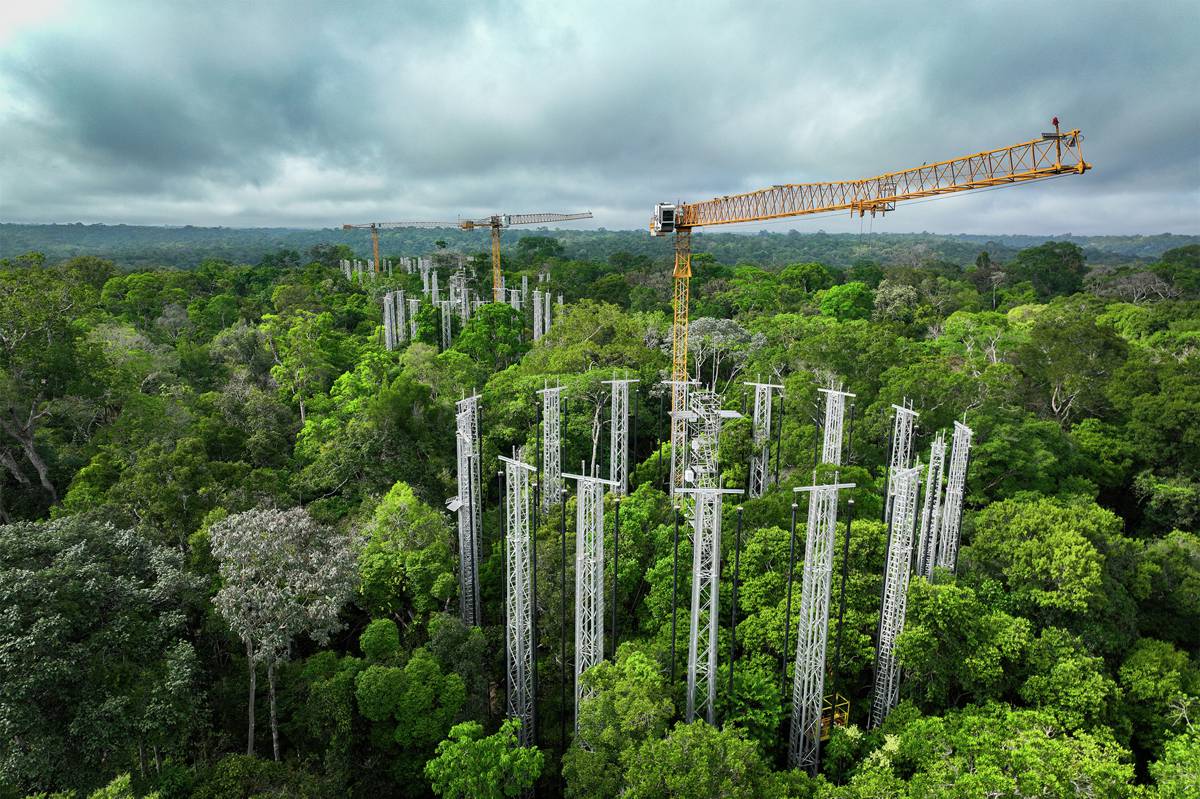
The deployment of four Liebherr 85 EC-B tower cranes at the AmazonFACE research site near Manaus reads, at first glance, as a curiosity: construction plant repurposed for science, a photogenic footnote to a climate story. The more useful reading for anyone in the equipment business is the inversion at its centre.
A standard piece of construction infrastructure has been chosen as the enabling technology for one of the most consequential ecological experiments now running, and it was chosen precisely because the permanent access structures that field science normally relies on would have compromised the experiment itself. The crane’s small ground footprint is not a logistical convenience here. It is a scientific specification.
That distinction matters because it points to an application that will outlast this particular announcement. AmazonFACE is the world’s first large-scale Free-Air CO₂ Enrichment experiment conducted in mature tropical forest, a step change from the temperate and boreal sites where the technique was proven, including Duke Forest in North Carolina, BIFoR FACE in Staffordshire and EucFACE in New South Wales.
The reason the tropical setting carries commercial weight is that the future response of tropical forests to rising carbon dioxide is one of the largest single uncertainties in estimating how much anthropogenic carbon the world’s natural ecosystems can absorb. Resolving it feeds carbon budgets, climate finance and the integrity of nature-based carbon markets, the same machinery that increasingly shapes where infrastructure capital flows and how it is regulated.
Construction equipment that can install, access and later remove a research platform without leaving a mark is now part of that value chain, and the firms that understand this early will be better placed than those who treat it as a novelty.
Briefing
- Four Liebherr 85 EC-B flat-top tower cranes now serve as the primary canopy-access platform at AmazonFACE near Manaus, raising researchers and instruments to heights above 45 metres, beyond the treetops.
- AmazonFACE is the first large-scale Free-Air CO₂ Enrichment experiment in mature tropical forest; earlier FACE programmes ran only at temperate and boreal sites such as Duke Forest, BIFoR FACE and EucFACE.
- The cranes were selected because a tower crane’s minimal mast footprint and wide horizontal reach avoid the soil compaction, root damage and canopy opening that walkways or scaffolding would inflict on old-growth forest.
- The Met Office rates tropical-forest response to elevated CO₂ as one of the biggest uncertainties in global carbon accounting, tying the experiment directly to carbon budgets, climate policy and the credibility of carbon markets.
- Liebherr-Brasil supplies continuing operator training, spare parts and on-call technical support, a reminder that in remote deployments aftersales capability, not hardware alone, determines reliability.
The uncertainty that carbon accounting cannot afford to leave open
The commercial case for AmazonFACE begins with an unresolved question in Earth system science that has quietly become a financial one. The Amazon basin holds an estimated 150 to 200 billion tonnes of carbon in its vegetation and soils, and whether that store grows, holds steady or shrinks as atmospheric CO₂ rises will shape global warming projections and, with them, the assumptions baked into national climate commitments and carbon pricing. The Met Office describes the future behaviour of tropical forests under rising CO₂ as one of the largest uncertainties in quantifying how much of humanity’s emissions natural land and ocean systems can sequester. That is not an academic caveat. It is a gap at the centre of the carbon budgets that underpin climate finance.
Recent evidence has sharpened the stakes rather than settling them. Atmospheric measurements published in 2021 found that south-eastern Amazonia has already tipped into acting as a net source of carbon to the atmosphere, driven by deforestation, warming and fire. A long-running throughfall-exclusion experiment at Caxiuanã in the eastern Amazon, one of the only tropical forest drought experiments maintained for more than two decades, has shown the forest shedding roughly a third of its aboveground biomass over about fifteen years of imposed drought before stabilising at a markedly lower level.
Read together, these findings describe a system capable of large, non-linear losses before it finds a new equilibrium, which is precisely the kind of behaviour that models struggle to predict and that carbon markets are ill-equipped to price. AmazonFACE exists to reduce that uncertainty by observing directly how an intact forest responds to the atmosphere expected in the coming decades. As Bruno Takeshi, operations lead for the programme, puts it, ‘Some phenomena that occurred very rarely began to be very frequent. The entire climate of the region started to become very abnormal.’ The experiment is an attempt to put numbers to that abnormality before it is locked in.
When a small footprint becomes a scientific requirement
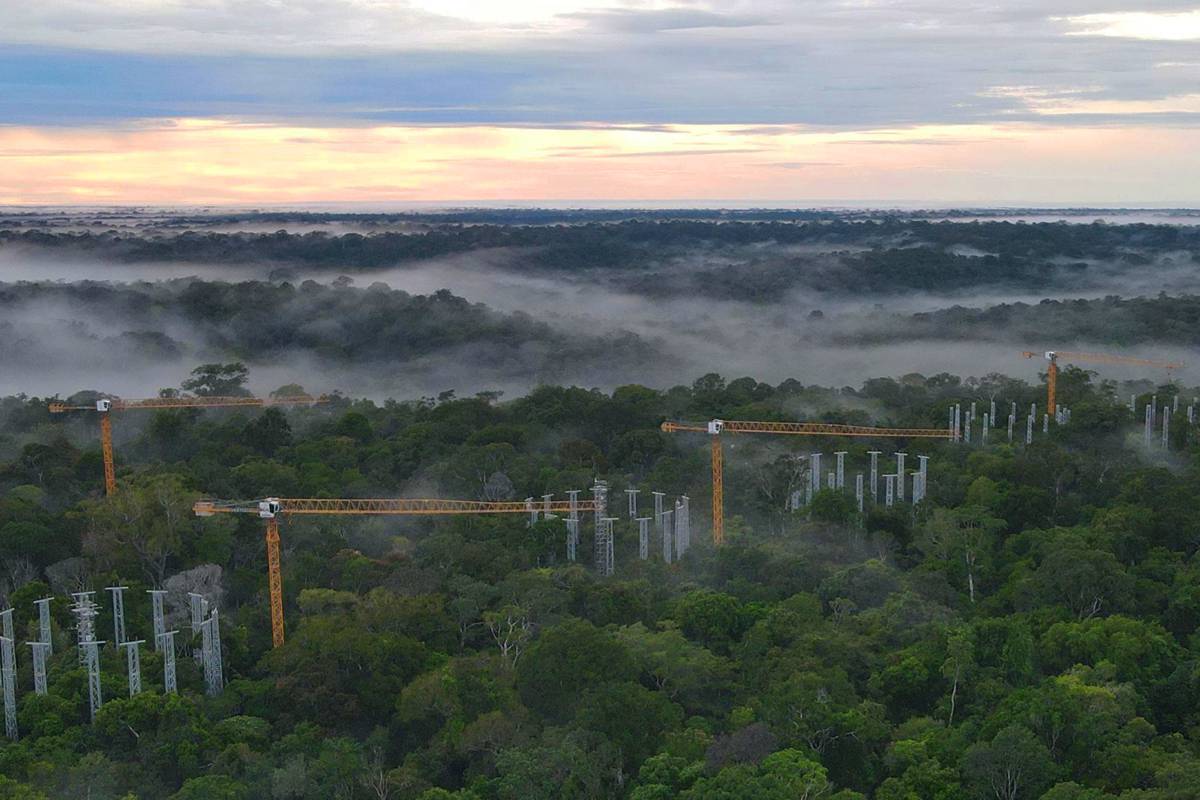
The choice of tower cranes over the scaffolding, elevated walkways and fixed platforms that field ecology usually depends on was made on grounds of preservation, and the engineering logic is instructive for anyone thinking about temporary works in sensitive environments. A tower crane concentrates its entire structure onto a mast that occupies a very small area of ground, which in an old-growth forest is decisive: soil disturbance, root damage and any opening of the canopy alter the very system the experiment is trying to measure.
A walkway or scaffold network covering the same experimental plots would multiply ground contact many times over, and every point of contact is a source of contamination in the data. The crane’s horizontal reach then compounds the advantage, because a single unit can service a wide radius of forest without being repositioned, eliminating the repeated ground disturbance any alternative would require.
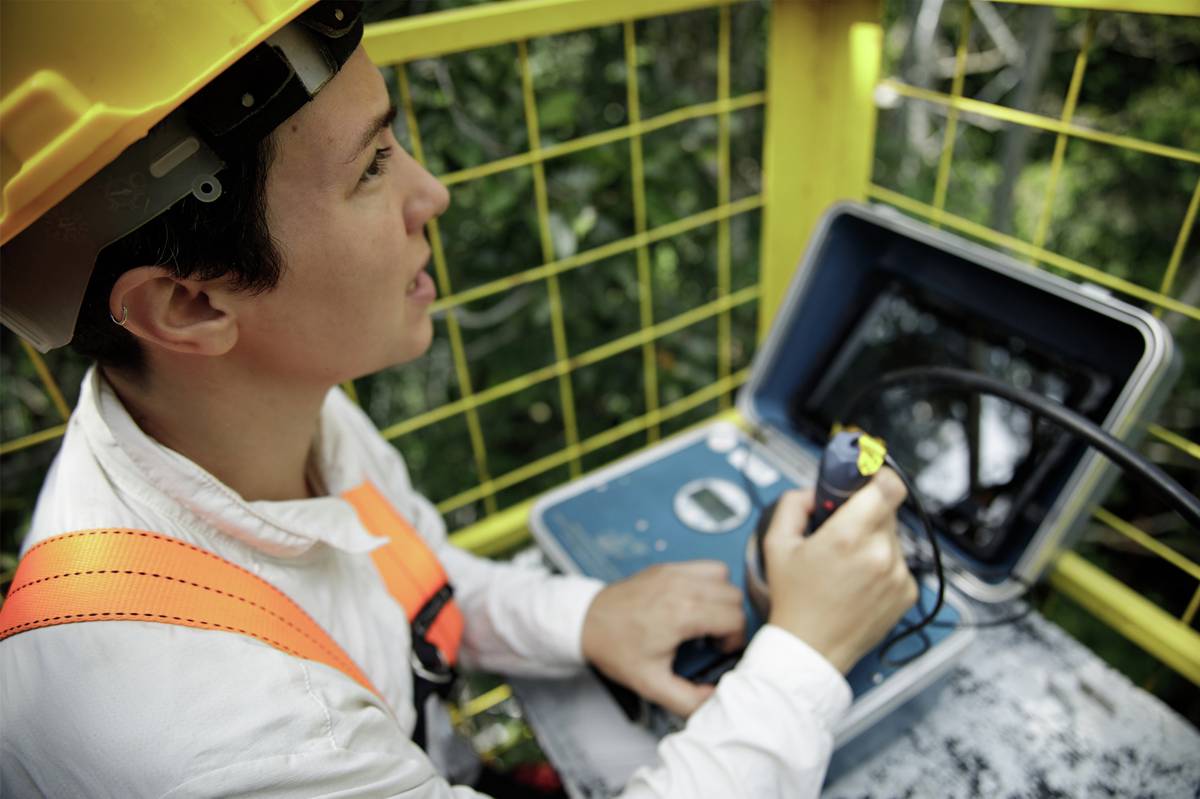
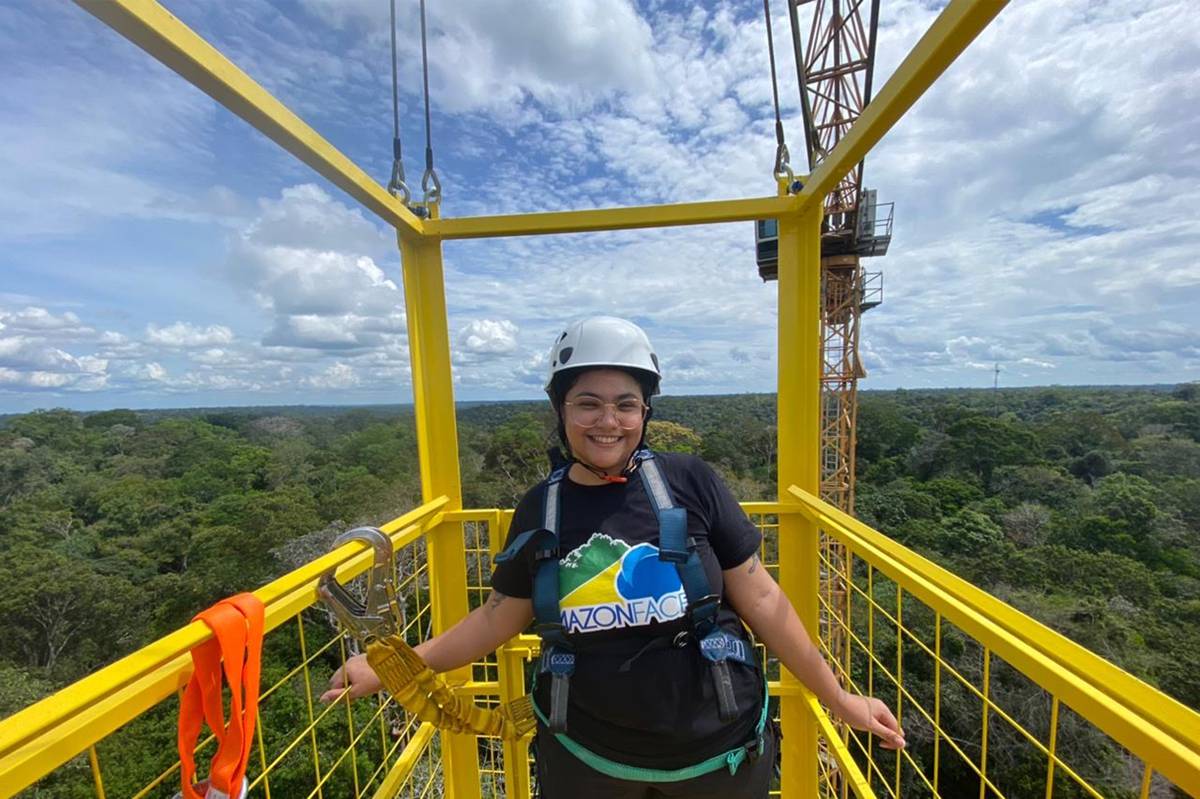
That reach is what turns the equipment from access aid into research platform. The four cranes lift researchers safely from the forest floor to above 45 metres, where measurements of CO₂ concentration, plant physiology, microclimate and biodiversity can be taken in the actual enriched atmosphere rather than inferred from the ground. The programme has secured the national authorisations and safety certifications required for lifting personnel by tower crane, a non-trivial regulatory step that many construction operators will recognise as its own project within the project.
Maria Juliana Monte, a site engineer on the programme, captures why the platform matters to the people using it: ‘You don’t expect to be so close to the forest. And then I’m working within it – you can understand its real importance very well.’ The point for the equipment sector is that low disturbance and wide coverage were not desirable extras here. They were the reasons the technology was viable at all.
Engineering for heat, humidity and precision
The 85 EC-B belongs to Liebherr’s compact flat-top range, built for sites where space and operational precision matter more than raw capacity, and several of its design features map neatly onto the demands of a rainforest research plot. The flat-top configuration removes the traditional A-frame head, lowering the structure above the jib and allowing multiple cranes to work in overlapping radius zones without their upper structures colliding.
In a dense canopy where four units must between them cover the full extent of the experimental plots, that ability to interleave working envelopes without one crane passing loads over another’s mast is not a refinement but a precondition. The model offers a jib length of up to 50 metres and a maximum lifting capacity of 5,000 kg, comfortably within the range needed to move people and sensitive instruments rather than heavy building loads.
Precision is where the specification earns its place. Frequency-controlled drives smooth acceleration and deceleration on both the hoist and slewing axes, damping the vibration that would otherwise travel through the load as it rises through the canopy layers. For gas analysers, sensors and sampling equipment, that smoothness is the difference between an instrument that arrives at measurement height intact and one that does not survive the mechanical shock of a coarser lift. Durability closes the argument.
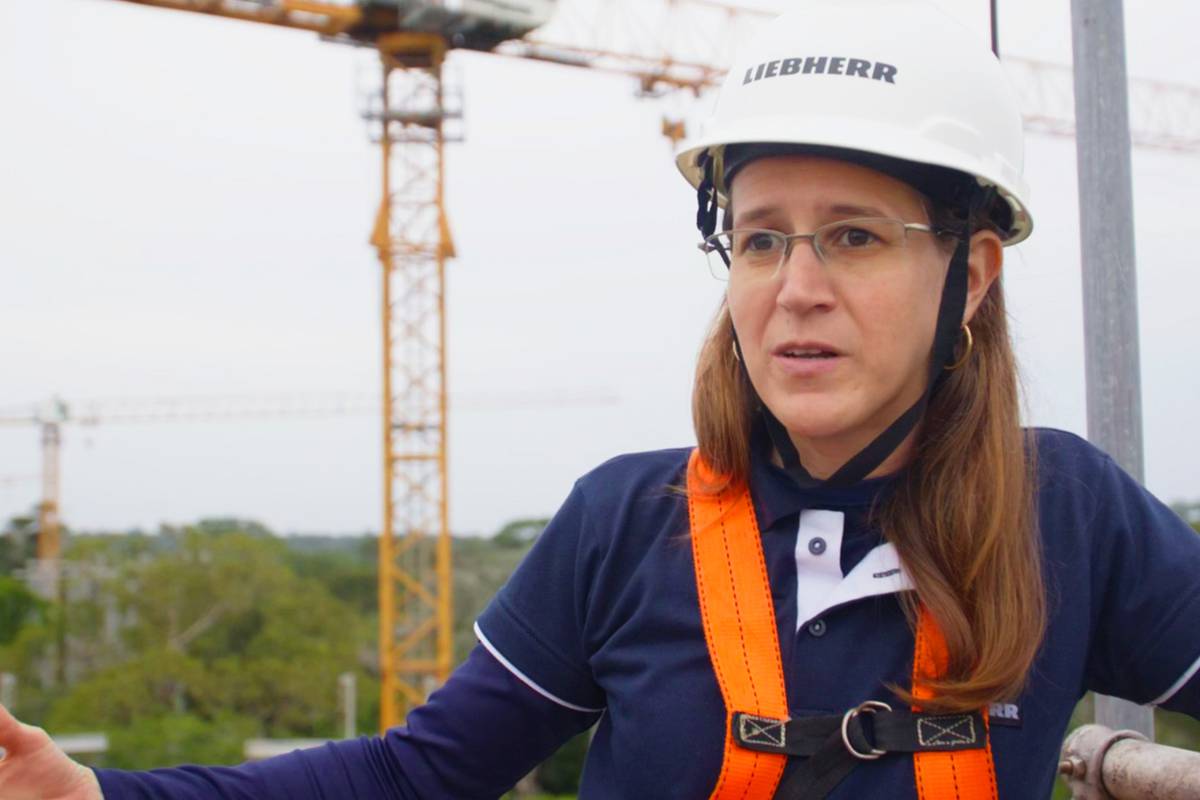
As Bruna Prisco, application engineer at Liebherr in Brazil, explains, ‘Here in the Amazon rainforest, the use of the crane is that scientists can study nature conservation more efficiently. The four Liebherr 85 EC-B 5 tower cranes were chosen precisely because they can withstand the extremes of heat and humidity and not disturb the habitat.’ Two of the four units were built at Liebherr’s Brazilian plant and two in Spain, a detail that says something about how a single equipment platform is now sourced across a global manufacturing footprint to land on one remote site.

The economics of keeping equipment running where logistics stop
A research site deep in protected forest, reachable only with difficulty, is an unforgiving environment for machinery, and it is here that the commercial character of the deployment becomes clearest. Liebherr-Brasil supports the programme on a continuing basis with operator training, maintenance instruction, spare parts supply and on-call technical assistance. That package is easy to overlook next to the hardware, but it is arguably the more important half of the transaction. A tower crane that cannot be maintained, or that waits weeks for a part, is worse than useless on a site where downtime stops the science and every access cycle has been planned around crane availability.
This is the reality the wider equipment market already understands from mining, offshore and remote infrastructure work, and AmazonFACE illustrates it cleanly. In deployments where logistics networks are thin, the differentiator between manufacturers is rarely the machine specification, which competitors can broadly match, but the depth and locality of the support behind it.
A Brazilian manufacturing base and a domestic service operation give Liebherr a continuity advantage on this project that a purely imported unit would struggle to replicate. For infrastructure owners and specifiers, the lesson is transferable: in any remote or sensitive deployment, procurement decisions that weight aftersales capability, local spares holding and training as heavily as headline performance will tend to age better than those that chase the lowest capital cost.
An adjacency the construction supply chain should not dismiss
Tower cranes are built for construction sites, yet the equipment industry has long supplied them into work that has nothing to do with erecting buildings, from wind-turbine assembly to events, film production and disaster response. AmazonFACE extends that pattern into scientific and environmental infrastructure, and it does so in a way that is more than incidental.
The requirement that drove the specification here, reversible access with minimal permanent trace, is becoming a recurring theme wherever construction activity intersects with protected habitats, contaminated ground, heritage sites or monitoring installations that must not alter the thing they monitor. Equipment that can be installed, operated for a defined period and then removed cleanly is a distinct proposition from equipment optimised purely for building throughput.
For the construction supply chain, the significance is that this demand is unlikely to be a one-off. Environmental monitoring, ecological restoration, climate research and the growing web of measurement infrastructure behind carbon and biodiversity markets all share the same underlying need for low-disturbance, temporary, precisely controlled access.
None of it requires new machines so much as the recognition that existing platforms have a market beyond the building site, and that the criteria buyers apply in these settings, footprint, reversibility, instrument-grade control and remote supportability, differ from conventional construction procurement. Manufacturers and rental operators that can articulate their offer in those terms will find themselves in front of a customer base, from research institutions to environmental agencies, that construction marketing has historically ignored.
What credible measurement is worth to the carbon economy
The through-line connecting a tower crane in the Amazon to the balance sheets of infrastructure investors is measurement, and its value is rising. Carbon markets, climate-linked finance and national emissions accounting all rest on the assumption that the carbon behaviour of natural systems can be quantified with enough confidence to be traded, taxed and reported against.
When the largest tropical carbon sink on the planet is capable of shedding a third of its biomass under stress, or of flipping regionally from sink to source, the credibility of that entire edifice depends on experiments able to observe the real response rather than model it from temperate proxies. AmazonFACE is one of the few installations attempting exactly that at ecosystem scale, and its outputs are explicitly aimed at informing regional Amazonian policy and international climate frameworks, including the agenda discussed at COP30 in Belém.
The equipment that makes such measurement physically possible is therefore not peripheral to the carbon economy but embedded in it. This reframes how the industry might value work of this kind. A crane contract on a research site is small in revenue terms, yet its strategic weight lies in association with the data infrastructure that markets and regulators increasingly rely on.
As nature-based carbon credits face intensifying scrutiny over whether claimed removals are real and durable, the demand for rigorous, physically grounded measurement, and for the access infrastructure that enables it, points in one direction. The construction supply chain has an opportunity to be recognised as part of the solution to that credibility problem rather than a bystander to it.
What the deployment signals for the sector
The most durable takeaway from AmazonFACE is not that cranes can be used for science, which is merely interesting, but that the criteria driving equipment selection are broadening in ways the industry should track. Footprint, reversibility and precision were the decisive factors on this site, and they are the same factors that will increasingly govern construction activity in environmentally and legally sensitive settings everywhere.
Manufacturers and specifiers who can meet those criteria, and who can back the hardware with the local support that remote deployment demands, are positioning themselves for a class of work that will grow as climate research, restoration and environmental monitoring scale up.
For infrastructure owners and investors, the wider signal is about where reliable data comes from and what it costs to obtain. The uncertainty around tropical-forest carbon is not an abstraction; it sits inside the models that price climate risk and shape long-horizon infrastructure decisions. Anything that reduces it, including the unglamorous business of getting scientists and instruments safely above a rainforest canopy, has value that extends well beyond the research plot.
The four cranes near Manaus are a small deployment with a large lesson: as the economy comes to depend on measuring natural systems accurately, the equipment that reaches those systems becomes strategic infrastructure in its own right.
Key Industry Questions
- Why were tower cranes chosen for AmazonFACE instead of walkways or scaffolding? The decision was driven by preservation of the experimental site. A tower crane concentrates its structure on a single small mast, minimising the soil compaction, root damage and canopy opening that a network of walkways or scaffolds would cause across the same plots. Because those disturbances would alter the forest the experiment is measuring, low ground contact was a scientific requirement rather than a convenience. The crane’s horizontal reach reinforced the choice, allowing one unit to service a wide radius without repositioning, which removes the repeated ground disturbance any fixed access structure would create. The result is an access platform that reaches above the canopy while leaving the surrounding ecosystem largely undisturbed.
- What makes the Liebherr 85 EC-B suited to a rainforest research site? Several features align with the site’s constraints. Its flat-top design removes the A-frame head, lowering the structure above the jib so multiple cranes can share overlapping working zones without their upper structures interfering, which matters when four units must jointly cover the plots. Frequency-controlled drives smooth movement on the hoist and slewing axes, reducing the vibration that could damage sensitive gas analysers and sensors during lifts through the canopy. A jib of up to 50 metres and a 5,000 kg capacity suit the light, precise loads involved, and the model is built to tolerate sustained heat and humidity. Together these traits let the crane function as a stable research platform rather than a simple hoist.
- Why does tropical-forest CO₂ response matter for carbon markets and investment? Carbon budgets, climate finance and national emissions accounting all assume that the carbon behaviour of natural systems can be quantified reliably enough to trade and regulate against. The Amazon stores an estimated 150 to 200 billion tonnes of carbon, and how that store responds to rising CO₂ is one of the largest uncertainties in global carbon accounting. Recent evidence that parts of the basin have become a net carbon source, and that drought can strip a third of aboveground biomass before the forest stabilises, shows how large and non-linear the swings can be. Until experiments like AmazonFACE narrow that uncertainty, the models that price climate risk and shape infrastructure investment rest on shaky ground.
- Is there a genuine commercial market in supplying equipment for scientific infrastructure? There is a real and probably growing one, though it is fragmented and rarely marketed as such. Construction equipment already serves work far beyond building, from wind-turbine erection to events and disaster response, and environmental science extends that pattern. Ecological restoration, climate research, biodiversity monitoring and the measurement infrastructure behind carbon markets share a need for low-disturbance, temporary, precisely controlled access. The opportunity for manufacturers and rental operators is less about new machines than about recognising that existing platforms suit customers, including research institutions and environmental agencies, whom construction marketing has largely overlooked. Firms that can speak to footprint, reversibility and remote supportability will reach that market more effectively than those selling on capacity alone.
- What does the Caxiuanã drought experiment add to the picture? The Caxiuanã throughfall-exclusion experiment in the eastern Amazon is one of very few tropical drought experiments sustained for more than two decades, which gives it unusual authority on how forests respond to prolonged water stress. Its findings indicate that the forest lost roughly a third of its aboveground biomass over about fifteen years of imposed drought, with disproportionate loss of large trees, before stabilising at a substantially lower biomass. That pattern of heavy loss followed by equilibrium at a diminished level is exactly the kind of non-linear behaviour that complicates climate modelling and carbon pricing. It underlines why direct experimentation, rather than extrapolation from temperate forests, is needed to understand the Amazon’s trajectory.
- How does AmazonFACE connect to climate policy and COP30? The programme is explicitly designed to inform both regional Amazonian policy and international climate frameworks, and its outputs feed the evidence base that underpins commitments discussed at COP30 in Belém. Because the future of the Amazon’s carbon store bears directly on how much of the world’s emissions natural systems can absorb, credible data from an intact tropical forest carries weight in negotiations over targets, forest protection and carbon budgeting. AmazonFACE is a scientific partnership involving Brazilian institutions and the UK Met Office, with researchers from several countries on its committee, which gives its results reach into multiple national policy processes. In effect, the experiment aims to supply harder numbers to debates that have often relied on contested assumptions.
- What are the main operational challenges of running cranes at a remote rainforest site? Remoteness is the central difficulty. The site sits within protected forest with limited logistics infrastructure, so anything that stops a crane working, a fault, a missing part, an untrained operator, directly halts the science that has been planned around crane availability. That makes continuity of support decisive. Liebherr-Brasil provides operator training, maintenance instruction, spare parts supply and on-call assistance, and a domestic manufacturing and service base shortens the response times that an imported unit would face. Heat, humidity and the need to lift personnel safely under national certification add further demands. The deployment illustrates a wider truth about remote equipment work: aftersales depth often matters more than the specification on paper.
- Could minimum-footprint access requirements shape equipment procurement more broadly? They already are, wherever construction meets sensitive ground. Protected habitats, contaminated land, heritage sites and monitoring installations all impose constraints where reversible, low-disturbance access is prized over raw throughput. As environmental regulation tightens and climate and biodiversity monitoring expand, specifications that weight footprint, reversibility and instrument-grade control are likely to appear more often in tenders. For manufacturers and rental operators, that suggests value in being able to demonstrate clean install-operate-remove capability and precise control, not just lifting performance. Buyers, in turn, may find that procurement criteria drawn from these settings, rather than from conventional construction, produce better outcomes on any project where the surrounding environment is part of the brief.
Strategic Takeaways
- The decisive equipment criteria at AmazonFACE, minimal footprint, reversibility and instrument-grade precision, are the same factors that will increasingly govern construction in environmentally and legally sensitive settings, and manufacturers should expect them in more tenders.
- In remote deployments the differentiator is aftersales, not hardware; local manufacturing, spares holding and training determine reliability, and procurement that weights these as heavily as headline performance tends to age better.
- Environmental science, restoration and carbon-market measurement form a real if fragmented adjacency for construction equipment, and firms that market footprint and supportability rather than capacity alone will reach customers the sector has historically ignored.
- The credibility of carbon markets and climate finance depends on physically grounded measurement of natural systems, which makes the access infrastructure that enables such measurement strategically valuable well beyond its modest contract size.
- Tropical-forest carbon response remains one of the largest uncertainties in climate accounting, and its resolution will influence the models that price climate risk and shape long-horizon infrastructure investment, giving experiments like AmazonFACE relevance far outside ecology.