Buenos Aires Takes V2X Technology Into Real-World Traffic
Buenos Aires has begun testing direct communication between vehicles and roadside infrastructure on live city streets, moving connected-vehicle technology out of controlled demonstrations and into the considerably less predictable environment of everyday urban traffic.
Kapsch TrafficCom has deployed a Vehicle-to-Everything, or V2X, system comprising roadside communication units, equipment installed in test vehicles and a central management platform. The trial is already being used to send information about roadworks, lane closures, stationary vehicles and hazardous road conditions directly to participating vehicles.
The next stage goes further. The programme is intended to examine how information generated by vehicles can influence traffic signal operation, including giving public transport priority according to conditions on the road rather than relying solely on fixed schedules or conventional roadside detection.
Kapsch describes the deployment as the first V2X test of its kind to operate in a real urban environment in Latin America. Rather than proving that two pieces of equipment can communicate, Buenos Aires provides an opportunity to see how connected infrastructure performs amid normal traffic, existing signal systems and the operational complications of a large city.
Briefing
- Kapsch TrafficCom is testing V2X technology on public streets in Buenos Aires.
- Roadside units communicate over 5.9 GHz, while vehicle units support 5.9 GHz, LTE and Bluetooth connectivity.
- Test vehicles are receiving warnings covering roadworks, lane closures, stopped vehicles and hazardous road conditions.
- Planned work includes traffic signal priority controlled according to time periods and conditions defined through the central platform.
- A future phase could integrate fleet management and public transport operating data.
Connecting Vehicles to the Road
V2X is an umbrella term for communications between a vehicle and other parts of the transport environment. In this deployment, the immediate relationship is largely between vehicles, roadside equipment and the traffic management platform.
Kapsch’s roadside units use communications in the 5.9 GHz band. The onboard units fitted to test vehicles combine 5.9 GHz communications with LTE and Bluetooth, providing more than one route through which vehicles and the wider system can exchange information. The central platform sits above those field devices, monitoring and configuring roadside units, managing standardised messages and presenting system information to operators.
Information can travel in both directions. Infrastructure can tell a vehicle about a lane closure or hazard ahead, while information originating from the vehicle can be passed back into the traffic system. At an intersection, that creates another source of information alongside programmed timings and conventional roadside detection.
“Conducting this test in a real urban environment allows us to move beyond technological validation toward concrete use cases for cities. V2X technology opens up new possibilities for vehicles, traffic lights, and management centers to exchange information and respond in a coordinated manner to what is happening on the streets,” said Ramiro Virreira, Kapsch’s Executive Vice President for Latin America.
Public Transport Priority
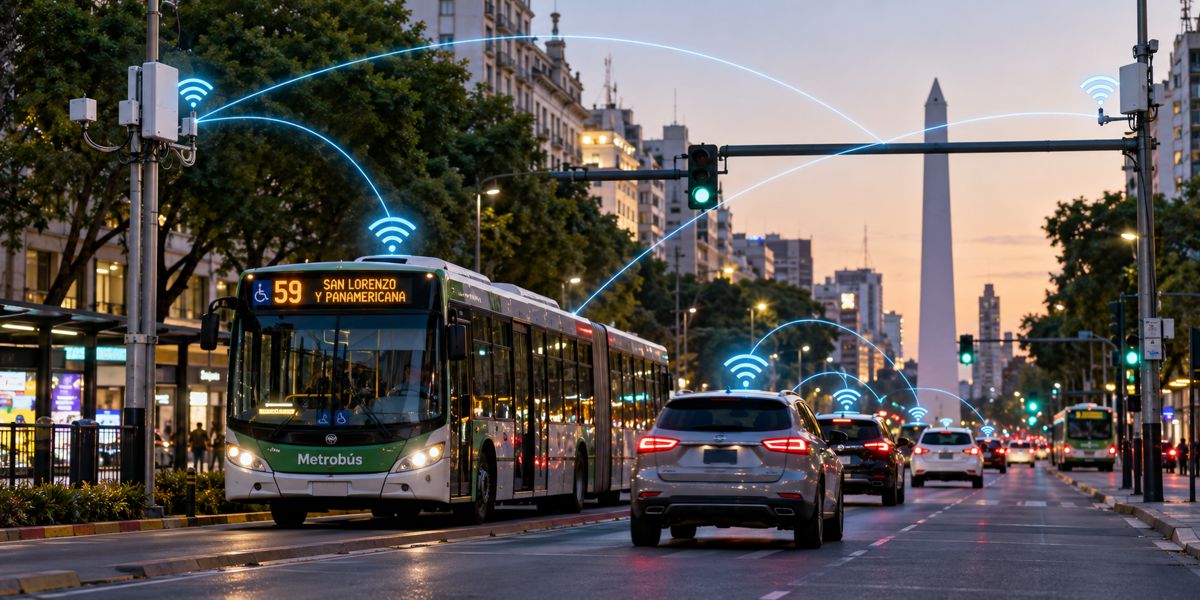
The next stage of the trial brings buses into the system. A vehicle equipped with an onboard unit could communicate its position as it approaches an intersection, allowing the traffic system to determine whether a priority request should be granted according to conditions established by the operator.
That provides more flexibility than simply recognising the arrival of a bus and automatically changing the signal. Priority could potentially depend on the vehicle, location, time period or other operating information available to the central platform.
The concept fits an existing direction in Buenos Aires transport planning. The city has long used dedicated and preferential bus corridors to reduce the effect of general traffic on public transport, while its developing TramBus system is intended to use exclusive or preferential lanes together with intelligent traffic signals capable of providing priority at major intersections.
The V2X trial therefore sits alongside an established transport policy rather than starting from an empty network. Kapsch says a later phase is intended to incorporate information from fleet management and public transport operating systems, potentially allowing different priority strategies to be applied according to operating circumstances rather than treating every request identically. The company has not yet reported results from that stage.
Testing on Live Streets
Urban roads contain changing traffic volumes, buses, cars, pedestrians, temporary works, lane closures and numerous existing systems installed at different times for different purposes. Connected infrastructure has to operate within that environment if it is to progress beyond isolated demonstrations.
Buenos Aires also provides a substantial public transport setting in which to examine the technology. The city’s mobility strategy has for years placed public transport priority alongside traffic management and road safety, while its Metrobus network has demonstrated the practical effect that infrastructure and priority measures can have on bus journey times.
The current V2X trial does not yet establish comparable benefits. Kapsch has not published performance figures for journey-time savings, communications reliability, signal delay reductions or safety outcomes from the proof of concept. At this stage, the deployment is primarily an operational test of the communications and control architecture.
Traffic Signal Control
Roadworks and hazard warnings are relatively straightforward V2X applications. Information held by the road operator can be transmitted to approaching vehicles before drivers encounter the affected section.
Traffic signal priority is more demanding because communication becomes part of a control decision. The system must identify the vehicle, understand the request, apply whatever operating rules have been established and coordinate the response with the traffic signal network.
Adding fleet and public transport data introduces another layer. A traffic management platform could potentially know more than the simple fact that a bus is approaching an intersection, allowing different priority strategies to be applied according to how the transport network is actually performing.
Whether that produces measurable improvements will depend on what the live trial demonstrates. For now, vehicles, roadside infrastructure and the traffic management platform are being tested as parts of the same operational system on actual city streets.
Key Industry Questions
- What is V2X? Vehicle-to-Everything describes communications between a vehicle and other elements of the transport environment, which can include infrastructure, other vehicles, networks and road users.
- What communications technology is being tested in Buenos Aires? Kapsch says its roadside devices use 5.9 GHz communications. The onboard units installed in test vehicles support 5.9 GHz, LTE and Bluetooth.
- What information is currently being sent to vehicles? The trial includes warnings concerning roadworks, lane closures, stopped vehicles and hazardous road conditions.
- Can the system control traffic lights? Traffic signal priority forms part of the trial’s planned design, implementation and validation work. Kapsch has not published results demonstrating the performance of that element yet.
- How could V2X help buses? An equipped bus can communicate information directly to connected roadside infrastructure, allowing the traffic management system to consider a priority request as the vehicle approaches an intersection.
- How is that different from conventional bus priority? Traditional systems can use physical detection equipment or predetermined operating rules. V2X allows information generated by the vehicle itself to become part of the priority decision.
- Will fleet management systems be connected to the platform? Kapsch says a future phase is intended to incorporate information from fleet management and public transport operations systems.
- Has Kapsch demonstrated journey-time or safety improvements from the Buenos Aires trial? No quantitative results were included in the announcement. The project remains a proof-of-concept deployment rather than evidence of measured network-wide benefits.
Strategic Takeaways
- Live urban operation provides a more demanding test of V2X than a closed demonstration environment.
- Hazard warnings can be deployed without requiring V2X to take direct control of traffic infrastructure.
- Traffic signal priority moves the technology from information delivery towards active traffic management.
- Combining vehicle communications with fleet operating data could allow public transport priority to become more conditional and targeted.
- The Buenos Aires deployment remains a proof of concept, so operational performance data will be needed to establish its practical benefits.