






Moldova Secures €344mn to Upgrade Strategic Roads Linking Ukraine and the EU
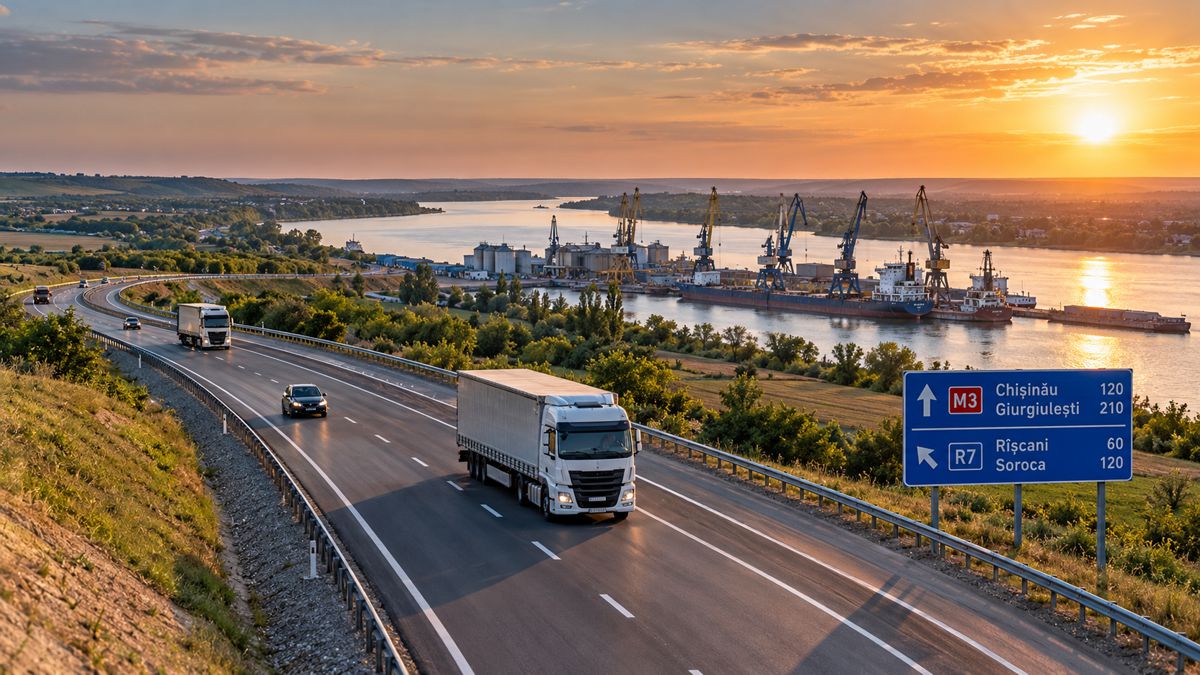
The European Bank for Reconstruction and Development (EBRD) is providing €344 million to upgrade two of Moldova’s most important road corridors, strengthening connections with Romania, Ukraine and the country’s principal Danube port. The financing will support rehabilitation, widening and construction along approximately 134 kilometres of the R7 in northern Moldova and the M3 linking Chișinău with Giurgiulești International Free Port.
The investment comes as Moldova’s road network assumes a larger role in regional freight movements, particularly through the European Union’s Solidarity Lanes initiative established following Russia’s full-scale invasion of Ukraine. With traditional transport routes disrupted and future Ukrainian reconstruction expected to create further demand for materials and equipment, Moldova is investing in infrastructure that serves domestic communities while providing alternative connections towards European markets.
The latest agreement follows €340 million in EBRD road-sector financing during 2024 and 2025, extending a programme that now encompasses highway rehabilitation, new construction and reforms to the management of the national road network. The EBRD loan will be complemented by European grants and government contributions, taking the overall project budget to approximately €397.3 million.
Briefing
- The EBRD is providing a sovereign loan of up to €344 million for approximately 134 kilometres of road rehabilitation, widening and construction.
- Investment will target the R7 northern corridor and the M3 route connecting Chișinău with Giurgiulești International Free Port.
- The M3 programme includes a 19-kilometre widening scheme, bridge repairs, drainage improvements and a new bypass near Giurgiulești.
- The overall €397.3 million project combines EBRD financing with European grants and Moldovan government contributions.
- Additional measures include a national road-sector masterplan, improved asset management and streamlined licensing for electric-vehicle charging infrastructure.
Two Corridors with Different Transport Functions
The R7 and M3 serve distinct parts of Moldova’s transport network, although both form part of the country’s extended Trans-European Transport Network (TEN-T).
In northern Moldova, the R7 connects communities along the Rîșcani-Soroca corridor and supports traffic moving towards Romania and Ukraine. Sections requiring rehabilitation will receive improvements intended to address deteriorating road conditions, reduce journey times and provide safer, more reliable access for commercial vehicles and local traffic.
The M3 performs a different function, linking the capital with southern Moldova and Giurgiulești International Free Port. Its importance extends beyond the communities directly served by the highway because the port provides Moldova with access to international shipping through the Danube, connecting inland freight operations with European and overseas markets.
The EBRD’s detailed project documentation identifies 70.9 kilometres of works along the M3, divided into four construction packages covering existing highway rehabilitation, capacity improvements and new road construction.
| M3 Section | Length | Principal Works |
|---|---|---|
| Airport Interchange–Porumbrei | 34.4 km | Four-lane rehabilitation, bridge repairs, slope stabilisation and drainage |
| Porumbrei–Cimișlia | 19 km | Widening from two to four lanes, culverts, bridges and stormwater drainage |
| Cimișlia–Comrat | 12 km | Rehabilitation of the existing two-lane road and improvements to heavy vehicle movements |
| Giurgiulești bypass | 5.5 km | Construction of a bypass and rehabilitation of an existing road |
The most substantial capacity improvement is planned between Porumbrei and Cimișlia, where 19 kilometres of two-lane road will be widened to four lanes. Earlier work financed through the European Investment Bank covered preliminary development and elements of the initial construction, while the EBRD-backed programme will complete the expansion and associated infrastructure.
The detailed scope includes bridges, culverts, stormwater drainage and a crossing of the Cogâlnic River. The project also makes provision for agricultural access separated from the main highway, an important consideration where high-speed through traffic shares a corridor with local agricultural movements.
Elsewhere, the works reflect different operating conditions. The Airport Interchange–Porumbrei section already has four lanes and will principally require rehabilitation, structural repairs and drainage improvements. The Cimișlia–Comrat section will retain its two-lane configuration while addressing road condition and the movement of heavy vehicles through the area.
Near Giurgiulești, a 5.5-kilometre package includes a new bypass following an existing unpaved route. This will provide an additional road connection near the country’s southern border and port facilities.
The Danube Connection and Ukraine’s Freight Routes
Giurgiulești has acquired greater logistical importance since the disruption of established Black Sea shipping routes in 2022. Situated near the borders of Romania and Ukraine, the port gives Moldova access to the Danube transport system, although its effectiveness depends on the roads, border facilities and freight services connecting it with the wider region.
The EU-Ukraine Solidarity Lanes were established in May 2022 to maintain trade through road, rail and inland waterway routes. Originally intended to help Ukrainian agricultural exports reach international markets, they have subsequently supported a much broader range of imports and exports.
According to the European Commission’s September 2026 figures, the Solidarity Lanes had facilitated approximately 240 million tonnes of Ukrainian exports and 116 million tonnes of imports since their establishment. These figures cover the entire initiative rather than traffic through Moldova alone, but indicate the scale of freight activity using alternative routes between Ukraine and European markets.
Road conditions along the M3 influence freight schedules, vehicle operating costs and the reliability of access to Giurgiulești. The corridor’s performance also depends on customs processing, border capacity and port operations, areas that are receiving attention through wider regional transport initiatives.
In November 2024, Romania and Moldova agreed to introduce coordinated border checks at the Galați-Giurgiulești crossing, intended to reduce delays affecting commercial vehicles. The European Commission has also continued working with Romania, Moldova and Ukraine on Danube navigation, port coordination and alternative routes in response to security threats affecting shipping.
These arrangements complement the physical highway improvements. Faster and more reliable road journeys are valuable to freight operators, particularly when matched by predictable crossing times and sufficient capacity at terminals and inland logistics facilities.
Financing the Road Programme
The EBRD’s €344 million sovereign loan will be provided in two tranches and forms the largest component of a project with an estimated overall cost of €397.3 million.
The financing package draws on several sources, including European Union grants through the Neighbourhood Investment Platform and Connecting Europe Facility, alongside a Moldovan government contribution supported by the EU Growth Plan.
| Funding Source | Amount |
|---|---|
| EBRD sovereign loan | €344.0 million |
| Moldovan government contribution | €34.2 million |
| EU Neighbourhood Investment Platform grant | Up to €11.4 million |
| Connecting Europe Facility grant | Up to €7.7 million |
| Overall published project cost | €397.3 million |
Source: EBRD project summary. Figures are rounded and proposed allocations may be subject to final financing arrangements.
The EBRD’s announcement also identifies more than €13.8 million in EU investment grant support and technical assistance, a narrower funding description than the full proposed capital financing presented in the project summary.
The investment sits within the EU’s €1.9 billion Growth Plan for Moldova, covering 2025 to 2027. The programme combines financial support with reforms intended to strengthen the economy, improve access to European markets and advance Moldova’s integration with EU institutions.
For Moldova, development-bank lending provides access to the long-term capital required for major road construction. The EBRD notes that comparable financing is not currently available from domestic commercial banks, while its involvement also establishes procurement, environmental and institutional requirements for project delivery.
Road Construction Costs and Programme Delivery
Moldova’s recent road investment programme has already encountered the cost pressures associated with major infrastructure construction.
In January 2024, the EBRD provided €150 million for improvements to the M2 Chișinău ring road and the M1 route towards Leușeni. A further €150 million followed in December 2025 after detailed design work identified additional technical and environmental requirements, alongside substantial increases in the cost of construction materials.
The Bank attributed part of the additional financing requirement to inflation and disrupted commodity markets, which had raised prices for materials including cement, steel, asphalt components and plastics. These are significant inputs for road rehabilitation and widening schemes, particularly where works involve new pavement construction, drainage, bridges and associated structures.
The R7 and M3 programme brings its own engineering requirements. Pavement rehabilitation must account for the condition and performance of existing road layers, while widening may require additional earthworks, drainage capacity and modifications to existing structures. The 19-kilometre Porumbrei–Cimișlia section is especially demanding because the additional carriageway capacity must be integrated with previously completed construction and existing local access arrangements.
The EBRD has classified the overall programme as Category A under its environmental and social assessment requirements, principally because of the widening works on the M3. Environmental documentation identifies construction-related effects including dust, noise, waste generation and land acquisition, together with measures to protect local access, biodiversity and road safety.
The assessment process has also examined pedestrian and vehicle crossings, livestock movements and agricultural access. Construction supervision will include monitoring of environmental and social commitments, with management plans intended to address identified risks during delivery.
Implementation will be managed by Moldova’s Ministry of Infrastructure and Regional Development through the National Road Administration. Although the financing agreement has been signed, individual construction packages will proceed according to their procurement arrangements, detailed designs and implementation schedules.
Strengthening the Road Administration
The investment includes measures to improve how Moldova plans, finances and maintains its national road network.
The EBRD will support the preparation of a National Road Sector Masterplan and Road Funding Strategy, establishing a longer-term framework for prioritising investment and estimating maintenance requirements. The masterplan is intended to consider capital expenditure and network upkeep over the coming decade, alongside road safety, European standards and the requirements of electric-vehicle infrastructure.
The programme will also support a Corporate Governance Action Plan for the National Road Administration, addressing institutional management and multiannual financial planning. Road maintenance is particularly exposed to interruptions in public funding, and a more predictable approach to expenditure could help preserve completed rehabilitation works while reducing the accumulation of future repair requirements.
Another component will establish a centralised digital one-stop shop for permits and approvals associated with electric-vehicle charging infrastructure. Developers and operators would be able to manage applications through a single portal, simplifying an administrative process that can otherwise involve several public authorities.
These reforms build on earlier EBRD-supported efforts to modernise Moldova’s road asset management systems. The December 2025 financing included equipment and software intended to improve the monitoring and management of road conditions, giving the National Road Administration better information for maintenance planning and investment decisions.
Preparing for Regional Freight Growth
Moldova’s road investment is taking place as the country works towards closer integration with European transport and economic networks. The R7 and M3 form part of that process, linking national infrastructure with international freight corridors while serving communities that depend on the roads for ordinary passenger and commercial movements.
Ukraine’s eventual reconstruction could bring additional traffic carrying construction materials, heavy equipment, fuel and industrial supplies. The distribution and volume of those movements remain uncertain, and Moldova will compete with established road, rail and maritime routes through neighbouring countries. Nevertheless, the country’s geographical position provides opportunities to support regional freight flows where suitable infrastructure and efficient border arrangements are available.
The immediate task is more straightforward. Around 134 kilometres of road are scheduled for rehabilitation, widening or construction, with sections ranging from existing four-lane highways requiring structural repairs to a new bypass near the Danube. Their completion will depend on effective procurement, construction management and the maintenance arrangements established to protect the investment.
For the R7 and M3, those practical considerations will determine how successfully Moldova converts substantial international financing into a road network capable of handling the traffic already using these corridors and the additional demands that may follow.
Key Industry Questions
- How much is the EBRD investing in Moldova’s R7 and M3 roads? The EBRD is providing a sovereign loan of up to €344 million, forming part of a wider programme with an estimated total cost of €397.3 million.
- How many kilometres of road will be improved? Approximately 134 kilometres of strategic road infrastructure will undergo rehabilitation, widening or construction, including 70.9 kilometres along the M3 corridor.
- What construction works are planned for the M3? The programme includes pavement rehabilitation, bridge repairs, slope stabilisation, drainage upgrades, widening of 19 kilometres from two to four lanes and a 5.5-kilometre bypass near Giurgiulești.
- Why is the M3 important to Moldova’s freight industry? The highway connects Chișinău with Giurgiulești International Free Port, providing access to the Danube transport system and freight connections serving European and international markets.
- How does the R7 support regional transport? The R7 serves northern Moldova, connecting communities along the Rîșcani-Soroca corridor and supporting transport links towards Romania and Ukraine.
- Are the R7 and M3 part of the Trans-European Transport Network? Yes. Both routes form part of Moldova’s extended TEN-T network and contribute to the EU-Ukraine Solidarity Lanes initiative.
- Who will manage the construction programme? Moldova’s Ministry of Infrastructure and Regional Development will implement the project through the National Road Administration, with procurement and supervision arrangements governed by the applicable financing requirements.
- What environmental requirements apply to the programme? The overall project is classified as Category A under the EBRD’s environmental and social assessment framework, principally because of the M3 widening scheme. Requirements include environmental management, road safety assessments, land acquisition safeguards and construction monitoring.
- Could Ukraine’s reconstruction increase traffic through Moldova? Reconstruction could generate additional demand for freight transport carrying construction materials, equipment and industrial supplies. Actual traffic volumes will depend on reconstruction activity, security conditions, border arrangements and alternative transport capacity.
Strategic Takeaways
- Highway capacity: The M3 programme combines rehabilitation with targeted widening and new construction, addressing different traffic requirements along the southern corridor.
- Freight connectivity: The R7 and M3 upgrades will strengthen Moldova’s connections with European transport networks, although border and port performance will remain important to journey reliability.
- Construction economics: Earlier Moldovan road projects have experienced cost escalation following design revisions and materials inflation, demonstrating the importance of detailed preparation and procurement management.
- Institutional investment: The national road masterplan, funding strategy and governance reforms could improve the long-term management of infrastructure beyond the current construction programme.
- Regional development: Improved highways will give Moldova greater capacity to accommodate international freight movements, including potential demand associated with Ukraine’s reconstruction.