Starlink Broadband Transforms Connectivity Across Construction and Infrastructure
For decades, construction and infrastructure projects have faced a familiar communications problem. The places where major engineering work takes place are often the very locations where reliable internet access is hardest to obtain. Remote highways, railway corridors, quarries, offshore installations and newly established construction sites can be hundreds of kilometres from the nearest dependable fibre connection, while mobile coverage frequently deteriorates beyond established population centres.
That problem has become more pressing as the industry adopts cloud-based project management, connected machinery, digital surveying and Building Information Modelling (BIM). Modern projects generate substantial quantities of information that must be shared between engineers, contractors, designers and clients, yet many still rely on unreliable mobile connections or expensive temporary telecommunications infrastructure that becomes redundant when construction is complete.
Low Earth Orbit (LEO) satellite broadband is beginning to change that equation. SpaceX’s Starlink network provides an increasingly practical means of connecting remote construction sites, mobile engineering teams and infrastructure assets without waiting for conventional telecommunications networks to arrive. More significantly, satellite connectivity is becoming part of mainstream business communications strategies rather than simply providing an emergency alternative when other options fail.
Briefing
- Remote Connectivity: Starlink delivers broadband to construction sites and infrastructure projects beyond reliable fibre and mobile networks.
- Digital Construction: Supports connected machinery, remote diagnostics, drone surveying, BIM and cloud-based project management.
- Flexible Deployment: Portable satellite terminals can be relocated between construction sites, temporary compounds and mobile operations.
- Network Resilience: Integration with fibre, cellular and SD-WAN provides alternative connections and improves communications reliability.
- Commercial Benefits: Faster mobilisation, reduced infrastructure costs and improved collaboration can strengthen project efficiency and productivity.
Why Construction Needs a Different Approach to Connectivity
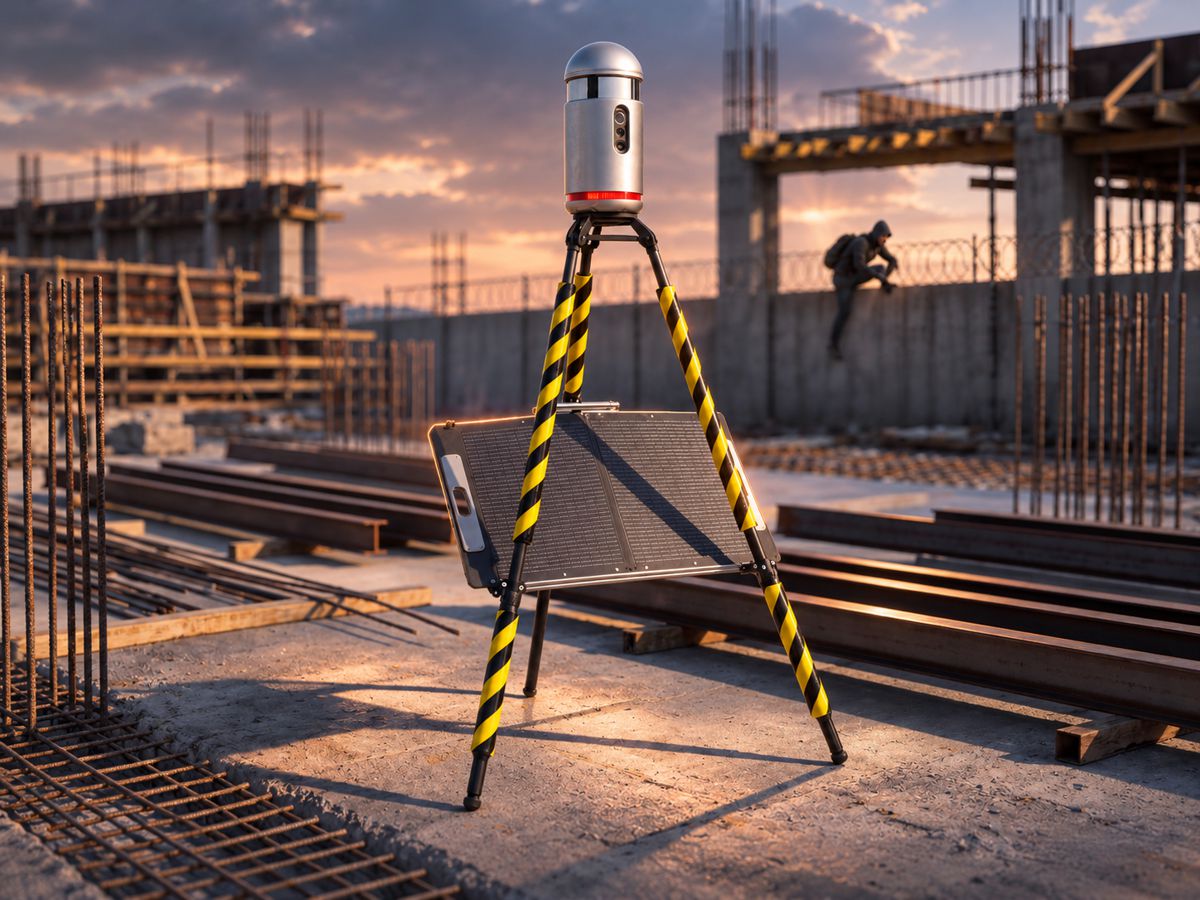
Construction sites present unusual challenges from a telecommunications perspective. Unlike conventional commercial premises, they may have no permanent address, mains electricity or established communications infrastructure when work begins, while their physical layout can change substantially as the project progresses. A network installed during initial site preparation may need to accommodate temporary cabins, mobile machinery, remote monitoring stations and engineering teams operating across an expanding construction area.
Major infrastructure schemes introduce the additional complication of geographical scale. A railway project might extend across hundreds of kilometres, with engineering compounds, bridge construction, tunnelling operations and maintenance facilities distributed along its route. Establishing conventional broadband at every location can involve substantial expenditure and lengthy delays, particularly where fibre installation requires additional civil engineering works or access permissions.
The challenge becomes greater when contractors operate internationally. A company delivering roads in Africa, renewable energy installations in remote Australia or mining infrastructure in South America may encounter entirely different telecommunications networks, regulatory arrangements and levels of mobile coverage. Communications systems therefore need to accommodate changing locations and operating conditions without introducing unnecessary complexity.
Satellite broadband provides an alternative because connectivity is delivered through orbiting infrastructure rather than depending entirely on nearby terrestrial networks. With suitable electrical power, an unobstructed view of the sky and an authorised service in the country concerned, a terminal can establish internet access without extensive local telecommunications construction. For temporary projects, that flexibility can be particularly valuable when equipment needs to move between successive working locations.
How Low Earth Orbit Satellites Make the Difference
Traditional satellite internet has generally relied on geostationary spacecraft positioned approximately 35,786 kilometres above the equator. Although effective for broadcasting and wide-area communications, these systems introduce substantial latency because signals must travel considerable distances between Earth and orbit.
Starlink’s satellites operate much closer to the planet, with a substantial part of the constellation positioned around 550 kilometres above Earth. The reduced propagation distance, combined with modern ground infrastructure and inter-satellite laser communications, enables significantly lower latency than conventional geostationary broadband.
According to Starlink’s published UK service information from October 2026, normally available peak-hour performance for certain business services is indicated at approximately 80–400 Mbps download and 10–30 Mbps upload, with typical latency between 25 and 50 milliseconds. These figures are UK service expectations rather than universal guarantees, and actual performance varies according to location, congestion, equipment and subscription arrangements.
The distinction between download and upload performance matters particularly in construction. Download capacity supports access to drawings, digital models and project documentation, while upload speeds become important when transferring drone imagery, inspection footage, survey datasets and equipment information from remote sites to central systems. Large files may still require compression, local processing or scheduled transfers, but the practical ability to exchange information directly from the field represents a substantial improvement over intermittent connectivity.
Lower latency also makes interactive applications more practical, including live engineering consultations, equipment diagnostics and cloud-based collaboration. Nevertheless, the availability of broadband should not be confused with the deterministic communications required for safety-critical machinery control, where dedicated systems and independently validated safeguards may remain essential.
Remote Construction Sites and Temporary Project Offices
A contractor establishing a remote highway construction compound may need to accommodate engineers, supervisors, administration staff and subcontractors before conventional telecommunications infrastructure is available. Internet access is no longer simply an office convenience in these circumstances, as much of the information required to coordinate modern construction projects is held within cloud-based systems.
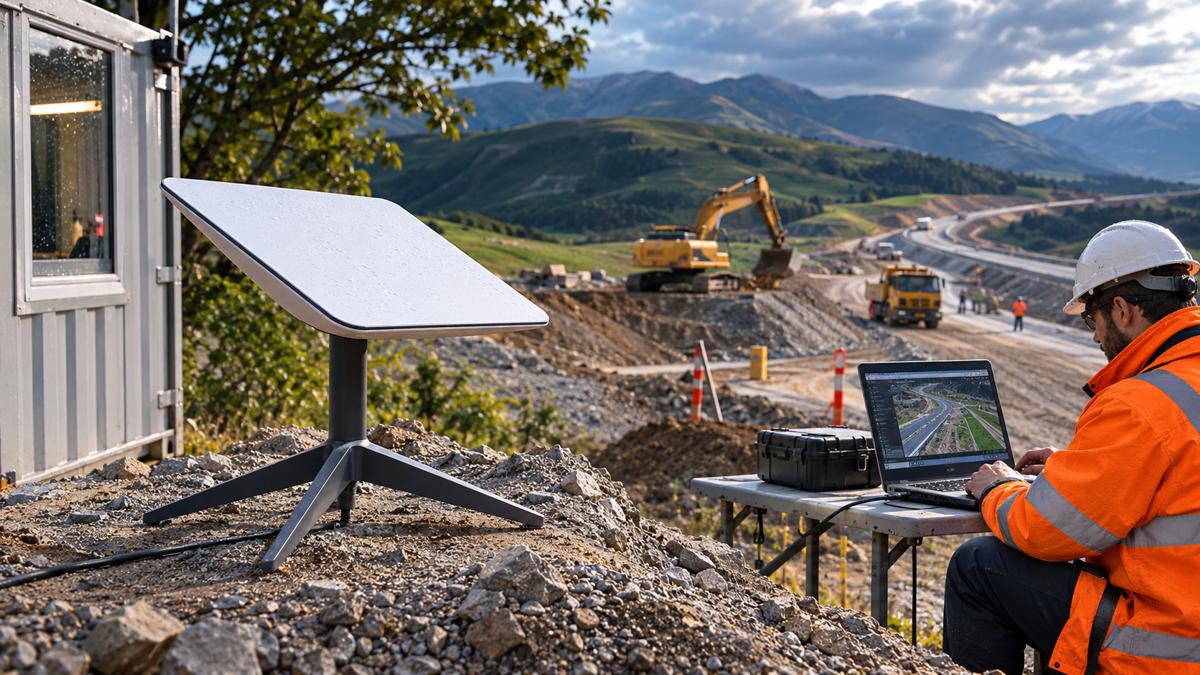
A Starlink terminal can provide broadband for project management software, video conferencing, digital procurement, engineering documentation and communication with suppliers. Where mobile coverage is unreliable, this can reduce interruptions to administrative and technical work while allowing site teams to access updated specifications without travelling to a regional office.
The portable nature of satellite equipment also offers an advantage during project mobilisation and demobilisation. Terminals can potentially be transferred between compounds or redeployed on subsequent contracts, subject to service-plan conditions and local telecommunications regulations. Combined with a suitable site-wide wireless network, a single broadband connection can support multiple buildings and working areas rather than serving only the location where the terminal is installed.
Connected Machinery and Remote Equipment Diagnostics
Modern construction equipment increasingly incorporates electronic control systems, telematics and connected maintenance platforms. Excavators, graders, haul trucks, drilling rigs and generators can produce operational information that helps fleet managers assess performance, monitor fuel consumption, schedule maintenance and identify developing mechanical problems.
These capabilities become less useful when machinery operates beyond dependable mobile coverage. Satellite broadband can provide a backhaul connection for local wireless or private cellular networks, allowing equipment information to reach fleet management platforms and technical support teams even at isolated work sites.
The benefits extend beyond routine monitoring. When a machine develops a fault, engineers may be able to examine diagnostic data remotely, discuss findings with site personnel and determine whether a technician needs to attend. In difficult-to-access locations, avoiding an unnecessary service visit can save considerable travel time and reduce disruption to the construction programme.
However, a Starlink terminal does not automatically connect machinery distributed across a large project. Contractors still require appropriate Wi-Fi, radio or private cellular infrastructure to carry information between equipment and the satellite connection, particularly where machines operate across extensive or obstructed terrain.
Digital Surveying, Drones and Geospatial Data
Surveying teams increasingly work with large volumes of digital information, from drone photography and photogrammetry to LiDAR scanning and detailed terrain models. On remote projects, capturing this information may be relatively straightforward, while transferring it to designers, engineers and project managers can present a much greater challenge.
Where mobile broadband is unavailable or inconsistent, surveyors may need to transport storage devices physically or wait until they return to an area with suitable connectivity. Satellite broadband provides an alternative by allowing captured information to be uploaded directly from field operations, potentially shortening the interval between data collection, processing and engineering decisions.
The technology can also support internet-delivered Global Navigation Satellite System (GNSS) correction services, including compatible Real-Time Kinematic (RTK) positioning workflows. Although Starlink does not itself provide survey positioning corrections, it can supply the data connection required to receive them in locations where terrestrial mobile networks are inadequate.
For the largest datasets, satellite upload capacity may still represent a constraint, making local processing and selective transfers important considerations. Nevertheless, improved field connectivity can help surveying teams collaborate more effectively with central engineering offices rather than treating remote data collection as an isolated activity.
Highways, Railways and Linear Infrastructure Projects
A highway contractor may establish a temporary compound at the beginning of a project, only to relocate its engineers, machinery and communications equipment several times as construction advances. Maintaining consistent connectivity along a changing work corridor presents challenges that conventional fixed-line broadband was never designed to solve.
Railways, pipelines, transmission corridors and major road schemes face similar difficulties, with construction teams distributed across sites that may be separated by considerable distances. Portable satellite terminals can provide broadband at temporary engineering compounds, inspection locations and maintenance facilities without requiring a new fixed connection at every stage of the programme.
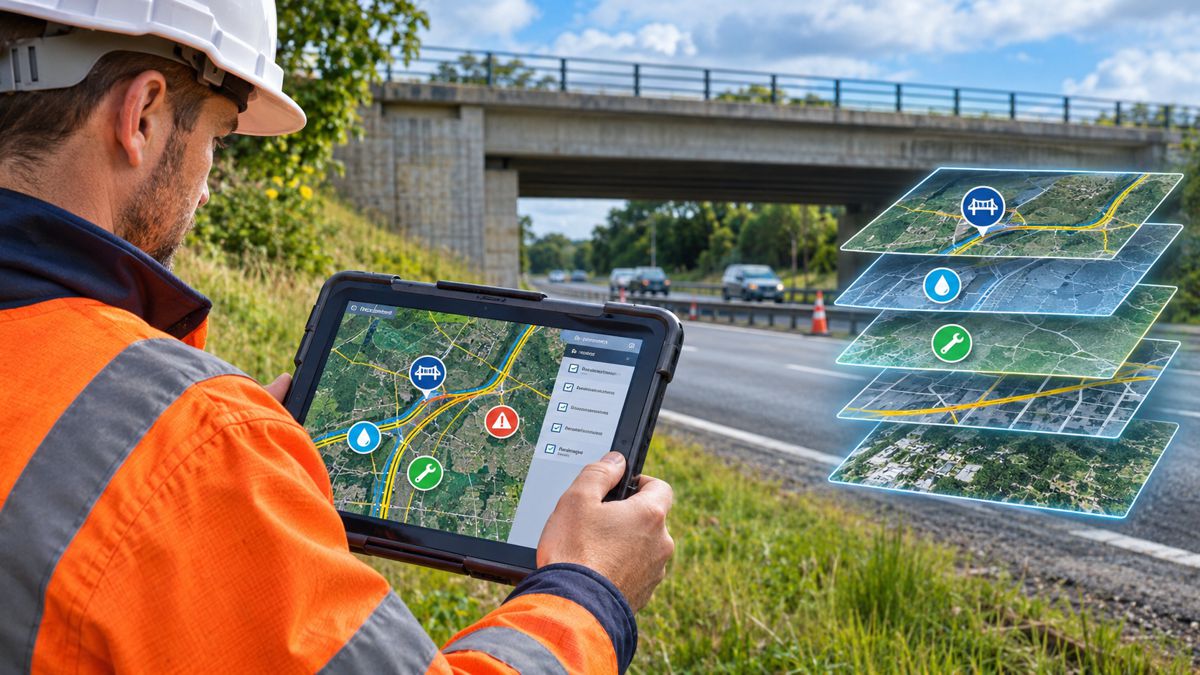
For highways and rail projects, connectivity supports digital quality assurance records, photographic inspections, programme reporting and access to engineering documentation. It can also provide communications backhaul for temporary traffic monitoring, environmental sensors and other connected systems, provided suitable local networks are installed.
The potential extends to mobile maintenance and emergency repair operations, where teams may need access to asset records, drawings and specialist advice at locations with little existing coverage. As infrastructure owners increasingly digitise their assets and maintenance processes, the ability to establish connectivity wherever work is required could become an important operational advantage.
Mining, Quarrying and Remote Resource Operations
Mining and quarrying frequently take place beyond the reach of dependable terrestrial telecommunications networks, making satellite broadband particularly relevant to both production and supporting infrastructure. Large operations may already rely on private radio, microwave or cellular systems for equipment monitoring and workforce communications, but still require reliable connections to company headquarters and external information services.
Starlink can provide an additional backhaul route, linking local operational networks with fleet management platforms, engineering support teams and cloud-based business applications. Potential applications include maintenance reporting, inventory management, environmental monitoring and communications between geographically separated facilities.
For larger operations, integrating satellite broadband with existing telecommunications systems may offer greater resilience than replacing established networks. Mining environments can impose demanding requirements for coverage, reliability and safety, particularly where automated machinery or critical process controls are involved, and these applications should remain supported by appropriately engineered industrial communications.
Renewable Energy and Remote Infrastructure Monitoring
Wind farms, solar installations, hydroelectric facilities and electricity transmission infrastructure are frequently developed in isolated locations where communications provision can complicate construction and commissioning. Engineering teams require connectivity for project coordination, technical documentation, delivery management and testing, even before permanent infrastructure is operational.
Once construction is complete, communications requirements shift towards asset monitoring, maintenance planning and remote diagnostics. Satellite broadband may continue to provide value where terrestrial connectivity is inadequate or where an independent communications route is needed for administrative and monitoring systems.
These longer-term installations require a different assessment from temporary construction compounds. Equipment durability, power consumption, environmental exposure, cybersecurity and ongoing service arrangements become more important when a terminal is expected to remain operational for years rather than months. Essential protection and control functions must also retain appropriate safeguards and should not depend exclusively on a general-purpose broadband connection.
Building Resilient Communications with Hybrid Networks
Satellite broadband is not restricted to locations without existing internet access. For major construction contractors and infrastructure operators, its ability to provide an independent communications path can be just as valuable as its usefulness in remote environments.
A project office may have a dependable fibre connection, but excavation works can accidentally damage underground telecommunications cables. Temporary infrastructure may also be affected by power failures, severe weather or changes to the construction programme, potentially disrupting communications at precisely the moment when coordination becomes most important.
Adding satellite broadband provides another route to the internet, although the effectiveness of that redundancy depends on how the overall network is designed. If multiple connections share the same router, power supply or vulnerable installation point, a single failure may still interrupt communications despite the presence of alternative services.
Software-Defined Wide Area Networking (SD-WAN) allows organisations to manage multiple connections through a coordinated architecture. Fibre, cellular and satellite services can be monitored and prioritised according to application requirements, while appropriately configured systems can direct traffic to an alternative connection when the preferred route becomes unavailable.
For contractors operating numerous temporary sites, this approach also provides opportunities for centralised network administration. Rather than managing every connection independently, an organisation can apply consistent security policies, monitor performance and allocate bandwidth according to operational priorities.
In practice, hybrid connectivity is likely to prove more useful than treating satellite broadband as a complete replacement for terrestrial networks. Fibre may remain the preferred option at permanent facilities, cellular services can support mobile personnel and equipment, while satellite provides coverage and resilience where the other technologies are unavailable or insufficient.
Choosing the Right Starlink Equipment for Construction
Selecting suitable satellite equipment depends on the operating environment, anticipated data requirements and whether the installation will remain stationary or move between locations.
A temporary site office with modest connectivity requirements may be adequately served by a standard terminal, provided the subscription permits the intended commercial application. Smaller portable systems, including Starlink Mini, offer alternatives for surveyors, inspection teams and short-duration engineering activities where portability and electrical consumption are important.
More demanding industrial environments may justify equipment designed specifically for harsh conditions. Starlink’s Performance Kit incorporates features intended for challenging temperatures, environmental exposure and installations subject to vibration, making it relevant to certain remote infrastructure and industrial applications.
According to Starlink’s published specifications, the Performance Kit supports AC and DC power arrangements and has been developed around a ten-year operational design life. That represents an engineering design objective rather than a guarantee of uninterrupted service, and actual suitability will depend on installation conditions, environmental exposure and maintenance arrangements.
Mounting arrangements are another important consideration, particularly where equipment is installed on mobile facilities or structures exposed to construction activity. Terminals must have adequate sky visibility, appropriate mechanical protection and reliable power, while operation on moving vehicles requires compatible hardware, service permissions and suitable mounting systems.
A construction company purchasing equipment for international deployment should also examine country-specific restrictions before standardising its installations. Subscription portability, roaming limitations and the availability of business service plans can vary between markets, making local verification essential.
The Practical Challenges of Satellite Broadband on Construction Sites
Although Starlink can simplify connectivity in difficult locations, it does not eliminate the physical and operational constraints associated with establishing a communications network.
An unobstructed view of the sky remains fundamental to reliable performance. Trees, steep terrain, buildings and tunnel entrances can interfere with reception, while the position of cranes, temporary structures and stockpiles may change throughout construction. Terminal placement therefore needs to be considered as part of the site layout rather than treated as an afterthought.
Electrical power introduces another challenge, particularly where remote installations depend on generators, batteries or solar systems. Satellite equipment creates a continuous electrical demand that must be included in power calculations, alongside routers, wireless access points and any associated monitoring equipment. Although portable terminals may reduce consumption, equipment selection should account for the available power supply and expected operating conditions.
Bandwidth requirements also need realistic assessment. A small engineering office accessing documents and holding video meetings will have very different needs from a site transferring extensive survey imagery or supporting large numbers of connected devices. Starlink’s business services offer different priority arrangements and data allowances, but network congestion, geographic location and subscription conditions can influence actual performance.
Security and network configuration become especially important when satellite broadband is integrated into established corporate systems. Starlink commonly uses Carrier-Grade Network Address Translation (CGNAT) for IPv4 connectivity, which can complicate certain inbound connections, remote access arrangements and traditional VPN configurations. Publicly routable IPv4 addressing is available through eligible Priority services, although Starlink does not provide permanently static public IPv4 addresses as a standard feature.
These limitations do not prevent enterprise deployment, but they require appropriate network design. Encrypted VPNs, centrally managed routers, secure remote-access services and suitable firewall policies can help ensure that remote construction sites remain integrated with corporate systems without introducing unnecessary security exposure.
Regulatory compliance is equally important for international operations. Satellite telecommunications remain subject to national authorisations, and contractors cannot assume that equipment purchased in one country may automatically be operated in another. Before mobilising equipment across borders, businesses should verify service availability, local licensing requirements and any restrictions on roaming or mobile use.
Understanding the Commercial Case for Satellite Broadband
The financial argument for satellite broadband becomes particularly interesting when compared with the cost and complexity of establishing temporary terrestrial connectivity.
Installing fibre at a remote construction compound may involve excavation, wayleaves, network extension charges and lengthy delivery schedules, all for infrastructure that could become unnecessary when the project finishes. Satellite broadband changes that cost structure by replacing much of the physical network extension with terminal equipment, installation and recurring service charges.
For contractors managing successive projects, the ability to relocate compatible equipment introduces another potential advantage. A terminal purchased for a remote road construction scheme may subsequently be redeployed at a quarry, railway project or temporary engineering compound, spreading the initial investment across multiple contracts rather than tying it permanently to one location.
However, an accurate cost comparison must extend beyond the subscription price. Mounting equipment, electrical supply, site-wide wireless coverage, network security, technical support and priority data charges can all influence the total cost of ownership. Larger contractors may also need centralised management systems and additional redundancy to meet corporate operational requirements.
There are potential productivity implications as well. Immediate access to revised drawings may help prevent construction errors, while remote equipment diagnostics can reduce unnecessary technician visits. Survey teams able to transfer field data directly to designers may shorten the time between investigation and engineering decisions, particularly on projects where travelling between site and office involves considerable distances.
These benefits are difficult to quantify universally because their value depends on the project, workforce and existing communications arrangements. Nevertheless, connectivity should increasingly be evaluated in terms of its contribution to operational efficiency rather than simply as an administrative overhead.
For temporary and geographically dispersed projects, the strongest commercial case may therefore lie in a combination of faster mobilisation, improved collaboration, reduced travel and the avoidance of expensive temporary telecommunications infrastructure.
Connectivity as Part of Modern Infrastructure Delivery
The wider significance of satellite broadband lies in its relationship with the industry’s digital transformation. Construction technology has advanced considerably, but the ability to deploy connected systems has often depended on whether suitable telecommunications infrastructure was already available.
Cloud-based project management, equipment telemetry, remote surveying and distributed engineering collaboration all require dependable communications. Where that connectivity has been absent, contractors have frequently been forced to adopt less efficient working arrangements, postpone digital processes or invest in temporary infrastructure that adds cost without contributing directly to the finished asset.
LEO satellite networks are helping remove some of those geographical limitations, allowing digital systems to reach projects that previously depended on paper documentation, intermittent mobile signals or the physical transfer of information. As satellite capacity, equipment efficiency and network integration continue to develop, these services could become increasingly valuable across both construction delivery and long-term infrastructure management.
For much of its history, the construction industry has accepted poor connectivity as an unavoidable consequence of working in remote and developing environments. That assumption is becoming increasingly difficult to justify as satellite broadband makes practical internet access possible in locations where conventional networks remain unavailable or commercially impractical.
The real opportunity is not simply to provide Wi-Fi to another temporary site office, but to integrate remote projects into the same digital systems used by major contractors elsewhere. From machinery diagnostics and engineering collaboration to surveying and infrastructure monitoring, connectivity is becoming part of the operational foundation on which modern construction depends.
Starlink will not eliminate the need for fibre, cellular networks or specialist industrial communications, but it is changing where connected construction can take place. For an industry whose work frequently begins beyond the reach of established infrastructure, that represents a significant shift.
Key Industry Questions
- How should contractors evaluate satellite broadband against temporary fibre and cellular installations? Contractors should compare the total cost of connectivity over the expected project duration, including installation, equipment, subscriptions, maintenance and eventual demobilisation. Fibre may offer better long-term capacity and reliability, but satellite broadband can be more economical for temporary or remote locations where extending terrestrial infrastructure would be expensive or time-consuming. Equipment that can be redeployed across successive projects may further strengthen the commercial case.
- Could portable satellite connectivity reduce the time required to establish digital operations at remote construction sites? Yes. Provided the service is authorised locally, equipment is available and there is suitable power and sky visibility, satellite broadband can be deployed without waiting for conventional telecommunications connections. This allows contractors to establish project management systems, engineering communications and digital reporting during initial mobilisation rather than delaying these activities until fixed infrastructure becomes available.
- What upload capacity is necessary for surveying, BIM and inspection workflows? Requirements depend on the volume of information being transferred and how quickly it must reach project teams. Routine document exchange and engineering collaboration may function adequately over modest connections, while drone imagery, LiDAR surveys and large BIM models can generate datasets requiring considerably more upload capacity. Contractors should assess actual file sizes, upload speeds and transfer deadlines, using local processing and scheduled uploads where necessary.
- How can contractors combine satellite broadband, private cellular networks and SD-WAN effectively? The most practical approach is to assign each technology a role within a coordinated network. Private cellular or Wi-Fi can provide local connectivity for machinery and personnel, fibre can serve established facilities, and satellite broadband can supply remote backhaul or an alternative internet connection. SD-WAN can manage traffic priorities and connection failover, allowing contractors to improve resilience without unnecessarily duplicating infrastructure.
- Which construction applications require dedicated industrial communications rather than shared satellite broadband? Safety-critical machine control, autonomous equipment operations and essential industrial protection systems may require communications with predictable latency, availability and fail-safe behaviour. General-purpose satellite broadband is better suited to applications such as telemetry, equipment diagnostics, engineering collaboration and non-critical monitoring. Where operational control is involved, network suitability must be assessed against the specific equipment, safety and regulatory requirements.
- How should international contractors manage telecommunications approvals and mobility restrictions? Contractors should verify Starlink’s commercial availability, permitted service plans and applicable telecommunications regulations before deploying equipment in another country. Roaming and mobility permissions vary between jurisdictions, and an active subscription does not necessarily authorise unrestricted international use. These checks should form part of project mobilisation, particularly where terminals will cross borders or operate on moving vehicles.
- Can centrally managed satellite services improve connectivity resilience across multiple construction sites? Yes, particularly when satellite broadband is integrated with existing fibre and cellular connections. Centralised network management allows contractors to monitor performance, maintain consistent security policies and configure automatic failover where supported. However, genuine resilience also depends on independent power supplies, suitable network equipment and avoiding shared points of failure that could disable multiple connections simultaneously.
- What communications redundancy is appropriate for remote infrastructure monitoring and operational technology? The answer depends on the consequences of losing connectivity. Routine environmental monitoring and maintenance reporting may tolerate temporary interruptions, while systems supporting essential infrastructure operations can require independently engineered communication paths and local fail-safe capabilities. Satellite broadband can provide useful redundancy, but critical protection and control functions should not rely exclusively on a single commercial internet service.
Strategic Takeaways
- Remote connectivity is becoming an operational requirement. Digital construction workflows increasingly depend on reliable communications even when projects are far from established telecommunications infrastructure.
- Satellite broadband can reduce deployment barriers. LEO networks provide alternatives to expensive or slow temporary network extensions, particularly for remote and mobile projects.
- Hybrid networks offer greater resilience. Combining satellite, fibre and cellular services can provide flexible communications without depending entirely on a single technology.
- Enterprise deployment requires proper engineering. Security, bandwidth management, electrical supply, equipment placement and local wireless coverage remain important considerations.
- Connectivity belongs in project planning. Incorporating communications requirements into mobilisation, procurement and operational planning can help prevent costly disruptions while supporting the adoption of digital construction technologies.