Eclipse Space Sets Out a New Model for Customer-Owned Satellite Constellations
Owning a satellite is one thing. Owning the communications network, spacecraft, ground infrastructure and operational capability behind an entire constellation is considerably harder.
Eclipse Space is building its business around closing that gap. The Redmond, Washington company has unveiled three spacecraft platforms covering direct-to-device communications, broadband and orbital computing, with the intention of supplying nations and enterprises with complete constellations that they can ultimately own and operate themselves. Rather than selling access to capacity on an Eclipse-operated network, the company proposes to integrate the satellites, payloads, ground infrastructure, launch and operations required to establish an independent system.
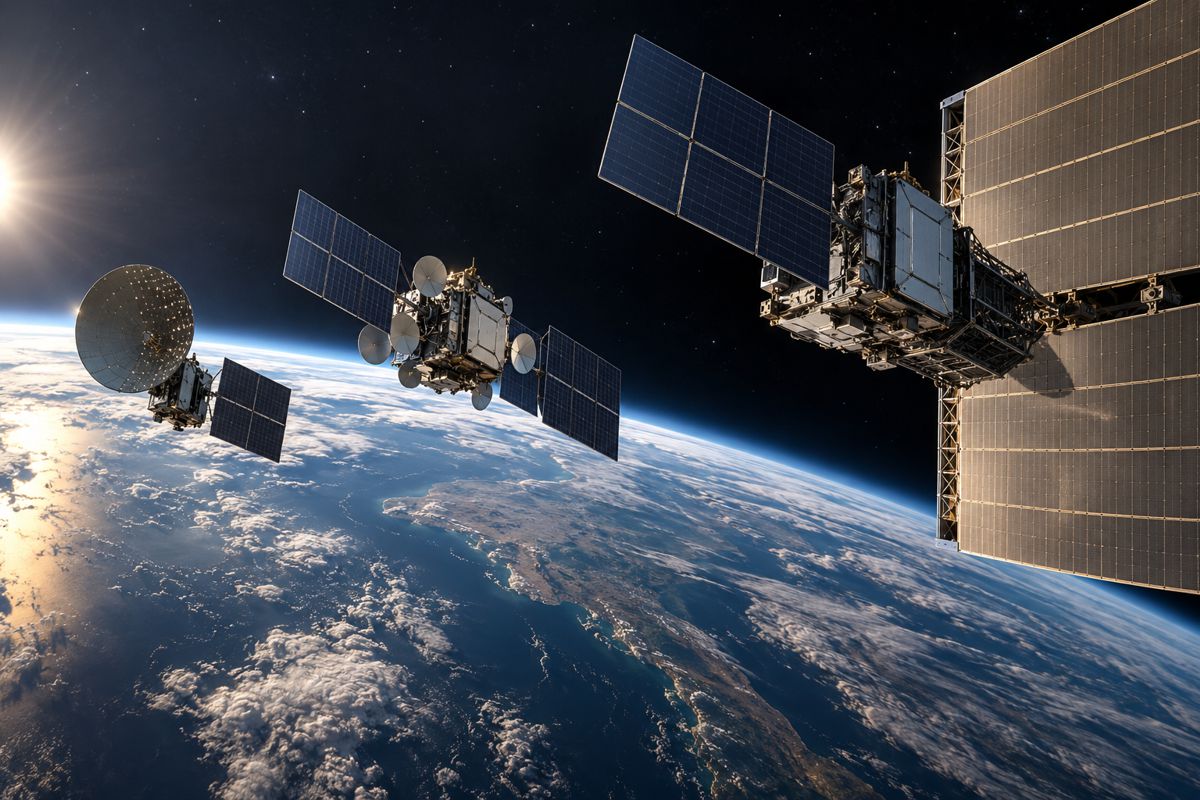
CitraSat provides the starting point, designed for direct-to-device communications with standard mobile devices. SliceSat extends the architecture into high-throughput broadband, while the much more ambitious SurgeSat is intended to take it into 100 kW-class orbital computing and data storage. The three describe a progression from owning connectivity to controlling the network and, eventually, potentially owning some of the computing infrastructure through which its data is processed.
Eclipse has also partnered with Paris-based Gama to develop deployable solar power systems capable of scaling with those ambitions. Their first in-space demonstration is targeted for 2028.
Briefing
- Eclipse Space has introduced CitraSat, SliceSat and SurgeSat as a family of constellation-scale spacecraft.
- CitraSat is designed for direct-to-device communications using a 3.5-metre S-band phased array and will be Eclipse’s initial market focus.
- SliceSat is intended for broadband services using four Ku-band phased arrays with V/E-band feeder links and V-band inter-satellite connectivity.
- SurgeSat extends the architecture towards 100 kW-class computing and sovereign data storage in orbit.
- Eclipse and Gama are developing scalable solar power technology, with an initial in-space demonstration targeted for 2028.
Building a Constellation for the Customer
A customer seeking sovereign satellite communications faces several difficult choices. It can buy capacity from an established commercial constellation, procure individual satellites and assemble the remaining infrastructure separately, or undertake the considerably more demanding job of developing a complete national or corporate system.
The latter requires much more than spacecraft. Ground stations, network management, launch integration, payloads, software, operational procedures and the people capable of running them all have to work together. Eclipse proposes to package those elements into a turnkey system and transfer the resulting infrastructure to the customer, making ownership rather than continuing access to an operator’s network the central commercial distinction.
Chief executive Derek Huerta describes that principle as fundamental to the architecture.
“Nations and enterprises increasingly understand the strategic importance of owning and controlling their critical space infrastructure,” said Derek Huerta, CEO of Eclipse Space. “We built Eclipse around a different model: give customers the complete infrastructure and the ability to operate it themselves. CitraSat, SliceSat, and SurgeSat give us a common architecture that can scale from communications to broadband and ultimately compute, while preserving that same principle of customer ownership.”
Commercial satellite networks already provide enormous capability without requiring customers to carry the capital and technical burden of building their own constellations. Eclipse is pursuing the smaller but potentially valuable market at the other end of that equation, where sovereignty, resilience or control of data and communications infrastructure can justify owning the physical network.
The company’s founding team brings experience from building and scaling Starlink, but Eclipse is pursuing a markedly different commercial structure. Instead of using constellation-scale manufacturing to operate one enormous network serving customers around the world, the same principles of repeatable spacecraft architecture and production are being directed towards networks built for individual customers.
Independent reporting also adds an important qualification to the breadth of the announcement. Eclipse does not intend to develop all three spacecraft programmes at the same pace. Huerta told Payload that CitraSat and direct-to-device communications will come first, with the experience gained there feeding subsequent broadband and orbital computing development.
The company is also not initially building its business around US government procurement. Huerta said Eclipse is deliberately avoiding that market for now because of the additional overhead involved, preferring to establish its commercial model and production economics first. That places a useful boundary around the sovereignty proposition: customer ownership does not necessarily mean beginning with traditional government space programmes.
Three Platforms from a Common Architecture
CitraSat is designed to communicate directly with standard mobile devices through a 3.5-metre S-band phased array, avoiding the requirement for a dedicated user terminal. Eclipse specifies multi-Gbps E-band backhaul, V-band inter-satellite links and a 6 kW peak solar power system.
The spacecraft uses a flat-panel architecture intended to stack efficiently for launch. That geometry is important for a platform designed around constellation deployment, where packaged volume and the number of spacecraft carried on each launch become part of the economics alongside individual satellite performance.
SliceSat takes the same approach into broadband. Eclipse specifies four Ku-band phased arrays, V/E-band feeder links, V-band inter-satellite connectivity and an 8 kW peak power system. The inter-satellite links would allow traffic to move through the orbital network before descending to suitable ground infrastructure, giving constellation operators more flexibility in the placement and use of terrestrial gateways.
Neither platform removes the wider engineering and regulatory burden involved in establishing a communications constellation. Spectrum access, orbital coordination, licensing, launch schedules, ground infrastructure and ongoing operations remain substantial undertakings. A common spacecraft family could nevertheless remove the need to develop a bespoke satellite platform for every customer network.
From Communications to Orbital Computing
SurgeSat takes the architecture into a different engineering class. Instead of concentrating primarily on moving information between orbit and the ground, the proposed spacecraft is intended to process and store substantial quantities of data in orbit, supporting high-performance computing, artificial intelligence workloads and sovereign data residency.
Eclipse specifies dual solar arrays producing 100 kW of peak electrical power and approximately 400 square metres of radiator area. The scale of the radiator system gives a useful indication of the physical challenge involved. High-performance computing generates considerable waste heat, and a spacecraft cannot rely on the air or water cooling infrastructure available to a terrestrial data centre. Heat ultimately has to be rejected by radiation into space.
Computing hardware must also operate through radiation, extreme thermal conditions and limited opportunities for physical maintenance. NASA’s work on high-performance spaceflight computing has been addressing many of the same underlying requirements, including radiation tolerance, fault handling, power management and substantially greater onboard processing capability.
There are good operational reasons to perform some computing close to where space-based data is generated. Earth-observation spacecraft and other sensors can produce large quantities of raw information, only part of which may need to reach the ground. Onboard processing can classify, compress or analyse data before transmission, while more capable processors can also support increasingly autonomous spacecraft operations.
Eclipse adds a sovereignty argument to those established technical uses. Under its proposed model, information could remain within a customer-owned orbital network, moving between satellites through inter-satellite links and being processed or stored without necessarily passing through third-party systems.
That does not make orbital computing a straightforward substitute for terrestrial data centres. Facilities on Earth retain major advantages in electrical supply, cooling, maintenance and the ability to replace computing hardware as technology changes. Launch costs, radiation exposure and thermal management all work against putting general-purpose computing into orbit.
Applications where the data already originates in space, where communications constraints make local processing valuable, or where maintaining control of particular information has strategic value present a more plausible early market for SurgeSat.
Powering a 100 kW Spacecraft
Electrical power becomes one of the defining engineering problems at that scale, which explains Eclipse’s partnership with Gama. The companies intend to combine Gama’s work on large deployable structures and solar arrays with Eclipse’s spacecraft power architecture, developing systems that can grow from communications satellites towards future 100 kW-class platforms.
The collaboration is being designed around production as well as performance. Large constellations require repeatable hardware rather than solar arrays engineered as effectively bespoke structures for individual missions, and the companies are targeting their first in-space demonstration in 2028.
Andrew Nutter, Gama’s chief executive, links the approach directly to those production economics.
“Eclipse is designing these systems around scale from the beginning, which is exactly how we approach space power,” said Andrew Nutter, CEO of Gama. “Our teams share a common engineering culture and firsthand experience building space hardware at unprecedented volume. Together, we are developing a power system designed not just for performance, but for the economics and production volumes large constellations require.”
Generating 100 kW in orbit requires large collection areas, deployment mechanisms, power management, structural stability and thermal control while keeping launch mass and packaged volume within practical limits. The 2028 demonstration will therefore be an important step towards determining how far the architecture can move from the several-kilowatt requirements of communications satellites towards the much more demanding power levels envisaged for orbital computing.
A Fabless Approach to Spacecraft
Eclipse does not intend to manufacture every subsystem itself. The company describes its model as fabless, retaining control of system architecture, spacecraft design and software while working with specialist technology and manufacturing partners for selected subsystems.
Constellation volumes make that approach more plausible than it would have been during an era dominated by low-volume, highly customised spacecraft. Hundreds of satellites create recurring demand for arrays, radios, structures, electronics and other components. If several customer constellations can share a common underlying architecture, suppliers potentially gain production volume without each programme requiring an entirely separate spacecraft design.
The approach also allows individual technologies to evolve without requiring Eclipse to vertically integrate every manufacturing process. There are corresponding risks. Supply-chain control becomes critical, interfaces have to remain disciplined, and responsibility for integrating components into spacecraft capable of surviving launch and years of orbital operation still rests with the system designer.
Production economics will only improve if sufficient volume materialises. Eclipse’s fabless strategy therefore depends on the development of the customer-owned constellation market as much as it does on the technical performance of CitraSat, SliceSat or SurgeSat.
From Satellite Procurement to Infrastructure Ownership
The three spacecraft represent different levels of the same proposition. CitraSat would give a customer its own direct-to-device communications network. SliceSat extends that ownership into broadband infrastructure. SurgeSat adds computing and data storage, potentially allowing information to remain within the same independently controlled orbital system in which it was collected or transmitted.
The technical ambition rises sharply between those stages, and the announcement should not be read as three mature systems arriving simultaneously. Eclipse is starting with CitraSat, while SurgeSat remains a proposed 100 kW-class architecture and the Eclipse-Gama power system still has an in-space demonstration ahead of it.
What has already changed is the industrial context in which such a proposition can be attempted. Low Earth orbit has demonstrated that satellites can be manufactured and launched in numbers once associated more closely with terrestrial industrial products. Eclipse is testing whether those production methods can support a different kind of market: not one global constellation selling access to millions of users, but multiple constellations built for organisations that want the network itself.
If that market develops, the scarce product may no longer be satellite capacity. It may be the industrial capability to give customers their own space infrastructure without requiring them to become spacecraft manufacturers first.
Key Industry Questions
- What is Eclipse Space offering? Eclipse intends to provide complete customer-owned satellite constellations, including spacecraft, payloads, ground infrastructure, launch integration and operational capability.
- Which Eclipse spacecraft is being developed first? CitraSat and the direct-to-device communications market are the company’s initial focus. Eclipse intends to use experience from that programme as it develops its broadband and orbital computing architectures.
- What is CitraSat designed to do? CitraSat is a direct-to-device communications spacecraft designed around an S-band phased array capable of communicating with standard mobile devices without a dedicated user terminal.
- How is SliceSat different? SliceSat is intended for higher-throughput broadband services and incorporates four Ku-band phased arrays, V/E-band feeder links and V-band inter-satellite connectivity.
- What is SurgeSat? SurgeSat is Eclipse’s proposed high-performance orbital computing and data-storage platform, designed around 100 kW-class electrical power and large-scale AI and computing workloads.
- Why put computing in orbit? Processing data close to where it is generated can reduce the amount of raw information requiring transmission to Earth, support autonomous spacecraft operations and reduce dependence on terrestrial processing for some applications.
- Does orbital computing replace terrestrial data centres? Not on the evidence currently available. Terrestrial facilities retain substantial advantages in power, cooling, maintenance and hardware replacement. Orbital computing is more immediately suited to specialised workloads where data originates in space, communications constraints matter or infrastructure control is strategically important.
- Why does SurgeSat require such large radiators? Computing converts a significant proportion of consumed electrical power into heat. In the vacuum of space that heat ultimately has to be rejected through thermal radiation, making radiator area a major design consideration for high-power spacecraft.
- What is Gama developing for Eclipse? The companies are collaborating on scalable deployable solar power systems intended to support increasingly power-intensive spacecraft, including future 100 kW-class platforms.
- When is the first power-system demonstration planned? Eclipse and Gama are targeting their first in-space demonstration in 2028.
Strategic Takeaways
- Customer ownership rather than access to network capacity is the central commercial distinction in Eclipse’s model.
- CitraSat provides the immediate commercial starting point, rather than Eclipse attempting communications, broadband and orbital computing simultaneously.
- Moving from communications into orbital computing substantially increases power, cooling, radiation-tolerance and systems-integration requirements.
- Eclipse’s fabless model depends on sufficient constellation volume to turn specialist spacecraft components into repeatable production rather than bespoke engineering.
- The larger commercial test is whether enough customers value control of the network itself to justify owning complete constellation infrastructure.