






Trimble Expands 3D Excavator Grade Control with Dual DA2 GNSS Receivers
Trimble is introducing a lower-cost configuration of its Earthworks 3D grade control system for excavators, using two DA2 GNSS receivers to make machine control more accessible to small and medium-sized construction contractors.
Scheduled for availability in mid-Q4 2026, the new configuration combines Trimble’s ProPoint positioning engine with a subscription-based commercial model. Rather than requiring contractors to commit to the full upfront expenditure associated with more sophisticated machine control installations, the offering provides another route into digital earthmoving, with access to Trimble WorksManager for managing construction data between the office and the site.
Although 3D grade control is well established on major infrastructure and earthmoving projects, its adoption among smaller contractors can be constrained by equipment costs, the complexity of introducing digital workflows and uncertainty about how frequently the technology will be used.
Briefing
- Trimble has announced a dual DA2 GNSS receiver configuration for its Earthworks excavator grade control platform.
- The system targets cost-sensitive small and medium-sized earthmoving contractors.
- Trimble ProPoint provides the GNSS positioning engine.
- A Trimble Works subscription includes WorksManager for office-to-field data management.
- Availability is planned for mid-Q4 2026 through Trimble’s dealer network.
Bringing 3D Grade Control to Smaller Fleets
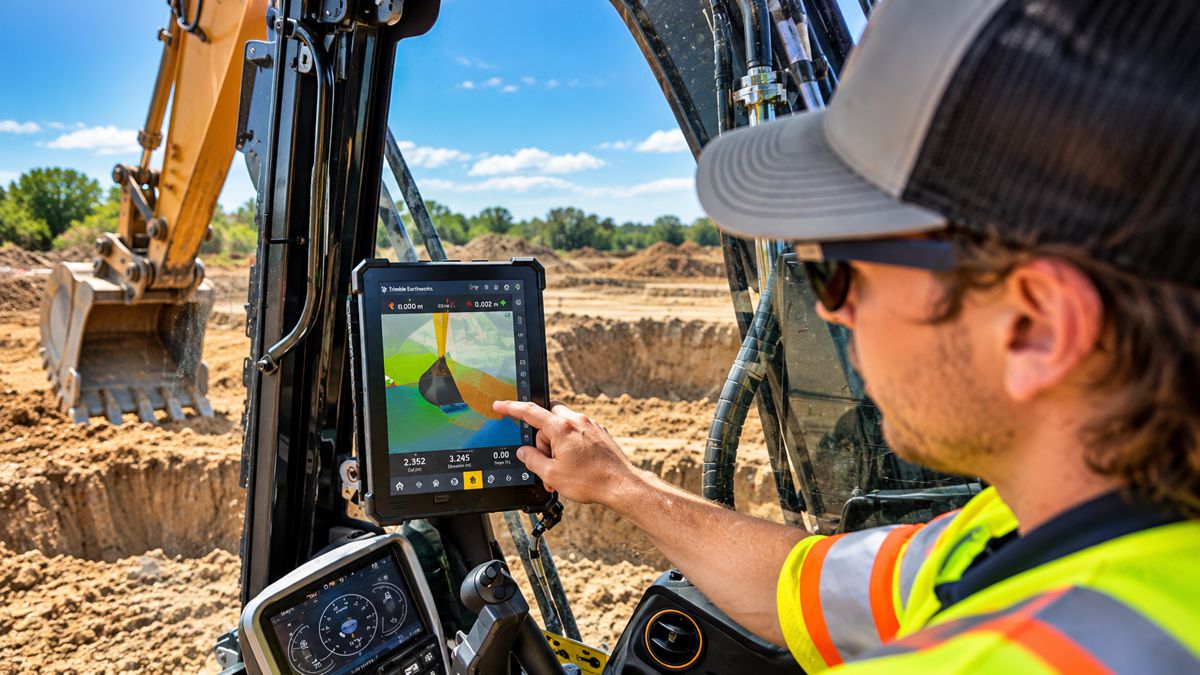
For excavator operators, 3D grade control provides a digital reference for excavation and grading against a project design. Rather than relying exclusively on physical setting-out, grade stakes and repeated survey checks, operators can use machine-mounted positioning technology and an in-cab display to understand the bucket’s position relative to the required excavation geometry.
Trenching, foundation excavation, drainage installation and formation preparation can all benefit from immediate information about depth, slope and design position. Accurate excavation can reduce unnecessary material movement and reworking, while limiting the need for repeated survey checks.
The business case can look quite different for a contractor operating two or three excavators compared with a major civil engineering company managing dozens of machines across multiple projects. Smaller fleets have fewer opportunities to spread the cost of technology across equipment, while individual machines may move between straightforward excavation work and more complex projects where digital positioning offers greater benefits.
Trimble’s new Earthworks configuration is designed for this part of the market. It adds a more economical option to the company’s existing machine control portfolio while retaining the established Earthworks software environment.
Dual GNSS Receivers and ProPoint Positioning
The configuration incorporates two Trimble DA2 GNSS receivers and the company’s ProPoint positioning engine. Trimble says the combination provides a cost-effective 3D positioning solution, with ProPoint designed to maintain reliable GNSS performance in challenging satellite reception environments.
The announcement does not detail the receiver arrangement, associated sensors or machine-level accuracy specifications. It also describes the product as a full 3D machine control solution without specifying which automatic control functions, if any, are included in this configuration. These details will be relevant when contractors assess its suitability for particular excavation tolerances and working conditions.
The DA2 is already part of Trimble’s wider positioning technology portfolio, supporting multi-constellation GNSS and high-accuracy positioning workflows. Its introduction into this Earthworks configuration allows Trimble to build on an established receiver platform rather than developing an entirely separate entry-level machine control system.
As with other GNSS-based machine control installations, performance depends on suitable positioning corrections, satellite visibility, machine calibration and the quality of the underlying project design. Contractors working around buildings, steep excavations or other obstructions must account for the limitations of satellite positioning when planning their operations.
Subscription Pricing and Fleet Economics
Trimble is offering the new configuration through a Trimble Works subscription that includes WorksManager, its platform for managing construction information between the office and connected equipment. The arrangement is intended to reduce upfront expenditure, although the company has not published specific subscription prices or detailed hardware payment terms for the DA2 configuration.
For smaller contractors, the attraction will depend on the total installed cost rather than the subscription alone. Hardware, installation, GNSS correction services, training and ongoing support can all affect the economics of machine control, particularly where an excavator is used across projects with very different positioning requirements.
A contractor operating a single machine on drainage and foundation work, for example, may find that the benefits depend heavily on how much of its workload involves accurately defined excavation levels and digital design information. A larger earthmoving business with several machines working continuously on engineered formations may have more opportunities to recover the investment through reduced setting-out, fewer corrective passes and improved production consistency.
The subscription approach also offers a different way to manage technology expenditure. Rather than treating machine control entirely as a capital purchase, contractors can account for recurring software costs alongside machine operating expenses. Whether this produces a lower total cost of ownership will depend on the subscription terms, equipment utilisation and the length of time the system remains in service.
Connecting the Excavator to the Office
The inclusion of WorksManager gives the new configuration a role beyond positioning the machine itself. Digital machine control depends on accurate design files reaching the equipment and being kept current as construction progresses.
On projects where excavation levels, construction sequences or design details change regularly, distributing the correct information can become an operational challenge. Connected workflows allow authorised personnel to manage project files centrally rather than relying entirely on manual transfers between office computers and individual machines.
Digital designs must still be prepared correctly, coordinate systems and site control must be established, and operators need to understand the information displayed by the system. Introducing 3D grade control can therefore involve changes to surveying, site preparation and supervision as well as the installation of equipment on the excavator.
For contractors already using digital surveying or machine control elsewhere in their operations, maintaining a common software environment may simplify the introduction of additional machines. Those adopting 3D workflows for the first time will need to consider how design information is produced, checked and distributed before it reaches the operator.
Availability and Market Position
The new Earthworks configuration is scheduled to become available through Trimble’s dealer network in mid-Q4 2026. Contractors can obtain regional availability and commercial information through the Trimble dealer locator.
Cameron Clark, senior director of earthmoving solutions at Trimble, said the company wanted to provide a competitive alternative without compromising the positioning performance expected from its machine control products.
“Other cost-competitive options tend to compromise on precision and reliability.” Clark said the subscription-based configuration would allow cost-sensitive contractors to introduce 3D machine control earlier and extend its use across more machines, with the aim of improving productivity and reducing the financial barriers associated with adoption.
The introduction expands Trimble’s options within an existing machine control platform rather than creating a separate entry-level product family. Contractors already familiar with Earthworks can evaluate the DA2 configuration alongside the company’s other receiver and machine control arrangements.
By introducing a more economical receiver configuration within the established Earthworks platform, Trimble is giving smaller contractors another way to adopt 3D excavation technology without committing immediately to its higher-specification hardware options. The system is expected to reach dealers during the final quarter of 2026, with detailed commercial terms and installation requirements to be confirmed through the company’s distribution network.
Key Industry Questions
- What is the new Trimble Earthworks DA2 configuration? It is a 3D excavator grade control configuration using two Trimble DA2 GNSS receivers and the Earthworks machine control platform.
- Which contractors is it designed for? Trimble is targeting cost-sensitive small and medium-sized contractors looking to introduce 3D machine control into their earthmoving operations.
- Does the configuration support automatic excavator control? Trimble describes it as a full 3D machine control solution, but the announcement does not specify which automatic control functions are included. Buyers should confirm the supported functions with their dealer.
- What is Trimble ProPoint? ProPoint is Trimble’s GNSS positioning engine, designed to improve positioning reliability and accuracy, particularly in challenging satellite reception environments.
- Does the system require a GNSS correction service? High-accuracy RTK positioning generally requires suitable correction information. The correction arrangements, connectivity and any associated fees for this configuration should be confirmed before purchase.
- Is the hardware included in the subscription? The announcement does not specify the complete hardware payment arrangements. Contractors should confirm which components are included in the subscription and which require separate purchase.
- Can the system be installed on existing excavators? Earthworks supports excavator machine control applications, but compatibility with particular makes, models and machine installations must be confirmed through Trimble’s dealer network.
- When will the new configuration be available? Trimble has announced availability for mid-Q4 2026, subject to regional dealer arrangements.
Strategic Takeaways
- Lower-cost receiver configurations may improve the commercial case for 3D grade control on smaller excavator fleets, particularly where machines regularly undertake precision excavation.
- Retaining the established Earthworks platform provides a common software environment across different machine control hardware configurations.
- Subscription pricing can reduce initial expenditure, but contractors must assess installation, positioning corrections and recurring costs against expected machine utilisation.
- Reliable digital designs, site control and operator training remain essential to successful machine control deployment, regardless of hardware cost.
- The ability to introduce 3D control incrementally may appeal to contractors seeking to develop digital workflows without equipping an entire fleet at once.